to

Review: Vampire: The Masquerade Bloodlines (PC)

Topics: , , , , , , ,
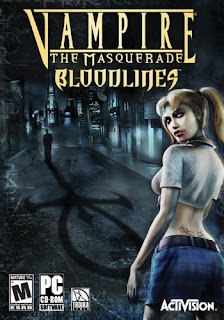
Vampire: The Masquerade Bloodlines

Genre: Action RPG, Fantasy
Lead Creators: Jason Anderson (creative director), Leonard Boyarsky (executive producer), Tim Cain (design), Brian Mitsoda (lead writing, design)
Developer: Troika Games
Publisher: Activision
Console: PC
Release Date: Nov. 16, 2004 (NA), Nov. 19, 2004 (EU)
Rating: M for Mature

Based on Vampire: The Masquerade, the story-telling RPG designed by White Wolf, Vampire: The Masquerade Bloodlines places you in the shoes of a newly turned vampire whose sire (the vampire who turned you) is killed for breaking vampire law. You are set in the service of Prince LaCroix, the leader of the Camarilla vampires within the city, and are sent straight to Santa Monica for your first mission. The game spans across four districts of L.A., and the major goal of the game is to uncover a supernatural artifact called the Ankaran Sarcophagus for the Prince. The story goes very in-depth, and players will learn much about the different bloodlines, political sects, and hidden agendas of vampires and humans during both the main storyline and the numerous side quests available.

The game starts off on a positive note with character customization. You can choose from one of seven clans as well as gender, both of which influence subsequent dialogue options. From there, players can customize their character however they so desire, making for some rather unique combinations, including a seductive computer hacker, an intimidating gunslinger, or a persuasive brawler. Stats greatly influence not only dialogue but world interactions, such as lock picking, hacking into computers, and effectively fighting in combat, so planning ahead is key. If you choose a clan that goes against what you want, such as picking a Tremere vampire who uses blood magic while wanting to be a fighter, then you’ll have great difficulty in enjoying the game.

After character customization, you are shown several cinematics, in which the political background and foundation of modern vampiric society is displayed at its finest. The laws, known as the “Masquerade,” are extremely important in the game, and breaking vampiric laws results in a Masquerade violation. Invoking too many violations, such as feeding or using abilities in public, not only causes your fellow vampires to hunt you down, but also attracts the likes of witch-hunters.

The gameplay is rather basic; your job is to complete as many quests as possible, obtaining as much experience as possible, in order to make the strongest vampire ever. Easy, right? While the quests are indeed rather fun, the experience points rewarded are oftentimes a bit sketchy. There are times when players will think “only one point for killing a leader of a death cult?!” This can make leveling up your character seem tedious and unbalanced, particularly at the beginning of the game. Unfortunately the game can often be weighed down by the sheer amount of loading time. Every time you enter a building or area, be it a place you never visited or a place you have visited a hundred times, the game takes some time in loading the area. Most loading screens run rather smoothly and quickly, but the massive amount of loading screens (accompanied with tips on gameplay as well as information on the World of Darkness background) can also be tiring to go through, particularly if you’re merely visiting an area to view an email or talk to someone standing next to the door on the other side.

The sense of atmosphere in Bloodlines is extremely well done. Graphics are good on the whole, although cinematics (particularly when you choose a female character) could have been much improved. Timing always seems a bit off between sound and movement, and as a female character, you will take note that your chest is sunken in and your stature seems to have been designed to mimic a male character’s stature. Not something you want to see while listening for cues as to your next destination. The backgrounds are nicely designed, however, as the musical soundtrack adds a level of dimension that is quite impressive. The music is just right for the area: haunting themes in haunted mansions, pulse-pounding background to combat areas, and a nice mixture of techno and Gothic music for the number of clubs you visit during your travels. The dark, gritty feeling of L.A. is captured nicely, and proper attention has been given to buildings and scenery.

There are two major flaws in Bloodlines, however. The first is the combat system; it relies on your stats in combat (naturally), but it seems more like a “mashing of the buttons and praying you hit your target” system. Guns are practically useless, as they do little damage to supernatural entities (the exception being a shotgun), and even with a high skill level you will find that a majority of your shots miss for no apparent reason. Melee and fighting hand-to-hand are a bit better, as these attacks typically do more damage, but there is also an obscene amount of hitting-and-missing action going on. You can see the blade hit the enemy, yet it will register as a miss. The only fun part about combat is your vampiric abilities (each clan obtains three distinct powers), and even some of those are worthless in combat.

The other problem is that there are glitches everywhere. Literally everywhere. In fact, players who purchase the game must download Patch 1.2 from the official website in order to complete the game, since the game is known to crash at specific points throughout the main quest line. Once downloaded, however, there are still plenty of problems, including errors in items, dialogue options not appearing when they should, quest errors, and issues concerning character placement and camera. While all these glitches are rather minor things, they tend to add up to a frustrating overall experience.

Despite these two major flaws, the game itself is a unique addition to the RPG genre. The storyline is original and dark, and the amount of customization available to players, both for their character and for the development of storyline, is quite enjoyable. The fact that there are five available endings also makes Vampire: The Masquerade Bloodlines worthwhile to play over and over again, as players will be able to change sides each new night.

[Passable]


This review is based on a retail copy purchased by the reviewer.

The Everygamer: History of a Rock Revolution

Topics: , , , , , , , ,
Guitar Hero Box

Every month, Evan Minto writes "The Everygamer," a column about video games for the casual audience. The article has been posted with permission from its original source, The Alternative Press.

Forget about Halo. Forget about Grand Theft Auto. If you’re looking for the games that all of the kids (and the adults) are really playing this year, look no further than Guitar Hero and Rock Band. Still, one might wonder: Are these games the same thing? Who makes each one? Which one is better?

The story of Guitar Hero begins with Red Octane, a company primarily dealing with peripherals for games like the hyper-popular Dance Dance Revolution. The company moved away from dance mats in 2005 when they decided to develop a plastic guitar controller with five colored buttons. They wanted a great guitar game to go with their new peripheral, so they approached a relatively new game developer called Harmonix, and asked them to create a "great guitar game."

Harmonix gratefully accepted, and got to work on what they believed was simply a fun little pet project. (The game only cost $1 million, a small sum for a video game) Little did they know that they were putting together the pieces that would soon make Guitar Hero an international sensation: eye-catching colored notes, a bonus-point-inducing "Star Power" mode, a distinctive visual style, and, of course, the guitar peripherals.

Finally, on November 8, 2005, the world witnessed the birth of Guitar Hero, and it skyrocketed into popularity as one of the most well-known, accessible video games of its time. Harmonix quickly got to work on its sequel, which enjoyed equally high sales.

However, in June of 2006, massive publisher Activision bought Red Octane, and Activision’s rivals at Electronic Arts (EA) bought Harmonix in September. Of course, Activision and EA were not willing to work together on a third Guitar Hero game, so the Guitar Hero series continued under the development of Activision’s studio Neversoft. When Guitar Hero III: Legends of Rock was released, it enjoyed high sales but suffered much critique from reviewers.

Meanwhile, a new competitor was emerging: the new game Rock Band, created by none other than Harmonix, original creators of Guitar Hero. In the agreement between EA and Activision, Red Octane (now under Activision) was allowed to keep the Guitar Hero name, but Harmonix (now under EA) was allowed to continue to create Guitar Hero-style rhythm games. Hence, Rock Band used guitar, bass, drums, and a microphone to simulate a full band experience, and received huge praise from the gaming community when it was released late in 2007.

This year, Red Octane has followed suit with a new game, Guitar Hero: World Tour, that uses the four-player mentality of Rock Band. World Tour and Rock Band 2 (the sequel), released mere weeks from each other this Fall, and their striking similarities in gameplay, have many people confused as to which one is a better buy. Reviewers have been praising Rock Band and its sequel for a whole year, but how can they explain the high sales and popularity of Guitar Hero, even after Harmonix’s separation from the franchise?

For those of you who remain confused, there are some simple comparisons that can be made between the two games. First, there is a distinct difference in their aesthetics: Rock Band uses a sleek, polished menu style, while Guitar Hero prefers a more over-the-top, glam rock style.

The songs included on the discs are also a big question. Where Guitar Hero has been known for relying heavily on metal and glam rock, Rock Band has a reputation for erring towards more soft rock tunes. Though these reputations still remain somewhat accurate, both games have been attempting to alleviate these criticisms by offering a greater variety of music. One way they have done this is by using a DLC (downloadable content) system wherein users pay a small amount of money (usually $2) per song to download and play the song on their console. Rock Band has been providing downloadable songs in great numbers since 2007, but Guitar Hero’s service has just started, meaning that Rock Band has many more songs to choose from at the moment. Still, World Tour boasts a fun, but admittedly cumbersome, song creation mode to increase variety.

Finally, it is very important to note that the people who developed Guitar Hero and Guitar Hero II (the two most successful games in the franchise) are the same people who made Rock Band. Guitar Hero: World Tour is actually created by different developers, even though the name remains the same. In the video game industry, it is developers (Harmonix), not publishers (Red Octane), who truly shape a game’s design and style.

So, which game is better for you to buy this holiday? That is a question that I leave up to each individual person. If you get a chance, play one or both of the games before buying them, to get an idea of which one you like more.

If you have kids, they might not appreciate the more mature sensibilities of Rock Band, but they’re sure to have fun with Guitar Hero. If you’re an adult, you might want to hold out for a little bit until Harmonix releases their Beatles game (which runs on the Rock Band engine) next holiday season.

Regardless of the game that you choose, there is no evidence that the rhythm game fad will be wearing off anytime soon.

Evan Minto is a New Providence resident and freelance writer. When he's not melting his brain away watching Japanese cartoons and playing video games, he's writing about them on his web site, Ani-Gamers. You can reach him at Evan.Minto@TheAlternativePress.com.

BlizzCon08: Starcraft II split into three "stand-alone titles"

Topics: , , ,
Starcraft II will be three games

Admit it. You're gonna be spending your money on Starcraft II when it hits shelves next year. Even with this assumption already made, Blizzard, creators of the mother of all cash cows - World of Warcraft - has got another way for you to blissfully empty your wallet. According to a brief, vague announcement at BlizzCon 2008, Starcraft II will release as three separate games, each with a fully-featured single-player campaign based around one of the three races in the game: Terran, Protoss, and Zerg.

The three games, titled Terran: Wings of Liberty, Protoss: Legacy of the Void, and Zerg: Heart of the Swarm, will each feature 26-30 missions, and according to Blizzard each will "feel like its own epic story." To assuage fears of an episodic release schedule forcing people to buy all three, Blizzard reps also assured gamers that each title will be a self-contained story that does not require the other two games.

But c'mon, don't try to tell me that you're only gonna get the Protoss game! I know just as well as the executives at Activision Blizzard do that you, my friend, are going to buy all three games. On launch day. At midnight.

[via 1UP]

Activision drops several Vivendi franchises

Topics: , ,
Activision Blizzard

It seems that publisher Activision has been hard at work "restructuring" and "streamlining" the operations down at Vivendi studios. While Blizzard remains untouchable, GameSpot has reported that the staff at Radical Entertainment (Prototype) and High Moon Studios (The Bourne Conspiracy) are undergoing "realignment," while members of Massive Entertainment (World in Conflict) and Swordfish Studios (50 Cent: Blood on the Sand) might soon find themselves without a home.

GameSpot also had the scoop on Activision’s dropping of several Vivendi franchises. "Streamlining" apparently means that we’ll be seeing a lot more Crash Bandicoot and Spyro the Dragon titles in the future, as well as Ice Age, Prototype (thank goodness), and one yet-to-be-announced game. Those that aren’t so lucky include Tim Schafer's Brutal Legend, and the upcoming Ghostbusters game.

As far as Brutal Legend is concerned, the team over at Double Fine has stated that their game "is fine." It has also been reported by Variety that the wayward title might soon be finding itself in a "unique" deal with an unnamed publisher in the near future. Variety also reported that Sony Pictures is trying to work out a 2009 release deal for the Ghostbusters title, though there is no word yet on who will publish it.


[via GameSpot, Kotaku, Variety]

Guitar Hero: World Tour (aka GH4) to include drums, vocals

Topics: , , , , ,
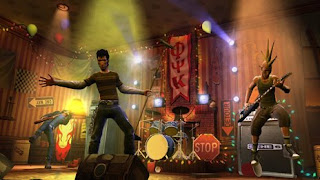
Guitar Hero: World Tour If you're a subscriber to GameInformer magazine, you have most likely received a wonderful little present in the mail this month, in the form of confirmation of Guitar Hero: World Tour, or "the game previously known as Guitar Hero 4." Unsurprisingly, this newest iteration of the immensely popular Guitar Hero franchise will feature a Rock Band emulation engine drums and vocals as well as the traditional guitar and bass.

In addition to the full band confirmation that we all saw coming, Activision also let GameInformer know about a couple exclusive bits of info, like the inclusion of a create-a-song mode in the game, a drum kit with cymbals, and fully customizable characters. In create-a-song mode (Activision called it "Studio Mode"), players will be able to choose a scale, record music, and send it to others online in a YouTube-esque social networking system that comes built in with the game. The drum kit looks suspiciously similar to Rock Band's, albeit comes with only three drum pads, has two cymbal pads, and will presumably be more durable than its competitor's. Finally, to the glee of many Rock Band-ers and Guitar Heroes, all of the instruments will be wireless.

Another big part of this game will be downloadable content, as Activision will be releasing new songs more frequently, possibly even weekly. Plus, Activision Blizzard's music library will quickly match MTV Games' thanks to owner Vivendi Universal's huge music label. Finally, the folks at Activision have announced that Guitar Hero: World Tour for the Wii will, in fact, have downloadable content.

Some confirmed artists are The Eagles, Linkin Park, Sublime, and Van Halen, hopefully a sign that Guitar Hero will be moving away from its metal-centric roots toward more varied types of music. There are also a couple of strange statements that have been thrown around about the game, including the promise of "local content" from "local bands" (possibly referring to small-time indy bands?). The game will release this fall on Playstation 2, Playstation 3, Wii, and Xbox 360.

I have my doubts that World Tour can size up to Harmonix's Rock Band, but who knows? Perhaps Neversoft can drag Guitar Hero out of the inferior position it has occupied after the release of Guitar Hero III. If it's cheaper than Rock Band, I can guarantee that it will be dragging my money out of its inferior position in my wallet.

[via GameInformer and Joystiq]

Links:
The new drum kit
First trailer of the game

Activlizzard Takes the World by Storm

Topics: , , , ,
Activision Blizzard Okay, so a Vivendi and an Activision walk into a bar. And guess who walks out? That's right, An Activision Blizzard.

You see, there's a legitimate reason for that terrible bar joke. Activision, huge publisher and owner of such franchises as Tony Hawk and Guitar Hero, has announced a merger with none other than Vivendi Games, the company that owns--drumroll please--Blizzard, creators of World of WarCraft and StarCraft. (Note: If Blizzard=WoW is news to you, please hit "x" on your browser right now) We could try to sound intelligent and tell you this was completely predictable and a normal business move, but instead we'll stick with our gut reaction, namely "OMGWTFBBQ!!?"

In a deal of nearly $19 billion, Vivendi Games merges itself (and Blizzard) with Activision in exchange for a 52% stake in the newly-named company, the inspired "Activision Blizzard." The new company now controls the rights to a huge portfolio of games, including most importantly World of WarCraft, StarCraft, and Guitar Hero, but also Tony Hawk, Spiderman, and (like you still care) Spyro and Crash Bandicoot. Activision Blizzard will seemingly attempt to challenge EA's spot as the #1 games publisher on all platforms, and the battle of the monopolies should be a sight to see.

Blizzard has assured that World of WarCraft (and Blizzard's entire operating procedure) will be unaffected by the merger, but that won't stop the complaints of lot sof addicted girlfriend-less nerds. While many fear the use of in-game advertising in Blizzard's games, what I'm most interested in is a possible move to consoles. If Blizzard is pressured correctly by their new publishers as Activison Blizzard, the developer could end up making console games alongside its famous PC lineup. The effects of this change could be quite interesting. Just as Bungie, previously developing Marathon games on PC and Mac, created the prodigious Halo franchise after their acquisition by Microsoft, Blizzard just might create something extraordinary on consoles in the near future.

All that's left to do is wait and see. As industry consolidation looms ever-closer, we have seen things like Bungie jumping the MS ship and EA eating their fill of BioWare/Pandemic. While the implications of this merger have great potential, the problem remains that there is now one less game publisher out there, and one more massive mega-publisher. Electronic Arts, Ubisoft, Activision Blizzard: Let the games begin.
[via Joystiq and Business Wire]

Guitar Hero III Rocks Your (PC or Mac's) Socks This Fall

Topics: , , , , ,
Guitar Hero III PC gamers, the final wall has been breached. Any arguments with your console-playing friends that ended in "At least I've got Guitar Hero" can be taken back. Any ones that ended with "I had sex with your girlfriend"... well, Aspyr, developers/publishers of Guitar Hero III, can't fix those ones. But hey, you'll be able to play Guitar Hero III on your PC or Mac this fall! With the possible DS version in the works, this means that Guitar Hero is officially a world superpower, seeing as it will release on all consoles but the PSP.

PC and Mac gamers will be able to play against each other online, and as Kotaku's Mike Fahey sugests, possibly settle the age-old Mac v. PC debate using the only thing that can truly decide it: Rock and Roll Combat. The release date has simply been stated as "this fall," begging the question of if it will release alongside its console counterparts on October 29.
[via Kotaku]