to

Impressions: Mysterious Girlfriend X Episodes 2-5

Topics: , , , ,

MysteriousGFXKissSequence

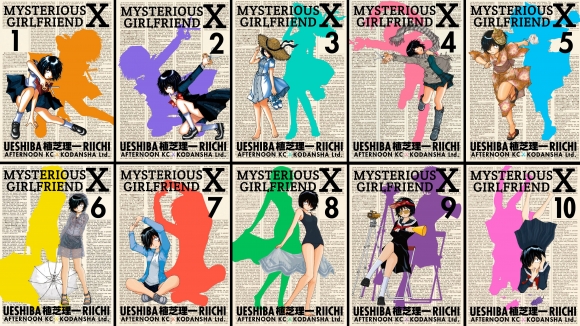
If you haven’t read Phillip’s impressions of the first episode of Mysterious Girlfriend X, go ahead and do so now. We’ll wait. Done? Good. I’m kind of impressed you came back for more, actually. The general consensus on this series seems to be one of outright intolerance built of repulsion or disgust, so I’m glad you’re keeping an open mind ... it’ll come in handy. I have an odd draw to this series, specifically when it comes to just how unflinchingly distasteful the show's premise is, with much, shall we say, admiration for how it takes lip contact out of kissing to make literal the American idiom of “swapping spit” and how that eliminated middleman lends to such a grandiose level of viewer discomfort. That unease is what drew me in. Why is this concept so powerfully repugnant? Well, we’ve got four episodes to run ya through, so strap yourself in and make note of the sick bag in the seat in front of you; this show ain’t for the squeamish.

– Ink

Episode 2: Mysterious Bond

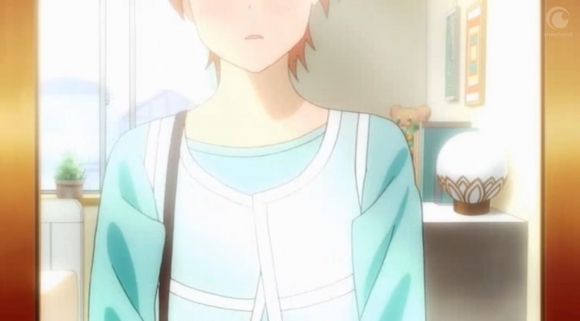
MysteriousGFXDroolIsBondInk: Even after a month of going out, Tsubaki and Urabe have not done anything physical aside from their daily unidirectional saliva-dosing ritual. This episode is all about Tsubaki attempting to break that rut. Since even holding hands seems irrelevant to Urabe, Tsubaki seeks advice by questioning his friend, Ueno, and consequently ends up asking Urabe about her hobbies. In answer, she produces scissors from on her person and demonstrates a unique skill. This does not lead to any physical intimacy. Urabe does, however, end up inadvertently flashing her underwear in front of Tsubaki and later sanctions the appropriateness of said glimpse. In the following days, a spontaneous hug from Tsubaki draws a furious reaction from Urabe, Tsubaki confronts Urabe about not acting like a couple, and Urabe proves her feelings by putting Tsubaki through an intimate test of trust. Tsubaki’s passing performance is rewarded with confirmation of his bond to Urabe via her specially conjured, emotionally conductive drool. Later, Urabe swipes a finger of drool from Tsubaki’s mouth and steals a dream he was withholding from her, revealing spit as a two-way river that conveys emotion and images — exact images, unfortunately for Tsubaki — between both parties.

MysteriousGFXDreamDollHeadPhillip: This episode is interesting for me because of the frustration Tsubaki feels at going so slow with Urabe. It reminds me of The Longest Time in that Tsubaki is prepared to “wait” after he passes the aforementioned trust test. That is an interesting scene to view from an outsider's perspective. And wherever this relationship goes, we at least know that Urabe places a lot of trust in him and Tsubaki isn't the type to abuse that trust. The dream Tsubaki “shares” with Urabe also demonstrate the great sorting house that is the mind. Tsubaki can’t articulate his feeling that the relationship seems to be going nowhere, but through the metaphoric connection with the drool Urabe understands Tsubaki better and puts his mind at rest.


Episode 3: Mysterious Test Tube

MysteriousGFXKissPhillip: Tsubaki witnesses his friend Ueno kissing Oka, a girl in their class. This triggers a reaction in Tsubaki: he too wants to kiss his girlfriend. I mean, it’s only natural. But Urabe’s reply is to give Tsubaki a test tube with her saliva in it. He goes home, tastes it and then has a dream where he decides after Urabe sneaks a kiss from him that they should wait until they are emotionally connected. Is this Urabe subconsciously trying to show Tsubaki her way of thinking? It would be interesting and would lend credence to the idea that Urabe is the one dictating the pace of the relationship. But while Tsubaki is worrying about kisses and such, Urabe has to decide whether or not she should accept Ogata’s request to go out with him. In this we see what I can only imagine is a reference to periods, with Urabe telling Tsubaki that she wanted to wait a day to answer Ogata since she could have an “abnormal reaction.” If there were no reaction from Ogata, he would not and could not ever connect with Urabe. This goes back to Tsubaki’s dream reference to emotionally connecting. I don’t want to step into an area I know little about, but it seems to state that girls only go out with guys they know are compatible with them (Urabe and Tsubaki), while guys go out with girls they think will be compatible with them (Ogata and Urabe). Weird dreams are nowhere to be seen in this episode, but it’s relatable to see Tsubaki worry about not being “worthy” enough to date Urabe. But in the end, like most blokes who stay true to their girl, he really doesn’t have anything to worry about.

MysteriousGFXTestTubeInk: I’ll wholeheartedly agree about how natural the need to compare one’s own romantic “progress” to that of your close friends. This naturalness is also represented in the bashful way Ueno and Oka keep themselves a secret. Tsubaki and Urabe are keeping the same secret, but there’s a little less of a bashful sense of it than there is one of unknowing tinged with that inescapable sense of shame that comes from outgrowing one’s youth and desiring what one once thought of as disgusting. Isn’t that what this series is all about, trying to make the unfamiliar and disgusting somewhat appealing? With this episode, especially via the titular mysterious test tube and its mixed tidings as first kiss and passive-aggressive admonishment of the same, the series does an excellent job of getting into the bewildered mindset of a newly sexually awakened youth (in this case, one that longs for a simple kiss against time which seems an eternity).


Episode 4: Mysterious Girl Meets Girl

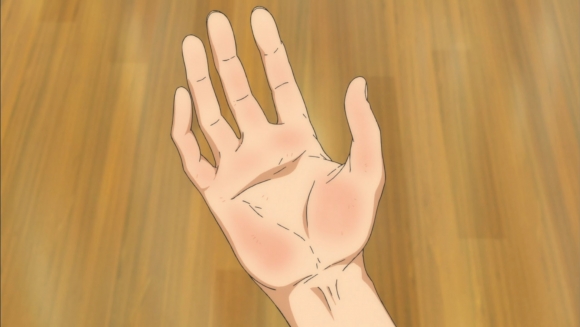
MysteriousGFXThirstyInk: This episode reminds me of Marie Howe’s, “Practicing.” Oka decides to befriend Urabe via the lure of home cooking (handfed nonetheless) after casually coming upon hers and Tsubaki’s afterschool spit swapping ritual. The pair of females unwittingly (at first) hold an experiment in the privacy of a dark, deserted nurse’s office via a shared bottle of soda. Urabe doesn’t entertain the notion that her own drool can affect another girl, so sharing a drink with Oka doesn’t pose any cause for caution. The consequences, however, reveal a deeper connection between the two girls that manifests in two ways: Urabe develops a taste for Oka’s cooking, mentioning at one point that her “body rhythm changed,” and it is revealed that not only can Urabe’s spit transfer emotions and mental images but physical wounds as well (skinned knee from a track accident and self-inflicted cut on her hand). Though both girls have boyfriends, they’re very interested in the bond itself and experimenting with it. The magic realism, already offered via transfer of emotions, thoughts, and dreams, gets a welcome physical manifestation, but this whole episode seems an excuse to fettishize the drool exchange by exploiting such themes as lesbianism, cutting, and cosplay (gym clothes).

MysteriousGFXFunToWatchPhillip: There’s an element of voyeurism to Oka observing Tsubaki and Urabe and not saying anything. I’m not saying that it doesn’t contain themes as mentioned above, but for me the most interesting angle is that Oka could blab to the whole school about Urabe and Tsubaki, but she doesn’t. She wants to keep Urabe’s “uniqueness” to herself. Why does she want to talk with Urabe alone? She says it was because she didn’t want to cause trouble for Tsubaki by approaching him but still, she completely focuses on Urabe. And in the nurse’s office, she drinks cider, an alcoholic drink traditionally, which would lower her inhibitions. What the hell is that scene about? Personally, the mix of two girls, booze and secrets makes it more confessional in nature than anything else, in my mind. Urabe needs Oka to be more human as it were, and Oka with her weird voyeur tendencies needs Urabe to be normal. If you can believe that.


Episode 5: Mysterious First Date

MysteriousGFXNice ShotPhillip: After seeing Urabe in her swimsuit in school, Tsubaki decides to invite Urabe to the beach because on a unconscious level he wants to see her on his own in a swimsuit. But like most guys in a relationship, he gets more than he bargained for when, after waiting weeks for the chance to see her, they go to the beach with her sporting a tan after spending time with her family (who curiously we don’t meet or see) and him wanting to see what her whole body looks like. Now most other shows would have him wanting a peek at her undressing, but they don’t do that. Instead we see her untying her bikini skirt to reveal her wearing bikini ends and a tan line where her panty scissors should be. Also, I can’t help but feel the shows producers and writers are trying to show Tsubaki is a good kid, because early on in the episode, the guys are practising goals in school with the teacher but deliberately kicking the ball over the hedge so they can peek at the girls practising swimming. Tsubaki is the one to try and check out Urabe but when he sees her through the hedge he slips and doesn’t kick the ball. Is that Tsubaki self-sabotaging his “shot” at Urabe? It stands to reason, in his mind at least, he doesn’t need to do that because his relationship with Urabe is his and his alone. And before you ask, Ueno sneaks a peek at Oka, so it’s not about Tsubaki having a girlfriend that he doesn’t do it.

MysteriousGFXDohInk: The approach used to introduce the poolside peeping at the beginning was impressively subtle for such a brazen show; winks and smiles, no-one in gym being able to properly kick a soccer ball/football, and the earnestly delivered compliments (instead of jeers) for such, all let viewers know something is not what it appears to be. Unlike Phillip, I’d argue that the only thing sabotaging Tsubaki’s shot at Urabe here is his respect for her, which is genuinely nice to see. Tsubaki’s embarrassment at spying Urabe through the trees, when they lock eyes for a moment, throws Tsubaki off, causing him to miss the ball. I’d like to think his botched peep was a combination of that unspoken warning from Urabe and an inner voice that realized the truth behind her glance. Aside from a couple really well-written and timed jokes towards its end, I think the episode falls apart from there. Don’t let Philip mislead you. Although Tsubaki indeed does not try to catch Urabe undressing, he does swim underwater to watch her body very closely ... only to be saved by a horribly flimsy excuse and an overly accommodating Urabe. Or is that a very forward hint?


Mysterious Girlfriend X is now streaming on Crunchyroll.

Review: Another

Death Is Not Kind

Topics: , , , ,

AnotherIt’s probably safe to say that there has been a point in everyone’s life where they felt invisible, like the people around them on the street, in the club, or in the classroom literally didn’t know they existed. What if that were actually the case? Wouldn’t that be maddening? What if they were intentionally pretending not to notice? Wouldn’t that be a conspiracy? What if it that cold shoulder was a matter of life and death? Wouldn’t that be Another?

Based on a novel by Yukito Ayatsuji, Another focuses on Yomiyama North Junior High ninth grade’s class 3. Kōichi Sakakibara, the male lead, transfers in from Tokyo, but even before he can step inside the school, he suffers a collapsed lung that puts him in the local hospital. A seemingly well-meaning bunch of representatives from class 3 visit Kōichi, but there’s something in the air that makes the gathering feel more like an investigation than a welcoming committee. For the first half of this 12-episode series, Kōichi tries to ascertain the reason behind his classmates’ enigmatic avoidance of certain subjects and specific people. The remaining episodes feature Kōichi trying to figure out a way to stop the rash of mysterious deaths plaguing class 3 without becoming one of the victims himself. 

A scene from the credits in Another

From its onset, Another frames its female lead, Mei Misaki, a student with an eye patch who lives above a creepy doll museum/shop, as an ambiguous entity. She appears and disappears at will and without warning, and no-one seems to see her ... except Kōichi. Mei could be a ghost or the walking spirit of a hollow doll or just another ninth grade student. The series is written and directed frustratingly well in that regard, so well that I almost threw something at my computer screen when the series decided to show its cards in episode five. Thereafter, the lack of ambiguity is certainly disappointing, but luckily the series has a lot more to offer to maintain viewership. Let’s start with the bloodlust.

As gruesome as the death scenes are, Another’s real power lies in its imagery.

As I mentioned earlier, there are a string of deaths at Yomi North. None of the initial incidents are malicious. Instead, each is set off in a manner reminiscent of Final Destination. Some deaths are masterfully foreshadowed, and some serve as ambient sucker-punches. Regardless, the series spares no effort and pulls no punches in delivering a mix of off- and on-screen misfortune in beautifully choreographed, horrific detail, making the tragedies, for the most part, 100% believable. But gore can get tiresome when put into heavy rotation, especially when the causes are random accidents. There needs to be motive, and here’s where Another’s linear plot turns from disappointing to exhilarating. Something is found. Information is revealed to a select few. But once the information is leaked, Another’s epic climax, comprising acts both emotionally twisted and disturbingly violent, carries interest through to the bitter end. As gruesome as the death scenes are, Another’s real power lies in its imagery ... and I’m not just talking about the superfluously interjected shots of creepy dolls.

A terrifying empty elevator
The art is all about isolation and diminishing the presence of the individual to make it feel stranded and helpless.

The portrayal of empty moments via scenery would make a Romantic weep. For instance: a door methodically sliding opening to expose the hollow guts of an elevator that's just arrived to the vacant hallways of the basement floor, on which the only room that has bodies in it is the morgue. The art is all about isolation and diminishing the presence of the individual, or in some cases humanity itself, to make it feel stranded and helpless. To his effect, the scenery is rendered such that it usually dwarfs the characters. Lush landscapes and detailed backgrounds (oh my god the textures!) are deliberate in setting this mood. Water-stained walls, paint-stripped wood with scrapes and obvious wear, and rusted metal surfaces create a realistic world that’s lost the attention of its inhabitants and fallen into decay. And while the persistence of setting may be overwhelming, it is none-the-less striking when considering its relation to the story. In fact, backgrounds are so wonderfully rendered that the characters feel superimposed by comparison. Often I found myself sighing whenever characters would return as the main visual focus (often when involved in close discussion).

Another

The character designs feel a little too clean or bright compared to their surroundings, almost as if they have not interacted with the darkness at all or are completely repelled by it. Each student is very distinguishable, which is a feat considering how many average-looking students are in class 3, although most are 2-D and forgettable (which is forgivable given their cannon fodder nature). One of the more distinguishable secondary characters, Izumi Akazawa, seems to be drawn to ooze tsundere, but her role is written such that her appearance is surprisingly the only 2-D thing about her character. Mei’s character, however, is a rather big disappointment. Her personality can seem painted on at random, changing from pensive or sullen to mischievous to almost flirtatious without actually fitting the scene. Of course this jarring effect does make the character seem a little more out of sync with her classmates, which sometimes lends to the  overall ambient effect of the series.

Short and maliciously sweet at 12 episodes, Another is worth the time investment. Pacing helps. Despite lingering shots of scenery, appetites are either satiated or left wanting more at each episode’s end. On the whole, this is a very satisfying bit of horror that, even when its mystery element is 99% exposed early on, has a lot to offer viewers by way of visual storytelling, Romantic images, luscious art, gratifying gore, and the always fun decent into madness. Another is not without its faults, but they are rendered almost forgivable due to its popcorn-horror nature. 

Death Is Not Kind

Medium: TV Anime (12 episodes)
Director: Tsutomu Mizushima
Studio: P.A. Works
Distributor: Kadokawa Pictures Inc.
Release Date: Jan. 9, 2012 (JP), Jan. 10, 2012 (US)
Age Rating: 17+ (violence, profanity)

Spring 2012 Anime Impressions Part 2

Fate/Zero S2 and Dusk Maiden of Amnesia

Topics: , , , , , , , , ,

We're back with more Spring 2012 Anime Impressions! This time David catches up with Fate/Zero Season 2 and Ink tackles the ghostly shenanigans of Dusk Maiden of Amnesia. This will be our final first-episode Impressions post this season, but we're proud to announce that we will be venturing into what you might call "pseudo-episodic" blogging.

What that means is that our writers will be writing up larger groups of episodes (like, say, episodes 1-4 of a series), tackling the whole group in order to provide more in-depth discussion and critique than a typical episodic post. This is new ground for us, so we hope you'll stick around and comment on these posts as they go up. Enjoy!


Gilgamesh enjoying himself during the aerial battle in episode 1 of season twoFate/Zero Season 2

Studio: ufotable
Director: Ei Aoki
Now Streaming on Crunchyroll


Airing during the most packed anime season in recent memory after every other show has had time to impress, the first episode of Fate/Zero Part II needed to be near perfect, or else I might've stopped watching altogether. After 13 weeks of build-up and another 13 or so weeks of delay, with an extra week on top to avoid watching in 360p, forgive me if I’ve lost my patience with this show.

Unsurprisingly, F/Z Part II episode 1 is not perfect, but it's as direct a follow-up as one could have hoped for. As if the Winter season never happened, viewers are dropped right back where Part I teasingly ended on. This episode's glorious aerial combat sequence alone features more spectacle than any scene in Part I. ufotable continue to raise the standards of TV anime with stunning lighting and great camerawork in each scene, making most shows this season look impoverished.

If the first episode is anything to go by, Part II aims to please a restless crowd disappointed by the non-existent body count of Part I. Time is running short, both in the F/Z universe and in the show’s episode count, leaving little excuse for characters to sit around and talk for episodes at a time. At the cost of all the characterization and philosophy from Gen Urobuchi’s original F/Z light novel, the story will at least begin to move now, if only out of simple necessity. I’m not convinced that F/Z will be my most anticipated weekly release, especially as it's the sole Crunchyroll delaycast among the six other shows I’m watching, but there are still 12 more opportunities to make the wait worth it.

 — David


The ghostly president Kanoe plays a prank on Okonogi while Niiya watchesDusk Maiden of Amnesia

Studio: Silver Link
Director: Shin Ounuma
Now Streaming on Crunchyroll


Tasogare Otome x Amnesia (Dusk Maiden of Amnesia) centers on activities of the paranormal investigations club at Seikyoy Private Academy. Rumors about paranormal activity haunt this school, and the club members — Kanoe, Niiya, Kanoe, and Okonogi — task themselves with investigating the more substantial reports they receive. The twist is that not all of the club’s members are, shall we say, on the class attendance list.

I was wary of this show based on its premise, which sounded like something akin to a mash-up of Sket Dance, Ghost Hunt, and Another. To my surprise, however, the humorous first moments of the show defused my standoffishness. The first half introduces Okonogi, who is so obsessed with trying to sort out which mysteries to investigate that she remains completely oblivious to the attention-seeking antics of a local poltergeist. This ghost turns out to be the club’s omnipresent president, who can be seen by all the members except Okonogi and is responsible for at least some of the recent paranormal events reported by students.

Playful humor is the key here. But as much as the first 10 minutes are strikingly tongue-in-cheek, the rest of the show is 98% mired in the usual adolescent anxiety yuks. The remaining 2% is comprised of scenes where the club president does things just to make Okonogi freak out (which alone are charming and make the first episode worth the view). Not what I was expecting, and pleasantly so, this show has at least hooked me in for a few more episodes to see where it wants to go and how it’s going to take its audience there.

— Ink

Spring 2012 Anime Impressions Part 1

Space Brothers, Mysterious Girlfriend X, and Kids on the Slope

Topics: , , , , , , , , , ,

The 2012 Spring anime season is in full swing, and we've got some impressions of the latest series. Wondering whether you should examine the effect of zero-gravity on the power of brotherly love in Space Brothers? Thinking of checking out the saliva-tasting romantic shenanigans of Mysterious Girlfriend X? Or maybe you want to dance along to some swingin' jazz music in Kids on the Slope. Well, Phillip and Evan are here to run down some of this season's hottest shows JUST FOR YOU.


Space Brothers 

Studio: Hoods Entertainment
Director: Ayumu Watanabe
Now Streaming on Crunchyroll


Mutta and Hibito Nanba are close brothers. One night, as children, they witness a UFO in the night sky as it streaks toward the moon. At that moment, they both promise to get to the moon. But 19 years later, while Hibito is on a fast track to being the first Japanese person on the moon, Mutta’s life has hit an impasse. That is until his younger brother helps him remember the promise he made to himself, all those years ago.

How to describe Space Brothers? How’s this: I never bothered with the thematically similar Moonlight Mile, so when Space Brothers was announced, I wasn’t too interested. But, much to my surprise, it’s a pretty good series. Hibito is the kind of person I’d like to be: determined, energetic and fun. However, Mutta is the person I’ll probably end up being: down on his luck, unmotivated, and a killjoy. But there’s hope for Mutta. Being fired from his job means that his promise that he and Hibito made to become astronauts has suddenly become a real goal for him to strive towards, however impossible the task is. This first episode has the beginnings of a good story of the greatest of adventures happening to the most ordinary of blokes, and the deadpan humor nicely complements the serious bits. The animation isn’t particularly impressive, but at least it’s competent. I like the leads and I’m looking forward to watching them grow over the course of the series.

Hey I just realized how to describe the series! Moonlight Mile is an anime set in space for people who liked Apollo 13 as kids. Space Brothers is an anime set in space for people who liked SpaceCamp as kids. So there!

— Phillip


Mikoto plops herself down on Akira's bed.Mysterious Girlfriend X

Studio: Hoods Entertainment
Director: Ayumu Watanabe
Now Streaming on Crunchyroll

(EDITOR'S NOTE: That's not a typo. Watanabe and Hoods Entertainment are producing both Space Brothers AND Mysterious Girlfriend X.)

You knew we were going to have to talk about this show eventually. Akira Tsubaki is a typical teenager. He meets a weird girl, Mikoto Urabe, who transfers to his school. One day he finds her asleep at the end of school classes at her desk. After she leaves, he sticks his finger into the pile of drool she left behind on her desk and puts it in his mouth. He gets sick afterwards and she visits him at home to explain that he’s suffering from love-sickness and only her drool will cure him. So he and she become boyfriend and girlfriend.

There, I said it.

Mysterious Girlfriend X is a weird series, from its circus organ score to the insane nature of Akira and Mikoto’s relationship. I mean, she tells him that a little voice told her he would be her first sex partner! There’s a glacial pace to the first episode. Nothing happens with any kind of speed (other than the fundamental ways that Akira’s life changes once Mikoto comes into it). Akira's dream sequences are well animated and they are excellent next to the relative normality to his real life. Plus the character designs are quirky. Unlike some reviews that bash the fanbase for liking something like this, I prefer to simply marvel that something like this exists. We’re usually treated to Japanese school kids having nice, safe relationships, and this is definitely different. It’s both repellent and fascinating and I’m compelled in a strange way to see how this all falls into place. Just don’t ask me to talk about it in anything but relative terms.

— Phillip


Sentaro and Kaoru argue about music while Ritsuko watches in the background.Kids on the Slope

Studio: Tezuka Productions, Mappa
Director: Shinichiro Watanabe
Now Streaming on Crunchyroll


In 1998, director Shinichiro Watanabe created one of anime's enduring classics, the jazz-infused space western series Cowboy Bebop, and in 2004 he came back for more genre-bending antics with Samurai Champloo, a hip-hop samurai adventure. Now Watanabe returns to the director's chair for yet another musical number, but this time it's a little different. Kids on the Slope (Sakamichi no Apollon), based on a josei (women's) manga by Yuuki Kodama, isn't exactly a slice-of-life to the tune of jazz music — it's a slice-of-life about jazz music.

Kaoru has been moving from school to school for his whole life, and after years of meeting new people and getting rejected by local cliques, he's developed an acute case of what appears to be social anxiety. Despite a less-than-warm welcome from his classmates, however, within the first few hours of school Kaoru finds himself in the company of not only the pretty class representative Ritsuko, but the intimidating delinquent Sentaro. Kaoru plays classical piano and Sentaro plays jazz drums, so while their decidedly Boys Love-friendly personalities clash left and right, they're clearly destined to play some sweet jazz music together, thanks in part to some prodding from Ritsuko.

Watanabe's deft touch is already on full display in Kids on the Slope, with excellent pacing, beautiful, slightly shaky camera work, and some expertly placed musical cues. Nobuteru Yuki's character designs retain their angular charm without his conspicious noses, and the animators at Tezuka Productions make great use of soft, watercolor-esque shading to give the show a distinct painterly quality. Realistic, heartwarming, and funny (in an "awww, awkward teenagers" sort of way), Kids on the Slope should be at the top of your list of must-watch shows this season.

— Evan

Poetic Propaganda

Reading Between the Cards of Chihayafuru

Topics: , , , , , ,

The title shot of ChihayafuruI’ll preface this article with three concessions: anime is not, for the most part, tailored to audiences outside of Japan; karuta is still popular in Japan, at least according to those responsible for its standing Wikipedia entry; and the Chihayafuru manga has won its fair share of popularity contests as well as awards. That said, it’s pretty easy to imagine Chihayafuru as propaganda targeting Japanese citizens, specifically those obsessed with anime and manga, who represent what I imagine is a growing disappointment to national pride in the eyes of elder Japanese. The dense, meditative poems of the island nation were once a source of pride and strong enough to arrest and sustain the attentions of the pre-Internet global community. However, the new instant-gratification Japanese generations (as well as the patience-deprived simulcast generations of the West) laud over-scripted, bang-the-point-over-your-head-with-a-pan cartoons. 

Indeed, the economy-pumping vigor of domestic interest and the growth of anime popularity worldwide form a double-edged sword for Japan. There’s a stigma associated with animation that labels it a child’s medium in the West (despite myriad age- and sex-appropriate subjects), yet even the most regrettably childish series afford artists an avenue by which to express themselves while also drawing foreign attention towards at least some portion of Japanese life and culture. Anime, with its 24-minute episodes and movie-length features, seems to be the ideal artistic medium for representing Japan to itself and to the world. So much so that it’s hard to imagine poetry appealing to the masses in this age where time literally equals money. Poetry takes time, thought, and sometimes a range of insights (historical, political, personal, regional) in order to fully comprehend its bearers’ beauty. How then to rectify this gap of expression and misappropriated focus? Integration. Enter Chihayafuru.

A classical set of karuta cards. Grabbing card (left) and reading card (right)Based on the manga by Yuki Suetsugu, Chihayafuru centers around a group of friends who are, by varying degrees and focus, interested in competitive karuta — a card game unique to Japan. Karuta is essentially a timed Concentration match, except that the players’ cards are all exposed and there are no “turns.” Players are tasked with being the first to touch the card (torifuda) with the phrase that completes the card being read (yomifuda) by a designated, third-party tanka reciter. The competitive aspect lends to intense action, while the subject of the game, Hyakunin Isshu (The 100 Poets), lends to a sense of national history and pride. There is an innate conflict in these two aspects, and as the josei (women's) anime it is, Chihayafuru represents such turmoil via one of its characters, Kanade Oe, in relation to the game itself as well as others’ attitude towards it.

Kanade explains Chihaya's "sweet card"
Kanade's fortitude represents ancient custom trying to find a place in the lives of the current generation.

Specifically, Kanade’s point of contention is that the nature of competitive karuta does not allow any time to actually enjoy the poems. Players often have to spring for a card based on the first audible syllable. This conflict, like much in Chihayafuru, has no direct resolution, but the series uses its themes to great effect. Instead of attempting to mend the contention between gameplay and subject, Kanade takes consolatory pleasure in other aspects of the game, such as traditional garb (hakama) worn by contestants. This is not as flippant as it sounds. Kande has been brought up by her parents, who own a store dedicated to such traditional clothing. Also, Kanade delights in edifying her teammates (mainly the protagonist, Chihaya) by elaborating on the meaning of some of the verse on the cards they’re so haphazardly slapping across regulation tatami mats. Kanade, new to competitive karuta, is not the fastest on the draw, so becoming the Queen, or best female player (as is usually the goal of any female karuta player), is rather unlikely. Upon realizing why she continues to be a part of her karuta team, to become an official yomifuda reciter, Kanade discovers that she must become a queen. By the end of season one, Kanade has a long way to go. Her fortitude, however, represents ancient custom trying to find a place in the lives of the current generation. Kanade loves the poems so much that she wants to read them (or at least as much of them allowed per volley) in a sport that attracts the young! We can see the opposite attitude in the anime’s main character, Chihaya Ayase.

Chihaya lunges for a cardIn the world of karuta, Chihaya Ayase is all ear and reflex — something that can actually bring about faults (otetsuki) during matches due to similar-sounding syllables. Chihaya represents the current generation of impulse and immediacy ... action without thought. This is made clear in several karuta matches where Chihaya loses because of her own limitations. The brilliance of the story, and I believe the intended moral as well, is how Chihaya, determined to become queen at all costs, takes in lessons from opponents and teammates alike. Every bout, whether participating or observing, is an opportunity for learning something new. Often, strength is associated with “personalizing” a particular card — a “sweet card,” if you will. Most often, it is the meaning of the lines of verse that make them “speak” to a player. Such internalization speaks more to poetry than to competition, yet still helps players get the upper hand during matches. This is epitomized in one of the last episodes of the first season, where the current queen, grown heavy from a lengthy chocolate binge, overcomes her speed handicap with the accuracy and determination derived from her personal connection to the poems.

Chihayafuru is nostalgic Japan exclaiming, “wake up and internalize your history!”

The effort and personal growth shown in all the characters are what drive this series. The action, mainly the way the matches are portrayed, and a subtly threaded love triangle keep the pace lively and tender (respectively). However, it is the individual evolutions spurred on by internalizing the poetic content of karuta, whether for memorization in hopes of a faster strike or personal relevance to add passion behind the same, that makes traditional content (poetry) relevant to a new generation (anime viewers). The message, as flatly stated by Kanade in episode six, is that “You can feel the seasons and modesty in a way that can’t be found in modern poetry!” This is nostalgic Japan exclaiming, “wake up and internalize your history” via a modern art form that currently holds the attention of more and more people on a domestic as well as international level.


Chihayafuru is streaming right now on Crunchyroll.

Review: Nisemonogatari

Topics: , , , , ,

NisemonogatariMedium: TV Anime (11 episodes)
Genre: Harem, Romance
Studio: SHAFT
Distributor: Aniplex, Crunchyroll
Release Date: Jan. 7, 2012 (JP/US)
Age Rating: Unknown (appropriate for 17+)

From title to content, Nisemonogatari, which roughly translates as "Fake Story," is in its entirety a deception of viewer expectations. Nise, the second anime adaptation of writer NisiOisin's popular light novel (LN) series, challenges what is expected of LN-style fiction while reveling in typical anime-caliber scenarios. Interestingly enough, the writer has discredited this particular work as professional writing with the mentality of a fan, suggesting it is a work that perhaps should not have been published. Nevertheless, the fact is that his editor got a hold of the novel and deemed it suitable for market. Unsurprisingly, everyone that has read it agrees that it is the weakest entry in the Monogatari series. Undaunted by public opinion, Akiyuki Shinbo took a shot at working the usual SHAFT miracle for Nise that made its predecessor, Bakemonogatari, one of the highest-selling television anime shows ever. Just as Bake put some viewers off with its artistic slideshow-style animation set to overly clever, occasionally sexually-charged, banter between teenagers, Nise is just as divisive — if only for a different set of reasons.

The greatest challenge to begin enjoying Nise is to abandon attachment to most of what was enjoyable in Bake. Bake begins interestingly enough as a sort of supernatural reverse harem (in the chronological sense), where the protagonist settles on a girl first and wanders the town collecting members for his harem afterwards. The 15-episode series tightly compresses two novels worth of character arcs, moving as quickly as text-dense adaptations allow. Despite how the story only seems to move through the sheer might of the sexual tension in some scenes, I will say that Bake has surprised me with the level of sincerity imparted to its characters and how they grow and bond with each other within the relatively short running time of the series.

Nisemonogatari

Nisemonogatari matches, if not improves upon, all of Bakemonogari's strengths in a technical sense. Taking a few broadcast seasons off to focus on their craft and roll in all that Madoka money has made all the difference for Studio SHAFT. They scale back on most of the shortcuts taken in Bake — empty black screens, literal walls of text ripped from the novel, still-frame montages — and actually animate what's happening in unusually splendid detail. The luxury of time and funding means minute physical character tics are placed throughout and that all characters are actually drawn on-model by the time of broadcast. Shinbo's visionary apporach to anime is in full effect for Nise, working sight gags for all they're worth and disregarding any notion of spatial continuity to wonderous effect. Nise triumphs over Bake in that characters rarely sit around to talk; they roll around, do handstands, get into earth-shattering fights, hop across works of post-modern public sculpture, and leave the realm of reality to speak in their inner voice. Nise captures that breath of life in its animation that was missing from most of Bake due to budgetary constraints.

Problems arise for Nise as it moves away from the promising set-up of the first novels. The original Nisemonogatari novel is split into two character arcs covering the protagonist's delinquint younger sisters' involvement with dangerous supernatural phenomena. NisiOisin relegates the principal heroine of Bake and her rival-in-love to supporting roles far away from the action of Nise, though trimming the cast does not give the project any tighter of a narrative focus. The first arc trudges along in the background before abruptly resolving in a most ungratifying manner. The second half isn't much more engaging, but at least there seems to be a deliberate attempt to engage the audience before the end.  The titular characters of each arc might only appear for a few minutes of screen time in some episodes, if at all, and the author doesn't utilize the newly introduced characters much either. Nise feels a lot like an extended intermission between Bakemonogatari and the next book.

As incongruous as Nise seems, it really is the logical (within Nise's personal construct of rules) place to end up after Bakemonogatari. The protagonist has already solved the problems of the members of his harem to a workable degree in the previous series. Bake ends satisfyingly enough, so forcing in a new plotline out of nowhere wouldn't work out. Instead, Nise's continued dialogues between characters further flesh out the kind of people they are and highlight their positions on the harem totem pole. What really works out for Nise, though is that it dissolves the protagonist's Nice Guy hero image from the first series. Even with complete power over the narration, he can't hide some decidedly un-Nice acts. The best writing in Nise comes from seeing the protagonist grapple with the disgusting side of himself as he tries to fight back his urges. I can only reference the actual Monogatari text beyond Nise in a very limited way, but I have the impression the seeds sown in Nise only produce fruit after this story is over. Whether anyone still cares about character dynamics might not be easy to ascertain over the noise caused by Nise's actual draw-in.

Nisemonogatari

Now I've finally arrived at the most polarizing element of Nisemonogatari: it's damn sexy. After about four episodes, there isn't a viewer left who can say they watch Nise for the plot without lying through their teeth. Anime conservatives will crawl back under their safety blanket at the sight of dead elementary schoolgirl upskirt shots, extended conversations with fully nude loli vampires, chiseled male and female collarbones, slavishly drawn bare feet, little sister kimono unravelling, and a lavishly animated toothbrushing sequence that establishes itself as a pivotal moment in changing brother-sister relationship conventions. Bake could get pretty hot when it wanted to, but Nise completely overblows the sex appeal. Factor in SHAFT's keen eye for framing, VOfan's attractive character designs, and NisiOisin's bold situational writing, and you have a product that trumps most standard ero-anime.

The effect is noticably ampilified considering the restraint previously shown by Bake that allowed the audience to grow fond of its characters without a reliance on sexuality. Even higher-leveled anime viewers who are normally okay with inappropriately sexualized underage girls find Nise to overstep the boundaries of dignity the general Western anime community have set forth. As lovingly crafted a sexploitation series NisiOisin and SHAFT have given the world, it's still an exploitation bound to discomfort those who haven't completely embraced their true otaku power. Watching Nise is nowhere near as shellshocking of an experience as, say, watching In the Realm of the Senses. As a major commercial late night television anime, however, it easily crosses over into that zone where viewers will want to take a step back and reexamine their motivations for watching.

Nise is as inaccessible as viewers will make it out to be. On many levels, it's a lot more fun to watch than Bake and certainly more polished than a lot of other work SHAFT has done. On the other hand, Nise leaves us in the middle of a messy web of character relationships that begs resolution. While the sexuality rarely pushes the plot forward, the show would be drained of its energy if the sexuality were taken out. And somewhere under the surface, Nise almost has the right idea in its approach concerning the topic of underage sexuality. The execution, however, is a failure from inception, as the work is clearly aimed to sell wishful fantasies to that crowd of esteemed gentlemen who have no qualms about loving young, idealized 2-D girls.

Nisemonogatari

SHAFT's next adaptation, Kizumonogatari, with its promise of gory vampire violence, will likely take back all of the attention lost during Nise. By no means is Nise the gravest mistep in Japanese young adult literature, but from here on out I hope NisiOisin's other Monogatari novels give SHAFT a little more to work with.

Review: The iDOLM@STER (Anime)

Topics: , , , ,

The (many!) idols of iDOLM@STERMedium: TV Anime (25 episodes)
Genres: Comedy, Drama, Music
Director:  Atsushi Nishigori
Studio:  A-1 Pictures
Distributor: Crunchyroll
Release Date: Jul 30, 2011 – Jan 14, 2012 (JP/US)
Age Rating: 13+
Availability: Streaming on Crunchyroll

The iDOLM@STER (iM@S) is, by far, the most alienating anime I have ever had the pleasure of earning the right to enjoy. There’s very little in this show that caters to the Western anime crowd. In fact, iM@S sits at the bottom of Crunchyroll's stats with 253 viewer ratings, compared to the 1000+ vote tallies held by other popular seasonal shows. Even the total download counts for the translated television rips on other spurious anime content providers are fairly low. That the games the show is based on have only minimal presence outside of Japan is perhaps the largest barrier to entry most viewers will face.

iM@S is the very embodiment of the “otaku making anime for other otaku” phenomenon that every reportedly serious anime blogger has been decrying. Series Director Atsushi Nishigori (Gurren Lagann, Evangelion 2.0) makes his directing debut on a project that he was purportedly already a fan of, an oft-heard claim that according to cynics is an omen of an early death knell for a creative work. The first half of iM@S is largely a big anime mess that underutilizes what people actually like about iM@S, but the path to redemption this show takes in the second half is quite unlike anything I expected from a series I wrote off as an easy cash grab.

iM@S follows the story of 765 Productions, a small-time idol agency aspiring to reach the top of a competitive idol world. The show begins with the arrival of a new producer, simply referred to as Producer for the run of the series, after going through a documentary-style introduction to the 765 Production idols. As interestingly directed as the first episode is, the show slips into standard anime mode for the next seven or so episodes. iM@S doesn't really properly set itself up as a typical slice-of-life show, yet in spite of a bold declaration from 765 Productions of attaining stardom around the beginning, no discernible plot really gets going until the second half. Much of the series is episodic, with each idol receiving focus for an episode or two. Aside from the first episode, there is no introductory easing-in period for the audience to begin caring about the characters, so a solid understanding of a good bit of the iM@S esoterica is required to glean an appreciation of the finer details. Not to say that the show doesn't try to have its cast appeal to viewers, but even after I played some of the game to better understand iM@S, the first episodes still slog through a streak of some of the most uninteresting scenarios committed to animation.

The iDOLM@STER girls crowd around their Producer.

It’s not until episode 8 where the show improves and doesn’t get significantly worse. Here Nishigori and staff start feeling comfortable enough to show off their robust animation talents after lulling audiences into a fanservice coma. The writers even manage to skillfully weave in some strong story arcs and an overarching plot as the show progresses, which is probably more than anyone asked for. Truthfully, the show doesn’t actually get legitimately good until around episode 18; considering that there are 25 total episodes, that means roughly two-thirds of the show consists of arguably okay anime before it drops its best content on viewers. This might be a major problem, but the thing is that iM@S doesn’t need to attract an audience outside of its circle of devotees. The franchise is established and popular, so it really doesn't affect the target audience if a good amount of the show simply consists of side stories like finding a pudding thief or returning someone's lost wedding ring, just as long everyone's favorite characters from the game are present. Unlike other “for fans” projects, iM@S plays the fan-driven angle harder than any anime I’ve seen before, but it is as much a labor of love as it is a calculated strike on the iM@S market. This is certainly one of the better joint efforts between suits and fans who happen to be working professionals.

As an iM@S poser, I seriously envy the level of enjoyment hardcore iM@S fans would have gotten from watching this. From a technical perspective, the show is a complete success. No expense is spared in animation, especially the dance sequences which I’ve heard are actually not traced from the game animations. I'm not too big on iM@S's catalog of ani-songs, but it is extensive and well-produced (I do listen to the first opening song pretty much every day, multiple times, though). The direction picks up superbly after the first half once the show moves into its most dramatic phase as the timing and framing of each important shot is hit perfectly. It's so astounding that I was visibly moved by the events unfolding in an anime adaptation for an arcade game meant to take otaku cash hand over fist. The range of facial expressions and all of the little quirks in movement that are often cut by low-level animators convey a level of genuine emotion that few anime released within the last ten years have reached.

Chihaya Kisaragi from The iDOLM@STER

The writing doesn’t quite hit the peaks set by the direction, but still manages a beautiful usage of fantastic elements blending with the realities of the idols in key moments of introspection. It would actually be reminiscent of Satoshi Kon’s Perfect Blue, if Perfect Blue had been capable of being heartwarming. The world building is excellently accomplished through a “show, don’t tell” policy that illustrates how the rise of the idols changes the world around them. The idols are not merely told that they've become stars, they walk through the streets disguised, wary of arousing attention, while passing billboards for their latest single and seeing their music videos playing along the face of a building by the pedestrian crossing. As far removed from the proceedings as I am, I can't help but to feel proud of these characters for coming so far and developing into proper idols.

iM@S is definitely a thing that is better than it has any right to be. By the time the cathartic final concert episode arrived, I found myself fully invested in this show and the characters, even after a few false starts. This show is an event anime that will and has completely passed under the Western radar for more valid reasons than poor excuses. There are more hurdles to overcome than it might be worth to enjoy the series without previous exposure to the property, and though I praise iM@S for what it does right, it dooms itself early on by being slow to engage the audience. I do apply a minor asterisk to my rating leading to a clause that you should watch it anyway if you have the patience of a saint and an extremely open opinion of what counts as interesting subject material for anime. The iDOLM@STER challenges in the worst way possible but still rewards those who can stick through it.

Secret Santa Review: Pale Cocoon (Sub)

Topics: , , , ,
Pale Cocoon, from Studio Rikka

Medium: Original Anime Video (OAV) (1 episode, 23 minutes)
Genres: Drama, Science Fiction
Director: Yasuhiro Yoshiura
Studio: Studio Rikka
Release Date: Jan. 18, 2006 (JP), Jan. 8, 2007 (Crunchyroll – NA)
Rated: Not Rated

Ed. Note: Welcome to the third of our four "Anime Secret Santa Reviews." Our reviewers were given review requests as gifts from their Secret Santas, and are now unveiling their opinions of the shows they chose. For more information, check out our 2010 Anime Secret Santa introductory post.


Pale Cocoon is a short (under 25 minutes), OAV by Yasuhiro Yoshiura that seems to mainly serve as an animation and concept demonstration. The story itself is quite simple, despite being told through vague, psuedo-deep dialogue. The message is one many would describe as "moving" or "profound," but all I saw was tiring environmentalism and juvenile artsy writing. Also, the dialogue is bland and the pacing needlessly drawn out. As a reader of magazines like Galaxy Science Fiction and Asimov's Science Fiction, I certainly enjoy a good piece of SF short story, but Pale Cocoon's premise lacks the impact it should have. From a social SF standpoint, the environmental aspect of humans being driven away from the Earth due their own mistakes is a dime-a-dozen plot that has been much better done elsewhere. As a character drama, the two protagonists seem like they could be interesting, but not enough depth or background to their relationship is present for me to feel emotionally invested. Despite an interesting SF concept, it needs a lot more fleshing out to be enjoyable.

In the future, human society has been forced underground by environmental destruction. Archeologists have now dedicated themselves to archiving and researching photos and other documentation from the surfacebound past. Photographs of a green, living earth captivate the protagonist of the story, while everyone else is questioning the necessity of the historical discovery and feel as if it is better if humanity doesn't know what it was once like. Despite his female friend encouraging him to abandon his work, the protagonist discovers an old music video that compels him to seek the truth about the human race's previous life.

A scene from Pale Cocoon

My issues with the plot are largely irrelevant since the entire OAV is a technical demonstration, but as a vessel for displaying Yoshiura and the studio's animation talent it succeeds quite well. The animation is gorgeously detailed with intriguing cinematography. The aesthetic is built around, well, technology looking cool, and as such it features lots of detailed shots of wires, pulsing light towers, computer desktop screens, and related. Naturally, it is impossible not to make the obvious Serial Experiments Lain (1998) comparison with its technical, cyber-cool focus. Interesting camera angles and panning may serve as animation shortcuts at times, but are effective stylistic choices at others. Aside from the amateurish character designs, Pale Cocoon is a strong demonstration of atmospheric, technological animation.

It is easy to compare it to Makoto Shinkai's Voices of a Distant Star (2002), as both are these are short works that showcase the director's budding talent. However, since Pale Cocoon is a studio production, it features better quality animation that Shinkai's home made effort, but there is a similar spirit between the two. In fact, both manage to pull off a "Macross" by using cheesy pop music to reinforce a climactic scene. Voices of a Distant Star, however, executes a very effective character drama built around strong SF themes, whereas Pale Cocoon's plot comes off as mere structure to show off pretty graphics.

If not for the Secret Santa recommendation, I would not have even bothered to review Pale Cocoon. I see it as a piece of experimental filming, used as practice for the director's "real" debut. Reviewing it seems equal to browsing through an accomplished director's early archives and giving criticism on their practice projects. I can understand commenting on it when it was first released, but now it should be left alone and treated only as historical documentation. Where Pale Cocoon succeeds is in whetting the appetite for future projects from the director.

Despite its flaws, Pale Cocoon has attracted a surprising amount of enthusiastic viewers. With its short length and ease of access through Crunchyroll streaming, it requires no significant commitment. I believe that it also represents anime fandom's interest in good science fiction anime, and people watch it in hopes of filling a void. Thankfully, Yoshiura went on to release Time of Eve (2008) that uses even better animation with similar elements and overall vibe. Time of Eve is a strong science fiction series that has the appeal that Pale Cocoon only hints at. I would recommend skipping out on Pale Cocoon, and diving straight into Time of Eve. Pale Cocoon could then viewed as a piece of historical interest to fans interested in the director's developing ideas.

[Bad]


This review is based on the Crunchyroll stream of the series, provided by Studio Rikka.

Code Geass: Lelouch of the Rebellion now available on CrunchyRoll

Topics: , , ,

According to today's press release from Bandai Entertainment, the hit television anime series Code Geass: Lelouch of the Rebellion is now streaming on website CrunchyRoll, the quickly-growing provider of online, streaming video anime distribution.

For those unaware, CrunchyRoll began its life in 2006 as a provider of primarily Asian user-submitted videos. When questions of copyright infringement started to come up regarding the high number of fansubbed (and even licensed) titles on the service, Bandai Entertainment expressed particular concern with the popular website. After the introduction of licensed titles on the video service, CrunchyRoll made it an official policy that users would no longer be able to submit video content.

Bandai has been slow on the draw in terms of digital distribution of their (typically very popular) titles, but announced in February their plans to stream some of their anime titles – including Code Geass – on YouTube. The move to CrunchyRoll represents a natural transition for the fan favorite anime, and can only signal Bandai's willingness to stream even more shows on the service in the future. Is that, perchance, the smell of Haruhi season two in the air, my friends?

[via Anime News Network]

News Briefs - FUNi licenses, Best Buy, DSi, and more

Topics: , , , , , , , , ,
Nintendo's DS redesign: the DSi

So, I've been a little absent lately, mostly due to some personal stuff mixed with the phenomenal task of organizing and writing up the piles of stuff that I still have left over from Comic Con. (Note to self: don't take on so many articles that your coverage will only be complete a full month after the convention.) Since I haven't been up on my normal (i.e. non-Comic Con-related) news in the past few weeks, I've compiled all of the big articles that you might have missed into this post.

First off, FUNimation picked up a bunch of new licenses back in the middle of the month. Their new titles include Bamboo Blade, El Cazador De La Bruja, My Bride Is A Mermaid, Rin ~ Daughters of Mnemosyne, and three Gonzo shows: Blassreiter, the infamous Dragonaut, and the quite well-received Tower of Druaga. (Read Uncle Yo's reviews of Druaga and Mnemosyne for more info on the shows!) It's interesting that FUNi is continuing to license Gonzo shows left and right despite Gonzo essentially spitting in the face of American distributors by pushing out Druaga and Blassreiter directly through CrunchyRoll. Apparently FUNi thinks that Gonzo giving free promotion for a show is at least a little better than Johnny McFansubber doing it.

Speaking of CrunchyRoll, the website announced a couple of days ago that in celebration of "Global Shinkai Day," they will be streaming three of director Makoto Shinkai's works (5 Centimeters Per Second, Voices of a Distant Star, and The Place Promised In Our Early Days) on Saturday, February 28 for 24 hours only. I've yet to experience Shinkai's critically-acclaimed anime, so I'll definitely be taking advantage of that limited time offer come Saturday to watch 5 Centimeters Per Second, a movie that is unfortunately stuck in limbo, as no North American anime distributor has officially picked it up yet.

Best Buy logo

Best Buy is cutting down on their in-store anime selection due to the economic situation, but it's not all bad news for anime fans. Select stores will be holding 50% off sales, which will make that Haruhi boxset that you haven't bought yet seem so. much. jucier. ANN has a preliminary list of participating stores, but it's still subject to change.

For those of you who watched the Oscars, you might have noticed that when La Maison En Petits Cubes won the award for Best Animated Short Film, it was not a French animator who stood up to take the award. That's because despite it's extremely French name, Cubes is actually an anime, created by Japanese director and writer Kunio Kato. This marks the second Oscar win for an anime, and the first in the Animated Short Film Category. (Studio Ghibli's Spirited Away won for Best Animated Picture in 2003.)

Finally, on the video game front, Nintendo has announced a release date for the DSi, the third redesign of the bestselling DS platform. The system will launch in the United States on April 5, 2009 in two colors (blue and black) and for an MSRP of $169.99. It will sell millions and will top the NPD charts for months on end, despite the fact that it provides no significant gameplay upgrades to the DS Lite. Such is life in this Nintendo-world of ours...

Digimon, Fist of the North Star, Pretty Cure, Slam Dunk on CrunchyRoll

Topics: , , , , ,
Fist of the North Star

Earlier this week, Japanese animation giant Toei Animation announced that they would be bringing some of their titles to the infamous CrunchyRoll video sharing service. The titles currently being uploaded to CrunchyRoll's free service are Digimon Adventure 02, Fist of the North Star, Pretty Cure, and Slam Dunk. All four are subtitled. A similar scheme was employed by Gonzo earlier this year as they made themselves the first anime studio to bring their shows over from Japan quickly and without going through an American distributor.

I still hear varied complaints from the more "legitimate" quarters of anime fandom about CrunchyRoll and their continued ad revenue from uploaded fansubs. Nevertheless, I stand firm in my opinion that regardless of CrunchyRoll having an unfair business model, this is a step in the right direction for actually combating the quick releases and availability of fansubs. What do you guys think of this big development?

[via Anime News Network]

CrunchyRoll and ADV partner to stream dubbed Welcome to the NHK

Topics: , , , ,
Welcome to the NHK I can't believe that we missed this rather important bit of news, but a big announcement came out on May 22 in the long line of CrunchyRoll evolutions. ADV Films, one of the largest anime distributors in North America, announced their agreement with online video streaming website CrunchyRoll, in which the site will stream the official ADV dub of the GONZO anime Welcome to the NHK for free. This means that anyone in the United States, United Kingdom, or Canada can watch Welcome to the NHK on CrunchyRoll for free, and ADV will make money through ads included in the video and its enclosing page.

Just months before, GONZO (creators of WttNHK) formed their own agreement with CrunchyRoll to allow streaming video of their newest television anime, The Tower of Druaga and Blassreiter, to be published on the site directly after they air on Japanese television.

This new agreement will likely face similar criticisms as the former, due to concerns over the clearly illegal business practices of much of CR's site. (They feature fansubs but make money off of site ads, which is both illegal and contrary to the "Fansub Code of Honor") In addition, it seems that the only Japanese animation studio willing to make the jump to digital distribution as of yet is GONZO, prompting fears that, at the end of the day, the controversial studio may fail in this ambitious experiment.

Nevertheless, this deal makes ADV the first North American anime company to distribute an anime title over a third-party video-streaming site. It is the hope of many fans (including myself) that this will put pressure on its competitors (namely FUNimation and BANDAI) to move into the same realm of distribution. This change could potentially turn around the faltering worldwide anime industry, and might specifically help ADV Films move out of the seeming rut they have been in since canceling many of their titles this past January.

[via Anime News Network]

GONZO premieres first ever simultaneous anime releases

Topics: , , , ,
The Tower of Druaga: The Aegis of URUK, the first anime to simultaneously release in the US and Japan As mentioned in a previous post, Asian media streaming website CrunchyRoll received over $4 million in funding, and has announced its partnership with oft-criticized Japanese anime studio GONZO (Gankutsuou, Trinity Blood, Samurai 7).

GONZO planned to release their new series nearly simultaneously in English and Japanese on various streaming websites, and on Friday, April 4 they did just that with the release of The Tower of Druaga: The Aegis of URUK (pictured). The three lucky(?) websites that streamed the subtitled first episode were YouTube, BOST TV, and of course, CrunchyRoll. In addition, GONZO released another anime (Blassreiter) in much the same way, utilizing all three services to deliver the first episode.

If anybody didn't catch that, that would make these two series the first ever anime to be released (essentially) simultaneously in both Japan and the United States.

While many critics (i.e. Daryl Surat) are apt to decry the alleged vapidity of GONZO's plotlines or shadiness of CrunchyRoll's business practices, one cannot deny the important impact an event like this will have on the domestic anime industry here in America.

Two things are (hopefully) about to happen here: One, legal releases will mix with illegal ones until the unwashed masses will end up watching predominantly licensed anime, paid for with online advertising. Two, GONZO will force the hands of not just other Japanese anime companies, but American companies like FUNimation (who they essentially screwed over after having years of licensing deals) as well. Now, even though these companies don't appreciate GONZO's backstabbing, they will be forced to enter the new realm of digital distribution or face the uncertain future of continued physical media distribution.
[via Anime News Network]

The Tower of Druaga: BOST TV - YouTube (CrunchyRoll's video is currently down for unexplained reasons)
Blassreiter: BOST TV - CrunchyRoll - YouTube

CrunchyRoll Acquires $4Mil in Funding

Topics: , , ,
Video-streaming service CrunchyRoll Sometime last week it was announced that CrunchyRoll, the popular Asian media streaming website, acquired over four million dollars of funding, most of it from Venrock, whose partner David Siminoff will join CrunchyRoll's Board of Directors. According to an interview with blog Kokoro Media, CrunchyRoll has been negotiating licensing deals with a "select number of Japanese firms" in order to legally license the anime content that is often posted illegally to their site.

So what does all this business jargon mean for you, the average anime fan? Well, it means that the anime episodes you're watching on CrunchyRoll will now most likely have ads either at the beginning or in the middle of them, but the huge upside to this is that you will be watching your anime legally. If CrunchyRoll can market themselves well among major Japanese anime companies, they could easily help springboard the anime industry into the world of legal digital distribution. And that, my friends, means more anime for you, licensed quicker, and sold cheaper (if not totally free). Future of the industry, here we come!
[via Kokoro Media]