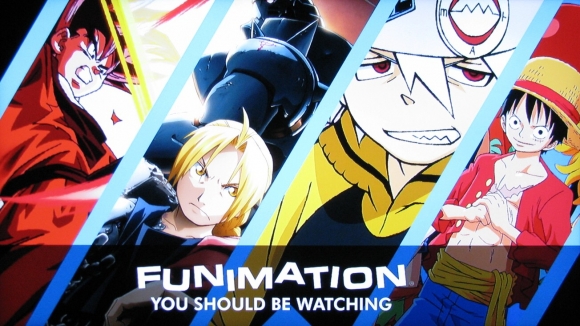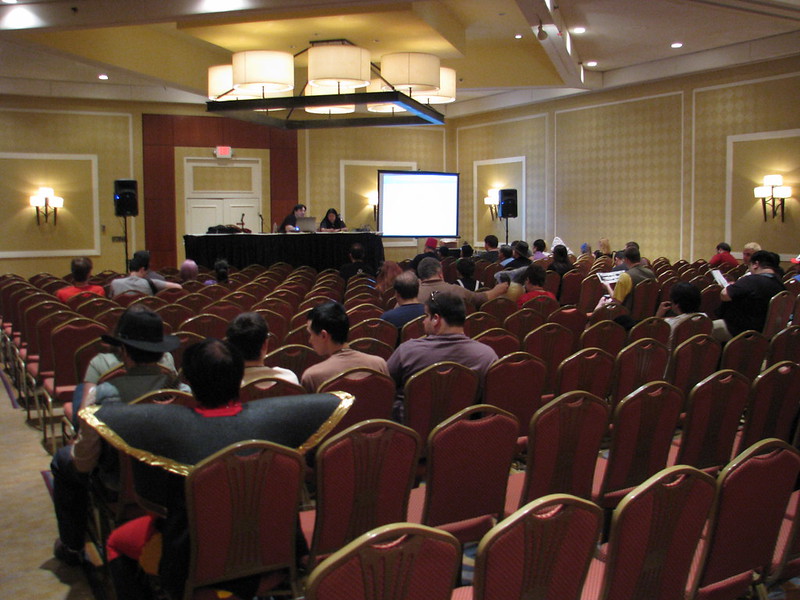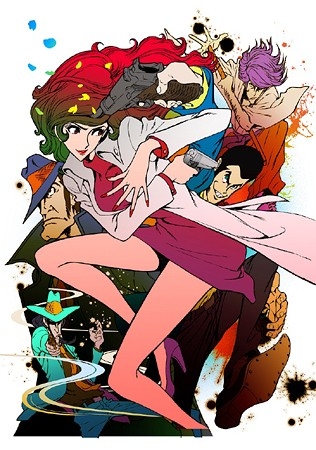
At their industry panel today at Anime Boston 2012, FUNimation Entertainment announced that they have acquired the streaming rights for Lupin III: The Woman Called Fujiko Mine, Jormungand, and Is This a Zombie? Of the Dead (the second season of Is This a Zombie?). The near-ubiquitous anime distributor also acquired the home video rights for Future Diary.
FUNimation's Lupin III license comes on the heels of widespread fan disappointment over its unlicensed status. Lupin III is a franchise with a lot of name recognition, but fans worried that the new series' racy content could scare away North American distributors. I'm really happy to see the series, which features character designs by Redline director Takeshi Koike, get official English distribution, in part because our site policies don't let us write about it until it gets licensed. And boy oh boy, are we excited to write about it!
Thanks to Scott Green of AICN Anime for his timely tweets about the announcements, as both David and I were not at the FUNimation panel when the announcements were made.
Click here for more coverage of Anime Boston 2012.
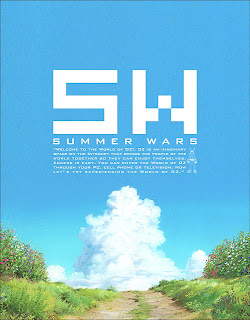
Medium: Anime Film
Director: Mamoru Hosoda
Studio: Madhouse
Genre: Romance, Science Fiction
Publishers: Kadokawa Group (JPN), FUNimation (NA)
Release Dates: 2009 (JP), 2011 (US)
Age Rating: PG (MPAA: action violence, some suggestion content, language, mild thematic material, and incidental smoking)
With every new season, the saturation of anime series continues to expand. If your tastes are fairly broad, there is plenty to keep yourself occupied with from currently running shows and a backlog spanning several decades. For theatrical films, however, the market is significantly thinner. If you don't count films based off of an anime series — original plots or condensed story arcs — the choices are rather limited. The big names are Ghibli, Otomo, Oshii, Kon, and Shinkai. Tragically, Satoshi Kon has passed away which will leave a noticeable void in Japan's animated film output. Otomo's last works include the disappointing Steamboy and oddball live action Mushi-shi adaptation. Shinkai is hard at work on a film that seems to be a (welcome) departure from his usual fare. Miyazaki and Takahata aren't getting any younger, and man cannot live on Ghibli alone. Thankfully, 2006 saw the release of The Girl Who Leapt Through Time as the feature length debut of Mamoru Hosoda. He went on to direct Summer Wars in 2009, establishing himself as a key industry director.
Kenji Koiso, a high school student and mathematics enthusiast, is recruited by a girl at his school to help her out with some job. Despite his current part-time work with the infrastructure of virtual-reality super-network OZ, he decides to help her out without asking details. He helps carry her things as they travel to the traditional Japanese family mansion to celebrate her grandmother's 90th birthday. The girl, Natsuki Shinohara, asks Kenji to play along as she announces him as her fiance to her grandma. He now finds himself in the awkward position of being a pseudo-newcomer to this tight-nit and very large family descended from a warrior clan. During his first night there, he receives an email with a large string of characters that he is asked to decrypt by an unknown entity. Being almost Japan's representative for the Math Olympics, he wastes no time in pulling out some paper to work out the problem, which takes him all night. What he did not realize is that he was being asked to break the security that would breach the main OZ server, and in the morning he finds that his account is being used by the hacker to cause chaos in OZ. With most major government and official institutions being dependent on OZ, the hacker is able to cause damage not only online, but in physical space by taking over the person's privileges. For example, by obtaining the account of the president it would be possible to launch a nuclear missile.
Kenji discovers that one of the family members, Kazuma Ikezawa, is the infamous OZ gaming champion King Kazma. The pair find themselves in a battle against a dangerous artificial intelligence being tested by the US Army within OZ. Meanwhile family drama arises as the problems online are connected to the family in ways they did not expect.
Beyond the themes of online action, what lies at the heart of Summer Wars is a thoughtful portrayal of family life. The members of Natsuki's massive family all believe Kenji to be her fiancé, and welcome him to the family in different ways. Hosoda relates his own experiences from when he suddenly became a member of a family due to marriage through Kenji's awkwardness at being accepted into their close group. Indeed, the closest thing to a human villain in the story is the one family member who drifted away from the rest and went to America. The two major aspects to the story — family life and Internet action — seamlessly intertwine, and neither is pushed into the background or feel tacked on to the other. Summer Wars is ambitious in the broadness of its scope, but this natural connection is what really makes the story stand out. If anything, it is much more realistic. In Summer Wars, world-changing events are caused from computers sitting in the middle of a traditional Japanese mansion, not an underground hacker cave with fifty monitors and a nonsensical cooling unit. The heroes are awkward mathematicians, well-connected grandmas, and working class dads with years of video game experience, as opposed to trenchcoat-wearing dudes with BitTorent and bad attitudes. (See: every movie about hackers ever to compare)
One of the most common complaints made toward Summer Wars is criticism of its technical inaccuracy. The story revolves around an incredibly advanced Internet structure, called OZ, that can be connected to through all types of devices and thus has became an extremely integral part of business, culture, and communication. Users create avatars and are able to interact over OZ in various ways: chatting, shopping, business, learning, etc. Additionally, languages are instantly translated to allow communication with anyone. Even the least technically minded viewer can see that it is an unrealistic view of the Internet. This leads to many lumping it together with WarGames and Hackers with their over the top, glamorized distortion of real technological advancements. However, this is completely missing the point of the story. Summer Wars may not be realistic in its details, but that is not the point. It is an exaggerated stylization of computer communications and should be treated as such. Like much good science fiction, it is able to make very relevant points that concern real world technology in a highly fictionalized setting.
A major theme of Summer Wars is communication. OZ's primary function, like the internet, it to connect people and services from all over. The film demonstrated both the dangers of over-reliance on digital networking, as well as celebrating the positive aspects of everyone being able to work together towards a goal. The theme goes beyond modern technology; the grandma was able to use contacts from a lifetime to make phone calls and encourage family members and important decision makers to take action during the crisis. Throughout the movie, communication is key in solving problems — online and off.
One aspect that many viewers should be able to relate to is the contrast between the characters taking initiative and using their computers to fight the AI, and the other relatives who can't understand why they are wasting their time with "video games" during this time. For Kazuma, Kenji, and the dads who pooled their resources together, nothing is as important as stopping that threat inside OZ. They realize, especially after what just took place in their own lives, that what goes on in the wires does affect what goes on the "real world." It isn't until tragedy is -literally- looming over their heads that the non-techie relatives finally realize the gravity of the situation.
Hosoda touches on plenty of scenarios throughout the movie that could have been pulled straight from Slashdot. Compromised users were being assured that the security was impenetrable even after the hacking took place. Online accounts held enough power that stealing their account granted the hacker the user's government privileges. A dangerous artificial intelligence program was developed which questioned the responsibility of the developer who didn't actually implement it himself. A hacker was causing problems through an account that had been taken over, leading to the arrest of the innocent true owner of the avatar. While the movie itself may be an implausible action movie with pseudo-technological workings, the points it makes are often grounded in reality. The actual computer use is done in a way that can be approachable to the average person, but the technically inclined viewer should be able to appreciate its themes with a deeper understanding. Instead of seeing it as dumbed down or inaccurate, I adored the stylization of the Internet and artistic interpretation of technical concepts through Superflat imagery. The last thing I would have wanted is if it became an Nmap documentary.
Summer Wars has very impressive production values with smooth, detailed animation and a high degree of artistic merit. Two distinct art styles are used to easily distinguish the real world and OZ: The real life characters are designed by Yoshiyuki Sadamoto, whose work contains the same appeal and quality that he is known for, and I've noticed since The Girl Who Leapt Through Time that his style has become even more distinct and refined. The background artwork is composed of beautiful countryside scenery and convincing realistic settings. The visuals are extremely detailed, which provides a noticeable contrast to the Superflat style used in OZ. This style, mostly associated with the work of Haruki Murakami, is frequently used in Hosoda's work and has been become a trademark of his style. Even his work with Digimon incorporated a very similar (if less ambitious) Superflat world for the Digimon to fight in. Summer Wars takes it to a new level, with a fantastic stylized world with bright, flat colours against a largely pure white canvas. I've always been a big fan of the Superflat style, and Summer Wars delivered a truly spectacular example of the craft.
Hosoda has obviously been holding onto this premise for a while — after all, his work with Digimon uses almost the same plot. In Digimon: Our War Game, a virus-type Digimon is infecting all of technology through the Internet and causing chaos by manipulating everything it can. Some of the first season's cast meet up to stop the threat by sitting at their computers and working with their Digimon partners who are battling inside a Superflat-style online world. The conclusion practically mirrors that of Summer Wars with the virus launching a nuclear missile (the possibility of this was even alluded to in Summer Wars, I'm assuming as a reference). In the end, people around the world send emails in support of the Digimon. There are so many emails that Izzy/Izumi forwards them to the virus who is then slowed down (DDoS?) enough for them to finish it off. It is good to see that Hosoda was eventually able to fully flesh out the concept with the experience he has gained since then.
I absolutely love this film. It follows a fairly typical action blockbuster formula, but with a level of craftsmanship, intelligence, and social satire that elevates it above the expectations of the genre. I have no doubt that there will be criticism of its typical action film influences, but it really does Summer Wars a disservice to lump it with the mindless action film crowd. If anything, it takes the elements that makes such films so entertaining, but loses the pedestrian brainlessness associated with them. Instead, it presents a thoughtful, realistic, and charming portrayal of family life in addition to the cyber-warfare action plot. Summer Wars is a film that embraces a video gaming, highly connected culture and equally the importance of everyday family life. It is a near-perfect representation of the joys of living in the information age, presented in a wildly unique and enjoyable package.
[Highly Recommended]
This review is based on a retail Blu-ray disc purchased by the reviewer.
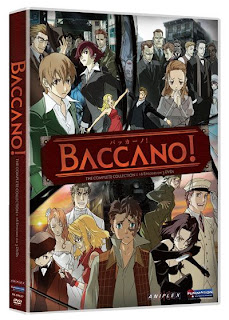
Medium: TV Anime (13 episodes + 3 DVD-only OAV episodes)
Genres: Drama, Adventure, Mystery, Comedy
Adapted from: Baccano! (ongoing 2003 light novel series)
Director: Takahiro Omori
Studio: Brain's Base
Release Date: Jul. 26 – Nov. 1, 2007 (JP – WOWOW), December 2009 (US – FUNimation), Oct. 2010 (UK – Manga UK)
Rated: 18 (UK BBFC, due to frequent swearing and frequent intense violence)
Ed. Note: Welcome to our fourth and final "Anime Secret Santa Review." Our reviewers were given review requests as gifts from their Secret Santas, and are now unveiling their opinions of the shows they chose. For more information, check out our 2010 Anime Secret Santa introductory post.
Before I talk about Baccano! proper, I'd first like to thank my Secret Santa, whoever they may be. All three of your choices were excellent. I had already seen and loved Kino's Journey (2003), but when it came to choosing between Baccano! and Eden of the East (2009), it was a close run contest. What made my mind up for me is the following sequence of events, which I shall dramatize for you:
![]() |
: "Hmm, I want to watch both Eden of the East and Baccano! - what to do?" |
| : "Hey, Hey Elliot!" | |
![]() |
: "What's that?" |
| : "Hey there!" | |
![]() |
: "What the?" |
| : "Hey there, Elliot, we think you should watch Baccano!. That would be for the best." | |
![]() |
: "Why?" |
| : "Well, look how happy we are! Don't you want to find out why we are happy, and be happy yourself?" | |
![]() |
: "I guess..." |
| : "Do it!" | |
![]() |
: "Agh! Okay, okay." |
| : "Excellent....." |
It went something like that. What I present here is more something of a trip report than a full review.
Now onto the show itself. Having watched the main 13 episode series, I have come to regard Baccano! as a series of victories and small wonders, furnishing the viewer with a massively entertaining show that manages to satisfy without outstaying its welcome or stretching too far.
I will admit that until sitting down and watching it I have avoided all discussion or reviews of Baccano! (Including the Ani-Gamers review) as whenever someone has mentioned the show they have taken pains to point out that almost anything is a spoiler when it comes to the shows twisting plotline. I even avoided reading the synopsis on the back of the DVD set before watching. (I'm glad I didn't—whoever wrote the one on the Manga UK DVD set appears to have been drunk.)
To outline the show: set primarily in the early 1930s, Baccano! follows the exploits of a wide range of characters in both Manhattan and the transcontinental express train "The Flying Pussyfoot" as they all go about their personal business. The narrative jumps between different time periods and different characters with such frequency that the show's creators saw fit to make much of the first episode a primer for what is to follow. For most of this episode, Norio Wakamoto (with full R-rolling in effect) and his assistant prepare the viewer by discussing in a broad sense the different time periods, settings and characters that you are going to spend the following 12 episodes with, as well as showing the viewer some juicy snippets of what is to come.
This initially flummoxing first episode nearly turned me off of the show. It felt like a warning, telling me "Hey, if you aren't down with whatâs going on now maybe you should just give up and put this back on your shelf. Oh, here is a quick cut of a young boy getting shot in the head. Bet you're interested now, eh?" Then, at the end of the episode something awesome happens (that I won't spoil) and I was hooked.
To cut to the chase, the plotting works marvelously. The highest praise I can lavish on Baccano! is that even with all the switching of character, time period and setting, the entire plotline comes together into a coherent whole that is massively satisfying, like watching a good detective story. The timing and placement of character and time zone transitions feels meticulously thought out and perfectly judged to maintain viewer interest without causing confusion or irritation. When transitioning between different time periods the show will throw up a black static image with the year that the following events take place in - the genius of these cuts are that they act as welcome breathing spaces in the action, heightening tension. The presentation reminds me an awful lot of the Guy Ritchie film Snatch (2000), which also uses multiple viewpoints to weave together a coherent and thrilling tale. I was worried towards the end that Baccano! would contract a fatal case of "Dumb Anime Ending" syndrome, but I was proven completely and wonderfully wrong. The ending was not bombastic or laden with sudden twists, but was immensely satisfying and ties the disparate plotlines up wonderfully.
The characters themselves also do a lot of the lifting when it comes to drawing you into the story, in part because there are so damn many of them but also because they are genuinely interesting. One particular character is called Jacuzzi Splot, and when I first saw him, i hated his guts. He had a dumb tattoo, a whiny voice, and a melancholy outlook on life. His one redeeming feature was that listening to Japanese voice actors try and pronounce "Jacuzzi" was endlessly amusing. But after a few appearances I began to root for the guy as his development on screen was so engaging and interesting to watch. This happens a lot with the characters â you might not like them, but you come to understand them through their actions. I can honestly say that Baccano! is one of the few shows that have had me rooting for a mass murderer. Multiple mass murderers, in fact.
Not only are the characters interesting because of their actions, but they also look great. Everyone is stylishly drawn and with a great deal of care, something that really helps out not only in learning names but also in deciphering expressions and intentions of the cast and helping you connect with them. This ability to empathize with the characters really pulls you in, and I feel is best outlined by two of its best characters, Isaac and Miria. I love these two, so very much. Isaac and Miria are a pair of loud, boisterous, idiotic and immensely lucky thieves and the fact that they feel like believable characters while acting in such an absurd manner for their entire time on screen is a credit to the series. They are used just the right amount â too little and they would become a throwaway gimmick, too much and they would take over the show and ruin the magic.
I mentioned that the characters were stylish before. In fact the whole series is damn stylish. Every character, backdrop and action has style in spades. What makes this work is that the style is completely cohesive and well thought out to work as a single whole experience: no sudden SHAFT-style insanity, no winks at the camera, no snickering to itself behind the stage curtains. Every element presented on screen has a purpose and it was put there to contribute directly towards viewer enjoyment, drawing you into a coherent world that has a tangible feeling of authenticity to it.
To sum up my thoughts on Baccano!, after the end of the 13th episode in my third non-stop viewing session, I stood up to retrieve the DVD from the disc tray and thought to myself: "Wow. That was really enjoyable. I wish more things were made this well." I only regret I waited until I had to be pushed by Santa to actually sit down and watch it!
[Highly Recommended]
This review is based on the Manga UK DVD box set, purchased by the reviewer.
Medium: TV Anime (26 episodes)
Genres: Adventure, Fantasy, Military, Science Fiction
Director: Koichi Chigira
Studio: GONZO
Release Date: Apr. 7 – Sep. 29, 2003 (TV Tokyo – JP), Nov. 18, 2003 (Geneon/FUNimation – NA)
Rated: Not Rated
Ed. Note: Welcome to the second of our four "Anime Secret Santa Reviews." Our reviewers were given review requests as gifts from their Secret Santas, and are now unveiling their opinions of the shows they chose. For more information, check out our 2010 Anime Secret Santa introductory post.
You know you're in for a polarizing show when one of the biggest pieces of praise people can give is "it's one of the few shows by this studio that's actually worth watching!" Unfortunately for anime studio GONZO (Gankutsuou, Welcome to the NHK, Linebarrels of Iron), that's basically the compliment granted to any relatively successful series that they create, and for better or for worse, Last Exile (2003) sits among this short list of "not terrible" GONZO series.
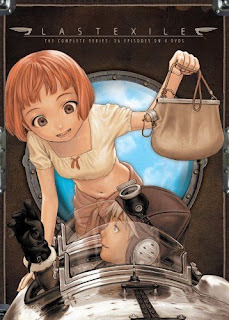
The show begins in a vaguely steampunk era in which giant airships have become the primary tool of war. Our heroes are two young pilots who make their living as couriers on the wings of their small fighter plane-esque craft called a "vanship." Claus Valca is a quiet, kindly pilot with a penchant for finishing everything he starts, while Lavie is his hot-headed, impetuous, and intelligent navigator. As the guy piloting the vanship, Claus is naturally the hero GONZO chooses to focus on, while Lavie serves simultaneously as his childhood friend, romantic interest, and moral compass.
These two couriers are living a simple life in the shadows of their legendary fathers (couriers who flew together until their untimely deaths) when they find themselves tasked with transporting a young girl named Alvis to the "Kill 'Em All" Silvana, a notorious mercenary airship thought to suck the souls out of anyone who comes aboard. After narrowly escaping attacks from the Guild, a shadowy organization that exerts subtle control over all the world's militaries and governments, the two vanship operators end up joining the Silvana's not-so-scary crew in a mysterious mission to strike the very heart of the Guild.
On paper, Last Exile seems like an exhilarating modern military tale, set in the skies of a unique world bound by strange rules — and it almost is, too. Unfortunately, GONZO's execution is painfully uneven, to the point that I often wondered if the writers knew where they were going when they created the original concept. The story is roughly split into three acts: 1) introduction of major cast and factions, 2) the Silvana wanders around doing things and battling some people, and 3) final confrontation with the Guild. As you might be able to guess, the second act features no central narrative or even an attempt at a formula (which would have made it much easier to follow). Instead the characters just meet a few unrelated challenges and overcome them, all the while developing ever so slightly as both individual characters and as a team.
Unfortunately, that individual development often leads to dead ends, as with two of the show's seemingly important romantic threads that simply die out before the introduction of the third act. The overall development of the cast, however, is one of the Last Exile's defining characteristics. The sense of cohesion between the Silvana's crew might not be apparent at first, but the motley crew of pilots, mechanics, and bridge personnel really start to feel like one big team by the end of the series. The most apt comparison that comes to my mind is original Gundam (1979), though Last Exile certainly doesn't pull it off quite that well.
Despite the compelling sense of overall camaraderie, some of the individual characters can get truly grating after 26 episodes. Let's start with Claus: his personality is so meek and boring that he is effectively the same as any of the cookie-cutter protagonists in harem anime. Underscoring this unfortunate truth is his harem of girls, including Lavie, Alvis, the cold-hearted pilot Tatiana, and even the strong-willed Vice Captain Sophia. To make matters worse, Tatiana turns into a mushy little lovestruck schoolgirl when Claus so much as lends her his jacket, and Sophia's romantic encounter comes from so far in left field that you'll likely be throwing things at your screen in frustration. To be honest, by episode 15 I was convinced that Last Exile was a harem show in disguise.
Meanwhile, there are a few characters who really shine despite their disappointing company. Alex Row, the stoic captain of the Silvana, rocks all kinds of socks with his grumpy demeanor and tortured past, but cracks begin to show in his emotional armor as we learn more about his history and see him lose control near the end of the show. Dio (no, not that one) and Lucciola, two runaways from the Guild who join up with the Silvana, and Mullin Shetland, a musketeer-turned-mechanic, provide an interesting counterpoint to the rest of the crew as outsiders coping with the stress of turning away from their previous loyalties. On the bad guy's side, the sinister Guild leader Maestro Delphine comes off as a poisonously sweet version of Gundam's Haman Karn.
But as far as I'm concerned, the real star of Last Exile is Lavie Head, Claus's energetic navigator. Originally she seems like nothing more than an obligatory bossy love interest, but by episode 8 or so it is clear that her personality reaches depths far beyond those of her lame childhood friend. Even when she decides that she doesn't want to be Claus's navigator as long as he is flying in combat (a brave and unexpected decision that throws a fascinating wrench in the works), she remains one of the most well-developed members of the crew. Lavie feels with a magnitude that nobody else in the show does, careening between nurturing love for Alvis, passionate concern for Claus, and unexpected bravery in the face of danger. Through it all, she manages to be both completely admirable and believably flawed, a feat that I'm frankly surprised GONZO managed to pull off so well.
While Japanese voice actor Chiwa Saito's performance as Lavie certainly gets the job done, Kari Wahlgren truly makes the role her own. Especially compared to Johnny Yong Bosch's typically overwrought Claus, Wahlgren's Lavie is always believable, no matter where she is on the emotional spectrum. In terms of the rest of the English cast, despite some clunky deliveries they mostly stack up well, especially thanks to spot-on Japanese-to-English voice matching by Bang Zoom.
Nearly all of the technology in the show (intricately researched and designed by character designer Range Murata and Gankutsuou's Mahiro Maeda) is animated using GONZO's notorious CG style, which only rarely blends with the two-dimensional character animation used throughout. Movement is also irritatingly choppy during the fight scenes, undercutting the clear quality of the original concepts. The skilled 2-D animators who realized Murata and Maeda's beautiful character and costume designs likely could have transformed most of the storyboards for the battle scenes into thrilling dogfights, but as it stands the 3-D fights are merely passable (though GONZO gets points for including ZERO Gundam-style monologues or pilot-to-pilot arguments during fights).
While I don't usually comment on such things, Last Exile's sound design is actually one of its greatest strengths. The sound effects used to represent the creaking and turning of machinery and the movements of the wind are far more visceral (and frequent) than the effects used in most other anime. This, combined with Maeda and Murata's unique and complex designs for clothing and machinery, makes for a lot of fascinating world-building potential. Unfortunately, spotty explanations of the factions and technologies often make it difficult to understand who is fighting whom and for what reasons. By the time the series reaches its exciting finale, it might still take a Wikipedia visit or two to understand just what was going on in the skies of Claus and Lavie's world.
Last Exile, like many GONZO series before it, is a valuable lesson in wasted potential. It's clear that the concept designers put a lot of work into the series during pre-production, and the animators' love for their material shines through in rare moments that belie Last Exile's most glaring flaw, which is that it doesn't really say or do very much with its own material. In the end, the exquisite presentation, the attempts at world-building, and the moments of genuine humanity come together to produce a work that is nothing more than the sum of its parts. We are left with a vaporous story about people in airships who fight each other.
[Passable]
This review is based on the Hulu streams (both dub and sub) of the series, provided by FUNimation.
Medium: TV Anime (24 episodes)
Genres: Fantasy, Action, Romance, Supernatural, Thriller
Adapted from: Fate/Stay Night (2004 game)
Director: Yuji Yamaguchi
Studio: Aniplex/Studio DEEN
Release Date: Jan. 6 â Jun. 16, 2006 (JP), Dec. 19, 2006 (Geneon/FUNimation â NA)
Rated: Not Rated
Ed. Note: Welcome to the first of our four "Anime Secret Santa Reviews." Our reviewers were given review requests as gifts from their Secret Santas, and are now unveiling their opinions of the shows they chose. For more information, check out our 2010 Anime Secret Santa introductory post.
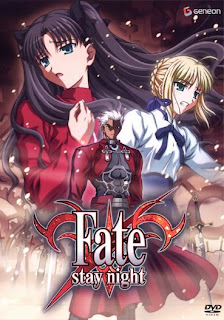
Fate/Stay Night tells the story of ShirÅ Emiya, sole surviving civilian of a local holocaust, ten years after said event. The man who rescues ShirÅ becomes his adoptive father and instills in him a sense of pacifist justice before passing away. Having taken this philosophy to heart, ShirÅ embodies self-sacrifice and lives as a doormat for his classmates' inconsiderate soles. He does not turn down any request and is always willing to sacrifice his own well being for the welfare of others. As a result, ShirÅ's philosophy is challenged one day after summoning the world's most capable warrior (Saber) via latent magical abilities in a knee-jerk response to a mortal threat. By doing so, ShirÅ inadvertently enters an exclusive tournament known as "The Holy Grail Wars," in which all participants â pairs comprised of masters (magi, or magic users) and servants (warriors) â must either kill or be killed until only one magus and his or her warrior remain.
While the overall presentation of said story is awash with harem elements, the main conflict of the story, pacifism in the midst of battle, is aptly personified via the assignment of Saber to ShirÅ. Furthermore, implications are deepened via the introduction of ShirÅ's inability, caused by his lack of study in magic, to make Saber properly materialize. Thus Emiya and Saber, respectively as magus and servant, portray two incomplete parts that leverage each other to form a whole in the hopes of competently fighting against multiple pairs of complementary wholes. This setup is rife for conflicts, and the execution does right by exploring the main theme of action vs. inaction. However, the weaving of romantic tension turns too many scenes into boring and (for the most part) inconsequential harem tropes.
That's not to say that romantic tension doesn't serve some purpose. Rather, the execution of its repeated influence only weakens the story. I'd maintain there are two instances of romantic tension aptly serving the story: that of Emiya's falling for Saber and Rin's unexplainable interest in Emiya. While the latter only serves as a reason why a fellow magus would not kill, and instead might even protect, a competitor, Emiya's falling for Saber further lends credence to why he constantly puts his life on the line for what he views as his responsibility. Really, there's an essay waiting to be written on Emiya and Saber, and that fact alone makes the anime a worthwhile watch, but other aspects deserved to be touched upon as well. Art in Fate/Stay Night is standard fare but of above average quality (budget). Really, its only fault would be the showcasing of CG alchemic circles, the animation of which seems a little too out of place. Fight scenes are well orchestrated and, for the most part, fully animated, and the overall ambience is set rather perfectly. Deep hues of night, the only time during which combat is permitted, are foreboding and bloodthirsty, while days offer a palate more complimentary to the harem walls and the associated tension break. Character designs are also quite Romantic, especially concerning the servants' attire/armor.
Writing is a tad overly dramatic, except, surprisingly, for the harem aspects. Instead, I found myself actually liking how statements by the majority of the female characters never (or rarely) said anything directly. In retrospect, I also greatly enjoyed the underlying and understated theme of regret that manifests not only within the warriors throughout the series but which also resonates as the drive behind the warriors â each a mythical figure of ancient origin.
If you have time to kill, there are far worse anime to help you pull the trigger. It's pretty, the pacing of the main plot is quick, and general subtext is nothing that requires much thought. There is even decent potential as fodder for analysis, which is surprising given the series' origin as an âerogeâ (erotic game). What I can only guess to be a successful anime translation (best to ask Elliot Page) manages to eliminate all hentai aspects, save the annoyingly omnipresent harem elements (beware the first half of the date episode!!!), and deliver an enjoyable watch akin to a more grown-up Zatch Bell (2003).
[Recommended]
This review is based on rental copies obtained via the reviewer's personal Netflix account.
Ahh, Black Butler, also known as "Kuroshitsuji" in Japan. Infamous for its perpetually squealing teenage girl fanbase, it can be difficult for male fans to actually give it a try. However, after my stint with the surprisingly funny Axis Powers Hetalia (also known for its prepubescent female fans), I thought I might as well give Black Butler from A-1 Pictures (Kannagi, Welcome to the Space Show) a fair shake.
In the two dubbed episodes that I received on FUNimation's preview disc, however, I found myself giving Black Butler much more than a fair shake. You see, this series is in fact a shōnen (boys) manga, even though it clearly aims for a female demographic with its pretty-boy main characters and vaguely homo-erotic situations. This combination of demographics, now quite common in the manga world, means that Black Butler can provide an experience that's fun for more than just the core girls audience. Go figure!
Sebastian is a demon butler, bound to his master, Ciel Phantomhive, by a devilish contract — he must obey all of his master's orders, but Ciel has also agreed to allow Sebastian to consume his soul after the contract has ended. Following along with this delightfully Faustian setup, the series is defined by a dark, gothic style, complete with classic ornamentation in both architecture and fashion.
Plus, FUNimation's dub uses some surprisingly accurate British accents to help geographically and historically place the story in Victorian England. The voices don't always work — namely Brian Mathis, who weaves in and out of an Italian accent for the villain of episode 2 — but even some of the weaker performances like Monica Rial's Cockney accent manage to produce moments of comedy.
These two (predictably) self-contained episodes center around Sebastian's dazzling butler abilities, as he shows up all of the manor's servants with his masterful preparation of dinner and ... fighting prowess. In fact, the inclusion of fight scenes highlights the most important thing about these first few episodes of Black Butler — they combine straight-up visual gags with black comedy, creepy gothic macabre, light drama, and A-1 Pictures' best imitation of BONES-style (Fullmetal Alchemist) action scenes. The result is a fun, creepy, and exciting pastiche that never leaves you without a dull moment, despite its tendency to careen between styles.
Granted, this is just based on a limited preview, so the show could easily let me down after more than two episodes. Regardless, the beginning of Black Butler is undeniably entertaining; it may feature a pretty-boy butler being pretty, but his Golgo 13-esque ability to effortlessly complete any task, no matter how gruesome, makes for fun times, and the variety of comedic styles is sure to please nearly anyone.
Look for Black Butler on DVD from FUNimation Entertainment on January 11, 2011, and check it out with English subs right now on FUNimation's video portal, Hulu, and Anime News Network.
This preview is based on a complimentary screener DVD provided by FUNimation Entertainment.
Medium: TV Anime (24 episodes)
Genres: Drama, Political, Science Fiction
Based on: Alexandre Dumas's novel
Director: Mahiro Maeda
Studio: GONZO
Release Date: Oct. 5, 2004 – Mar. 29, 2005 (Japan), Oct. 16, 2007 (Geneon/FUNimation – N.America)
Rated: Not Rated (appropriate for 16+)
Adaptations are one of my favorite types of stories to review due to their ability to show one story from multiple perspectives and through the eyes of multiple generations of writers. Thus, Gankutsuou, Gonzo's 2004 anime adaptation of Alexandre Dumas' seminal novel The Count of Monte Cristo, is simply irresistible to my sensibilities as both an anime fan and a fan of the original novel.
Unlike many others of its ilk, Gankutsuou goes above and beyond slavish imitation, changing a number of relatively important parts of the story from the get-go. Naturally this can confuse most readers of the book as they try to figure out how the plot could possibly work out with all of the changes. When I began watching, I, too, was a skeptic. Though I am certainly not a total believer now, the 24 episodes of Gankutsuou: The Count of Monte Cristo have shown me a fascinating approach to adaptation that maintains (and in some cases improves) the depiction of the central theme while not fretting over the nitty-gritty details of the original work.
On the topic of omitting grit, Gankutsuou skips Dumas's entire set of introductory chapters, which serve to construct the tragic back-story of the mysterious, fantastically wealthy Count of Monte Cristo. Instead, scriptwriters Natsuko Takahashi (Fullmetal Alchemist, Romeo X Juliet) and Tomohiro Yamashita (Afro Samurai, Red Garden) drop us into the Carnivale on Luna, a strikingly science-fictiony replacement for the original setting of Rome. As if the book purist in me wasn't already crying out at the omission of Edmond Dantes’s/Monte Cristo's unjust 15-year imprisonment, giant CGI blimps and reveling space colonists seem to state immediately that this is not Dumas's original (and, very importantly, that it is not trying to be).
The switch in the starting point, however, actually serves to set up the first of many important narrative shifts; the focus of the story is transferred from the Count of Monte Cristo to the anime's new protagonist, Viscount Albert de Morcerf (who plays an important role as a side character in the novel). While partying on Luna with his best buddy Franz d'Epinay, Albert finds himself in trouble with bandits, only to be saved by the Count. Before long he becomes close friends with the rich aristocrat, who ends up living in Paris, forging bonds with many of the most influential families in the city (including Albert's).
But as tragedy befalls Albert's friends, acquaintances, and enemies, it becomes clear that something sinister is afoot. Some see the Count as a prime suspect, but Albert cannot believe that the man who once saved his life would be out to cause harm to him or any of his friends.
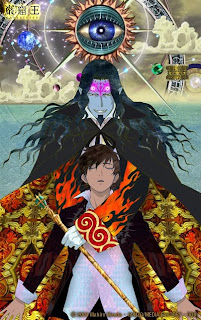
The true strength of director Mahiro Maeda's (Blue Sub Six, "Second Rennaisance" portion of Animatrix) retelling lies not in simple translation. He might miss essential pieces of what Dumas was trying to say, but through these changes he creates an entirely new story, rooted in the basics of the original but not necessarily tied down to its themes or messages. Indeed, this contemporary version of The Count of Monte Cristo has its own moments of storytelling and aesthetic brilliance. Textile designer/digital director Yasufumi Soejima (Last Exile, Ristorante Paradiso) captures the opulence of Parisian aristocratic life using a fascinating and unique visual technique involving brightly colored textures that seem to remain stationary as the characters and objects they are attached to move around the frame. The effect is disorienting at first, but it lends the series a distinctive air of gaudiness that suits the setting. Meanwhile, the Count himself is the most striking image of the entire anime, with his almost vampiric blue face, pointed ears, and protruding canines. In the novel he is described as being so intriguing that he is the center of attention whenever he enters a room, so it is impressive that character designer Hidenori Matsubara (Bubblegum Crisis Tokyo 2040, Sakura Wars) was able to maintain this feature while not adhering strictly to Dumas's other descriptors.
Unfortunately, Gankutsuou's anime trappings don't always work to its advantage, especially when it comes to an overuse of exposition. The original Count of Monte Cristo revels in its mystique, never making an explicit connection between the Count and Edmond Dantes (nor with his own revenge plot) until the novel's final act. In Gonzo's version, the connection is made within the first episode, and though Albert is given an incredibly wide swath of incriminating information regarding the Count, it takes him around 20 episodes to finally discover the (then quite obvious) truth. Admittedly this kind of exposition is necessary due to the omission of Dantes's back-story, but it doesn't make the dramatic irony any less frustrating.
Geneon's dub doesn't exactly help matters either, with Johnny Yong Bosch's predictably overwrought performance adding a bit more intensity than necessary to Albert's character. The Count, however, finds a quietly sinister portrayal in Jamieson Price, one that I would even say fits Dumas's original version of the character. Backing up Bosch's occasionally effective performance is Ezra Weisz, mucking up nearly all of Franz's lines with mood-crushing wooden acting. Luckily, he's one of the few stinkers in the cast, but that doesn't diminish the damage Franz does to the dub version every time he's on screen.
Gankutsuou's most effective moments come when Dumas and Maeda's sensibilities play off of each other. A scene of a girl suffering from poison, lit only by lightning bolts, expresses Dumas's supreme melodrama with a profound visual language not available to the author. Even scenes with sweeping changes, such as the aftermath of the duel near the end of the series, carry emotional weight thanks to Maeda's choice to continually compound his own calamitous plot threads and Dumas's own acute sense of tragedy.
At its best, Gankutsuou can produce just such moments of silent collaboration between Maeda and Dumas, but in between the high points are scenes of bland anime exposition and maddening, poorly executed dramatic irony. Through it all, the series maintains a quick pace, fueled in part by Takahashi and Yamashita's propensity for cliffhanger endings in each episode, which pulled me along in much the same way that Sunrise's Code Geass did. This might not be hailed as the kind of timeless classic that its source material is, but Gankutsuou: The Count of Monte Cristo is certainly a compelling, firmly above average anime melodrama, not to be missed by any genre aficionados.
[Recommended]
This review is based on a Netflix streaming video version of the series provided by FUNimation and viewed through the reviewer's personal Netflix subscription.
State of the Industry
(prescribed with a grain of salt considering the source)
Dubs are here to stay, as there is more consumer demand for DVD releases with subs than without. “There’s money to be made here.”
Viewers older than 25 now represent 51% of market, while those from 18-24 years of age represent 40%. People ranging from 13-17 years old represent the largest group of online viewers.
Convention attendance is steadily growing.
Social Media Branch
http://blog.funimation.com/ (which will post this entire panel in a week or so)
twitter.com/funimation (75,000 followers)
Facebook (72,000 fans)
YouTube.com (159,000 subscribers, 8th largest following worldwide)
Simulcasts
One Piece
Rainbow
Black Butler Season 2
Legend of Legendary Heroes
Sekirei Season 2
Shiki
Anti-Piracy Initiatives
Hired 1 lawyer and 3 additional staff to police and report online and offline copyright infringements.
DVD Releases
My Bride is a Mermaid (funimation.com/mybrideisamermaid)
Master of Martial Hearts – “Mortal Kombat with less clothing,” due August 2010
Casshern Sins (funimation.com/casshernsins) – parts 1 & 2 due August 17, 2010.
Corpse Princess (funimation.com/shikabanehime) – due September 14, 2010.
Hetalia (funimation.com/hetalia) – 26 episodes due out September 14, 2010.
Hetalia Season 2 – with tons of extras due out October 12, 2010.
Eden of the East (funimation.com/edenoftheeast) – complete series due out September 28, 2010 for $54.98 ($59 Blu-Ray)
Voice Cast Announcements
Oh! Edo Rocket (see picture for blurry but readable list)
Black Butler (see picture for blurry but readable list)
New Acquisitions
Phantom, Requiem for the Phantom
Strike Witches Season 2 (picture) coming 2011
Blessing of the Campanella (picture) coming 2011
Okamisan (picture) coming 2011
Hetalia Seasons 3 and 4 (picture) coming 2011
Hetalia “Paint It White” movie coming 2011
Summer Wars (picture) coming 2011
Evangelion 2.22 (picture) coming 2011 – possible theatrical release mentioned
Social Networking Site
Launching in September, with beta available sometime in near future, funimation.com will feature personal profiles for users as well as news, videos, behind-the-scenes exclusives, forums and contests. “Elite member subscriptions” will be available, which offer ad-free viewing and early access to dubs prior to DVD releases.
A Couple Answers from Q&A Session
FUNimation offers encouragement for small retailers via incentive support, streaming video services for in-store play, and free promotional materials that do not have to be returned.
Oasis performs opening song for Eden of the East, but only in first episode (could explain the price tag).
Click here for more of our Otakon 2010 coverage
Medium: TV Anime (57+ episodes, 13 reviewed)
Genres: Action, Adventure
Director: Daisuke Nishio (original series director)
Studio: Toei
Release Dates: Apr. 5, 2009 – ongoing (Fuji TV–Japan), May. 18, 2010 (FUNimation–N.America)
Rated: Not Rated (appropriate for 13+)
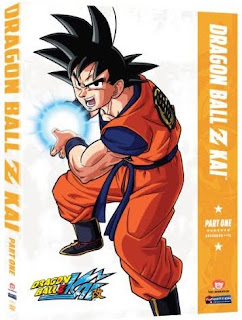
Dragon Ball Z kids, you know who you are. The generation that came home from school every day excited to watch the ongoing adventures of Goku and friends may have grown up now, but Toei's classic adaptation of Akira Toriyama's smash-hit shōnen manga remains a staple of fandom for many anime fans. Of course, before going any further, I should mention that I too was one of those exuberant DBZ kids. (In fact, before making Ani-Gamers, I once created a stupid DBZ fansite filled with photos, episode summaries, and ridiculous made-up power level comparisons.)
Despite the widespread love for Dragon Ball Z, though, many fans who have returned to the series since watching it as a child have found it to be tiresome and plagued by filler episodes (made to hold off production of the animation so there would still be manga content to animate). Enter Dragon Ball Kai, Toei's 20th Anniversary revival of the original TV series. Unlike many other anniversary projects, however, this is not a new series based on the same basic plot (like the 2003 Astro Boy series), nor is simply remastered footage (like the DBZ "Dragon Box"). No, Dragon Ball Kai (christened "Dragon Ball Z Kai" in North America) is, in a way, a "director's cut" of the original Dragon Ball Z, with remastered footage, new sound effects and background music, re-recorded dub tracks (in both English and Japanese) and — perhaps most importantly to many grown-up fans — all of the filler cut out.
The story of Part 1, which features 13 episodes about the martial artist Son Goku and his allies as they fight off an evil alien race called the Saiyans, moves along at a brisk pace, with barely any of DBZ's trademark scenes of laborious power-ups and staring contests. In fact, the 13 episodes of the first DVD set cover the events of the first 30 episodes of the 1989 Japanese TV broadcast, setting a pace that nearly matches that of Toriyama's manga. Granted, there are a few scenes not depicted in the manga, such as a brief moment of comedy when the Saiyan Nappa scares away a news crew, screaming, "I hate the media!"
Furthermore, Kai includes new opening and ending songs from Tanimoto Takayoshi, called "Dragon Soul" and "Yeah! Break! Care! Break!" respectively. (Beware of the awkward — yet thankfully optional — English versions of the songs included by FUNimation!) Fans of the recent Dragon Ball video games might also notice flashy new eyecatches and opening/closing animations, which I assume were drawn by the same team that creates the art for games like the Budōkai Tenkaichi series.
FUNimation's new dub (presumably made up of all new audio) sounds scarily accurate to their fantastic original, which was recorded over 10 years ago! However, the folks at FUNi have clearly made a concerted effort to appeal to hardcore anime fans this time, with frequent uses of mild profanity ("damn," "hell," and the occasional "bastard"), untranslated attack names ("Makankōsappō" instead of "Special Beam Cannon"), and a subtitle track with a notably different, more accurately translated script. Clearly this is a release for the kids who grew up on DBZ and have now grown into older otaku with the disposable income to buy a fan-centric re-release. Considering this, it's surprising that the DVDs have no special features beyond textless openings and closings, but such is the state of the struggling anime industry at the moment.
Most importantly, behind all of the great modifications from both the animators at Toei and the folks at FUNimation, the backbone of Dragon Ball Z is still surprisingly strong, even two decades after its Japanese TV release. Toriyama's unforgettable characters and trademark slapstick comedy are still an absolute joy and the action scenes have a quickness and a sense of power that served as the inspiration for many modern shōnen fighting anime. What's more, there are actually some really great-looking pans around characters in the show, notable for their fidelity despite being drawn entirely using cel animation on a weekly TV budget. Unfortunately the anime version fails to fully bring out the beauty of Toriyama's exquisite sense of shot composition, though it makes some noble efforts in many of the fight scenes.
All in all, Dragon Ball Z Kai is well worth the $50 for anybody with an interest in experiencing the joy of DBZ all over again. It distills the best qualities of the show through improvements to its visuals, sound, pacing, and top-notch English adaptation, and should be a treat for anybody who grew up watching the TV airing. For new fans of the series it might not work so well, since the 13 episodes finish up partway through the fight with main villain Vegeta, prompting a necessary purchase of Part 2 for interested viewers. Actually, newcomers might even be better served by picking up volumes 1 through 4 of Viz's release of the Dragon Ball Z manga, which cover the entire Vegeta fight and can be purchased for well under the price tag of DBZ Kai Part 1.
Still, as a lifelong fan of Dragon Ball Z, I can confidently say that, if given the choice, this is absolutely THE release of the Dragon Ball Z anime that I would purchase. With Dragon Ball Z Kai, you don't just get 13 episodes of Dragon Ball Z, but you get 13 legitimately good episodes. It's a wonderful chance to experience the best that DBZ has to offer and a chance that no true fan of the show should pass up.
[Recommended]
This review is based on a review copy of the DVD box set, provided to the reviewer by FUNimation Entertainment.
Hey, by any chance do you guys like free stuff? Oh, you do! Well, how would you like a free copy of Soul Eater, the new action anime from FUNimation Entertainment? Fortunately for you, Ani-Gamers reviewer Ink has just finished watching Soul Eater, Part 1 for review, and we will be sending his DVDs out to one lucky Ani-Gamers reader.
How do you enter? Just drop us a comment on this post letting us know your e-mail address and the name of your favorite character from a shōnen action series, and we'll pick a random winner from all of the commenters. It doesn't even have to be a character from Soul Eater — you could pick somebody from Dragonball, Naruto, Fist of the North Star, or any other show, as long as it is a shōnen action. Good luck!
EDIT: We will stop taking submissions on Wednesday, February 17 (that's next week) at 11:59 PM.
Medium: TV Anime (51 episodes)
Genres: Action, Adventure, Comedy, Fantasy
Director: Takuya Igarashi
Studio: BONES
Original Run: Apr. 7, 2008 - Mar. 30, 2009 (TV Tokyo–Japan)
Release Date: Feb. 9, 2010 (FUNimation–N.America)
Rated: Not Rated
Forgive my repetition, but for summary’s sake: Soul Eater revolves around a bunch of kids, classified as anthropomorphic tools of destruction (weapons) or those that wield them (meisters), whose end goal by training at the Death Weapon Meister Academy (DWMA) is to keep the world safe from witches as well as those that feast on human souls for the sheer guilty pleasure of it. Centered on students, the main theme is, appropriately, one of learning. Edification does not have to mean mindsets or skill sets or interpersonal relationships, but Soul Eater manages rather impressively to interweave all three in a manner that never becomes formulaic or boring.
If there was one defining factor that initially caught my eye and made me keep tuning in to FUNimation’s streaming broadcast, it was a combination of the art and fight choreography. But within the first few episodes, I also found myself chuckling at the series’ sense of self-deprecation and drooling over the engrossing nature of the interaction between all of the characters. In short, for a Naruto-esque anime, there’s a lot of good writing lurking in the subtext and an abundance of surrealist art bolstering the background that lend to an amazing series. Not to say that the screenplay is Kafka nor the art Dali, but the series doesn’t attempt to hide its obvious craft. Instead, it adopts elements and uses them to suit its own various needs.
The art, while a bit CGI-heavy, offers viewers surrealistic backdrops and personifications (gotta love the sun and moon) as well as fight scenes that are as interestingly executed as they are engrossing. There is a minimum of hazed-out background transformations and executions during fight sequences, making the animation and depiction of fights solely reliant upon actual action (go figure). This adds to both the realism of certain situations and the sheer pleasure of watching things actually happen. Details, it’s all about the details ... until things get moving.
Over the run of the first 13 episodes, the first three of which are entirely action-driven, character-building prologue, the frequency of detailed action scenes slips, but this is taken up by the upswing in character maturation and mind games between friends and enemies alike. This is not a weak point though. The action remains in focus while more and more characters are introduced and simultaneously woven into the fray. In fact, one of the most interesting and sinister characters, whose actions result in one of the most entrancing battles within the fantasy genre I’ve yet to see, only really gets her debut in episode 12!
Ah, which audio track to tune into? (I could write an essay purely on that!) While I think the Japanese is absolutely and without question perfect, I’d also admit that the dub grew on me like a weed. Don’t get me wrong; the English dub is well-acted in almost every respect (if only seeming phoned-in and out-of-sync a bit too many times), but whoever cast a woman to voice Black Star is at fault for the series' sole inexcusable audio atrocity. While her enthusiasm shows through and through, Brittany Karbowski should NOT be voicing one of the most vivacious central characters in the show, an early teen male, simply because of her estrogen levels and vocal range. Everyone else, however, finds their role and convincingly plays their parts, but there’s just something grinding about Brittany’s girlishness, which, to her credit, is either tamed or brainwashed via repetition throughout each subsequent episode.
This review is based on a DVD box set provided by FUNimation Entertainment.
great.
Medium: TV Anime (26 episodes) Genres: Action, Adventure, Comedy
Director: Koichi Mashimo
Studio: Bee Train
Original Run: Apr. 2 - Sep. 24, 2007 (TV TokyoâJapan)
Release Date: Dec. 15, 2009 (FUNimationâN.America)
Rated:Not Rated
Thereâs definitely a division between the last box set and this one, an accelerated (though far from rushed) pacing and linked plot advancement, that makes episodes 14-25 a little more interesting, if only at some slight expense of the seriesâ sense of patient humor. Sight gags and the female leadsâ charm remain but are relied upon far less often to carry the series, which now leverages viewersâ existing investment in Nadie and Ellis to bring weight to the involvement and interaction of ancillary characters such as Rosenberg, LA, Blue Eyes, and Ricardo.
The formulaic town stops are also given a tweak to develop relationships between Nadie, Ellis, Ricardo, and Lirio. You might get sick at the predictability of Ricardo encounters, but formulaic does not mean boring. Thereâs a gradual (if only predictably episodic) humanization budding beneath the naïve Ellis that blossoms quite believably. Her foil, the downright creepy gothic tween LA (the other human-created witch/stalker/assassin), likewise gets a chance to be more than the ruffles of his shirt and empty intimidations. His character, like Ellis, grows via confrontations with his guardian figure on a journey of self-realization.
A friend once noted that every comedic anime had its mandated hot springs episode, and I had to laugh at how brilliantly Bruja works its in (as well as the fun the writers evidently had in doing so). This is in addition to other cliché episodes, such as the hotel that turns out to be an abandoned (and now haunted) house as well as what Iâd like to refer to as the bounty hunter code of ethics concerning the pseudo-ending. None of these detract from Bruja, because this series relies upon nothing but its characters to sustain itself. Thus there is no storyline too out there, no episode impugnable, because the only way the series can fail is if the characters do not develop.
That is what I mean by pseudo-ending, because Bruja actually has two. The first serves to wrap up plot and journey, while the second completes the characters. Unlike most extended finales, thereâs an unsaid sorrow that should permeate the viewerâs consciousness. This is due to nothing short of the love developed between Nadie and Ellis throughout their experiences and the culmination of so much time on the road. In short, the series makes it evident that these characters know each other and are sacrificing for each other, even though neither would ask the other to do so for them. The result, if you like character-driven anime, is a bit of a tearjerker, as you realize that everything ends up exactly as it should, and youâve been privy to some pretty intimate feeling captured though the two main charactersâ realistic dialogue and some extraordinary situations.
This anime may not be for everyone. But if you like lighter stories that develop their characters with charm, humor, and a bit of subtlety, Bruja, if for nothing else, is a trip worth stealing a jeep for the privilege of taking friends of similar interest along for the ride.
This review is based on a FUNimation box set purchased by the reviewer.
fair.
Medium: TV Anime (26 episodes)
Genres: Action, Adventure
Director: Koichi Mashimo
Studio: Bee Train
Original Run: Apr. 2 - Sep. 24, 2007 (TV Tokyo-Japan)
Release Date: Dec. 15, 2009 (FUNimation-N.America)
Rated: Not Rated
Eru Kazado – El Cazador de la Bruja (English translation: The Hunter of the Witch) – is Bee Train’s finishing move to their girls-with-guns trilogy (after Noir and Madlax), a bounty hunter-and-prize buddy pic that spans 26 episodes spread over 2 FUNimation box sets. Episodes 1-10 are formulaic and inexplicably slow-paced, but there’s an innate charm that I blame on the original writing and talented English dub that warrants a committed run through. The fact that I laugh, literally, out loud despite myself three to four times per episode is enough to make me dispute the conclusion reached by Anime News Network’s Shelf Life (though not by dissention on any of its points).
Early-20s Nadie (the bounty hunter) has come into town to capture a pre-teen-ish Ellis (the bounty) while defending herself and the bounty from the myriad other bounty hunters on her tail. Nadie is over-accommodating, inexplicably acting most of the time like an over-protective sister instead of a bounty hunter, and Ellis is like a tweeny female version of rain man with unexplained “abilities” and a case of (dum-dum-dum!) amnesia. The sources of Ellis' abilities and Nadie's passive nature are explained in the last few episodes (Eps 11-13) of the first box set, which also serve to catapult the plot into high gear without losing the charm that you’re "forced" to linger through during episodes 1-10. There’s also a plot about a top-secret experiment and the man behind the bounty as well as interactions between those in contact with Nadie and those who are observing her.
Even when you’re watching the action sequences, you might find yourself asking where the action actually is. Whether this is intentional or not, El Cazador really forces you to concentrate on the characters. If this was a more shallow series, this concentration would be a great downfall, but the writers have come up with some decently three-dimensional characters worth your interest and time. It’s not that the characters are particularly deep, but there’s enough kept unsaid that a viewer is forced to wonder. As proof of this, in episodes 11-13, when most up-in-the-air mysteries are more or less explained or have some light shed on them, the series seems to move into high gear. But high-gear pacing does not mean value, and, if you want to look at the series in terms of geography, the southern US, Mexico, and Latin American countries tend to be significantly slower-going regions. The series never really identifies where it takes places to my notice, though one would assume Mexico. The fact that the series manages to evoke this sense of timelessness is a testament to, not a condemnation of, its direction.
It would be impossible to recommend this series without the English dub. This is due in general to the actual use of Spanish (in a Spanish-titled anime, go figure). While used sparsely and sporadically, the lobbing in of occasional simple and familiar Spanish words and phrases makes the dub more sincere. In particular, though, the dub would not be what it is without Maxey Whitehead as Ellis and Trina Nishimura as Nadie. Whitehead offers up a very clueless naiveté that borders on monotone and lends great punch to the character’s antics and expressions, while Nishimura’s performance, which is overwhelmingly warm and only justified somewhere in episodes 11-13, is indispensable because of the sarcastic asides Nadie makes to herself and her travel companion during their trip ever further south. Both actors lend a humorously endearing intimacy, seldom seen in dubs, that is the drive of this series.
If you’re not laughing by episode four, call it a day. But if you noticed a smile creeping up on your face or your gut suddenly aching for breath due to sucker-punch lines, stick with the rest of the first half of this series. The writing and voice acting make for a wholly enjoyable journey that, while not anything spectacular, is too well-executed to pass up.
This review is based on a FUNimation box set purchased by the reviewer.
fair.
American anime distributor FUNimation, in their quest to license EVERYTHING EVER, acquired the rights to Production I.G and Gainax's OAV series FLCL today. This continues the trend of the distributor picking up licenses for series that were dropped by out-of-business or defunct anime distributors. [Correction: FLCL was distributed by Synch-Point, not Geneon Entertainment]
For those of you who hopped on the FLCL train a long time ago, this news is probably a little bittersweet. After all, the old Synch-Point release featured two episodes on each of three discs, and the entire set went for a whopping $60 double the price of some of FUNimation's newer box sets for 13- or 26-episode series. Now FUNimation has confirmed a box set for the series that will likely be somewhere in the range of $30, which is great for people like me who waited to buy FLCL, but no so great for people who already paid for it.
The series will drop sometime in "late 2010" on both DVD and Blu-ray. Furthermore, according to FUNimation's Twitter account, "FLCL has been dubbed before and we think it's awesome. As soon as I know for sure if we will go with the old dub or new, you guys will know." So it's a safe prediction that we won't be hearing a new English dub, but we'll update this post with definite information if and when we hear about it. [EDIT: Yes, FUNimation will use the original Synch-Point dub.]
[via FUNimation website]
Medium: TV Anime Number of Episodes: 23
Genre: Adventure, Psychological, Science Fiction
Director: Shukou Murase
Studio: Manglobe Inc.
Version Reviewed: FUNimation DVD box set
Original Run: February 25, 2006 - August 12, 2006 (JPN)
Rated:16+
Most Ergo Proxy reviews will begin by pitching the story of Re-L Meyer, an officer for an intelligence bureau who, during a classic post-apocalyptic X-Files-style investigation of unexplainable murders, comes in contact with a monster of unknown origins. What many reviewers neglect to mention are the themes of self-discovery, destiny-versus-choice, and the heavy religious symbolism that appear from episode two onward.
Not long after the show's opening credits, it is apparent that society is breaking down. Man's self-made android escorts, the infallible "Autoreivs," have begun to slowly turn upon their masters, making their own choices and falling to their knees in submission, welcoming the Wachowski Brothers' influence and clad-in-leather aesthetic. Re-L seems to be the only person with enough free thought to quest for the origins of this dangerous virus. Good thing her personal Autoreiv, Iggy, remains immune. Oh wait...
And then comes Ergo Proxy, a beast that is surprising, intelligent, scary and worthy of Isaac Asimov's scrutiny and praises. During its 23 episodes, viewers will see the love triangle of God, Man and Machine brought to a new light as the egg comes face-to-face with the chicken.
Studio Manglobe maintains a bleak, monotone aesthetic, resulting in a world in which mankind's creator is just as lively as he is thought to be deceased. Head writer Dai Sato has worked on Samurai Champloo, Eureka Seven and Cowboy Bebop, so clearly he's had extensive experience with showing rather than telling. In a show like this, he holds his best cards until the final play. During most of the series, viewers are presented with many persepctives on the values and boundaries of human life. What defines humanity? Our emotions, our memories, our duties, our firearms? God is certainly not going to answer us any time soon.
Through the journey of Ergo Proxy, Re-L and her other two companions discover their own answers and boundaries. First is Vincent Law. He is voiced in English impeccably by Liam O'Brien, and is a generic mechanic who faces his true meaning in life. His near-deadly encounter with an unstoppable monster named Monrad Proxy makes him a prime suspect during Re-L's investigations. Second is an Autoreiv shaped like a ten-year-old girl, Pino, who has an interesting inner-development story that intentionally parallels Pinocchio's tale of achieving humanity. The three of them form an interesting parody of the nuclear family unit, which I can't help but feel was very intentional. By episode seven, all three characters become the central party, traversing a poisonous and flat world completely devoid of life, save for the pockets of danger they encounter in search of their world.
What makes Ergo Proxy stand out for me is its stellar English voice-acting and manipulation of story-telling. Karen Thompson's Re-L is quietly furious, capturing the character's bravado and internal turmoil. FUNimation voice director Jonathan Klein deserves applause for pulling the voice cast through such a heady, deep and philosophical story. Many of Ergo Proxy's greatest episodes involve Vincent's internal struggles personified, his id and super-ego directly arguing over who Vincent should listen to. This series then breaks the rules on standard story-setting. Its exposition episode (the only time we learn the truth about mankind's obliteration) is told through a trivia-based game show that nobody knows the answers to! And episode 16: hands-down as funny as Seinfeld, and as poignant as Waiting For Godot. Ergo Proxy's ability to manifest the abstractions of psychological development is something very often tried in anime, but rarely pulled off so well.
The series has been out since 2006, and my only regret is not having watched this anime immediately upon its release. Originally released by Geneon, now re-released by FUNimation, Ergo Proxy has never been cheaper and is an excellent addition to the collection of any fan of Satoshi Kon's work or even the old What-The-Hell style of anime. This is the kind of thought-provoking horror/psychological suspense series that puts man (and anime viewers) in their place.
great.
Medium: TV Anime Number of Episodes: 26
Genres: Drama, Musical, Romance
Director: Osamu Kobayashi
Studio: Madhouse
Licensed?Yes (FUNimation)
Ever wanted to be a rock star? Stand on a stage and sing your heart out for a packed show? See your picture plastered all over album covers? Well, as we so often hear, that sort of stardom doesn't happen overnight in real life. Apparently, it doesn't happen in anime either, because it takes twenty-five episodes for Yukio Tanaka, the protagonist of Beck: Mongolian Chop Squad, to make it big.
Beck is a story of slow successes. Really, really slow successes. Yukio begins the story as a lowly middle schooler, with nothing going for him except for a vague interest in swimming and a childhood friend that he's crushing on. After a chance meeting with a sixteen-year-old guitarist named Ryusuke "Ray" Minami, Yukio dives headfirst into the world of rock and roll. He borrows CDs from his childhood friend Izumi and takes guitar lessons from his swim coach Saito, with no real goal except to impress Ryusuke. Eventually he joins up with Ryusuke's band, Beck, and the group (Ryusuke on lead guitar, Tsunemi Chiba on vocals, Yoshiyuki Taira on bass, Yuji "Saku" Sakurai on drums, and Yukio on rhythm guitar and vocals) struggles to "Hit in America" – the title of the show's OP – by climbing up the indie charts in Japan. Meanwhile, Yukio struggles with a complicated love triangle between him, Izumi, and Ryusuke's sister Maho.
It's important to note here that nothing happens quickly in Beck. It takes quite a few episodes for Yukio to even get a guitar, and it takes him much longer to learn it. Then it takes him a similar amount of time to get over his crippling wimpiness and approach Ryusuke. Finally, it's almost halfway through the series by the time he is actually a member of Beck. Hell, he doesn't even have his mind made up about who he has a crush on until the halfway point.
As cool as it is to see a wimp transformed into an awesome rocker, and as novel a concept as it is to show this as a realistically difficult process, none of these things contribute to Beck actually being enjoyable. It begins with potential, but quickly sputters out as it turns into a series of dismal failures on Yukio's part. There's so much whining and so many excuses in the first half of the series that you just might mistake it for Evangelion: The Musical.
The second half picks up a bit, and eventually reaches a climactic 5-episode-long concert scene that manages to keep things rolling for a surprising length of time. Still, wading through the sludge that is episodes 1 through 20 is painful, which gives the sweet final scenes a bit of a bad aftertaste.
Further, the animation reeks with the kind of half-assed, sloppy vectorized style that marred director Osamu Kobayashi's notorious stint on Gurren Lagann (episode 4), and serves as a stern reminder of why digital animation is not always better than cels. Character designs will occasionally be drawn completely wrong, and there are moments where faces in the background of a scene will be wordlessly gesticulating for no apparent reason. It feels like this was made on a tight schedule and/or with very low production values, or that there was minimal communication between different parts of the animation team. The only parts that ever look very good are the guitar scenes, which are lovingly animated in full cel-shaded 3-D.
But hey, at least the music's good, right? The songs are a lot of fun, as they span everything in rock and roll, from pop-rock to blues to Chili Peppers-esque rap-rock. The riffs are quite catchy, even if you only catch bits and pieces of music each episode up until the final show. Sadly, a lot of the Engrish from the original Japanese makes the lyrics sound comically awful, even when translated into their slightly-improved English dub counterparts.
On that note, the dub is one of the most important features of Beck's North American release. Many characters in the original Japanese dub track speak English, so ADR directors Taliesin Jaffe and Christopher Bevins faced a unique challenge in translating this difference into a dub track that would be entirely in English. They achieved this by having characters speak with different tones and levels of formality, so that informal speech would be from English speakers talking in Japanese, and formal speech would be from Japanese speakers speaking Japanese. The parts where characters switch to English were essentially ignored, and treated as if they were in Japanese. The result is a pretty well-performed dub track (with great singing performances!) that differs substantially from the original Japanese, to the point where, switching between the two mid-episode, I often felt like I was watching two entirely different shows. For that reason, as well as the important and intentional cultural issues raised by the show's bilingualism, I highly recommend the Japanese track. (Despite its hirarious Engrish slip-ups)
Unfortunately, Beck is very difficult to suggest to most people. It's got great music, a realistic, down-to-earth premise, and an awesome final stretch. It's almost worth it to get through the twenty episodes that it takes to reach the rocking finale of the series, but in reality the bad pacing and even worse animation make Mongolian Chop Squad a chore to complete. Interestingly enough, however, Beck seems to almost be teaching us, whether by accident or not, the essential discipline of music: If you can get through the hours and hours of grueling practice, you'll find that all of the beauty and awe lies just on the other side.
average.
Otakon 2009 seemed to be slightly lacking in the way of major announcements. Bandai blew their big license on Thursday with the surprise announcement of Kannagi, but FUNimation kept their big guns held for their Saturday morning panel. After Adam Sheehan went through the anime distribution giant's most recent titles, he finally got to his three-part new announcement segment.
First was Daytime Drinking, a Korean comedy about... well... drinking, apparently. Then he busted out a new envisioning of an old classic: Casshern Sins, which finished up in Japan this past March. The biggest announcement of all, though, and the one that I was the most excited about, was Eden of the East, Production I.G's new political thriller, which finished in Japan no more than a month ago.
Next, Adam teased us all with the lead-in to a Dragonball license that was not what we hoped it would be. Instead it was the Dragonball Z "Dragon Box," a special edition of the series from Japan featuring the uncut original episodes, each remastered "frame-by-frame." Additionally, the box features the original Japanese episode previews and an 80-page hardcover collector's booklet. The box, which will contain the first 42 episodes on 6 discs, will also automatically default to Japanese language with English subs, which Sheehan pointed out, was proof that the Dragon Box was for the hardcore fans only.
EDIT: Daytime Drinking and Eden of the East will release sometime in 2010. Casshern will hit retailers next year in two 12-episode sets, and the Dragon Box will be out at $79.98 on November 10, 2009.
After that, Sheehan entertained the room with some questions and answers. One of the first pieces of info that we gleaned was that "September sounds like a good month" for the release of the Fullmetal Alchemist Brotherhood dub, though release format (DVD, streaming) was not discussed. On a slightly related note, Sheehan said that we will have an "update very soon on the online status" of One Piece, which has been missing from the FUNimation video portal for about a month now due to online video pirates (har har). Phantom, which has been airing on the video portal as well, will also see a dub and a DVD release in early or middle 2010, though Sheehan seemed to be leaning toward earlier in the year.
Finally, when I asked him about the potential for FUNimation picking up some of Central Park Media's titles (the company went out of business in April), he replied: "We'd love to, we'd love to. There's some stuff that CPM left out on the table that's just great, great stuff. So we're going to be looking at that."
That's about it! Look forward to some more Otakon 09 coverage of a considerably less industry-centric bent in the coming weeks!
We sincerely apologize for the lack of "Brotherhood Diaries" posts in the past few weeks. Unfortunately, though, the FUNimation video portal has been down for weeks as the anime distributor performs "maintenance operations." The site just came back online recently, but the latest Fullmetal Alchemist episode is still Episode 9, so we cannot provide a column about Episode 10 just yet.
(Yes, we realize that the series has been broadcasting on Japanese TV and there are fansubs for it online. However, Ani-Gamers pledges to give our full support to the localized version of any series, as long as is currently licensed and distributed by a North American distributor. A two-week interruption of service does not warrant an abandonment of FUNimation's localization of Fullmetal Alchemist.)
Wow, I blink and all the news flies past me. In the last couple weeks, we've seen some nice expansion of the anime industry with video distribution and theatrical plans announced for a whole slew of new shows. First off is today's announcement from Disney of a release date for Ponyo on a Cliff by the Sea, the newest anime movie from award-winning director Hayao Miyazaki and Studio Ghibli. Disney will release film in a currently unspecified number of theaters on August 14, 2009, the only week when it will face no major box office competition in the animation category. I haven't gotten a chance to see Ponyo yet (seeing as I don't live in Japan and didn't indulge in fansubs), but it looks like a movie that can really sell to the American family audience. Make sure you support Ponyo by going out to see it this summer!
In celebration of Hulu's first birthday, FUNimation has announced three new titles that will stream on the website, now the second-most-popular video streaming site (behind only YouTube). Those three titles are the baseball anime Big Windup (a.k.a. Ookiku Furikabutte), the sci-fi Heroic Age, and the full-length film Origin: Spirits of the Past. Clarissa of the Anime World Order podcast is a pretty big fan of Big Windup, and Uncle Yo recently gushed over Origin in an Ani-Gamers review, so I'm excited that FUNi has given us a chance to watch these titles for free.
On the topic of GDH (Gonzo Digital Holdings, the studio behind Origin), FUNimation has finally solidified a new deal with the struggling studio, which cut its anime production in half just a few months ago in response to economic and industry pressures. The company has been attempting to reap a profit from streaming its shows for free on websites like CrunchyRoll, but most reports are saying that the endeavor has not brought in much money for Gonzo. Oddly enough, the move to CrunchyRoll was seen by many as a betrayal of FUNimation, which has so often handled the American distribution of Gonzo's properties, but was now out of the loop as the studio dealt directly with video distributors.
In response, the apparently forgiving (or just smart) folks at FUNimation have agreed to pair up with GDH and take over North American distribution for all of its properties. That includes video streaming sites, presumaly meaning that FUNi would regain its place as the middleman between GDH and CrunchyRoll, which Hulu would probably also see an increase in Gonzo titles hosted on its service. The first titles to be taken over by FUNimation are The Tower of Druaga and Blassreiter, the first series that GDH ever broadcast simultaneously.
I think that it is simply amazing that Gonzo took such a risk in moving to a simultaneous broadcast, streaming video model, and despite their losses, were able to hold out until this new development. Now FUNimation has followed in GDH's footsteps and even supported the studio, and the entire anime industry (FUNi pretty much controls the whole thing) is finally participating heavily in the video distribution market the true future of the industry in this blogger's opinion.
Finally, AD Vision, once the most preeminent anime distributor in the country, now nearly license-less and struggling to maintain relevance, has put some of its Anime Network titles on the iTunes store. While I don't think that this will have a big effect on the company's fortunes, it should be able to provide some income from their anime properties, since the sales through the iTunes Store are almost pure profit. The titles now available for download are Angelic Layer, Mahoromatic, Pet Shop of Horrors, Saiyuki, and Tsukihime.
And with that, I think that I can confidently say that the anime industry is finally moving in the right direction, with video streaming, simultaneous broadcasts, and direct downloads all options for those who want to watch their anime for free or cheap online (and without fansubs). Now that's change we can believe in. (I couldn't help it!)
So, I've been a little absent lately, mostly due to some personal stuff mixed with the phenomenal task of organizing and writing up the piles of stuff that I still have left over from Comic Con. (Note to self: don't take on so many articles that your coverage will only be complete a full month after the convention.) Since I haven't been up on my normal (i.e. non-Comic Con-related) news in the past few weeks, I've compiled all of the big articles that you might have missed into this post.
First off, FUNimation picked up a bunch of new licenses back in the middle of the month. Their new titles include Bamboo Blade, El Cazador De La Bruja, My Bride Is A Mermaid, Rin ~ Daughters of Mnemosyne, and three Gonzo shows: Blassreiter, the infamous Dragonaut, and the quite well-received Tower of Druaga. (Read Uncle Yo's reviews of Druaga and Mnemosyne for more info on the shows!) It's interesting that FUNi is continuing to license Gonzo shows left and right despite Gonzo essentially spitting in the face of American distributors by pushing out Druaga and Blassreiter directly through CrunchyRoll. Apparently FUNi thinks that Gonzo giving free promotion for a show is at least a little better than Johnny McFansubber doing it.
Speaking of CrunchyRoll, the website announced a couple of days ago that in celebration of "Global Shinkai Day," they will be streaming three of director Makoto Shinkai's works (5 Centimeters Per Second, Voices of a Distant Star, and The Place Promised In Our Early Days) on Saturday, February 28 for 24 hours only. I've yet to experience Shinkai's critically-acclaimed anime, so I'll definitely be taking advantage of that limited time offer come Saturday to watch 5 Centimeters Per Second, a movie that is unfortunately stuck in limbo, as no North American anime distributor has officially picked it up yet.
Best Buy is cutting down on their in-store anime selection due to the economic situation, but it's not all bad news for anime fans. Select stores will be holding 50% off sales, which will make that Haruhi boxset that you haven't bought yet seem so. much. jucier. ANN has a preliminary list of participating stores, but it's still subject to change.
For those of you who watched the Oscars, you might have noticed that when La Maison En Petits Cubes won the award for Best Animated Short Film, it was not a French animator who stood up to take the award. That's because despite it's extremely French name, Cubes is actually an anime, created by Japanese director and writer Kunio Kato. This marks the second Oscar win for an anime, and the first in the Animated Short Film Category. (Studio Ghibli's Spirited Away won for Best Animated Picture in 2003.)
Finally, on the video game front, Nintendo has announced a release date for the DSi, the third redesign of the bestselling DS platform. The system will launch in the United States on April 5, 2009 in two colors (blue and black) and for an MSRP of $169.99. It will sell millions and will top the NPD charts for months on end, despite the fact that it provides no significant gameplay upgrades to the DS Lite. Such is life in this Nintendo-world of ours...
Yeah, these panel reports are late, but I had a few things that I wanted to say in relation to them. First up are the actual announcements. After that I'll have my little analysis.
Bandai Entertainment
Bandai is one of the few anime companies holding on in the struggling anime industry, thanks in no small part to licenses for fan-favorite shows like Gurren Lagann, Code Geass, and Gundam 00. On that topic, the only big announcement made by Bandai at the New York Comic Con was their license of the Gundam 00 and Gundam 00F manga, as well as the light novels based on the series.
One of the more interesting things that Bandai rep Robert Napton let slip was that the first presses of the Akira Blu-ray release have already sold out to retailers, and the next presses will be in "a couple months." Also, Robert confirmed that Bandai will NOT be distributing Makoto Shinkai's award-winning 2007 film 5 Centimeters Per Second, previously licensed by ADV before they went under. Who's going to pick it up then? The only possibility seems to be FUNimation, but if they wait too long, the buzz might completely wear off. (it already has to some degree) I'd hate to see 5cm/s come out years late and experience terrible sales numbers.
FUNimation
FUNimation also only felt the need to send one representative, the ever-charismatic Adam Sheehan. He began his presentation by showing some charts to illustrate FUNi's growth in a bad economy, hoping to reassure anime fans who fear that our little niche will be crushed under a failing global economy. (I don't blame them, we're all scared.)
Other than that, Sheehan just went over FUNi's new releases and answered some questions. Among his answers to those questions was word that the FUNimation podcast has been put on hiatus until "things get better," Baccano will probably be released in a 13-episode boxset, and FUNimation hasn't licensed Hellsing Ultimate yet because it quite simply "hasn't been offered to us."
What really struck me about both of these panels was a single quote, spoken word for word by both Adam and Robert: "Single-volume releases have gone the way of the dodo." Hearing this exact same sentiment said in the exact same way from the two biggest names in anime got me thinking about what that says about the anime industry. Dare I say it?: the New York Comic Con 2009 was the site of the official death of the single-volume release. And you know what?
Good riddance.
The single-volume release has always been one of my biggest problems with anime releases. Yes, I understand that people want their anime quickly, but even if you released DVD Volume 1 of some show on the same day as it was released on Japanese television, what are the odds that the average otaku will buy that $20 DVD instead of watching an HD-quality fansub? Exactly.
The box set release is where the real purchases come in. If anime companies like FUNimation released shows in cheap boxsets and scrapped the single-volume releases entirely, they would save quite a lot of money on DVDs that are probably not selling very quickly during their first few runs. Luckily, this seems to be happening, so hopefully FUNi and Bandai should see the improvements immediately Bandai especially, since the combination of Code Geass on TV and boxsets in stores is exactly the kind of model that has worked for American television for so long.
I will admit that I don't have the sales numbers for any of these companies, so I don't know how single-volume releases sold when they used to be all over the market. Still, I can say from personal experience that the average 15-year-old otaku will not buy six $20 DVDs, so the strategy is inherently flawed.
It is said that necessity is the mother of invention, and this recession just might be the very necessity to spur the kind of invention that our industry needs right now.
On December 17th, big-name anime distributor FUNimation announced that they would be announcing a new anime license each day in the ten days leading up to New Year's Eve. They have already completed seven of their ten announcements, which we have listed for you below. I'll be coming back to edit these posts as the next three licenses are announced.
- Ikki Tousen (Enoki Films) orig. Geneon
- Gad Guard (Gonzo) orig. Geneon
- Vandread (Gonzo) orig. Geneon
- Nabari no Ou (D. Rights)
- Last Exile (Gonzo) orig. Geneon
- Oh! Edo Rocket (Madhouse)
- Gankutsuou: The Count of Monte Cristo (Gonzo) orig. Geneon
- EDIT 1: Slayers Revolution (Enoki Films)
- EDIT 2: Gungrave (Mahouse) orig. Geneon
- EDIT 3: Samurai Champloo (Manglobe INC.) orig. Geneon
- Soul Eater (Media Factory)
- Evangelion: 1.0 You Are [Not] Alone (NTV)
More commentary on the licenses will be coming after FUNi has released all of the information. Until then, let me just point to the five mentions of Gonzo Digimation Holdings (GDH) on that list - a clear indicator that the anime studio's decision to release some of its shows directly to the American market over the Internet has not caused any major friction between GDH and their mainstays at FUNimation.
EDIT 3: Yes, yes, I know that FUNi just picked up Eva. I'll have commentary after I finish friggin' CELEBRATING THE NEW YEAR!
EDIT 4: So, here I thought that FUNimation had reached the pinnacle of their announcements when they put out the post about Samurai Champloo. It's a pretty cool (and very popular show), so they decided to save it until the end. That makes sense. Then Soul Eater hit us. This is a show that some people have called the second coming of Bleach, so I'm sure it's going to be a big hit. Still, Soul Eater is really not that important in the grand scheme of things. After all, it doesn't seem to have the momentum needed to surpass its rival shonen action series.
But FUNimation wasn't done. As of the December 30 announcement, Rebuild of Evangelion is now in the hands of the most powerful company in the American anime industry. With AD Vision (owners of the Evangelion TV anime and the presumptuous licensees of Rebuild) unfortunately out of the picture due to financial problems, FUNimation has finally picked up the one franchise that truly represents their new found prominence. My friends, the torch has been passed.
All that remains to be seen is how the release will pan out. Will the original dub actors reprise their iconic roles? Spike Spencer is a little too old to whine his way into Shinji's character, and I'm sure it would be lots of trouble to bring back everybody else as well. Plus, will the practically-defunct but still-functioning ADV be doing the dub, or will FUNimation take up the reins? If you hear anything about the Eva 1.0 release, be sure to let us know.
Evangelion has found a new home. What an interesting way to usher in a new year for anime in America...
[via FUNimation.com]
The free, legal anime train rolls on as American anime giant FUNimation announced yesterday that video streaming site Hulu would be hosting free episodes of three additional anime series: Peach Girl, Shuffle, and Slayers. Hulu is already host to eleven other FUNimation titles: Black Blood Brothers, Blue Gender, Galaxy Railways, Kiddy Grade, Moon Phase, Mr. Stain on Junk Alley, Mushi-shi, Rumbling Hearts, School Rumble, Shikabane Hime Aka, and XXXHOLiC. Counting in titles from Viz (Bleach, Death Note, and Naruto) and other distributors (Astro Boy, Ikki Tousen, and Speed Racer), this brings the total number of anime series hosted on Hulu to twenty.
I think it's pretty clear by now that if you're not already using Hulu, you SHOULD BE. Free, legal anime? Online? On demand? How could any self-respecting, empty-walleted otaku pass this one up? Any readers already taking advantage of this great offer?
[via Anime News Network]
According to an Anime News Network tipster, American anime distributor FUNimation's YouTube Channel has scheduled the release of studio Gainax's (Evangelion, Gurren Lagann) latest project, Shikabane Hime: Aka, for "next week" (as of October 16th). The only episode currently planned is episode one, though more are surely to come. This unprecedented move shows a surprising willingness from FUNimation to bring their shows to Americans in record time; Shikabane Hime, after all, premiered just this month in Japan.
Shikabane Hime: Aka is based on Yoshiichi Akahito's original manga, Shikabane Hime ("Corpse Princess"), which portrays an undead girl who must collect 108 corpses so she can go to heaven.
Presumably, the YouTube video will be subtitled (there's not enough time to assemble and record a dub cast), and FUNimation will likely be releasing the show later to DVD. Regardless, this is a fantastic opportunity to watch a brand new show through totally legal means. Take them up on it, people!
[via Anime News Network]
Today, on the first day of the New York Anime Festival, two of the American anime industry's biggest heavyweights, Bandai Entertainment and FUNimation, controlled a single panel room for a whopping three hours. Uncle Yo and I tag-teamed on the panels to get all of the big announcements.
Bandai Entertainment
The representatives from Bandai Entertainment and their Honneamise line (formerly Bandai Visual) started their panel with what they called an "un-announcement": Sola and True Tears, originally slated to be released by Honneamise, have, in fact, been cancelled. Then they spent around forty-five minutes discussing their new titles, including Code Geass R2 (on Adult Swim in October), Gurren Lagann, Gundam 00, Ghost Slayers (Ayashi), and Ghost in the Shell 2: Innocence.
Bandai manga will be releasing the Gurren Lagann manga series as a companion to the very popular anime title. Honneamise also announced (arguably) their biggest license yet: Akira. It will be rereleased under the Honneamise line for 49.98 on Blu-ray with 24bit Japanese audio and the English dub included in the Geneon release.
The final announcement came from Bandai Entertainment, who let us know that THEY would be releasing Sola and True Tears under their Anime Legends label. No price or release date was given.
Honneamise plans to release anime simultaneously in the US and Japan with lower US prices. When I asked Honneamise’s rep, Loy Fruel about the possibility this creates for "reverse importation" of American DVDs to Japan, he seemed unconcerned. "If it happens, it happens. We just want Americans not to import from Japan."
FUNimation
(Karl "Uncle Yo" Custer compiled the information for this panel)
While FUNimation has a lot to discuss thanks to their sweeping acquisition of former ADV and Geneon titles, there was very little new information to be had. The representative Adam Sheehan obviously talked about Hellsing Ultimate, Negima, Claymore, Ouran High School Host Club, and even some Dragonball Z (I know, right?). Darker than Black opened up the panel, with an energetic trailer featuring Yoko Kanno's prominent musical talents in center stage.
The biggest announcement of the panel was FUNimation's license of the Japanese Mushi-shi live action movie. On another note, Adam also hinted that Ouran might be available at AnimeUSA before it’s street date. After opening up the floor to questions, Sheehan finally moved on to a whole separate panel regarding the FUNimation Channel.
FUNimation Channel
Continuing with his very candid style, Sheehan went into details of the channel's growing penetration into American television. His main point was that anime fans should be bothering their local cable companies to add the FUNimation Channel, even going to such lengths as requesting that people make threats like, "If you don't add the FUNimation Channel, I'll drown your dog." He also briefly discussed that Video-On-Demand services, currently only on Verizon FiOs, will soon be coming to other providers, like Comcast.
Sheehan also announced some brand new titles to the channel, including Burst Angel, Jyu-oh-sei, Black Blood Brothers, Solty Rei, and Negima!? (season 2). Of course, an entire series of Powerpoint slides was dedicated to the announcement of Ouran High School Host Club on the FUNimation Channel. There is "no date yet" for the show's premiere, but Sheehan estimates it to be sometime this fall.