-

Review: Evangelion 2.0 – You Can [Not] Advance (Sub)

Topics: , , , , , ,
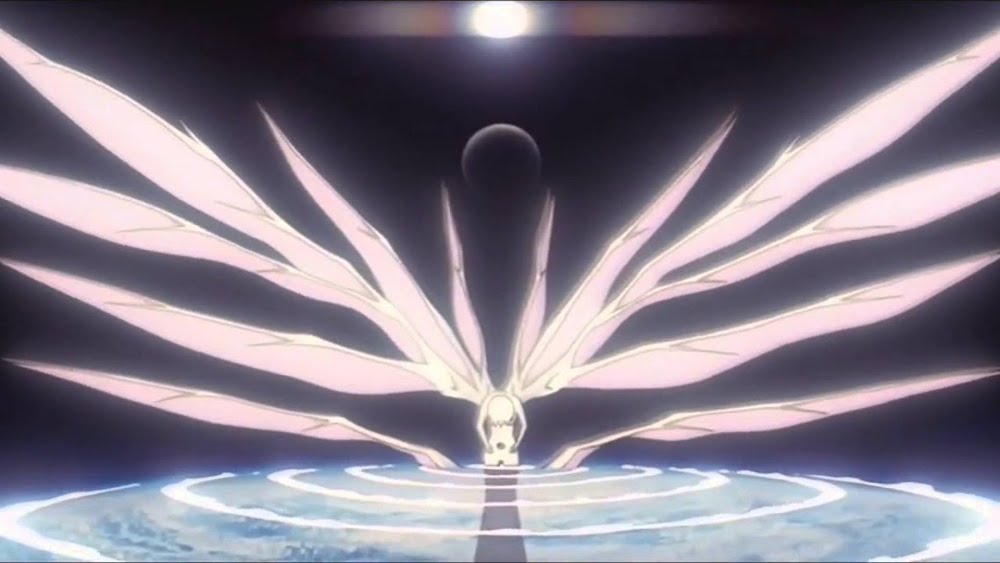
The poster for Evangelion 2.0: You Can [Not] Advance

Medium: Anime Film (108 minutes)
Genres: Action, Drama, Mecha, Science Fiction
Directors: Hideaki Anno (Chief Director), Kazuya Tsurumaki, Masayuki (Co-Directors)
Studios: Studio Khara, Gainax, et al.
Release Dates: June 27, 2009 (JP)
Rated: Not Rated (appropriate for 13+)

Before I get into the review proper I want to bring up a conflict of interest that I feel is important for readers to bear in mind. I am a massive fan of the original Neon Genesis Evangelion TV series, and as such am predisposed to enjoy this movie. I will try my best to put aside my preconceptions for the purposes of this review, but I wanted to point out this potential bias at the first instance. I consider it only fair to do so.

Like the first film, Eva 2.0 is a reimagining of the original Neon Genesis Evangelion TV series which follows the exploits of a small group of teenage pilots conscripted to fight in massive humanoid weapons (Evangelions) against monstrous creatures hell-bent on destroying humanity (Angels), and how they cope with this crushing responsibility. You can read an excellent review of this first installment by Uncle Yo on Ani-Gamers here. In the case of this second film, there is a large twist applied to the events from the series, which allows the film to emerge as its own fresh creation. The beloved core of the characters, robots, and events are still there but with refreshing changes: fat is trimmed, plot elements are tidied up, and entirely new material is added. In fact, those expecting a straight-up remake will find that the film will play on your expectations and fake you out to great effect, although thankfully these hints are packaged in a way that do not run the risk of wrecking the film for someone new to the franchise.

The extraneous elements removed from this adaptation are many in number, but none are worth mourning the loss of. The main beneficiary of this trimming is, rather surprisingly, the quieter moments in between the massive robot battles which have greater deal of clarity and impact due to the tighter writing. In particular, the fluctuating relationship between Shinji and his father is explored in a new depth, making it a much more tangible element in the storyline than simply a sterile case of “whiny brat hates his asshole dad.” One downside of this compression is that the relationships between Shinji and Rei/Asuka lose much of their subtlety. At some points the movie feels like it has switched genre to a harmless harem comedy show following a love triangle of socially useless robot pilots.

The film itself looks utterly amazing, with almost mind-wrecking detail lavished into the art and the robot models in particular. The Angel designs have had a complete overhaul and some pivotal examples have been re-worked with almost sick levels of care. The fights themselves sport amazing CG animation and are utterly engrossing in how they are presented for the most part — unlike other recent films that shall remain nameless. You can easily follow the fight and appreciate the overall tide of the battle, drawing you in. Fans of the original, who may think they know how every fight turns out, will be met by some surprising variations that keep the film feeling fresh and punish you for assuming that it is merely a remake of the original series. While the music during the quieter moments follows the previously used themes and leitmotifs from the TV show, the fight scenes have an all-new pulse-pounding score that amplifies the impact of the action to explosive levels.

It’s not without flaw though — there are times when the movie loses its way and forcibly ejects you from the experience. Most notable of these is the entirety of the first fight scene, which feels very roughly conceived and edited. You are introduced to a new character, mecha, and setting, but are never given time to absorb and appreciate what is being shown on the screen. I, for one, have no clear recollection of what the new Evangelion featured in this battle even looked like! One particular gripe, and one I assume will be fixed for the DVD/BD, is that most of the characters in this scene speak in mumbling "Engrish" at a level just barely louder than the surrounding battle.

A Yoshiyuki Sadamoto sketch of Mari Illustrious Makinami, the new, bespectacled Eva pilot

Thankfully this poor presentation does not infect the rest of the film, but then neither does the newly introduced character. Strangely, she only appears and interacts with the principal cast twice for the entire rest of the film. While the things she does are important to the overall plot, you can’t help but feel that she was roughly shoehorned into the proceedings by an over-eager intern who would burst into meetings waving his new character design around. I imagine him saying something like:

“Duuuuuudes! You gotta include her; she has glasses and a ponytail! Plus, she has a bigger chest, so we can use her for the trademark Gainax Bounce!” At which point everyone cheered and went out for a round or five of drinks.

When they got back from having nine drinks each, the staff set to work on my personal pet peeve of the entire movie: CG people in the background of scenes. It wrenched me out of the film entirely to see tiny, stiff polygonal people from Quake 2 stuttering in the background of scenes that needed to include some humans for atmosphere. I hope they fix this for the inevitable revised version as in this theatrical version it looks just plain cheap and nasty.

These small flaws are all utterly forgotten, however, in the exuberant blur of activity that is the last 30 minutes or so. At this point the movie stops joking around and ramps every setting it can up to 11, utterly destroying any doubts you may have had festering about the film or the direction of the series overall. In remaking what was already a pivotal part of the original TV series, the creators went all out in providing a mind-blowing ending that left the cinema audience cheering through the end credits. I dare not spoil a single second of it, but I implore you not to leave your seat until after the credits are done or else you will miss the single craziest thing of the entire film, one which bodes well for the two that are to follow. I already can't wait to get my hands on the Blu-ray version so I can see it all again.

[Highly Recommended]


This review is based on a theatrical version of Evangelion 2.0 shown at the London BFI Cinema as part of its Biannual Anime Weekend. Admission and all related expenses were paid for by the reviewer.

Aim for the Top: Gunbuster, Gurren Lagann, and the Mechrescendo

Topics: , , ,
Amano (left) and Noriko (right) from Gunbuster, with the eponymous robot in the background

Spoiler Warning: This post contains plot spoilers for both Aim for the Top! Gunbuster and Tengen Toppa Gurren Lagann.

It's no secret that Gainax's newest fan-favorite original anime series, Tengen Toppa Gurren Lagann (2007), is heavily inspired by the studio's own Top wo Nerae, a.k.a. Aim for the Top! Gunbuster (1988), their second major project after Royal Space Force: Wings of Honneamise (1987). The two share a giant robot focus, characters whose abilities are fueled by "hard work and guts," and a certain fusion of comedy and melodrama. However, beneath these surface similarities, Gunbuster and Gurren Lagann also have one incredibly important connection, one that serves as the primary reason why both have been flagships of otaku devotion for their time: a music-like crescendo of both emotion and scale.

Personally, I am a fan of any music that builds, and what both of these anime series do is, in reality, no different from what Coldplay does in "A Message" or what Spoon does in "The Delicate Place." They take something simple, maybe even something that's not very entertaining, and expand it, bit by bit, until it turns into something fantastic.

With the seeming importance placed on the climax, it is easy for us to try to discount the rest of the work, focusing only on the "best" part of it, but this leaves out the importance of the preceding crescendo. Gunbuster is proof of this, as the first three episodes are pretty mediocre fanservice-filled vignettes showcasing the four protagonists (Noriko, Amano, Jung, and Coach Ohta) and establishing their relationships. Noriko, Amano, and Jung are both friends and rivals, the Coach is the driving force behind all of them, and Noriko has the death of a love interest (Smith Toren) to especially motivate her.

However, it is in episode 4 that the series hits its first climax, with Noriko launching for the first time in the prototype "Gunbuster" robot. The first three episodes have already established the tensions between the three girls and their coach, while the first half of episode 4 establishes Noriko's dejection over being "benched" during the battle raging outside. Suddenly, the girl transforms her grief over Smith's death and her ensuing space phobia into an intense hatred for the "space monsters" that killed the boy she loved, and jumps in Gunbuster to face off against the army of enemies.

Here director Hideaki Anno (Evangelion, Nadia) shows a firm understanding of what makes a good crescendo in music, and translates that knowledge into animation. His instruments are the characters, their interactions, the art itself, the cinematography, and of course, the background music. For the crescendo to work, these things must be present in some form throughout the earlier part of the series, but we mustn't notice them as a coherent whole. They must creep up on us, until we eventually realize that we have come to the culmination of everything the series has presented thus far.

With only six episodes to tell its grand, time-bending story, Gunbuster only achieves two (arguably three) climaxes of this sort, but with its 27-episode span, Gurren Lagann has time to pull off a number of mini-crescendos. Most notably, the one at the end of episode 8, in which Kamina pushes Simon to put his all into a battle for the first time, has all the trappings of a Gunbuster climax. Simon's slow growth as a pilot and a young man is moved along concurrently with a romantic subplot between Kamina and Yoko, and in the final moments of the scene, it all comes together as Kamina gives Simon the push he needs before tragically dying, thereby crushing both Simon's morale and Yoko's hopes for the future.

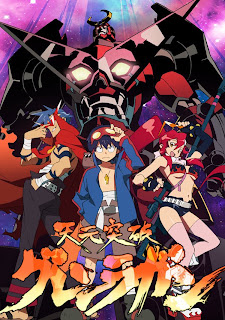
Simon And the Gurren Lagann from Tengen Toppa Gurren Lagann

However, there is another very important type of crescendo that Gainax uses in both shows, one whose scope is far grander than that of the mini-crescendos leading into each little climax. What gives both series such an uplifting, empowering tone is a sense of constant, steady crescendo throughout the show. In both Gunbuster and Gurren Lagann, Gainax achieves this through the steady magnification of scale, moving the size of the robots and ships up until they become powerful enough to toy with such unthinkable tools as the galaxies themselves.

In Gunbuster, Anno and his team achieve this effect through an accelerated sense of time, as relativity's effects send the characters far into the future every time they warp across the universe. Every time that they return to Earth, technology has continued its inevitable march forward, and the girls find spaceships that have grown to multiple orders greater than the size of the ship they served on. In fact, humanity even progresses so far that they are capable of compressing Jupiter itself into an unthinkably massive, galaxy-smashing bomb.

In Gurren Lagann, on the other hand, Gainax uses hidden enemy technology to move the scale forward, as Team Gurren finds larger and larger weapons for it to use against the Beastmen — and later the Anti-Spirals. Granted, Gunbuster more directly speaks to the unending power of humanity to advance, reaching higher and higher heights through our ingenuity and determination, but Gurren Lagann argues — just as solidly — for the human desire to survive, and our ability to do absolutely anything to ensure that survival. (Naturally, both shows share both themes in some form.)

In the end, that is what has made both Gunbuster and Gurren Lagann so incredibly popular for their respective eras. Both bring us along for a powerful, steady crescendo, as we watch the characters — indeed humankind itself — rise further and further into the heavens. Gunbuster and Gurren Lagann are all about triumph, and their ability to pull us along for every triumph, from the large-scale battles for the universe to the most basic of emotions, is what makes them as "musically" beautiful as they are simply entertaining.

Review: Shikabane Hime - Corpse Princess, Season 2 (Sub)

Topics: , ,
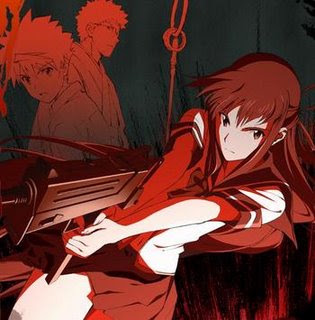
Shikabane Hime: Kuro Medium: TV Anime
Number of Episodes: 12
Genres: Action, Horror, Supernatural
Director: Masahiko Murata
Studios: Feel, Gainax
Licensed? Yes (FUNimation)

"Shikabane": human spirits whose regrets in life cause them to return as vengeful monsters.
"Shikabane Hime": young (usually hot,) undead women employed to seek and destroy shikabane.

A few months ago, I reviewed the first season of this supernatural/horror/drama/fan-service extravaganza by GAINAX with great delight. The cliff-hanger ending of episode twelve gave me plenty of motivation and desire for more.

To recap, there are monsters, and there are strike teams of monks and undead teenage girls who fight off said monsters. Ouri, an introverted youth fascinated with death, has been following his adoptive older brother, Keisei and his partner, Makina Hoshimura. In a critical moment of defiance and selfless sacrifice, Keisei finally lays down his life for Ouri and Makina, setting the stage for the second half of this passionate drama.

In season two, we turn our attention to the Seven Stars, a team of untouchably powerful shikabane who seek the utter destruction of the Kougon Sect and their shikabane hime. With a clear central villain and a clear conflict of interests between central characters, you would think the story has plenty of steam to keep this freight train on the move.

Then the middle of the series comes, and with it the mid-season-two-drag. We fall into the shallow grave of flashbacks, recaps and tertiary character development, but only to emerge stronger than ever.

Somehow during the transition of acquiring Ouri as her new contractor monk, Makina has developed a curse, a super-power that gives her unlimited regeneration at the cost of shortening Ouri’s life. This twist is more for dramatic effect then an actual plot point, as she continues her regular Shikabane Hime duties of monster-mashing and self-loathing. Although it does lend itself to some pretty impressive fight sequences.

Some support characters are developed for the sake of cautionary tales between Ouri and Makina, while some new characters are introduced for the sake of fan-service. Not to say that Shikabane Hime loses any of its dark, morbid charm. Most of the fights leading up to the final conflict with the Seven Stars are downright cruel to viewers. Bravo. All that was lacking was development on the Seven Stars: a majority of them are not given memorable names or even discernible powers. Come on guys, you had 25 episodes! At least give me a back story!

Eventually, the Seven Stars and Akasha, the “traitor monk,” get their acts together and start causing mayhem on a grand scale. By using their young leader, a seemingly brain-dead girl named Hokuto, the Stars wreak Left 4 Dead-style havoc on Tokyo. The potential for mass-slaughter is ignored for a handful of “I’m-gonna-follow-my-path-no-matter-what” speeches, but I can overlook them.

The series caps out at twenty-five episodes, and while the plot does not resolve entirely, the characters’ resolve is set in stone, and we leave the series with a satisfying acceptance of life over a peculiar fascination with death, and the changing of the guard - the passing of the torch - is complete.

A huge part of Shikabane Hime’s appeal was its convenience. Using Hulu, I was able to watch the entire series at my leisure with about a minute of commercial interruption. Other than the obvious mid-season-two-slump, Shikabane Hime delivers and pushes its characters to develop their motivations, not just their powers. (Something Bleach might want to take note of.)


good.

Review: Gurren Lagann (Hyb)

Topics: , ,
Gurren Lagann Medium: TV Anime
Genres: Action, Mecha, Science Fiction
Director: Hiroyuki Imaishi
Studio: Gainax
Licensed? Yes (Bandai Entertainment)

It’s Gainax. Of course there are going to be giant robots and bouncing boobies.

From the very beginning, Gurren Lagann is a story of reaching new heights and climbing higher. Simon (pronounced See-moan) is a measly digger, one of the countless humans living in despair beneath the Earth’s crust. Banished to never see the sky above, mankind is truly at its lowest. If it were not for his inspirational and testosterone-exuding gang-brother Kamina, Simon would be almost deprived of confidence and willpower. Change is set into motion as Simon discovers a mechanical face buried in the soil, and the tiny drill that activates it. From there, destiny spins itself out of control as Simon and Kamina aim their sights for the grand, unexplored world above their tunnel city.

Halfway through the first episode, a giant robot falls from the ceiling, as does a beautiful, rifle-wielding tom-boy named Yoko. Once Simon pilots the pint-sized Lagann to victory, Team Gurren’s journey truly begins. Upon reaching the surface, Simon and Kamina learn that mankind was driven underground out of terror of the Beastmen and their giant robots. They join up with Yoko’s village and begin living to the fullest, leading a full-out war against the Beastmen and their terrifying Spiral King.

I've waited a long time for an anime like this. I remember being a hot-blooded teenager, thrilling over Dragon Ball Z, Ronin Warriors and, yes, even Sailor Moon. When a character wanted something, they yelled louder, lights appeared from nowhere, and they achieved the impossible. It’s that moment in anime when willpower and desire are personified, and every hair on your arm stands up on end. If it weren’t for the visual barrage of colorful characters and hypnotic robot battles, Gurren Lagann’s predictability and formula would murder its potential. But it’s almost too good to dismiss as another kids show overloaded with toy company fodder.

From there, the formula is set in place. Just as good as it is bad, you cannot shake off Gurren Lagann’s almost cop-out ability to drill through every obstacle imaginable the same way every time. Whenever there is a chance of emotional development and a deep meaning, a bigger robot appears and the human’s flagship mecha, Gurren Lagann, makes an even bigger drill, penetrates the enemy robot, and pounds its way to a lightshow of victory.

Gurren, Lagann, and the combined Gurren Lagann

Gainax’s distinctive choppy animation style that they embraced during FLCL adds a level of spunk and pep that compliments the chromatically intense visuals. Staying on the visuals, the eyecatches are some of the... catchiest I’ve seen since Cowboy Bebop, in that they stand out with a raw and colorful style on their own. The fights are way over-the-top and can easily lead to an epileptic breakdown without proper lighting or medication on hand. Lagann’s animators use old-school cell-paint techniques, which are severely lacking these days in anime; I’m getting tired of bland and depthless 3D rendered backgrounds. And because this is a Gainax anime, no drill-to-penis innuendo is too low nor too overt; in fact very little is spared. Yoko provides the essential “Gainax-bounce” and her fiery brassiere top becomes a character on its own.

Take the fan gushing with a grain of salt: Kamina’s unlimited “fighting spirit” becomes obnoxious quicker than expected. The over-the-top ego drills on your nerves, but it all leads up to the more fascinating and challenging second part of the series. Without any spoilers, I will say this about the second season: think Watchmen or Squadron Supreme, when the righteous make the wrong choices for the right reasons.

Bang Zoom delivers a fantastic dub. Steve Blum goes way off-character to play Leeron, the effeminate tech-head. A-lister Kyle Hebert does a great performance as Kamina, bringing full bravado and macho suave to the all-around badass Kamina. This cast was very carefully put together, and the precision of voice director Tony Oliver paid off fantastically. For more details, check out our podcast episode that Evan recorded at the New York Anime Festival – still jealous over that, Minto!

But suspension of disbelief set aside, Gurren Lagann is worth it – without a doubt. This wasn’t the smartest anime, nor the deepest, but it never tried to be. It just tried to be a good ride with robots – and even a bitter, jaded fan like me couldn't help but fall head-over-heels for it.


great.

Review: Shikabane Hime - Corpse Princess (Sub)

Topics: , , ,
Shikabane Hime: Corpse Princess Medium: TV Anime
Number of Episodes: 12
Genres: Action, Horror, Supernatural
Director: Masahiko Murata
Studio: Feel, Gainax
Licensed? Yes (FUNimation)

Hopefully, by now you’re pretty much aware of FUNimation’s desire to bring us fresh, crispy, brand-new anime NOW. Shikabane Hime: Corpse Princess (Shikabane Hime: Aka in Japan) is the first in what may be a long trend of anime released online, fully subtitled, through an American company. True, you can buy high-quality subbed episodes right now through iTunes, or watch them on YouTube or Hulu, and it’s perfectly legal. But we’ll hold off on the legality for a law firm podcast.

For now we’ve got guns, demons and boobies to discuss.

Studio Gainax picked up this supernatural action series from a moderately popular manga. Shikabane Hime follows Makina Hoshimura, an undead soldier who must slaughter 108 fellow "shikabane" (vengeful zombie/spirits) in order to achieve Heaven. Fighting alongside her is her contract monk, Keisei Tagami, a modern man using old-school methods. The real pull of the story is through his adoptive, detached younger brother, Ouri. Ouri’s fascination with death is a moth-to-the-flame archetype that is destined to leave him burned. The situation quickly reaches the clichéd catch-22 of “we both want to protect each other, but we’ll both get killed in the process,” as Ouri includes himself in many of Makina’s missions.

Gainax flexes their muscles with the opening animation, whipping zombie arms and bullet casings like they were party-poppers at a New Year’s party. The fluid animation paired with the distorted close-up angles bears the proud badge of the studio that gave us Evangelion. Shikabane Hime tones down most of its colors to create the eerie atmosphere we’ve come to associate with modern Gothic stories. It’s dark, almost macabre coloration reminded me of Blood+ (though without the whiny characters). It is strange how the camera holds Makina in frame: her ice-cold beauty and violent passion is quite hot. Almost all of the backgrounds and scenery are unmistakably grim however, due to the lack of any major light source.

Sadly, at times the overbearingly grim tones leads to flat, professional supporting characters that do not elicit much sympathy. Even so, director Masahiko Murata tries to interject slapstick humor and innuendo comedic relief... to no avail. If anything, the jokes are so forced and out-of-place they distract from the task at hand: shooting up zombies. Still, I’d hate to think of how dull this series would be without Keisei’s closeted otaku-tendencies.

Gainax’s staff brought out their big guns in letting Shou Aikawa handle the script. His ear for corrupted morality can be heard in the Fullmetal Alchemist movie, Rahxephon, Wrath of the Ninja, and the OVA of Vampire Princess Miyu. In short, a very experienced man with one foot firmly planted in the realm of the fantastic.

Beyond the gripping stories of people resurrecting as powerful monsters only to be mowed down, I was most invested in the political struggle of the monks’ hierarchy. Indeed, the tethering of "shikabane hime" (corpse princesses) to fight off monsters is a no-win situation of fighting fire with fire – and boy do they use fire. Makina’s firearms are a beautiful, bouncing pair of... Uzis. Another corpse princess fights with her fists, another with a big-ass hammer, and another with a sniper rifle. This team of living corpses perpetually argues among themselves and with their contracted monks, leading to a more fitting, subtle (though definitely black) humor.

As the story exhumes the mysteries surrounding Makina’s death and Keisei’s involvement with the Kougon Sect, it is clear that Ouri’s involvement with the hime will only pull him deeper. I will not spoil the end of the first season, but I will remind you to stay tuned to FUNimation’s YouTube channel, as Shikabane Hime: Kuro, or season two, is already in post-production and ready to launch here in America. It turns out that Gainax is keeping themselves quite busy between this production and both the Gurren Lagann movies. They're clearly not going to let Studio BONES have all the fun.

Shikabane Hime is an all-around decent action piece that dictates a black-and-white argument on using monsters to blow away other monsters. Nothing ground-breaking, but much better than your run-of-the-mill zombie film.


fair.

Review: Evangelion: 1.0 You Are [Not] Alone (Sub)

Topics: , , ,
Rebuild of Evangelion 1.0: You Are [Not] Alone Media: Anime Film Series
Genre(s): Action, Drama, Mecha, Military, Psychological, Science Fiction
Director: Kazuya Tsurumaki (overseen by Hideaki Anno)
Studio: Gainax
Number of Films: 4 (1 completed)
Licensed? No

When I was fifteen, I spent a summer borrowing a friend's VHS tapes of subtitled Evangelion. I was ready for the robots and the boobies, but those are just light reflecting off the tip of an iceberg that was years beyond anything in animation. To this day, I wish more people ignorant to anime could digest and discuss Eva as proof that animation goes beyond Spongebob.

With Evangelion: 1.0, we may yet have a chance. Hideaki Anno has rereleased his touchstone creation through three new hour-and-a-half-long movies which hope to condense the 26-episode series. How'd he do it? By adding visual but sacrificing story details.

At first glance, 1.0 looks like a recap movie. But Anno and his team have put a fresh coat of computer-graphics-tasting paint over his creation, adding immense 3D graphics and details to every last nut and bolt of Nerv's HQ. Scenes with vague backgrounds have been revisited and placed in locker rooms, jazz clubs, elevator shafts, and military prep rooms, grounding viewers into paying even more attention to the dialog. Action scenes have abandoned the framing-and-flashback technique and become straight-forward fights. Angels now bleed, spark and then explode. With today's computers, Anno has added very complex lighting effects, which help create a greater contrast between domestic and action scenes.

This revision of Eva is loaded with new dialogs, scenes, shots and colors which develop Shinji's story by putting every scene, at last, into a coherent context.

That's right, I said coherent Eva. I know, I was surprised too!

This may be the best thing to happen to Evangelion since Prozac. For the first time, the story is told chronologically and tersely. Anno's reworking of the script has eliminated the space and time disorientation that kept the original cut of Eva enigmatic. Hopefully, Evangelion 1.0 will resurrect the series for a new generation of otaku, allowing potential fans to dedicate an evening (rather than an entire semester) to watching and, more importantly, understanding Eva.

On the downside, Evangelion fans may not be comfortable with the hasty pacing and Anno's choices to completely cut out fluff and humor scenes. Some of the surrealism and existentialism remains, but it does not interrupt the action or the plot. Can I get a "Hallelujah?" Story-wise, we still follow Shinij, though he remains as meek and spineless as ever. We should remember, however, that Evangelion 1.0 had one goal to establish: to focus on Shinji's fear of reaching out and taking responsibility. By the end of this first installment, you feel like he has made a valiant effort.

There may yet be hope for Shinji…unless you've already seen Death and Rebirth.

I think Hideaki Anno has gone back, tightened up some loose ends, edited down, and put significant thought into this terse update of his masterpiece. Congratulations.

Animation: 3.5 Average:

(3.375 stars)
Plot: 3.0
Voice Acting: NR
Sound: 3.0
Overall: 4.0

Review: FLCL (Hyb)

Topics: ,
FLCL Media: OVA
Genre(s): Action, Slice-of-life
Anime Director: Kazuya Tsurumaki
Studio: AIC
Number of Episodes: 6
Licensed? Yes (Synch-Point)

FLCL? Furi Kuri? Fooly Cooly? What is this strange phenomenon? Well it, happens to be one of the most popular and talked-about anime ever made. This is what we have come to expect from studio Gainax, creators of such controversial anime as Evangelion. Fooly Cooly (as is its official English translation) is, at its heart, a simple coming-of-age story. The main character Naota begins as a bored (and boring) 12-year-old living in a uninteresting town. Through the plot's absolutely bizarre twists, we watch this boy realize how pointless his life is right now, and how all he needs to do is step up and put a little energy into his life to make it exciting.

Naota Nandaba is a 12-year-old living in Mabase, a fairly average Japanese town except for the huge Medical Mechanica plant in the middle. The factory mysteriously spews out smoke and steam all the time, and the people never seem to wonder why this plant exists. Naota, however generic in personality, has a life that is far from normal. His brother went to America a few years ago to play baseball, and his brother's high school girlfriend Mamimi Samejima is, for all intents and purposes, going out with the 12-year-old Naota. The boy feels bored with his uneventful life, until one day, a mysterious girl appears on a motorcycle. She drives right into Naota, and proceeds to hit him in the forehead with a guitar. We later find out that this 19-year-old girl is named Haruhara Haruko, and she is now the housekeeper at Naota's house. As the series progresses, robots and other strange objects begin to appear out of the growing "horn" or lump on Naota's head. (formed by getting hit with the guitar) The show gets crazier and crazier as Haruko helps Naota to mature and see himself in a new way.

The writing in FLCL is a strange type that walks the line between drama and comedy. At times, it will seem like the story is getting very serious and really trying to get across a moral. As quick as this scene appears, Haruko will come by to hit Naota with a guitar, or his dad will pop up with some sexual wisecrack about Naota. The viewer has to be ready to change tones over and over during the course of each episode; to get sense (and sometimes even a lesson) from seemingly random insanity, and to suspend all reality to watch these events unfold. Believe me, this show does not follow any boundaries of reality or genre. Science fiction will be mixed with comedy, romance, and drama. Meanwhile, you will be introduced to secret organizations, giant eyebrows and unexplained problems. (like a giant satellite bomb headed for Mabase) The story is chock-full of metaphors about growing up and making your own choices. Another interesting inclusion is all of the subtle references to anime and popular culture, such as Evangelion, Gundam, and South Park. It is easy to watch FLCL with a shallow eye, only picking up the loud and violent humor. However, if you look closer, you will find a really meaningful story about one boy's quest to grow up and become a man.

Animation is, just like plot, another confusing aspect of FLCL. More tone changes abound, as Gainax and Production I.G. switch us between normal, chibi, manga, and even South Park styles of animation. Each of these represents a change in plot tone, but they are not as effective as the changes in writing. The difference here is that your eyes often cannot react fast enough to pick up and interpret all of the flashing images in front of you. Though confusing, the action scenes are very entertaining. There are hybrid organic-robotic cretures such as Canti, a robot that comes out of Naota's head, and when they fight, they move with a beautiful fluditity of motion. In general, FLCL uses very good animation for its time period, but can sometimes be too confusing for its own good.

Music is the absolute best aspect of FLCL. All of the music, from backgrounds to the closing song, were performed by "The Pillows," a Japanese rock band. The band has a distinctive British sound, and infuse a very contemporary, fun sound to the series. Not only is the music well-performed and very catchy, but it is flawlessly integrated. During action scenes, Gainax actually animated based on the music, as opposed to dubbing music based on the animation. This results in a really synchronized feeling in which the music really enhances the action. Also, slower, more uplifting songs are used during key emotional scenes in each episode. (Most notably the song "Little Busters" in the conclusion of each episode) These cap off each episode with a powerful, emotional mood.

The dub is surprisingly good, and is actually better than the sub. There are many plays on words that only Japanese people would get in the sub, while the dub changes these to jokes that American audiences will understand and laugh at. Also, the actors are both believable and funny when they need to be.

FLCL rightly deserves the title of classic, and it does not shy away from the uniqueness that many anime lack. The plot is twisty and interesting, but manages to tell a profound, very personal story in only six episodes. Those looking for a straight comedy will be disappointed. Deep down, Fooly Cooly is an uplifting, powerful story that can make you laugh, think, or even cry.

Animation: 3.5 Average:

(3.6 stars)
Plot: 3.5
Voice Acting: 3.5
Sound: 4.0
Overall: 3.5