Japan's Apocalyptic Imagination in Anime, Manga and Art, a panel at Otakon 2011, featured essayist and Japanamerica author Roland Kelts, who offered examples of apocalyptic imagery in Japanese art and pop culture, put them into historical and cultural perspectives, and analyzed them. While the focus of his examples was definitely anime films, Kelts went as far back as Katsushika Hokusai's famous woodblock print The Great Wave off Kanagawa (pictured right) to show how apocalyptic imagery is nothing new to the island nations creative focus.
The Great Wave..., published between 1830 and 1833, depicts a large wave immediately threatening boats off the shore of Kanagawa Prefecture. While almost 50% of the frame is taken up by the wave, its ominous nature can actually be attributed to how tiny Mt. Fuji, a symbol of Japanese pride and culture, is by comparison. Another threatening aspect noted by Kelts is the crest of the wave, which seems lined with "clawing fingers." Hokusai, according to Kelts, has often been referred to as a precursor or gateway to modern manga. And with that smooth transition, together with the statement that anime and manga have always been at least in part a response to catastrophes (which Ill explain a little further down), the discussion shifted to the God of Manga, Osamu Tezuka.
Kelts specifically noted Astro Boy, which emerged after World War II, and pointed out how the story uses radiation as an aspect of creation rather than destruction. This "boy born of radiation" shows a faith in the same technology (or along the lines thereof) that delivered such a crushing blow to life not even a decade earlier. Along the same lines, Kelts offered up a similar method of thinking regarding the resurrection of the Japanese battleship Yamato, which was the pride of the countrys naval fleet as one of its most technologically advanced WWII warships. After its defeat, the Yamato came back to life via fiction as a technologically superior spaceship ("Take THAT, America!"). In addition to Kelts also mentioned the birth of mecha as means to fight the disillusionment with current technology. In all instances, destructive new technology didnt bring about fear in art but rather promise as well as hope that what has been survived can be learned from and built upon to become stronger.
Next Kelts focused on two anime film directors, Hayao Miyazaki and Isao Takahata, and their specific works. Perhaps to take advantage of Ponyos immediacy, Kelts pointed to this Miyazaki film as a shining example of the portrayal of natural disasters and Japanese natives reactions to them. Kelts focused specifically on the scene where personified waves of a storm are reaching up and over the road with cars, which are trying to escape. Kelts said that this portrayal is not a malicious one but rather a dangerous fact of life. He said that the eyes in the waves had a sort of aimless, "staring into space" aspect that relayed the same sense of natural innocence as another one of Miyazakis creations, Totoro.
Kelts pointed out one scene in particular from My Neighbor Totoro built on a couple of images meant to evoke memories of the Japanese people who went through WWII. In this particular scene, characters in mismatched clothes watch as a man drives off into the countryside in a jalopy. According to Kelts, this scene was one that took place in many homes during WWII as those types of cars were simply what were available and clothing supplies were scarce. In all, Kelts concluded that since Miyazakis family was one of relative privilege and could afford to escape the paths of destruction, that personal history is what colors his work.
This contrasts Isao Takahatas Grave of the Fireflies, which is tied to the notion of not being able to escape and having to deal with the event as well as its aftereffects. Most of the movie, after all, centers around trying to define and etch out an existence after an American firebombing raid consumes life as the children had known it. Kelts said the differing vantages between directors makes sense given the fact that Takahatas family was of lesser means and could not afford to escape.
After a few more specific examples of the panel, an audience member asked if there was a difference in how man-made and natural disasters are depicted. Kelts postulated that manmade disasters serve as an analogy to the evil that resides within all of us. He noted that even historical apocalyptic depictions spare specific countries any finger pointing. Instead the focus of most anime that deals with man-made apocalyptic scenarios open with disasters instead of trying to prevent them (as with the majority of Western media). This further demonstrates the themes of coping with and overcoming ourselves. Natural disasters, said Kelts, are portrayed as indirect, non-intentional ... just a part of life thats meant to be dealt with and overcome. A rather pertinent question from the audience as to if there has ever been any backlash to the depiction of such tragedies reaped a rather funny, rather thoughtful response from Kelts, who said that there have been none to his knowledge but that the popularity of mo might just be that ... another means of escape from economic or climate-based disasters or both.
Click here for more of our Otakon 2011 coverage
Medium: Manga (1 volume in English, 3 in Japanese)
Author: Shotaro Ishinomori
Genre: Drama, Educational
Publishers: Nihon Keizai Shimbun (JPN), University of California Press (NA)
Release Dates: 1986 (JP), 1988 (US)
Age Rating: Not Rated (contains some sexual material and mild swearing)
We don't tend to see much educational manga here in the US, most likely because the modern manga audience is still mostly kids who are interested in gripping teenage action series or sappy romance — in other words, pure entertainment rather than education. Sure, we got those "Manga Guide To..." books, but the Japanese manga world is filled with comics that function simultaneously as narratives and as educational tools.
It is appropriate, then, that Japan, Inc. is not a modern manga; released in 1988 by University of California Press with an introduction by Stanford professor Peter Duus, it represents a mature, academic style of manga publishing almost completely divorced from the modern, teen-centered world of North American manga. Heck, I obtained my copy by borrowing it from my college's library, which mostly has textbooks and other purely academic texts!
Released to Japanese readers in 1986 as a companion to Zeminaru Nihon Keizai Nyuumon, an economics textbook released by Nihon Keizai Shimbun (the Japanese equivalent of the Wall Street Journal), Japan, Inc. makes no bones about its status as an educational tool. Nevertheless, writer/artist and Osamu Tezuka follower Shotaro Ishinomori (Cyborg 009, Kamen Rider) makes valiant and often successful attempts at infusing a sense of humanity into the dry facts and figures that populate the comic.
Our story centers around two workers at the Mitsutomo Trading Corporation: Kudo, a young businessman who works tirelessly to ensure that the "little people" are not left out in large business decisions, and Tsugawa, a ruthless schemer who's always got his eyes on ways to make the company as much money as possible. Surrounding them is a small cast of other businesspeople, including the curious and idealistic young worker Ueda, the cute and feisty secretary Amamiya, and a number of older executives who give advice to the younger workers.
The bosses often serve as our teachers, explaining the long-term ramifications of events like the 1970's oil crisis on world trade and business, while Ueda's cluelessness about business gives us a character to connect to in the frequently confusing web of connections that Ishinomori walks us through. Most of the time, these explanations work out fairly naturally, thanks to a cast of characters with all different levels of knowledge and experience. Unfortunately, though, the need to explain far-reaching consequences of events can lead to confusing flashbacks, and at one point Japan, Inc. even employs the most dangerous tool of all: the DOUBLE FLASHBACK.
Despite Ishinomori's valiant attempts at narrative, including some examination of the differing relationships that Kudo and Tsugawa have with their families, Japan, Inc. is absolutely an educational text. The chapters are separated based on their respective topics, and given invigorating titles like "Trade Friction," "Countering the Rise of the Yen," and "Deficit Finance."
Every other page features a small footnote describing the topic at hand, and there are a few pages that simply stop the action to provide a short essay on the topic or show some graphs. (I dubbed them "economic Masamune Shirow moments.") While all this information is great to have, it's clear that the book is written for businessmen and women looking to bolster their existing knowledge of the business world, because at times the jargon can get pretty confusing for laypeople.
Unfortunately, Japan, Inc. suffers from its age, as University of California Press chose to flip most panels, but leave the ones with drawn text unflipped, resulting in page layouts that lose their natural artistic flow. Additionally, all of the information comes from 1986, so while it's fun to read predictions about how the Internet just might change the landscape of business by 2010, some of the facts are laughably out of date now. (Everybody in Japan is really excited when the yen-dollar exchange rate finally reaches ... 150 yen/1 dollar!)
Japan, Inc. is certainly not what most people expect from their manga: it's considerably drier than even the more subdued seinen manga series, and Ishinomori's art is an acquired taste, lying somewhere between Tezuka (Astro Boy), Mitsuteru Yokoyama (Tetsujin-28/Gigantor), and Akira Toriyama (Dragon Ball). The American version's sporadic flipping shakes up Ishinomori's panel layouts a bit too much for comfort, while the footnotes and full-page info sheets break the flow of the manga from page to page. As a result, Japan, Inc., which clocks in at just over 300 pages, is a considerably slower read than the average manga.
Without any really powerful modern relevance, Japan, Inc. stands as little more than a fun little curiosity for amateur manga historians. Still, if you're interested in economics, international business, or modern Japanese history, and/or if you enjoy seeing manga-fied versions of Ronald Reagan and the Pope, Japan, Inc. might be just the right little curiosity to pique your interest.
[Passable]
This review is based on a copy borrowed from the Folsom Library at Rensselaer Polytechnic Institute.
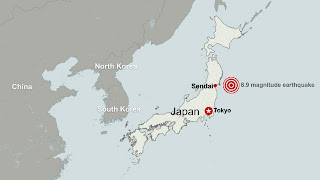
As I'm sure most of our readers have heard already, on Friday, March 11 a powerful earthquake (8.9 on the Richter Scale) struck just 80 miles east of Sendai, on the central Honshu island of Japan. In addition to shaking up buildings throughout Japan and causing widespread death and injuries, the quake also sent a massive tsunami thundering across the Pacific Ocean, which hit the northern coast of Honshu at speeds comparable to a commercial jet. The city of Sendai was hit with the brunt of the wave, but it also swept through various cities and towns in the north of Japan, resulting in the utter decimation of many towns and deaths numbering in the hundreds.
Additionally, a nuclear power plant at Fukushima (a city approximately 50 miles southwest of Sendai) was severely damaged by the earthquake, resulting in a breakdown of its safety system and a potential for dangerous nuclear fallout. Citizens have been evacuated from the immediate area and officials are hard at work on containing and cooling the reactors, but there is still a significant risk.
Despite all the bad news, it would seem that Japan's strict building codes and mandatory earthquake/tsunami training has been an incredible boon in ensuring the safety of their citizenry. While the death toll is certainly horrific at the moment, it would undoubtedly have been at unthinkable levels had Japan not been as prepared as it was. On that note, The New York Times is running an eye-opening story on Japan's anti-earthquake measures, which is a must-read for anyone interested in the implications of this disaster.
Plus, charitable organizations around the world have quickly mobilized to provide relief to the people in Japan suffering due to this unforeseen disaster. Most notably, the American Red Cross has been heavily promoting their SMS service, which allows you to easily donate $10 to Japanese earthquake relief by texting "REDCROSS" to 90999. (The organization also has a donation page on their site, where they can take larger donations by credit card or other payment methods.)
For more information on ways to help the Japanese people affected by the earthquake, visit the website Causes Exchange, which has a very helpful list of charities that are accepting donations toward the cause. (Big thanks go out to Anime Diet for providing the list, and for their swift coverage of the disaster.)
Meanwhile, Anime News Network is maintaining a massive list of anime/manga industry members who have checked in to confirm that they are OK in the wake of the earthquake and tsunami. Notable names so far include Mamoru Hosoda, Kenji Kamiyama, Tite Kubo, and Hideo Kojima.
Longtime anime convention personality Walter Amos has confirmed via a Facebook post that "Noboru Ishiguro (Space Battleship Yamato, Macross), Artland Studios, and all its staff are OK." Artland staffer Yuko Suguro sent Mr. Amos the following message today:
Thank you for checking out [sic] on us! Artland is fine and so is Mr. Ishiguro. There were [sic] no damage in the building, and no one got hurt. We are working regularly from today, but everybody is a bit nervous because of the continuous after shake [sic]. I think everything will be back to normal by Monday.
If you have any news or stories about the earthquake, or if you have suggestions for ways that people can get involved in helping those affected by it, please leave us a comment on this post or send an e-mail to evanm [at] anigamers [dot] com. As new developments or suggestions come up, I will update this post with the new information.
EDIT 1: Vertical, Inc. Marketing Director Ed Chavez confirms in a Twitter post today that Mari Morimoto, Japanese/English translator for such manga as Dragon Ball and Naruto, is safe after leaving an evacuation center in Sendai with her mother.
[Sources: US Geological Survey, Business Week, Reuters, Anime News Network]
Medium: Book of Essays/Reviews
Author: Patrick Macias (foreword by Kinji Fukasaku, afterword by Takashi Miike)
Illustrator: Happy Ujihashi
Publisher: Viz Media (Cadence Books imprint)
Version Reviewed: Retail paperback, library copy
Release Date: November 2001
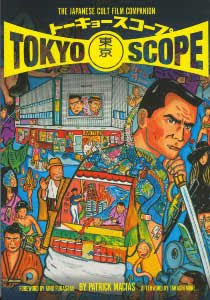
There was a time when anime was a cult phenomenon in the United States. A time when the only way to find episodes of your favorite giant robot show was to seek out either the obscure fansubbing group releasing a low-quality tape of it or the production company that just happened to license a strange show and release it in your local video store. Anime has now moved further into the mainstream, but for fans of Japanese pop culture, the cartoons are only the tip of the iceberg. Beneath the surface of the water is the other 90% of that iceberg, and there lies world of Japanese cult films. Patrick Macias' TokyoScope seeks to bring that world to the surface in a way that few have ever done before.
The book reads like a very fannish, often tongue-in-cheek exploration of every single facet of Japanese cult films, from their production to their promotion and theatrical showings. Japanese history is referenced in detail right next to scans of real posters from '70s triple-feature showings and silly, manic illustrations from Japanese artist Happy Ujihashi. Macias pulls no punches, with short one-page reviews of films of all calibers, ranging from monster movies to yakuza (mobster) flicks to softcore pornos (a.k.a. "pink films"). At the end of each genre-themed chapter, there is a series of extra articles, including interviews, scanned promotional materials, and/or profiles of actors, directors and such.
Macias' knack for storytelling carries the reader through the different chapters, connecting all of them through an omnipresent description of the Shinjuku Showakan theater, a defunct (as of 2002) movie theater originally built in 1932 that specialized in cult films, and was for a time even funded by yazuka, who often visited to watch the latest films about their fictional gangster counterparts. (For more on the Showakan, read August Ragone's writeup of the theater's final show.)
TokyoScope is the kind of book that holds far more information than one person could possibly absorb in one reading, a fact that serves as a reminder of just how much of a wealth of knowledge Patrick Macias is when it comes to Japanese pop culture. However, despite the wide range of genres and films, the focus of the book often circles back to a few major names, including directors Kinju Fukasaku (Fight Without Honor Or Humanity, Battle Royale), Ishiro Honda (Godzilla), and Takashi Miike (Dead Or Alive, Ichi The Killer) and actors Sonny Chiba, Bunta Sugawara, and Tetsuro Tamba. While all of the names might not sink in, even a quick first read of TokyoScope is a fantastic start for any new fan looking to get into the dark and dirty world of Japanese exploitation cinema. It might not add much for longtime fans of the films, but it certainly offers some insight into movies that they might have overlooked.
The book itself is a good size, with large pages and a light weight that makes it perfect for carrying around on the train or bus. Unfortunately it is published in black and white, which significantly ruins the value of having so many wonderful pictures of Japanese films both new and old.
We've now reached a point where anime has become a very noticeable presence in Western culture, so for many the light of animation has eclipsed Japanese live action cinema. In reality, however, there has never been a better time to seek out these films. As fans of Japanese culture seek out more entertainment to sate their apetite, they should reach out not only to the brightly lit halls of Akira Kurosawa, but also to the dimly lit Showakan theater, where the soft underbelly of Japanese cinema once lived. As an inviting gateway into this all-but-forgotten facet of Japanese cultural heritage, TokyoScope is unrivaled.
great.
The phrase "If you like it so much, why don't you marry it?" has never been more terrifyingly applicable. Recently a Japanese man traveled to a Guam church where he was able to somehow marry Nene Anegasaki, who is not a pretty young girl who he met at a bar, but instead a pretty young cartoon character who he met in Nintendo DS dating sim game Love Plus.
The newlyweds held a reception today to show slides of their wedding and (dialogue-tree-filled) courtship, which you can now view on Japanese video site Nico Nico Douga (EDIT: You'll need to log in to watch it thanks to Yumeka for the link). You can also promptly slam your head into a pillow and cry for the state of humanity.
A few years back, some Japanese guys tried to put together a petition to convince the Japanese government to allow them to marry cartoon characters. Luckily their weak petition fell through, but now it seems like the author of the online message (who claimed that he would marry Mikuru Asahina if given the chance) finally has a ray of hope in the dark void that is his life. He can find consolation in knowing that another otaku has found happiness with his own virtual girlfriend, as he sits in his cramped apartment, crying himself to sleep because he will never have a meaningful interaction with a fellow human being in his entire life. (Some folks in the comments section of the Tiny Cartridge post might strongly disagree as they hug their body pillows and complain about the "tyranny of women")
The best part of the whole thing is that this is a character who thousands of other otaku have probably fallen in love with. Now that one guy has married her, is she off-limits to everybody else? Oooh, brutal! Maybe you guys will have to start widening your horizons a bit. Think outside the box if you know what I mean.
[via Tiny Cartridge]
Tired of waiting for the next mouth-watering Ani-Gamers post to knock your socks off? Well maybe I can satiate your appetite with my review of an art exhibit, which was recently posted over at Manga.About.com. "Snoore-fest," you say. BUT WAIT! This is no ordinary art exhibit. It's a celebration of Japanese anime, manga, and video games, presented in the form of art. (Video games as art? Roger Ebert's blood pressure just shot up a notch.)
Anyway, The Anime Almanac's Scott VonSchilling and I had the chance to visit the exhibit thanks to Deb Aoki of Manga.About.com, who was nice enough to provide us a ticket to an exclusive early preview. Below is an excerpt from our two-page tag-team writeup. Click the link to check out the rest.
The typical anime or manga convention may be populated mostly by squeeing fanboys and fangirls, but outside of the world of "traditional" fandom, there are mainstream establishments that are examining manga and anime in a very different way.Read the full article...
Two of those groups - the Vancouver Gallery of Art and New York City's Japan Society - recently teamed up to bring Japanese pop culture to the people of New York City with KRAZY! The Delirious World of Anime + Manga + Video Games. KRAZY! is an exhibit curated by the Vancouver Gallery of Art, and it's on display at the Japan Society in New York City from March 13 to June 14, 2009. KRAZY! offers an in-depth, scholarly look at the art and evolution of these three influential Japanese pop culture phenomena.
Some very dedicated Japanese fans are preparing to celebrate one of the most important events in world history, an event that changed the course of countless lives for hundreds of years to come and it never really happened.
That's because in February of 2009, the giant spaceship "SDF-1 Macross" from Shoji Kawamori and Noboru Ishiguro's original Super Dimension Fortress Macross series launched after its ten-year rebuilding period. As announced on the official Macross Frontier website, there will be a completely non-fictional event held in Akihabara, Tokyo to celebrate the fictional launch of the fictional spaceship. The event, which has been given the superfluous title "Macross: The Super Dimension Space Launching Ceremony ~It's Really 2009 Already…It's 2/22 (Nyan Nyan Nyan), Deculture!~," will feature guests from all over the world of Macross yes, real guests like animators and voice actors.
Hey Japan, in case I haven't reminded you in the past couple of months... you're totally crazy, okay? First you have a funeral for Raoh of Hokuto no Ken, and now you're celebrating the launch of a fictional spaceship? You're crazy... but we love ya even more for it, kid!
[via Anime News Network]
According to a press release from Japanese anime company Geneon's parent company, Dentsu, the latter will be selling a majority ownership of the former to Universal Pictures International, effectively making Geneon (yes, including the American division) a part of Universal, one of the largest studios in the United States. At the end of November, Geneon Entertainment will join Universal Japan, where it will most likely continue to distribute Universal's films in Japan.
What does this mean for anime fans here in the U.S.A.? Well, I would think that Geneon's status in the American market probably won't have a chance to regain its former glory. Their anime distribution department in America has ceased operations, so a huge Geneon comeback is quite unlikely.
However, since the dead American wing of Geneon is owned by proxy by Universal Pictures here in America, this merge could have a positive effect going into the future. Think of the fact that FUNimation is owned by large, profitable company Navarre. If Geneon can begin to distribute anime in America again (even if only in small quantities), Universal can surely keep it going throughout good times and bad, as Navarre has done for FUNimation.
Here's hoping, Geneon!
[via a geek by any other name]
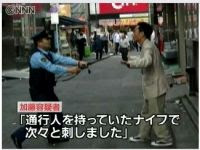
Shoppers in Akihabara, Japan's otaku mecca, were shocked on Sunday afternoon when a man crashed a truck into a crowd of people, injuring up to six people. He proceeded to leave the car and stab innocent bystanders with a knife, resulting in at least 17 wounded victims and 7 deaths.
Tomohiro Katō, a 25-year-old Japanese man, was soon arrested and admitted his guilt. He allegedly posted a message on an anonymous mobile phone bulletin board seven hours before the incident, titled "I Will Kill People in Akihabara" and reading, "I will come barging in with a vehicle, and if I can't use the vehicle, I will use a knife. Farewell, everyone." Sources say that his only reason for the attack was that he was "tired of life."
According to 47 News, Katsuhiko Nakamura (male, 74 years old), Kazunori Fujino (male, 19), Kasuhiro Koiwa (male, 47), Naoki Miyamoto (male, 31), Takahiro Kawaguchi (male, 19), Mai Mutō (female, 21), and Mitsuru Matsui (male, 33) are confirmed dead.
This is really some stunning stuff. Beyond the sheer madness of a man killing seven people because he was "tired of life," this event will surely make a major dent in Akihabara's image. Just as Japan's iconic otaku shopping center was reeling from police crackdowns on things like pop idols and cosplayers, this man has driven his truck straight through a carefully held-up image of decency and safety. Now American tourists will have to remember that Akihabara isn't just some magical land of otaku dreams, but a place just as flawed and imperfect as any other.
As Patrick Macias nicely put it, "This guy just killed Akihabara the way Charles Manson killed the sixties. And we're all under arrest now..."
[via Anime News Network and Patrick Macias]
According to JAniCA, a storyboard works for an average of 3,360,000 yen (US$28,800) a year, without vacation, and a key animator works for 2,160,000 yen (US$18,400) a year, with no vacation. As most of you have figured out, this organization plans to work for the improvement of the working conditions for the men and women who create all that wonderful anime you all love to watch.
[via Anime News Network]
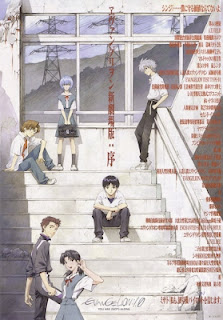
Rebuild of Evangelion, Gainax's newest remake of their The only other anime in the top 10 is Pocket Monsters Diamond & Pearl: Dialga vs. Palkia vs. Darkrai at #9. This was a really great weekend for Eva, and it's easily apparent that the series is still immensely popular in Japan. Ani-Gamers will have a full review when the film comes stateside.
[via Anime News Network]