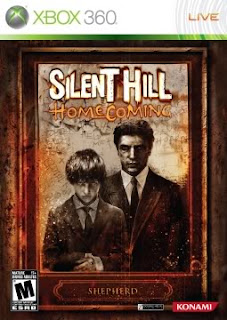
Genre: Survival horror
Designers: Jason Allen (Lead Designer), Jeremy Lee (Producer)
Developer: Double Helix Games
Publisher: Konami
Platforms: PS3, Windows, Xbox 360
Release Dates: Sep. 30, 2008 (US/CA), Feb. 27, 2009 (EU), May 12, 2009 (AU)
ESRB Rating: M for Mature
Silent Hill: Homecoming proves that a game series can still remain scary and true to itself while changing elements that define it. Homecoming follows a man named Alex Shepherd whose family was one of the four founding families of Shepherds Glen, a town located across Toluca Lake from Silent Hill. Waking from a dream in which he sees his younger brother running away while exploring a hellish hospital, Alex returns to Shepherds Glen in order to find his missing brother. Things are worse than he first imagined, though, as his mother is catatonic, his mentally abusive father has abandoned the family, and a childhood friend reports that more people go missing every day. As he continues chasing after his brother, talking to several of the citys prominent leaders in the process, he travels through Shepherds Glen and Silent Hill, discovering the truth to Joshs disappearance and the secret history of his familys heritage.
The storyline itself is very interesting, and the symbolism involved is rather profound. Taking its enemies into the darker corners of Alexs past, the creators at Konami have once again hinted towards the truth through bosses, enemies, and sceneries, mixing symbolism with the background to the game. Enemies, which range from nurses to underwater lurkers to creatures which walk on needles, are all scary but rather easy to kill given the right weapon. It takes very little practice to master the games combat system, yet fighting on the whole is somewhat clunky. Alex receives a variety of weapons throughout the game, and it is explained that he can handle most without training due to his background in the military. Therefore, Alex easily wields weapons such as knives, pipes, and even guns, but the game does a somewhat poor job of making combat as seamless as possible. Guns tend to lag when fired, and enemies will freeze for split seconds when shot. It is much more efficient and satisfying to play the game without guns at all, but when the time calls for some heavy firepower, players will be met with a bit of lag.
The sights and sounds in Homecoming are highly impressive. The graphics appear to be taken out of an old photoshoot, as there is always a bit of fading in the details of scenery and characters, particularly in the hellish versions of Silent Hill and Shepherds Glen. Rather than taking away from the experience, this touch makes the events that are happening truly seem otherworldly. Overall, graphics are very bleak and gray while nightmarish and dark in the hell counterparts, making for a beautifully disturbing game. Lighting is once again a crucial factor, as enemies are attracted to Alexs flashlight as well as light from objects such as televisions. However, on default mode, the game is almost too dark, to the point that players will have to turn the brightness level up just to see what they are doing. It is nice when things are dark and scary, but there is a point when players just have to be aware of their surroundings. The sounds of the game are just as good as the graphics, and voice acting is also well done. The only flaw is that dialogue is spoken very softly, making it difficult for players to hear at times. Subtitles help immensely, but surprisingly subtitles oftentimes do not align with what characters are saying. A word or two is off or the timing is wrong, making it difficult to follow along if players are relying solely on subtitles (which they should not have to do). However, the soundtrack to the game is phenomenal, and Akira Yamaoka has once again made magic with gruesome sounds and terrifying noises.
The game features a lot of exploration, and maps are, as they are in all Silent Hill games, extremely helpful. Traveling in the game can get pretty tedious, though, as players will backtrack through multiple areas numerous times in order to gain new items, talk to different people, or simply retrace their steps. Save points are scattered haphazardly around the worlds of Silent Hill and Shepherds Glen as well, making it hard to gauge when the next save point will be. Some save points come within five minutes of each other; others may take up to an hour to find. Furthermore, Homecomings puzzles can be a bit tiresome, including several tablet puzzles where players need to move pieces on a board in just the right way to proceed. These are frustrating, in that when a player gets stuck, they must exit and return in order to reset the puzzle, if it resets at all. With the lack of save points in certain areas, this can make for some disgruntled players. There are plenty of hidden items to find during Alexs travels, including photos taken of the various Shepherds Glen citizens, drawings left behind by Josh to be used as clues, and powerful weapons. Obtaining these items can be tricky at times, but the rewards are relatively good. Not only are there achievements to be unlocked, but they add a layer to the overarching story that makes it worthwhile to explore. With so many items to find, the inventory system is laid out somewhat nicely, yet it stops overall gameplay and can be tricky to maneuver when in the middle of combat, as players must choose from a wheel what items they wish to use.
Silent Hill: Homecoming has its flaws, but compared to the entire game, theyre actually relatively minor. The game itself is a great, in-depth story that is both horrific and inspiring. With five available endings for players, along with many unlockable items including outfits and weapons, there are plenty of reasons to replay this game. Achievements are relatively easy to get, as it only takes two or three playthroughs to unlock them all, but with such a good storyline, players will want to play it to relive the experience instead of just obtaining points.
[Highly Recommended]This review is based on a retail copy of the Xbox 360 version, purchased by the reviewer.
Medium: Manga (7+ volumes in JP, 1+ in US/UK)
Author: Konami Kanata
Genre: Comedy, Pet, Slice-of-life
Publishers: Weekly Morning – Kodansha (JPN), Vertical, Inc. (NA/UK)
Release Dates: November 22, 2004-present (JP), June 29, 2010 (US/UK)
Age Rating: Appropriate for all ages
I know, I know: The last thing you'd expect me to be reviewing is a manga about a kitten, but here I am, talking about the brand-new Vertical, Inc. release of Chi's Sweet Home by Konami Kanata. What may surprise you even more is that I actually like it!
The entire plot of Chi's Sweet Home can probably be summed up by simply reading down its table of contents, which contains chapters like "A cat is lost," "A cat is found," "A cat forgets," and "A cat understands." In fact, the comically straightforward nature of the titles underscores simplicity as the fundamental attribute of this manga story of a stray cat named Chi and the Japanese family that takes her in.
It's actually rather surprising to see such simplicity in a manga serialized in a seinen (men's) magazine, Weekly Morning, but as with many cutesy seinen titles such as Yotsuba&!, the manga is actually much more attractive to American children than it is to American men. Pursuant to this, Vertical's translation keeps the dialogue brief and easily comprehensible, while the intentional lack of detail in the art breaks with seinen's American reputation as being (sometimes indecipherably) detail-heavy. What's more, the book has only full-color pages, painted in beautiful, subdued pastel colors, which are sure to entice young readers looking for something more flashy than the typical black-and-white manga aesthetic.
On that note, Chi's design is easily the most important piece of art in the entire book, and it certainly gets the job done — and then some. Her saucer plate eyes and giant triangular mouth express a childlike excitement over even the simplest of everyday delights, and it can be hard to not imagine her screaming at the top of her lungs and smiling every time she gets excited. (By the way, this is coming from someone who has never seen the anime and thus doesn't have a preconceived voice for Chi.) Believe me, I didn't think that I would enjoy it, but I really took to Chi and the rest of the family after a few chapters.
Still, I feel like the comedy — if you can even call it comedy per se — might wear a little thin if the later volumes don't introduce any major new developments. After all, I don't really think that a picture of a cute kitten getting excited can remain very interesting for very long.
The chapters range in length, though they are typically much shorter than the average manga chapter, and some even come in at around five or six pages. Given such brevity of storytelling, it would almost seem like the story is built for the 4-koma (four-panel) format, but Kanata manages to tell a short, charming story in every chapter while maintaining the flow of a full-page manga layout.
As I mentioned before, Chi's Sweet Home doesn't really feel like a men's title in an American context, but it's actually a genuinely fun little book for children or cat lovers of all ages. Of course, I wasn't satisfied with simply guessing at the right audience for the book, so I let my 12-year-old sister read it to get a feel for what she thought of it. Within an hour she had read the entire thing, and claimed that she would actually buy the second volume if she saw it in a store (even after I informed her of the slightly high $13.95 price point).
To be clear, Chi's Sweet Home is not for everyone, but when put in front of the right eyes, it's an absolute joy. Kanata has crafted a simple yet charming mix of visual comedy, cute animal shenanigans, and great art that can manage to evoke quite a few chuckles, even from this jaded manga reader.
[Recommended]
This review is based on a promotional copy of the graphic novel, kindly provided by the publisher, Vertical, Inc.
Genre(s): Action, Stealth
Director: Hideo Kojima
Developer: Konami
Publisher: Konami
Console(s): PS3
Rated: M for Mature
It is a rare occurrence when a video game has the ability to move a person in a way much like the films of today. In 1998 video game director Hideo Kojima blurred the line between game and movie with the release of his first masterpiece, Metal Gear Solid. Nearly ten years later, this now ancient PlayStation title has spawned three direct sequels and a number of spin-offs. Claimed to be the series' "swan song," Metal Gear Solid 4: Guns of the Patriots provides an immersive experience that not only raises the bar for its in-game storytelling and technical proficiency, but also boasts the ability to emotionally affect and change the player's worldview.
The Metal Gear Solid series has always been close to my heart, and the fourth iteration is no exception. By nature I am not all that competitive; for me video games are a means to relax and unwind after a long day. What I look for in a game is a good story; one that sticks with me long after the game is over. One might have difficulty understanding why I look to a video game instead of a movie for good narrative and a solid plot. However, what they don't understand is that there is an additional layer of immersion within a story that only a video game can provide.
Metal Gear Solid 4 delivers on this level and provides a gripping story up to par with today's Hollywood blockbusters. From fleshed out characters to underlying moral agendas, this game has got it all. And if any complaint were to be made, it would be that this game relies too much on story driven cut-scenes to progress the plot. Personally, I have no problem setting my controller aside and watching some of the game's most impressive cut-scenes. This, however, is not for everyone. The game itself took me over twenty hours to complete and approximately half of that time was dominated by in game cinemas. Regardless, rhere is an option for those who do not care to watch the scenes to skip past them and get right into the gameplay.
Speaking of gameplay, MGS4 improves on its predecessors dramatically. The one gripe I had always had with the Metal Gear series was its outdated and often frustrating gameplay. Konami scrapped the old-school overhead view, and "westernized" the camera and controls. It is important to note that while the gameplay is vastly improved, it still takes some time getting used to. The controls, while streamlined, are still quite complex and require a bit of a learning curve to overcome. While somewhat complex, this level of complexity is absolutely necessary, as MGS4 opens an endless number of ways to play the game. From straight-up stealth to first person run-and-gun, the way you play is completely up to you. There is a plethora of different weapons, and the ability to customize each weapon to your liking encourages the gamer to replay the game a number of times to experience all this game has to offer.
What gripped me more than anything was the level of presentation; I have never seen such a polished game experience. Riddled with traces of Japanese humor, dramatic fight scenes and over the top plot twists, this game will have you on the edge of your seat until the very end. The entire game is run on the in-game engine and each cut-scene seamlessly transitions into gameplay. The game itself is broken into five self-contained acts spanning five vastly different locales, pushing the PS3's power to its limits. The game itself fills up an entire Blu-Ray disc, an equivalent of over six DVDs! The graphics and sound compete with the likes of Uncharted and Gears of War.
This game is art. Kojima once again pushes the envelope, essentially redefining the video game medium. You will come away from this game changed. There has been much talk as to what defines the next generation of videogames, but I'm telling you that this game is the ushering in of a new generation of games. If you are hungry for a solid narrative and an immersive experience, go out and buy this game now. You will not be disappointed.
Metal Gear Online:
In addition to the fantastic single player, MGS4 includes
Metal Gear Online, a place where you can test your stealth
skills against other gamers around the globe. Boasting a number of
different game types and the same great gameplay found in the single
player, there is much for fans to love. Unsurprisingly however, this
multiplayer component is no Halo or Call of Duty. The
registration process alone reminds you why Xbox Live is still leaps
and bounds over the PlayStation Network. Regardless, there is still
fun to be had here.
![]() |
||||
| Graphics/Sound: | 4.0 |
Average:
(4.0 stars) |
||
| Gameplay: | 4.0 | |||
| Design/Story: | 4.0 | |||
| Lasting Appeal: | 4.0 | |||
| Overall: | 4.0 | |||
Genre(s): Action, Stealth
Director: Hideo Kojima
Developer: Konami
Publisher: Konami
Console(s): PS1
Rated: M for Mature
There are some games that simply define not only their consoles, but their console generations as well. One of those games is Hideo Kojima's master work, Metal Gear Solid, for the Playstation. The story follows a special agent code-named "Solid Snake," assigned to infiltrate a military facility off the coast of Alaska that has been taken over by terrorists. The group in control of the island is made up of rogue members of FOXHOUND, Snake's former unit. They include soldiers appropriately code-named Decoy Octopus, Liquid Snake, Revolver Ocelot, Psycho Mantis, Sniper Wolf, and Vulcan Raven. In this one-man mission, Snake must meet up with hostages who can help him complete his mission, all while eliminating the members of FOXHOUND and deactivating the nuclear mech Metal Gear that the terrorists have hijacked in the base. Sound confusing? Welcome to the mind of Hideo Kojima.
The entire game is 3D (not as much of a given as it sounds back then) and is played from a top-down perspective. There's a reason MGS has a subtitle of "Tactical Espionage Action"; the game is played by moving Snake carefully so that he is not caught by the multitude of guards and security cameras looking to discover his position. He can use a lot of different abilities, including hand-to-hand combat, shooting a variety of guns, throwing grenades (frag, stun, or chaff, which disrupts cameras), snapping necks, and planting bombs.
The question for many modern gamers has been, "Why is this game so popular?" While there are many reasons, the most important one is pretty clear: characters. Solid Snake is, by far, one of the coolest and most memorable heroes video games have ever seen. Experienced, collected, and witty, this special agent is so much fun to watch and listen to (voice: David Hayter) that he has become an icon for video games. As if that wasn't enough, Snake meets characters like the anime fan Otacon (yes, named after that Otakon), the gruff Colonel Campbell, and the Engrish-speaking information specialist Mei-Ling. Finally, Snake's enemies include the giant Native American shaman Raven, the crazy Russian psychic Mantis, and the evil gun-slinging Ocelot. Nothing aids these characterizations more than the great cast of voice actors present in MGS
There are some great moments in this game's plot, all of which are supported by wonderfully-directed, cinema-esque cutscenes and stylized animated art in the scenes when Snake talks over his "Codec" communicator. Whether it's a ridiculous thing like Mei-Ling pointing out that "If you were my boyfriend, you'd never be able to cheat on me," or Psycho Mantis recalling his dark and surprisingly intriguing past, you'll be enjoying every moment of this clearly anime-like story.
While some modern gamers will find fault with Metal Gear Solid's dated graphics, it really is incredible what Konami has done with such a simple architecture. Each area is distinct and memorable, and there is a palpable sense of style that permeates everything from the character and level designs to the menu system. Even better, the inspired direction of the cinematic scenes turns unmoving, badly-rendered faces and other vague details into short films that will manage to captivate even the most hardcore graphics maniac.
Metal Gear Solid has a reputation for featuring some truly great sneaking gameplay, and it is indeed a reputation well-earned. Snake uses his radar to find enemies and their fields of view, but when he is caught, his radar becomes unusable until he gets out of sight. One of the great mechanics of this game is the ability to press Snake against a wall, at which point the camera changes so that he can see down the adjacent hallway. This simple use of the camera is one of many ways that the game makes sneaking feel natural. The only thing truly missing from the controls is the ability to shoot from the first person. You can shoot and you can go into first-person mode, but there is a conspicuous absence of the two together in Metal Gear Solid.
The puzzles in the game are also really fun. Puzzles you ask? Well, you see, the game isn't all about killing terrorists. Sometimes you will have to figure out a way into a room or (as is most often the case) a method of killing a boss. At this point, the game reaches its most fun point. Nearly every boss requires the player to think in unique ways. Not just out of the box, but out of the game as well. For one boss, the player must actually backtrack through the previous levels in mid-fight in order to find a weapon, and in another, the fight can only be won by switching the controller to the second slot. That, my friends, is what we call creativity.
With the recent release of Metal Gear Solid 4: Guns of the Patriots on the Playstation 3, people should also be looking back on the past of Hideo Kojima and Konami's iconic franchise. The original Metal Gear Solid has remained surprisingly fresh and relevant a full decade after its release. If you haven't already played this game, start up your Playstation 2 (or backwards-compatible PS3 if you're lucky) and pop in an old copy of Metal Gear Solid. Believe me, Solid Snake will be glad to relive his glory days -- as any old soldier should be.
![]() |
||||
| Graphics/Sound: | 3.5 |
Average:
(3.6 stars) |
||
| Gameplay: | 3.0 | |||
| Design/Story: | 4.0 | |||
| Lasting Appeal: | 4.0 | |||
| Overall: | 3.5 | |||
What better wayWhile some may argue that this was Kojima's announcement, most tend to believe that it was the announcement that Silent Hill V (that's 5) will release on PS3 and Xbox 360. No dates yet, but Konami promises more news on the game in the near future.
to end your day
at Konami's media briefing collecting ...
News for a major announcement
you were not expecting.
[via Joystiq]
Save This Page (And in case anyone was wondering: Yes, MGS4 is still a PS3 exclusive...for now)
[via Joystiq]
Save This Page