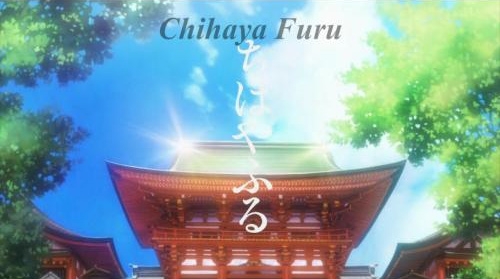
Reading Between the Cards of Chihayafuru
I’ll preface this article with three concessions: anime is not, for the most part, tailored to audiences outside of Japan; karuta is still popular in Japan, at least according to those responsible for its standing Wikipedia entry; and the Chihayafuru manga has won its fair share of popularity contests as well as awards. That said, it’s pretty easy to imagine Chihayafuru as propaganda targeting Japanese citizens, specifically those obsessed with anime and manga, who represent what I imagine is a growing disappointment to national pride in the eyes of elder Japanese. The dense, meditative poems of the island nation were once a source of pride and strong enough to arrest and sustain the attentions of the pre-Internet global community. However, the new instant-gratification Japanese generations (as well as the patience-deprived simulcast generations of the West) laud over-scripted, bang-the-point-over-your-head-with-a-pan cartoons.
Indeed, the economy-pumping vigor of domestic interest and the growth of anime popularity worldwide form a double-edged sword for Japan. There’s a stigma associated with animation that labels it a child’s medium in the West (despite myriad age- and sex-appropriate subjects), yet even the most regrettably childish series afford artists an avenue by which to express themselves while also drawing foreign attention towards at least some portion of Japanese life and culture. Anime, with its 24-minute episodes and movie-length features, seems to be the ideal artistic medium for representing Japan to itself and to the world. So much so that it’s hard to imagine poetry appealing to the masses in this age where time literally equals money. Poetry takes time, thought, and sometimes a range of insights (historical, political, personal, regional) in order to fully comprehend its bearers’ beauty. How then to rectify this gap of expression and misappropriated focus? Integration. Enter Chihayafuru.
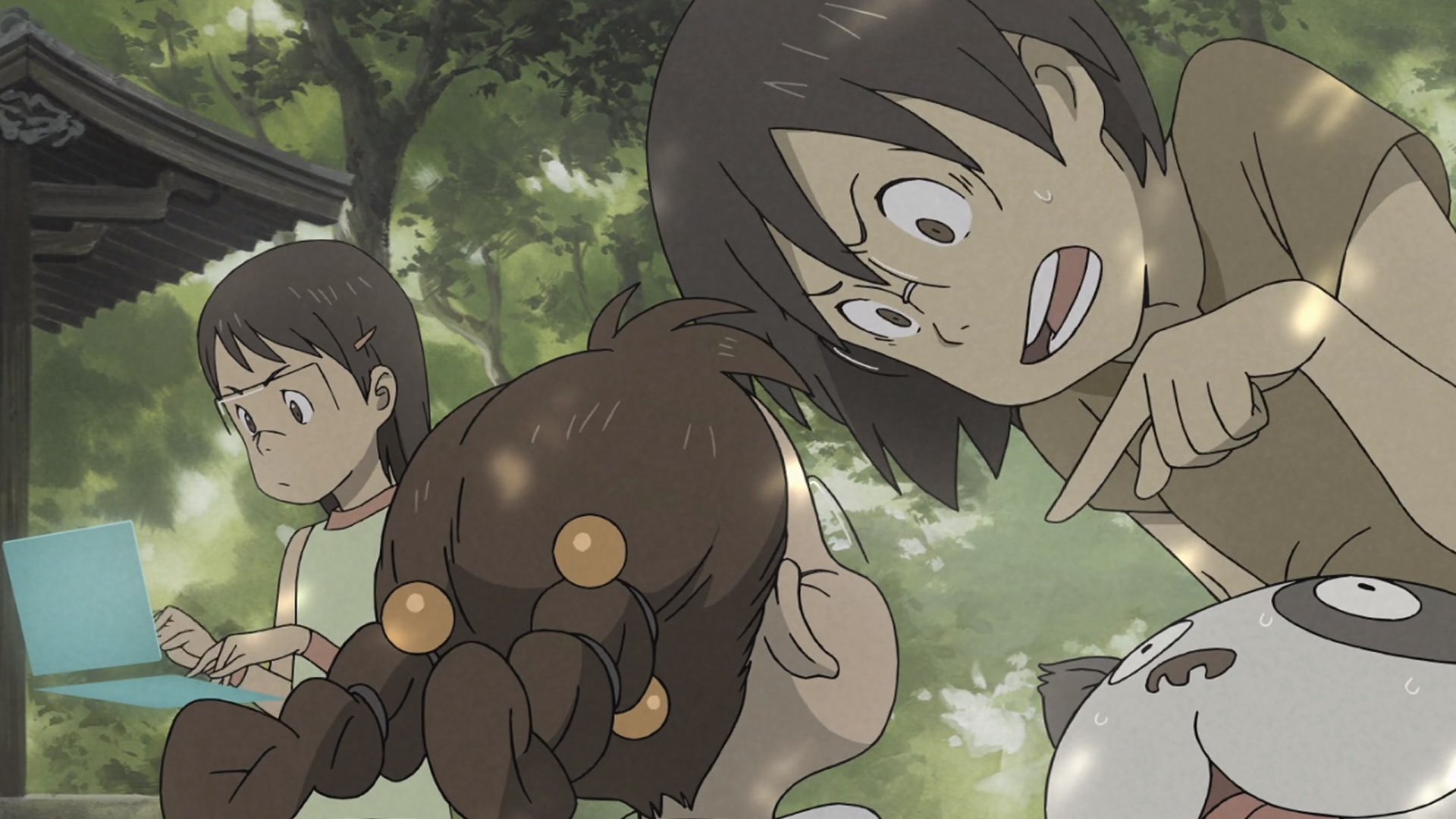
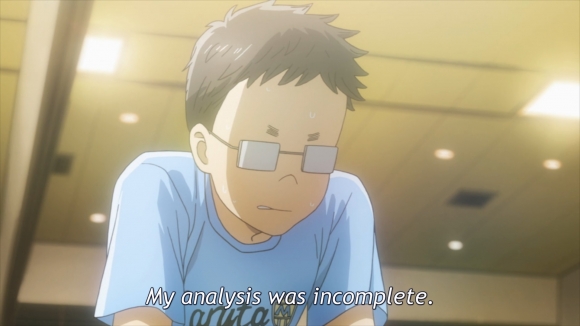
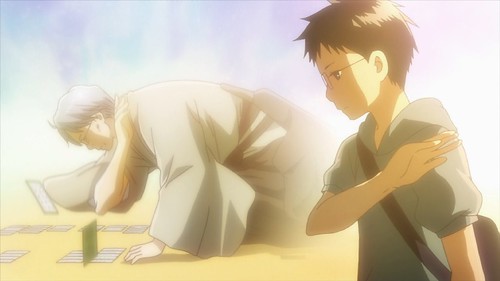
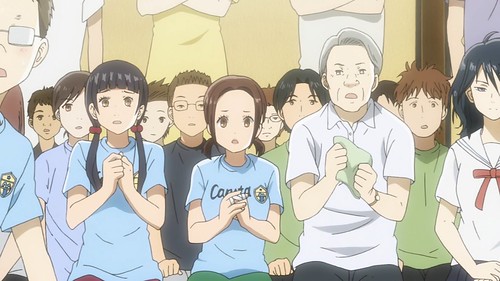
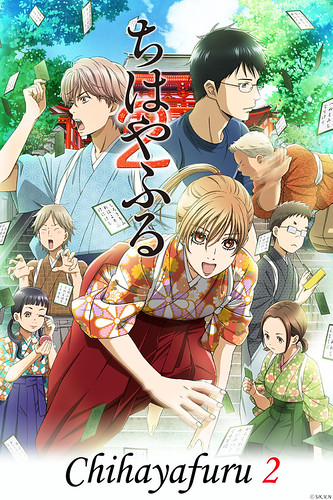
Based on the manga by Yuki Suetsugu, Chihayafuru centers around a group of friends who are, by varying degrees and focus, interested in competitive karuta — a card game unique to Japan. Karuta is essentially a timed Concentration match, except that the players’ cards are all exposed and there are no “turns.” Players are tasked with being the first to touch the card (torifuda) with the phrase that completes the card being read (yomifuda) by a designated, third-party tanka reciter. The competitive aspect lends to intense action, while the subject of the game, Hyakunin Isshu (The 100 Poets), lends to a sense of national history and pride. There is an innate conflict in these two aspects, and as the josei (women's) anime it is, Chihayafuru represents such turmoil via one of its characters, Kanade Oe, in relation to the game itself as well as others’ attitude towards it.
Specifically, Kanade’s point of contention is that the nature of competitive karuta does not allow any time to actually enjoy the poems. Players often have to spring for a card based on the first audible syllable. This conflict, like much in Chihayafuru, has no direct resolution, but the series uses its themes to great effect. Instead of attempting to mend the contention between gameplay and subject, Kanade takes consolatory pleasure in other aspects of the game, such as traditional garb (hakama) worn by contestants. This is not as flippant as it sounds. Kande has been brought up by her parents, who own a store dedicated to such traditional clothing. Also, Kanade delights in edifying her teammates (mainly the protagonist, Chihaya) by elaborating on the meaning of some of the verse on the cards they’re so haphazardly slapping across regulation tatami mats. Kanade, new to competitive karuta, is not the fastest on the draw, so becoming the Queen, or best female player (as is usually the goal of any female karuta player), is rather unlikely. Upon realizing why she continues to be a part of her karuta team, to become an official yomifuda reciter, Kanade discovers that she must become a queen. By the end of season one, Kanade has a long way to go. Her fortitude, however, represents ancient custom trying to find a place in the lives of the current generation. Kanade loves the poems so much that she wants to read them (or at least as much of them allowed per volley) in a sport that attracts the young! We can see the opposite attitude in the anime’s main character, Chihaya Ayase.
In the world of karuta, Chihaya Ayase is all ear and reflex — something that can actually bring about faults (otetsuki) during matches due to similar-sounding syllables. Chihaya represents the current generation of impulse and immediacy ... action without thought. This is made clear in several karuta matches where Chihaya loses because of her own limitations. The brilliance of the story, and I believe the intended moral as well, is how Chihaya, determined to become queen at all costs, takes in lessons from opponents and teammates alike. Every bout, whether participating or observing, is an opportunity for learning something new. Often, strength is associated with “personalizing” a particular card — a “sweet card,” if you will. Most often, it is the meaning of the lines of verse that make them “speak” to a player. Such internalization speaks more to poetry than to competition, yet still helps players get the upper hand during matches. This is epitomized in one of the last episodes of the first season, where the current queen, grown heavy from a lengthy chocolate binge, overcomes her speed handicap with the accuracy and determination derived from her personal connection to the poems.

The effort and personal growth shown in all the characters are what drive this series. The action, mainly the way the matches are portrayed, and a subtly threaded love triangle keep the pace lively and tender (respectively). However, it is the individual evolutions spurred on by internalizing the poetic content of karuta, whether for memorization in hopes of a faster strike or personal relevance to add passion behind the same, that makes traditional content (poetry) relevant to a new generation (anime viewers). The message, as flatly stated by Kanade in episode six, is that “You can feel the seasons and modesty in a way that can’t be found in modern poetry!” This is nostalgic Japan exclaiming, “wake up and internalize your history” via a modern art form that currently holds the attention of more and more people on a domestic as well as international level.
Chihayafuru is streaming right now on Crunchyroll.
Medium: Anime Film
Director: Mamoru Hosoda
Studio: Madhouse
Genre: Romance, Science Fiction
Publishers: Kadokawa Group (JPN), FUNimation (NA)
Release Dates: 2009 (JP), 2011 (US)
Age Rating: PG (MPAA: action violence, some suggestion content, language, mild thematic material, and incidental smoking)
With every new season, the saturation of anime series continues to expand. If your tastes are fairly broad, there is plenty to keep yourself occupied with from currently running shows and a backlog spanning several decades. For theatrical films, however, the market is significantly thinner. If you don't count films based off of an anime series — original plots or condensed story arcs — the choices are rather limited. The big names are Ghibli, Otomo, Oshii, Kon, and Shinkai. Tragically, Satoshi Kon has passed away which will leave a noticeable void in Japan's animated film output. Otomo's last works include the disappointing Steamboy and oddball live action Mushi-shi adaptation. Shinkai is hard at work on a film that seems to be a (welcome) departure from his usual fare. Miyazaki and Takahata aren't getting any younger, and man cannot live on Ghibli alone. Thankfully, 2006 saw the release of The Girl Who Leapt Through Time as the feature length debut of Mamoru Hosoda. He went on to direct Summer Wars in 2009, establishing himself as a key industry director.
Kenji Koiso, a high school student and mathematics enthusiast, is recruited by a girl at his school to help her out with some job. Despite his current part-time work with the infrastructure of virtual-reality super-network OZ, he decides to help her out without asking details. He helps carry her things as they travel to the traditional Japanese family mansion to celebrate her grandmother's 90th birthday. The girl, Natsuki Shinohara, asks Kenji to play along as she announces him as her fiance to her grandma. He now finds himself in the awkward position of being a pseudo-newcomer to this tight-nit and very large family descended from a warrior clan. During his first night there, he receives an email with a large string of characters that he is asked to decrypt by an unknown entity. Being almost Japan's representative for the Math Olympics, he wastes no time in pulling out some paper to work out the problem, which takes him all night. What he did not realize is that he was being asked to break the security that would breach the main OZ server, and in the morning he finds that his account is being used by the hacker to cause chaos in OZ. With most major government and official institutions being dependent on OZ, the hacker is able to cause damage not only online, but in physical space by taking over the person's privileges. For example, by obtaining the account of the president it would be possible to launch a nuclear missile.
Kenji discovers that one of the family members, Kazuma Ikezawa, is the infamous OZ gaming champion King Kazma. The pair find themselves in a battle against a dangerous artificial intelligence being tested by the US Army within OZ. Meanwhile family drama arises as the problems online are connected to the family in ways they did not expect.
Beyond the themes of online action, what lies at the heart of Summer Wars is a thoughtful portrayal of family life. The members of Natsuki's massive family all believe Kenji to be her fiancé, and welcome him to the family in different ways. Hosoda relates his own experiences from when he suddenly became a member of a family due to marriage through Kenji's awkwardness at being accepted into their close group. Indeed, the closest thing to a human villain in the story is the one family member who drifted away from the rest and went to America. The two major aspects to the story — family life and Internet action — seamlessly intertwine, and neither is pushed into the background or feel tacked on to the other. Summer Wars is ambitious in the broadness of its scope, but this natural connection is what really makes the story stand out. If anything, it is much more realistic. In Summer Wars, world-changing events are caused from computers sitting in the middle of a traditional Japanese mansion, not an underground hacker cave with fifty monitors and a nonsensical cooling unit. The heroes are awkward mathematicians, well-connected grandmas, and working class dads with years of video game experience, as opposed to trenchcoat-wearing dudes with BitTorent and bad attitudes. (See: every movie about hackers ever to compare)
One of the most common complaints made toward Summer Wars is criticism of its technical inaccuracy. The story revolves around an incredibly advanced Internet structure, called OZ, that can be connected to through all types of devices and thus has became an extremely integral part of business, culture, and communication. Users create avatars and are able to interact over OZ in various ways: chatting, shopping, business, learning, etc. Additionally, languages are instantly translated to allow communication with anyone. Even the least technically minded viewer can see that it is an unrealistic view of the Internet. This leads to many lumping it together with WarGames and Hackers with their over the top, glamorized distortion of real technological advancements. However, this is completely missing the point of the story. Summer Wars may not be realistic in its details, but that is not the point. It is an exaggerated stylization of computer communications and should be treated as such. Like much good science fiction, it is able to make very relevant points that concern real world technology in a highly fictionalized setting.
A major theme of Summer Wars is communication. OZ's primary function, like the internet, it to connect people and services from all over. The film demonstrated both the dangers of over-reliance on digital networking, as well as celebrating the positive aspects of everyone being able to work together towards a goal. The theme goes beyond modern technology; the grandma was able to use contacts from a lifetime to make phone calls and encourage family members and important decision makers to take action during the crisis. Throughout the movie, communication is key in solving problems — online and off.
One aspect that many viewers should be able to relate to is the contrast between the characters taking initiative and using their computers to fight the AI, and the other relatives who can't understand why they are wasting their time with "video games" during this time. For Kazuma, Kenji, and the dads who pooled their resources together, nothing is as important as stopping that threat inside OZ. They realize, especially after what just took place in their own lives, that what goes on in the wires does affect what goes on the "real world." It isn't until tragedy is -literally- looming over their heads that the non-techie relatives finally realize the gravity of the situation.
Hosoda touches on plenty of scenarios throughout the movie that could have been pulled straight from Slashdot. Compromised users were being assured that the security was impenetrable even after the hacking took place. Online accounts held enough power that stealing their account granted the hacker the user's government privileges. A dangerous artificial intelligence program was developed which questioned the responsibility of the developer who didn't actually implement it himself. A hacker was causing problems through an account that had been taken over, leading to the arrest of the innocent true owner of the avatar. While the movie itself may be an implausible action movie with pseudo-technological workings, the points it makes are often grounded in reality. The actual computer use is done in a way that can be approachable to the average person, but the technically inclined viewer should be able to appreciate its themes with a deeper understanding. Instead of seeing it as dumbed down or inaccurate, I adored the stylization of the Internet and artistic interpretation of technical concepts through Superflat imagery. The last thing I would have wanted is if it became an Nmap documentary.
Summer Wars has very impressive production values with smooth, detailed animation and a high degree of artistic merit. Two distinct art styles are used to easily distinguish the real world and OZ: The real life characters are designed by Yoshiyuki Sadamoto, whose work contains the same appeal and quality that he is known for, and I've noticed since The Girl Who Leapt Through Time that his style has become even more distinct and refined. The background artwork is composed of beautiful countryside scenery and convincing realistic settings. The visuals are extremely detailed, which provides a noticeable contrast to the Superflat style used in OZ. This style, mostly associated with the work of Haruki Murakami, is frequently used in Hosoda's work and has been become a trademark of his style. Even his work with Digimon incorporated a very similar (if less ambitious) Superflat world for the Digimon to fight in. Summer Wars takes it to a new level, with a fantastic stylized world with bright, flat colours against a largely pure white canvas. I've always been a big fan of the Superflat style, and Summer Wars delivered a truly spectacular example of the craft.
Hosoda has obviously been holding onto this premise for a while — after all, his work with Digimon uses almost the same plot. In Digimon: Our War Game, a virus-type Digimon is infecting all of technology through the Internet and causing chaos by manipulating everything it can. Some of the first season's cast meet up to stop the threat by sitting at their computers and working with their Digimon partners who are battling inside a Superflat-style online world. The conclusion practically mirrors that of Summer Wars with the virus launching a nuclear missile (the possibility of this was even alluded to in Summer Wars, I'm assuming as a reference). In the end, people around the world send emails in support of the Digimon. There are so many emails that Izzy/Izumi forwards them to the virus who is then slowed down (DDoS?) enough for them to finish it off. It is good to see that Hosoda was eventually able to fully flesh out the concept with the experience he has gained since then.
I absolutely love this film. It follows a fairly typical action blockbuster formula, but with a level of craftsmanship, intelligence, and social satire that elevates it above the expectations of the genre. I have no doubt that there will be criticism of its typical action film influences, but it really does Summer Wars a disservice to lump it with the mindless action film crowd. If anything, it takes the elements that makes such films so entertaining, but loses the pedestrian brainlessness associated with them. Instead, it presents a thoughtful, realistic, and charming portrayal of family life in addition to the cyber-warfare action plot. Summer Wars is a film that embraces a video gaming, highly connected culture and equally the importance of everyday family life. It is a near-perfect representation of the joys of living in the information age, presented in a wildly unique and enjoyable package.
[Highly Recommended]
This review is based on a retail Blu-ray disc purchased by the reviewer.
Medium: TV Anime Number of Episodes: 26
Genres: Drama, Musical, Romance
Director: Osamu Kobayashi
Studio: Madhouse
Licensed?Yes (FUNimation)
Ever wanted to be a rock star? Stand on a stage and sing your heart out for a packed show? See your picture plastered all over album covers? Well, as we so often hear, that sort of stardom doesn't happen overnight in real life. Apparently, it doesn't happen in anime either, because it takes twenty-five episodes for Yukio Tanaka, the protagonist of Beck: Mongolian Chop Squad, to make it big.
Beck is a story of slow successes. Really, really slow successes. Yukio begins the story as a lowly middle schooler, with nothing going for him except for a vague interest in swimming and a childhood friend that he's crushing on. After a chance meeting with a sixteen-year-old guitarist named Ryusuke "Ray" Minami, Yukio dives headfirst into the world of rock and roll. He borrows CDs from his childhood friend Izumi and takes guitar lessons from his swim coach Saito, with no real goal except to impress Ryusuke. Eventually he joins up with Ryusuke's band, Beck, and the group (Ryusuke on lead guitar, Tsunemi Chiba on vocals, Yoshiyuki Taira on bass, Yuji "Saku" Sakurai on drums, and Yukio on rhythm guitar and vocals) struggles to "Hit in America" – the title of the show's OP – by climbing up the indie charts in Japan. Meanwhile, Yukio struggles with a complicated love triangle between him, Izumi, and Ryusuke's sister Maho.
It's important to note here that nothing happens quickly in Beck. It takes quite a few episodes for Yukio to even get a guitar, and it takes him much longer to learn it. Then it takes him a similar amount of time to get over his crippling wimpiness and approach Ryusuke. Finally, it's almost halfway through the series by the time he is actually a member of Beck. Hell, he doesn't even have his mind made up about who he has a crush on until the halfway point.
As cool as it is to see a wimp transformed into an awesome rocker, and as novel a concept as it is to show this as a realistically difficult process, none of these things contribute to Beck actually being enjoyable. It begins with potential, but quickly sputters out as it turns into a series of dismal failures on Yukio's part. There's so much whining and so many excuses in the first half of the series that you just might mistake it for Evangelion: The Musical.
The second half picks up a bit, and eventually reaches a climactic 5-episode-long concert scene that manages to keep things rolling for a surprising length of time. Still, wading through the sludge that is episodes 1 through 20 is painful, which gives the sweet final scenes a bit of a bad aftertaste.
Further, the animation reeks with the kind of half-assed, sloppy vectorized style that marred director Osamu Kobayashi's notorious stint on Gurren Lagann (episode 4), and serves as a stern reminder of why digital animation is not always better than cels. Character designs will occasionally be drawn completely wrong, and there are moments where faces in the background of a scene will be wordlessly gesticulating for no apparent reason. It feels like this was made on a tight schedule and/or with very low production values, or that there was minimal communication between different parts of the animation team. The only parts that ever look very good are the guitar scenes, which are lovingly animated in full cel-shaded 3-D.
But hey, at least the music's good, right? The songs are a lot of fun, as they span everything in rock and roll, from pop-rock to blues to Chili Peppers-esque rap-rock. The riffs are quite catchy, even if you only catch bits and pieces of music each episode up until the final show. Sadly, a lot of the Engrish from the original Japanese makes the lyrics sound comically awful, even when translated into their slightly-improved English dub counterparts.
On that note, the dub is one of the most important features of Beck's North American release. Many characters in the original Japanese dub track speak English, so ADR directors Taliesin Jaffe and Christopher Bevins faced a unique challenge in translating this difference into a dub track that would be entirely in English. They achieved this by having characters speak with different tones and levels of formality, so that informal speech would be from English speakers talking in Japanese, and formal speech would be from Japanese speakers speaking Japanese. The parts where characters switch to English were essentially ignored, and treated as if they were in Japanese. The result is a pretty well-performed dub track (with great singing performances!) that differs substantially from the original Japanese, to the point where, switching between the two mid-episode, I often felt like I was watching two entirely different shows. For that reason, as well as the important and intentional cultural issues raised by the show's bilingualism, I highly recommend the Japanese track. (Despite its hirarious Engrish slip-ups)
Unfortunately, Beck is very difficult to suggest to most people. It's got great music, a realistic, down-to-earth premise, and an awesome final stretch. It's almost worth it to get through the twenty episodes that it takes to reach the rocking finale of the series, but in reality the bad pacing and even worse animation make Mongolian Chop Squad a chore to complete. Interestingly enough, however, Beck seems to almost be teaching us, whether by accident or not, the essential discipline of music: If you can get through the hours and hours of grueling practice, you'll find that all of the beauty and awe lies just on the other side.
average.
Medium: TV Anime
Number of Episodes: 13
Genres: Drama, Mystery, Psychological, Supernatural
Director: Satoshi Kon
Studios: Madhouse
Release Year: 2004
Licensed? Yes, but out of print (Geneon)
You should know the name Satoshi Kon. Well-known for his films Millennium Actress, Perfect Blue, Tokyo Godfathers, and Paprika, the "Hitchcock of anime" decided after his first three movies that he had more ideas to play with, so what did he do? He dumped all his unused stories into a 13-episode mini-series that does to society what a starfish does to a fiddler crab. Look it up on Wikipedia it’s awesome! And Paranoia Agent isn’t that bad, either.
The surrealist psychological drama centers upon the mystery of Shonen Bat (‘Lil Slugger in the English version), a mysterious young boy terrorizing emotionally cornered citizens with a bent, golden baseball bat. Ah, little league tee-ball; those were the days. The detectives who act as the loose story's main characters have no leads and each victim leads only to more dead ends as the murky legend of Shonen Bat reaches mythic, nearly supernatural proportions. And the strangest part of these attacks? The victims lose their worldly troubles; their head traumas somehow make them happier. Not very hard for the average Japanese cram school student, let me tell you. So just when you start to fear Shonen Bat, you start to respect him...then go right back into being terrified, like a circus clown with a flamethrower.
Kon roped in Seishi Manakami for the script. His goal was to shift perspectives by changing the main character in each episode, giving viewers a macrocosm of Shonen Bat’s influence. Each character gives a very personal POV into their individual case, personal struggle, and eventual encounter with Shonen Bat. Some episodes can be watched on their own as their characters have little relevance to the larger story. Such episodes are magnificent fillers, but Kon’s fingerprints are all over each of them. His grasp of human emotion, psychology and story structure are frighteningly accurate, which makes the black humor in Paranoia Agent even funnier and more poignant. If you laughed at Heath Leger in The Dark Knight, you’ll get a few sick chuckles out of episode eight.
What draws me to Paranoia Agent, from the old-fashioned detective to the reserved animator to the schizophrenic tutor to the fallen golden child to the lecherous reporter, was the pathos developed with every character. Every character is a case study for the psychological pressures of modern Japan. The situations are very believable and the stress of Tokyo almost becomes its own character as students, teachers, and the elderly are all equally pressed from all sides by the struggle to match society’s expectations.
As a testament to Satoshi Kon’s micromanagement prowess as a director, every episode features a repetitive sound that sets the pace and structure for the story. Speaking of sound, the bizarre pseudo-techno, dreamlike music of Susumu Hirasawa (Paprika, Berserk, and Millennium Actress) adds another level to this visual mind-screw into a scrambled but beautiful mess, like a naked rugby game during a hurricane.
During his interview on the first DVD, Kon mentioned his fascination over a child’s ability to create a stomachache just to avoid going to school. Thematically, avoiding responsibility is the social and emotional paralysis that summons Shonen Bat. If you watch this series and keep “accountability” in mind, you will understand every symbolic shot in this series.
Now Paranoia Agent is obviously not for little kids, but this masterwork deserves at least a gander from any fan of Hitchcock, Memento, or Misery. For the ridiculously low price you can find it for, it deserves a spot on your shelf. (The English dub is unmatched in its execution to boot!) It is exciting, dangerous, and visually dazzling stories like this that keep me watching anime.
excellent.
The prolific Japanese anime studio Madhouse held a panel at Otakon 2009 to promote their titles in the United States. The panel primarily consisted of previews of upcoming movies/series that had been announced at previous conventions.
The first to be presented was Rideback, which concentrated on “a cute girl” and a mech. The mech, in this case, was a motorcycle with stabilizing arms, which turned into a mobile suit whenever the LED display read “spread legs.” Yeah. When asked why the studio was involved with a story involving mechs and cute girls when the studio usually favours neither of the two, the panel responded that they didn’t really mind the cute girl and that the mech issue was generally one of work, and since the work for the mech aspect was farmed out to a 3D CGI department, they didn’t mind that either.
The second preview was for the second season of Hajime no Ippo, or The Fighting Spirit, which will be under the supervision of a new director since the original director is involved in a movie for the same property.
Up next was The Heavenly Road (working title), which focuses on Chinese warlord stories and populates them with “beautiful young men” (since that is the trend).
Along with season 2 of Chi's Sweet Home, which was resurrected due to popular demand (according to the company), Madhouse previewed a movie called Summer Wars. Stunning just from the preview, Summer Wars turns out to be from Mamoru Hosoda, the director of The Girl Who Leapt Through Time, and it features most of the same primary staff. It focuses on a rather large family (80) and took 3 years to make. It was visually entrancing, and, given the director, I’m sure the story will be just as compelling as the animation.
Yona Yona Penguin, a collaboration between Madhouse and a French studio, is a 3D movie that evokes an Alice In Wonderland effect. The main character, a young girl in a penguin suit, aids forest nymphs (fairies) in an attempt to help a fallen angel (literally) get back to heaven.
Another movie, Mai-mai Shinko, deals with two kids living the country life of the ancient cultures of Japan. Although the panelists ensured it would be heartwarming, they also divulged that the director was none other than Sunao Katabuchi of Black Lagoon.
On an action note, the movie Redline, directed by Takeshi Koike (the same man who directed “World Record” for The Animatrix), offers its viewers the stark landscapes and machine-oriented but human-driven settings/action reminiscent of Dead Leaves. Nothing more was said of the project (other than what the preview itself showed), but it looked to be highly stylized and adrenaline-packed.
Lastly was a fan favorite (based on the surrounding hoots and hollers) originally revealed at Anime Expo: The Trigun movie. Judging from the preview, fans can expect more of the same from a movie that introduces a new villain and pits Vash against an old friend.
After the previews, it was onto Q&A with the panelists. Among Madhouse’s deep, dark secrets was that there can be found many dead (sleeping) bodies at the studio during production; that Satoshi Kon’s new project, Dreaming Machine is still in the storyboard/key animation stages; and that two new TV series with separately feature “a cute girl” and “a boy in a tough environment.”
Hosts: Evan "Vampt Vo" Minto, Mitchell Dyer
Topic: Tokyo Godfathers (2003)
This time we're talking about a movie from Evan's favorite anime director: Satoshi Kon (Paprika, Paranoia Agent). The review portion is sort of short compared to the What'cha Been Doing? segment, which is probably because Evan had to rush to go see Star Trek at the end of the episode.
Our plans for next episode are not yet solidified, but the goal is to record a whole slew of new episodes at Otakon later this month, and to record a Cowboy Bebop episode featuring Evan, Mitchy, and Karl once the former actually finishes watching the show. Till next time, so long, dear listeners!
Show notes and links can be found after the break.
(Runtime: 49 minutes)
[0:00:00] Intro: Voice actor Bill Rogers (recorded at Castle Point Anime Convention 2009)
[0:00:04] Opening Song: "R.O.D Theme" by Taku Iwasaki (R.O.D. OVA opener)
[0:00:19] Introductions happen. They are brief. Like this summary.
[0:01:11] What'cha Been Doing? Evan has been watching Cowboy Bebop, reading The First President of Japan, and playing Fallout 3. Also he has NOT been reading the yaoi doujinshi that his uncle accidentally bought him. Mitchy has been playing BlazBlue: Calamity Trigger, BloodBowl, and Battlefield: Heroes.
[0:22:45] Break: Title music for Tokyo Godfathers
[0:23:46] Discussion: Mitchy and Evan gush over Tokyo Godfathers for twenty minutes. Highlights of this segment include: a homeless Japanese drag queen, right turns, and Christmas MIRACLES! <3333333
[0:42:54] Promo: Anime3000 Panel
[0:44:02] Links of the Day: Mitchy can't stop laughing at this kid who goes crazy when his mom cancels his WoW account, and Evan is promoting a mini-protest against gender-stereotypes in comics fandom.
[0:47:16] That's a wrap!
[0:48:42] Ending Song: "WORLD END Instrumental" by FLOW (Code Geass R2 second opener)
[0:49:00] Outro: Mitchy is Japanese Retarded.
Medium: OAV (Original Animated Video) Number of Episodes: 3
Genres: Action, Cyberpunk, Science Fiction
Director: Yoshiaki Kawajiri
Studio: Madhouse
Licensed?Yes, but out of print (Central Park Media)
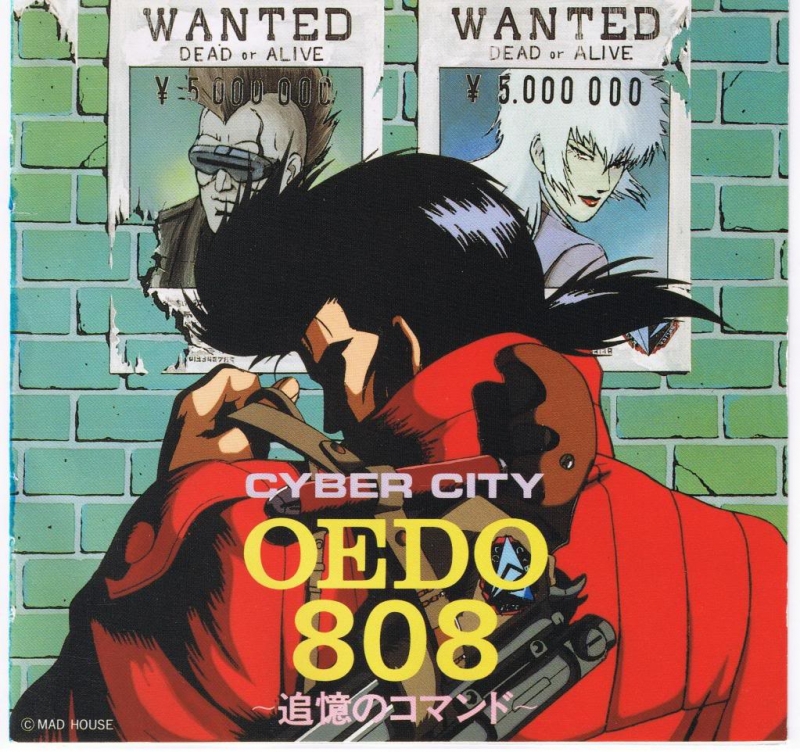
There's something special about OAVs from the late 80's and early 90's. Their blatant disregard of silly things like coherency and decency have made for some epic flops (M.D. Geist) and some verified classics (Megazone 23), but among the pile of crap and quality is an oft-overlooked anime that deftly skirts the line between being great and just plain stupid: director Yoshiaki Kawajiri's Cyber City Oedo 808.
Our story follows three reluctant heroes from (get this) a "cyber city" called Oedo, set in the year 2808. But these heroes are not out to save the world or anything as silly as that. They are "cyber-criminals," sentenced to hundreds of years in space-jail for presumably cyber-related crimes. These unlikely heroes – hothead Sengoku, hacker Goggles (pronounced Gogol), and mysterious androgynous dude Benten – are hired as cyber-police to do the dirty work that the normal police won't do. If they disobey their warden and boss Hasegawa, the collars around their necks will explode, taking their heads off with them.
Obviously, these guys pretty much have the worst job in the world. Giant space-scraper (like a sky-scraper, but bigger) is being hacked into? They've got it. Psychic cyborg is killing random scientists? Make the call. CYBER-vampire is, um, being a cyber-vampire? Bring in the cyber-police! Each of these stories focuses on one of the three characters, resulting in a sometimes formulaic structure that still manages to give each of them a chance to shine.
It is natural to assume that a show like this would have a really silly, stupid plot. After all, I've just mentioned space-scrapers, psychics, and vampires all in one paragraph, and it seems like every word in this show begins with the word "cyber". However, Kawajiri (Vampire Hunter D, Ninja Scroll), known for his testosterone-addled, nonsensical stories and needless violence, manages to make it all work together in one of his tamest anime ever (by which I mean it is utterly devoid of rape). The character developments and twists in each act are relatively believable, despite their often outrageous circumstances. Beyond that, scriptwriter Akinori Endo (Armitage III, Battle Angel) manages to throw in some human drama and even romance among the robots and explosions. These excursions into deeper narratives, such as Benten's brief and thwarted love for a vampire woman, are limited in length and not always particularly good, but they manage to soften the plot enough to keep it from being too laughable.
But now that we're on the topic of laughs, let's go over what really makes Cyber City Oedo such a fun time. As mentioned before, there are cyber-vampires and psychic robots, but the three stories are also riddled with skeleton-controlled-computers, copious amounts of monofilament wire, and even a team of robot sabertooth-tigers equipped with mouth-lasers. Can nothing else make this anime crazier? Well, as it turns out, the kind people at Manga Entertainment, in their quest to gain a higher age rating for the movie, provided viewers with a dub containing hundreds of swear words and even whole plot changes (a dated technique called fifteening). It's truly amazing what Manga did to this movie. Sengoku comes up with wondrous uses of profanity, such as "fuckin' pisser," while all the characters (magically transmuted into double the assholes that they were in the original Japanese) speak with some variety of a New York accent.
For those worried that this OAV's 1993 release date spells bad animation, don't fear. OAVs were able to use more time for development, and less money for distribution, so the top-notch animation and art quality have aged very well, despite the fact that Cyber City is over a decade old. The art direction, which calls up images of Ridley Scott's classic cyberpunk Blade Runner, is also pretty cool, though the costumes scream 90's like an orange-striped neon green running jacket.
Cyber City is good fun, though it is admittedly far from clean. It might have jettisoned Kawajiri's trademark misogyny, but it retains his fascination with hyper-violence, as people's limbs are torn from their bodies and their heads explode. Still, that violence, combined with its relentless and immediate action, provide just the thrill that its target audience is looking for. Any fan of science fiction and/or cyberpunk anime will find much to love in the dirty cyber-streets of Oedo. Cyber City might not be high art, but who's saying that the Mona Lisa wouldn't have been improved by the addition of a couple cyber-vampires?
Just sayin'!
great.
Medium: Anime Film Genres: Adventure, Drama
Director: Satoshi Kon
Studio: Madhouse
Licensed?Yes (Sony Pictures)
Satoshi Kon is like a master mechanic. Give him the parts, and he will concoct a machine that breaks new ground in whatever genre he pursues. In Perfect Blue, he made a seemingly traditional psychological drama that in fact directly attacked the underbelly of otaku-dom. In Millennium Actress, a simple biographical story took us to realms rarely touched in such narratives. Paranoia Agent broke down the conventions of murder mysteries, resulting in a twisty show that never seemed to go where you expected. In Tokyo Godfathers, Satoshi Kon takes a trio of cold, hungry homeless people, and weaves around them a story of hope, redemption, and sacrifice: a story as emotionally touching as it is subtly funny.
Tokyo Godfathers takes place, naturally, in Tokyo, where Gin, a gambler and alcoholic, Hana, a former drag queen, and Miyuki, a runaway teenage girl, - all homeless - find an abandoned baby in the garbage. It is Christmas Eve, so they decide to try to find the baby's mother rather than simply hand it to the police. The three take the newly-named Kiyoko all around the city in search of her parents, meeting a wide array of side characters and learning about themselves and each other along the way.
Unlike Kon's usual fare, Tokyo Godfathers cuts back on the surrealism and takes a more realistic road to reach his classic reality-fantasy split. From the get-go we are hit over the head with striking dichotomies between idealism (a church choir) and realism (a crowd of hungry homeless). Throughout the movie these themes are continued as Gin searches piles of trash under the beaming lights of Tokyo Tower (an important visual motif in the film). The only time we feel the typical Kon come through is in a brief dream sequence where he brings back his traditional identity-confusion and complex symbolism.
The major difference between Kon's other stories, however, is the focus on characters over narrative. While the central plot remains strong, with Kon's trademark narrative crescendo/subtle ending combination, the focus of the audience's attentions in Tokyo Godfathers rest very heavily on the three main characters. We are made to laugh with them, smile with them, and sometimes cry with them, as they meet new friends and battle terrible circumstances to bring a baby back home.
This central tale, the concept of three pieces of "human trash" being blessed with a piece of unspoiled humanity, is something that we can all relate to in some way. Gin, Hana, and Miyuki are all given fair time to play out their own separate dramas, but Miyuki most surely steals the show. She represents a fascinating and complex parallel in which a young girl runs from her parents, only to embark on a journey to find the parents of an abandoned girl. These sorts of deep-rooted thoughts of home and family that run through the three characters are what hold together the sometimes disjointed little vignettes that make up the story.
Gin and Hana perhaps sum up the themes of the film perfectly in one exchange. Gin reminisces about his daughter, telling Hana, "a father never forgets his child." Miyuki, shaken by a message from her father, suddenly storms out of the room. After a moment, Hana adds, "a child never forgets its parents."
As we have come to expect from Kon and his go-to studio, Madhouse, Tokyo Godfathers looks beautiful. The backgrounds (especially the snow-covered buildings and streets) are as stunning as any classic Christmas painting, and all of the characters move with a lively and often comical fluidity. Even so, the film suffers occasionally from Kon's traditional character design problem: Most of the male side characters look a tad similar, meaning that audiences will have to pay close attention to understand who's who.
Arguably it doesn't have much competition, but that doesn't stop Tokyo Godfathers from being the best Christmas movie to ever come out of the anime medium. Satoshi Kon has pulled together three pieces of garbage, and given them a light to shine their way through the cold and dark. He has engineered a film that finds beauty not in shimmering lights of Tokyo Tower, but in the hopes and dreams of two rejects, the tears of a runaway, and the shining face of an abandoned child.
Medium: TV Anime Genres: Cyberpunk, Drama, Mystery, Science Fiction
Director: Hiroshi Hamasaki
Studio: Madhouse
Licensed?Yes (fmrly. Geneon, status unknown)
The era of cyberpunk anime has come and (some might argue) gone. From the mid-1990's to the early 2000's, the medium saw a huge glut of Blade Runner-inspired cartoon TV series and films exploring the depths of human nature and technology's part in our lives. Smack in the middle of this techno-human revolution are the works of Chiaki J. Konaka and Yoshitoshi ABe, the writer-illustrator team best known for Serial Experiments Lain. In an epic 26-episode collaboration with studio Madhouse, these two men created Texhnolyze, a dark thriller that comes off as being a little too punk and not enough cyber.
Ichise is a prize fighter who's down on his luck. Not only does he live in the filthy, dank, dangerous underground city of Lukuss, but he's also just had his right arm and leg cut off by some members of the ruling class, the "Organo." A beautiful doctor takes him in, and outfits him with cold, mechanical replacements limbs in a process called "Texhnolyzation." Though this process is reserved for the upper class, Ichise is incensed at Doc's decision, and immediately escapes her lab. Unfortunately for Ichise, however, a visitor to the city named Yoshii is beginning to stir things up among the mafia-like Organo, a religious sect called the Salvation Union, and the street gang the Racan.
Ichise soon finds himself among the ranks of the Organo, trying desperately to fight for his life and his future in a city thundering down the road to madness. All the while he attempts to track down a young girl named Ran living outside the city limits. She is a legendary seer who apparently has the power to determine the fate of the city. In this brutal scenario, the stories of Ichise and the people he meets carve a sad, gruesome tale of dreams, pride, and loss.
The writing in Texhnolyze is as complex as it sounds. Like a Serial Experiments Lain without its cyberculture bite, this show is a much more traditional dystopian tale. Even though humanity has developed technology to fix their own bodies, everything in Lukuss, from its buildings to its people, is broken down and dilapidated. This becomes the primary concern of Texhnolyze as soon as we see Ichise's tragic 3-episode battle to simply walk after his incident. Hell, he even spends an entire episode in a daze at the bottom of a staircase, willing himself to get to the top.
The script is painfully convoluted, sometimes with important information, and sometimes with useless psychobabble. Comprehending the hierarchy of the various factions in Lukuss is essential to an understanding of the show, so viewers will unfortunately be forced to hang on every word in order to make sense of the dialogue. Exacerbating this is an irritatingly unbalanced dub track, and no dubtitles to back it up. Still, if you can navigate through the problems and understand the story, Texhnolyze manages to be surprisingly engaging, especially in its final act.
ADR Director Jonathan Klein provides for a fairly entertaining dub, capturing the depression and lost hopes of the city of Lukuss. Justin Gross and Carrie Savage get their rather emotionless jobs done as Ichise and Ran respectively, but the ones to look out for are Onishi (leader of the Organo) and "Doc." Patrick Seitz puts out a very cool, powerful persona as Onishi, while Victoria Harwood is sexy (and British) as Doc. To my delight, the DVDs also come with some mildly funny parody dub lines the guys in the studio made for each DVD.
We have come to expect big things from Madhouse, and Texhnolyze does not disappoint on the visuals. The dark, moody atmosphere of Konaka's script is effectively brought out in the brownish-gray color tone of the show. When, near the end of the show, we finally see a world other than the derelict Lukuss, the contrast is beautifully portrayed. Sadly, Madhouse dilutes the clean, stylish artwork with odd touches like a static screen overlaid on fight scenes and unnecessary rotated frames. This works with a cerebral show like Lain, but I think it's safe to say that a static overlay is unnecessary in Texhnolyze's well-drawn action scenes.
Yoshitoshi ABe's character designs are great as always, though they still suffer from being unrecognizable from each other when animated. Regardless, a choice few of the characters are distinctly recognizable, especially Onishi and the Lain-inspired Ran.
Texhnolyze is surely not for everyone. It has brutal violence, political intrigue, and philosophical questions, but as usual, Konaka's script skirts these issues and takes a roundabout approach. Thus, it is the approach, and not the content, that will probably turn most people off of this series. If you liked Serial Experiments Lain a whole lot, but thought it needed more bloodshed, characters, and episodes, you might want to give this anime a shot. However, if you're not into depressing stories about sad people in a sad, dirty city, Texhnolyze probably isn't up your alley.
![]() |
||||
| Animation: | 3.0 | Overall: (2.5 stars) |
||
| Plot: | 2.5 | |||
| Voice Acting: | 3.0 | |||
| Sound: | 2.5 | |||
Release Quality:2.5
Media: TV Anime Genre(s): Drama, Shojo, Romance
Director: Osamu Kobayashi
Studio(s): Madhouse
Number of Episodes: 12
Licensed? Yes (Geneon)
Disclaimer: This is a shojo. There are no ninjas or explosions; there is only fashion. E! did not get me interested in fashion: Paradise Kiss did.
Yukari Hayasaka is a bit of a stuck-up senior high school student: she studies hard to earn her B-average and is already bored with life. This comes to a crashing halt when she discovers a team of fashion school students who take her to their underground "workshop." Suddenly Alice has been tripped into a Wonderland of lace, butterflies, polyester, silk, clovers, and the bisexuals who design and wear them.
Paradise Kiss feels like an indy project from underground art school drop-outs. It can be described as a slice-of-life, coming-of-age story with a surplus of style and a forte of fashion. Its opening and closing themes, "Lonely in Gorgeous" and "Do You Want To" respectively, carry the show's youthful and vibrant energy, blasting you with colors, caricatures and craft. Many scenes morph between super-deformed and real characters in the same shots, giving great flexibility in the series' tone. The series also developed its own screen-wipe transitions of spinning flowers and mutated stuffed animals, which only adds to the pleasant aesthetic.
The characters are just as unique as their clothing habits. There's cross-dresser Isabella, the quiet idealist who dresses like the countess from a lost romance novel, Heart-stiched-on-her-sleeve Miwako, who is basically a walking piece of cotton (and eye) candy, and Arashi, the grumpy punk rocker, whose safety pin piercings are enough to make the cast of Hellraiser flinch. Finally there is George, the suave Prince Charming who leads his team the way Griffith led the Hawks from Berserk. The four form Paradise Kiss, their own line of clothing. The best part? George wants Yukari to model their final project.
Though reluctant at first, Yukari decides to test the waters of the world of fashion. After being given a new nickname of Caroline (or Carrie) by Miwako, she is reborn and redressed into a world she originally dismissed. In no time flat, she falls for the enigmatic playboy, George, and her dedication to the group's project becomes inescapably personal. In an attempt to abandon the mediocrity of her life at home and school, she moves into Arashi's apartment and seeks work as a fashion model. Through her new friends' stretch at nepotism, Yukari's good luck lands her at a modeling agency. But just before things get too out of hand, she moves in with George, and the two lovers become inseparable.
(This is the part where you all say "yikes!")
The most engaging aspect of Paradise Kiss is Yukari's challenging and complicated relationship with George, whose feelings are harder to interpret than the plot of Serial Experiments Lain. Does he really care about her decision to abandon her life for his ambitions? How will he use her after the project is done? Despite his debonair standoffish attitude and unreadable expressions, George holds himself with the impeccable charm and the faultless poise of a James Bond or Calvin Klein. He's so dangerous, you almost have to fall in love with him and hate yourself for it. Nevertheless, it is a story about young love, which is always passionate and fiery at first, but is quick to consume itself and become ash.
While the show concerns itself with fashion shoots, modeling agencies, and hair dressing, it never overwhelms Yukari's voice and perspective of this new and flamboyant world. Her narrative voice is self-conscious and borderline arrogant: in other words, the perfect high school senior. It is easy to see people disliking Yukari for her stubbornness and naivete, but her blossoming passion for love and George redeems her.
Paradise Kiss's treatment of sex, virginity and sexual identification plays a major role in its story-telling. It boils with rampant sexuality, though more subtly rather than crudely (think Romeo and Juliet rather than Colorful.) Many of the love-making scenes are treated with the classic Japanese fashion of showing objects in the room rather than actual nudity; this technique doubles the emotional weight of each scene.
While the dialogue can fall into many of the pitfalls of directly-translated manga-into-anime, the visual experience of Paradise Kiss is crisp and deep, each shot as carefully sculpted as an assignment on Project Runway. In the end, the conflict of romanticism and love vs. real world values leans with total bias toward the romantics and idealists (this is a shojo after all.) Though its commercial success in the states makes the final chapters hard to find, even on Ebay, it is a very pleasant show. Girls as well as boys who, like Isabella, think they're girls will enjoy the romantic treatment of first love.
![]() |
||||
| Animation: | 3.0 | Overall: (3.0 stars) |
||
| Plot: | 3.0 | |||
| Voice Acting: | 2.5 | |||
| Sound: | 3.0 | |||
The renowned anime studio behind Death Note, Metropolis, and Paprika will be working with American comicbook giant Marvel to create four anime series based off of some of Marvel's properties, according to a Marvel press release. This "cross-cultural adaptation of the Marvel Universe" will include a spring 2010 series featuring Iron Man and Wolverine, among others. (The image to the right features the Madhouse Iron Man on the left and Marvel's Iron Man on the right)
No other details have been given, except that each series will contain twelve thirty-minute episodes and Marvel plans to create more if sales are favorable. Oddly, Marvel has not discussed licensing these series in the United States, though the "worldwide audience" may be in reference to a global release plan.
It is almost certain that Marvel has made this decision in response to Warner Bros. and DC Comics' production of the Japanese-animated title Batman: Gotham Knight. (Check out Uncle Yo's review) However, the distinct difference between Gotham Knight and these new Marvel series is that Marvel has given total creative control to Madhouse, so that all of the writing and directing will be done in Japan. Perhaps elitist anime fans will finally cease their anti-American ways and give in to American comicbook characters... Or perhaps not.
Check out the full press release after the break.
[via Anime News Network]Marvel Recreates World Renowned Super Heroes for Japanese Culture, Partnering with Leading Japanese Animation Studio Madhouse
Aug 25th 2008
Madhouse to produce cutting-edge Japanese anime series based on Marvel Universe
NEW YORK--As part of the company's aggressive strategy to grow the exposure of its character franchises in international markets, Marvel Entertainment, Inc. is partnering with Madhouse - one of the top Japanese animation studios in the world - to create brand new characters inspired by the Marvel Universe for the Japanese market.
Working closely with Marvel, Madhouse will produce cutting edge Japanese anime series based on Marvel's world-renowned character library for the Japanese market. The characters will be adapted visually, using the unique style of Japanese anime, and their back stories and histories will interweave the local culture and history of Japan, with an eye toward making their mythology more relevant to the Japanese audience. This collaboration will result in a completely new character base, which will eventually cross-over into the current Marvel Universe.
“Marvel has continuously looked to push the boundaries with the Marvel Universe and seek new mediums for our characters. Madhouse is helping us expand the Marvel brand with a truly global vision tailored to themes and artistic styles popular in Japan, creating a uniquely localized and cross-cultural adaptation of the Marvel Universe,” said Simon Philips, President, International & Worldwide Head of Animation, Wireless & Gaming for Marvel Entertainment. “With over 35 years of experience developing and producing worldwide entertainment hits, we are confident Madhouse will be able to translate the vision of the Marvel Universe through the unique anime style, to create captivating new entertainment that will thrill both new and old fans alike.”
Madhouse is currently in production on the first of four new series (12 x 30 minutes), which are scheduled to launch in spring 2010. The initial series will feature characters including Iron Man and Wolverine, among others, and Madhouse will ultimately look to adapt the entire Marvel Universe, creating in essence a whole new character base for Marvel.
“We are incredibly excited to have this full collaboration with Marvel to create a completely new world that has never been done before in the Marvel Universe. This will be the first time there will be a full Japanese anime style for Marvel, and the Madhouse creative team is fully engaged to bring this to a worldwide audience,” said Jungo Maruta, president and CEO of Madhouse Inc.
The Marvel anime series will debut on ANIMAX, the first and largest 24-hour network dedicated to anime.
Additionally, Marvel and Madhouse will be exploring related merchandising initiatives to support the new series.
About Marvel Entertainment, Inc.
With a library of over 5,000 characters built over more than sixty years of comic book publishing, Marvel Entertainment, Inc. is one of the world's most prominent character-based entertainment companies. Marvel utilizes its character franchises in licensing, entertainment (via Marvel Studios and Marvel Animation) and publishing (via Marvel Comics), with emphasis on feature films, television, DVD, consumer products, video games, action figures, role-playing toys and promotions. Marvel's strategy is to leverage its franchises in a growing array of opportunities around the world.
About Madhouse, Inc.
Madhouse, Inc., established in 1972 with offices in Tokyo, Los Angeles and Beijing, is one of the top animation studios in the world working exclusively with some of Japan's top anime directors. They have created many well-known titles such as worldwide hits NINJA SCROLL, VAMPIRE HUNTER D, TRIGUN, TOKYO GODFATHERS, and METROPOLIS, Japanese successful TV series such as DEATH NOTE and NANA, as well as PAPRIKA (an Official Selection at the 2006 Venice Film Festival) and THE GIRL WHO LEAPT THROUGH TIME (2007 Japanese Academy Award for Best Film – Animation)
Super Hero is a co-owned registered trademark. Marvel, Iron Man, Wolverine and their distinctive likenesses: TM & © 2008 Marvel Entertainment, Inc. and its subsidiaries. All Rights Reserved.
Media: TV Anime
Genre(s): Action, Drama, Superhero
Director(s): Yasuhiro Aoki, Futoshi Higashide, Toshiyuki Kubooka, Hiroshi Morioka, Jong-Sik Nam, and Shojiro Nishimi
Studio(s): Bee Train, Madhouse, Production I.G., Studio 4°C
Licensed? American-produced (Warner Bros.)
Of all the comic book heroes in America, few are as open to interpretation as Batman. Gotham city was once described by writer Alan Moore as “stranded somewhere between 1930 and 2001 Art Deco,” and its leading crime-fighter has evolved over the years to forever hold our interest. With Batman: Gotham Knight, Warner Bros. tried very hard to recreate the eclectic, spectacle-driven fan-service we remember from The Animatrix.
Story-wise, Gotham Knight is vaguely slapped together as a whole, and the story thread gets thinner and thinner as it goes along. Visually it’s like a gothic jaw-breaker, each background getting better and better. It’s a double-edged bat-a-rang choice between style and substance, and we can clearly see which one came out on top. By the end, Gotham City becomes its own ominous character, engulfing every shot and looming like the ghost of a filthy Post-Depression slum.
Six writers in America gave six directors in Japan the option to show the Dark Knight and his mysterious, dark environment from every conceivable angle, like staring at a carved diamond from every cut. The result is six heavily stylized takes on Batman that fail to tell a solid story. It is not directly anime, nor is it directly Batman: Dark Knight; it’s a hybrid that runs the risk of injuring Batman fans against anime.
Our first story, directed by Shoujirou Nishimi (of Tekkon Kinkreet), is a tribute to the animated series episode "Legends of the Dark Knight," in which four skate-boarding Gotham teens share their stories and views of Batman as he chases down a tech-driven thug. Mecha-bat, Man-bat and vampire-Batman all come together in this mélange. The characters, with their Nishimi trade-marked shifty faces and tiny eyes, almost clash completely with the background.
Secondly there is “Cross-fire,” in which two detectives (fan boys hush) are brought to trust Batman after they are caught in the midst of a gang war cross-fire. Style-wise, Futoshi Higashide presents a world that would work beautifully for Hellboy or Hellsing, but it makes Batman a tad satanic. He walks through fire! The burning kind! That defines badass!
Thirdly the director of the .hack// series (Horioshi Morioka) gives us a nearly shojo-style pretty-boy of Bruce Wayne as he prepares to test a new bullet-deflection system on some thugs. For me, this was the first redeeming chapter of the story as we not only see Bruce Wayne’s side of Batman, but also the driving sympathy and unexpected compassion that defines the Dark Knight.
Part four was written by Batman: Beyond and Dark Knight writer David S Goyer. Visually, we travel with Batman into the underground hollows beneath Gotham City to fight Killer Croc and the Scarecrow. If this were expanded into the whole movie, I would be one pleased little otaku. Batman becomes something fantastic here as his tech and classic vanishing act take the cake and overshadow the Scarecrow’s new, Gothic Frankenstein costume. If anything, it blends horror with urban mythology into a great visual piece.
"Working Through Pain" shows Bruce Wayne training in India (that’s right, India: deal with it) through a series of flashbacks. In this part, a wounded Batman performs self-surgery on himself as he tries to navigate his way out Gotham’s deadly sewers. As a stand-alone piece, this is magnificent. The writing combined with relatively unknown director Toshiyuki Kubooka creates great film transitions and symbolism. Bravo. Pain and rejection are the guiding forces in this story, the spiritual side of Wayne’s journey in becoming Batman. Huge parallels are drawn between Bruce’s personal rejection and his lady trainer’s social rejection. The scene where Batman wades through garbage and finds a pile of guns is shocking and full of pathos. It’s simple, but "Working Through Pain" is both human and compelling.
Finally, "Deadshot" is about Batman taking down a villainous assassin who (for this very anti-gun piece) is the perfect villain. Arrogant, merciless, and more pro-gun than Charlton Heston, Deadshot’s story is far too short for this fifteen minute visual masterpiece. Sadly, story-wise, it is simply Golgo 13 getting sucker-punched by Batman.
In the end, we see every side of Batman. World’s greatest detective, billionaire playboy, tech wizard, dark angel of mercy, self-driven philanthropist, and vigilante – they all come through in this piece. I fail to see this as an over-budgeted failure on Warner Bros. part, even considering the severe downplay on the Japanese directors. (Show some love, WB!) I guess you could say that too many cooks over-spiced the soup and abandoned the chance to tell one solid story. Instead we leap through time and places in Batman’s career.
The voice acting is top-notch, and you'd have my permission to go full-out Itachi on me for not mentioning the great work (as always) by veteran voice-actor, Kevin Conroy. He syncs up well with the Japanese lip-action and delivers yet another spine-tingling performance as the Dark Knight.
![]() |
||||
| Animation: | 4.0 |
Average:
(3.0 stars) |
||
| Plot: | 1.5 | |||
| Voice Acting: | 4.0 | |||
| Sound: | 3.0 | |||
| Overall: | 2.5 | |||
Just a couple days ago, Wizard magazine announced the creation of an anime adaptation of the Batman franchise, developed in similar style to the Animatrix feature created to promote The Matrix. DC Comics producer and comic creator Bruce Timms will work alongside Japanese animation studios Studio 4°C (The Animatrix), Production I.G (Ghost in the Shell), and Madhouse (Vampire Hunter D: Bloodlust) to create a series of six shorts about the Dark Knight, to be released sometime in the summer of 2008.
Just today, Animation Magazine posted six shots of the film, showing off the new, gritty anime-style Batman character. Have a look at the mouth-wateringly awesome shots yourself, and then you too can wonder why anime and Batman haven't collided like this until now.
[via Anime News Network]
In October, TV Tokyo will begin broadcasting an anime series inspired by MapleStory, the popular Korean MMORPG. It will premeir on Sunday, October 7 at 8:30 AM on the Japanese network TV Tokyo. Madhouse Studios (of Metropolis, Paranoia Agent, and Death Note fame) will animate the series.
A MapleStory anime? And I thought the Viva Pinata TV show was stupid.
[via Anime News Network]
Media: Anime Film
Genre(s): Drama, Suspense, Thriller, Science Fiction
Director: Satoshi Kon
Studio: Madhouse
Licensed? Yes (Sony Pictures)
I'll admit it right now. I'm a Satoshi Kon fanboy. I saw Paprika as soon as it came out, just to see if the trailers were not deceiving me in the belief that Satoshi Kon may have just topped the amazing Millennium Actress. Welcome to Satoshi Kon's Paprika, a smorgasbord of themes and ideas mashed together into a single 2-hour dream sequence. The film takes much of its style from some of Kon's previous works, particularly Perfect Blue and Millennium Actress, but creates a very different feel than any film he has done before.
Dr. Atsuko Chiba is a researcher working on a new piece of technology called the "DC Mini." It is a machine that connects to someone's ear, allowing "psycho-therapists" to view and even enter the dreams of their patients, and therefore help solve their mental problems. The typically uptight doctor uses her lighthearted alter-ego Paprika when she enters the dreams of others. However, the powerful machine has now been stolen, and someone is using it to broadcast their dreams into the waking minds of their victims. Paprika, Atsuko her partners Tokita, Osanai, their Chief, and the detective Konakawa, who has his dream visited by Paprika earlier in the film, try to find and stop this "psycho-terrorist" before he or she can kill more people and discredit the DC Mini.
As most have come to expect from Kon and his mainstays at Madhouse, Paprika has beautiful animation. It provides fantastic contrasts between the gritty details of real life and the colorful and whimsical characters of a dream. In addition, the film provides some truly exhilarating scenes where reality and fantasy blend, and the smooth animation and screen warps achieve this effect spectacularly. The character designs are vivid and drastically different, making it quite easy to tell the differences between characters.
Susumu Hirasawa's score is yet again the most memorable element of the entire production. He provides breathtaking technopop-style vocals and background music that fully compliment Kon's fantastic dream vision.
Sadly, Paprika does not deliver as well as I would have liked when it comes to plot. It's not that the writing is bad, but simply overcomplex. The use of dreams as a theme makes for some very interesting situations, but also makes the film convoluted and hard to understand. The ending, while epic and truly exhilarating, was dissapointing as well. When I found out who the psycho-terrorist really was, I was very disappointed in their identity and motives. Even so, the characterization is very well-done, especially the dynamic relationship (and eventual conflict) between Atsuko and Paprika.
The Japanese voice acting is high-quality, with the famous Megumi Hayashibara voicing both Atsuko and Paprika. She does a great job pinning down the harsh, down-to-earth tones of Atsuko while subsequently sounding like a young girl for Paprika. The supporting characters are also fine, though their acting is nowhere near as important as Megumi's.
Many people have already said it, but I'll say it again: Paprika is an experience. It may have flaws in its plot, and it might not make you think as much as Perfect Blue, but this movie is a joy to watch. If I had to choose a single scene that pins down the emotions that Paprika bestows upon its viewers, it would simply be the opening credits. The scene shows Paprika moving around the city as she merges between reality and dreams. With Susumu Hirasawa's main theme playing behind, and Satoshi Kon's trademark directorial style determining the action, this scene is absolutely breathtaking.
As you watch Paprika, Satoshi Kon is able to take you into a world far away from reality. A world so strange and imaginative, so powerful and breathtaking, you might even call it...a dream.
![]() |
||||
| Animation: | 4.0 |
Average:
(3.625 stars) |
||
| Plot: | 3.0 | |||
| Voice Acting: | NR | |||
| Sound: | 4.0 | |||
| Overall: | 3.5 | |||
Media: TV Anime
Genre(s): Horror, Mystery, Science Fiction, Supernatural
Director: Takashi Watanabe
Studio: Madhouse
Number of Episodes: 12
Licensed? Yes (Nozomi)
One night, a tower of light pierces through the sky from the roof of Shinyo Academy. For a moment, silence, as every piece of electronics in the city shuts down, and then reboots. Across the city, many people witness this strange phenomenon. Their lives, and the city itself, have been changed forever.
This is the opening scene of Boogiepop Phantom. Over the course of the series, it tracks the actions of "Boogiepop Phantom" and "Manticore", ghosts created by the light in the opening scene. High school students are "evolving" and becoming higher forms of humanity. They are being kidnapped by unknown assailants, and people are starting to wonder. Is Boogiepop back? The death god that kidnapped students a little while ago, and took them away, never to be seen again. Boogiepop, his phantom, the Manticore, and the young vigilante Nagi Kirima clash as the students' stories intertwine, and Nagi seeks to uncover the mystery of Boogiepop Phantom.
If Boogiepop Phantom is your first foray into the Boogiepop series, (and for many it is) be prepared for something thoroughly confusing. The opening scene of the beam of light seems so random and unrelated that many viewers will be turned off from the series after the first episode. However, those who stick with Boogiepop for the first three episodes will find something truly worth their time.
The first failure of Boogiepop Phantom is it's weak first episode. While it has its creepy moments, they are very subtle scenes, such as when you realize that a certain character is afflicted with a mental disorder and the reasons for it. It also falls too much into teen drama at times, focusing on the relationship between a girl Moto and the now-missing Saotome. Finally, the first episode fails to do what certain shows of it's genre, Paranoia Agent in particular, have done very well. It does not start with something tangible and easy to understand, break it down over the course of the series, then build it back up at the end. (as with the concept of Lil' Slugger at the beginning of PA) Instead, the first episode sends you blasts of seemingly unrelated material that may seem significant after multiple viewings, but seem like bad direction for the first-time viewer. In short, it fails to hook you.
The plot is just what fans of the psychological horror/mystery genre will enjoy. High school students are disappearing, and no one really knows how or why. Each episode focuses on a different character (usually a high school student) and their descent into near-madness. As you may have guessed, there is usually an "attack" of some sort on this stressed person, but luckily it is not as formulaic as Paranoia Agent's "person goes crazy, Lil' Slugger hits them with bat." (sorry about all of the references to PA, but with the shows having such similar premises, comparisons are inevitable) The character-by-character method of revealing the plot works very well in this case, and serves to slowly highlight the message of the series without having to spell it out. Viewers will delight both in the startling and oftern disturbing twists in each episode. Also, the characters are all connected, in a web that will induce many "ohhh"s from a viewer.
Animation is slightly dated, and does not stand out very much. The character art is rather bland, causing the viewer to have to backtrack and look at many of the characters (mostly schoolgirls) to figure out who's who. However, the animation in general is smooth and precise, with lots of grays and similar "urban" colors saturating the screen to give a dark and unsettling feeling.
The dub shines in these DVDs, showing how sometimes the most overlooked dub tracks can be the most accurate. I watched the entire series with both the dubbed voices and the subtitles scrolling on the bottom. In almost every scene, the dub was better written than the sub, and the actors performed their lines naturally. On a much smaller note, the next episode sequences feature creepy overlayed whispers that do not include subtitles, so the English version gets the point across better.
Sound is another noticeable portion of the anime. Along with the diverse and often disturbing musical track, (made up of strange techno beats and instruments) there is a persistent tone that is repeated to amazing effect. At the start of every episode, and at many times in between, the viewer will hear a the same note played. It is driven into your head until it becomes a symbol of its own, and you know there is something important and usually psychological going on when you hear it.
The Boogiepop Phantom box set is a very good investment for fans of the psychological horror and mystery genres. The set comes with the 12-episode series (with some cool music videos and such inside) and the live action film Boogiepop and Others. Together, "Phantom" and "Others" explain missing information, and Boogiepop Phantom is nearly impossible to fully understand without watching "Others." (Though I suggest watching Phantom first, since Boogiepop's identity will be a mystery until the end if you do, while his identity is given away in Others) This show is confusing, but with that comes the ability to truly make you think. It will leave you pondering its profound message about memories, change, and humanity itself.
![]() |
||||
| Animation: | 3.0 |
Average:
(3.4 stars) |
||
| Plot: | 3.5 | |||
| Voice Acting: | 3.5 | |||
| Sound: | 3.5 | |||
| Overall: | 3.5 | |||