to

Review: The iDOLM@STER (Anime)

Topics: , , , ,

The (many!) idols of iDOLM@STERMedium: TV Anime (25 episodes)
Genres: Comedy, Drama, Music
Director:  Atsushi Nishigori
Studio:  A-1 Pictures
Distributor: Crunchyroll
Release Date: Jul 30, 2011 – Jan 14, 2012 (JP/US)
Age Rating: 13+
Availability: Streaming on Crunchyroll

The iDOLM@STER (iM@S) is, by far, the most alienating anime I have ever had the pleasure of earning the right to enjoy. There’s very little in this show that caters to the Western anime crowd. In fact, iM@S sits at the bottom of Crunchyroll's stats with 253 viewer ratings, compared to the 1000+ vote tallies held by other popular seasonal shows. Even the total download counts for the translated television rips on other spurious anime content providers are fairly low. That the games the show is based on have only minimal presence outside of Japan is perhaps the largest barrier to entry most viewers will face.

iM@S is the very embodiment of the “otaku making anime for other otaku” phenomenon that every reportedly serious anime blogger has been decrying. Series Director Atsushi Nishigori (Gurren Lagann, Evangelion 2.0) makes his directing debut on a project that he was purportedly already a fan of, an oft-heard claim that according to cynics is an omen of an early death knell for a creative work. The first half of iM@S is largely a big anime mess that underutilizes what people actually like about iM@S, but the path to redemption this show takes in the second half is quite unlike anything I expected from a series I wrote off as an easy cash grab.

iM@S follows the story of 765 Productions, a small-time idol agency aspiring to reach the top of a competitive idol world. The show begins with the arrival of a new producer, simply referred to as Producer for the run of the series, after going through a documentary-style introduction to the 765 Production idols. As interestingly directed as the first episode is, the show slips into standard anime mode for the next seven or so episodes. iM@S doesn't really properly set itself up as a typical slice-of-life show, yet in spite of a bold declaration from 765 Productions of attaining stardom around the beginning, no discernible plot really gets going until the second half. Much of the series is episodic, with each idol receiving focus for an episode or two. Aside from the first episode, there is no introductory easing-in period for the audience to begin caring about the characters, so a solid understanding of a good bit of the iM@S esoterica is required to glean an appreciation of the finer details. Not to say that the show doesn't try to have its cast appeal to viewers, but even after I played some of the game to better understand iM@S, the first episodes still slog through a streak of some of the most uninteresting scenarios committed to animation.

The iDOLM@STER girls crowd around their Producer.

It’s not until episode 8 where the show improves and doesn’t get significantly worse. Here Nishigori and staff start feeling comfortable enough to show off their robust animation talents after lulling audiences into a fanservice coma. The writers even manage to skillfully weave in some strong story arcs and an overarching plot as the show progresses, which is probably more than anyone asked for. Truthfully, the show doesn’t actually get legitimately good until around episode 18; considering that there are 25 total episodes, that means roughly two-thirds of the show consists of arguably okay anime before it drops its best content on viewers. This might be a major problem, but the thing is that iM@S doesn’t need to attract an audience outside of its circle of devotees. The franchise is established and popular, so it really doesn't affect the target audience if a good amount of the show simply consists of side stories like finding a pudding thief or returning someone's lost wedding ring, just as long everyone's favorite characters from the game are present. Unlike other “for fans” projects, iM@S plays the fan-driven angle harder than any anime I’ve seen before, but it is as much a labor of love as it is a calculated strike on the iM@S market. This is certainly one of the better joint efforts between suits and fans who happen to be working professionals.

As an iM@S poser, I seriously envy the level of enjoyment hardcore iM@S fans would have gotten from watching this. From a technical perspective, the show is a complete success. No expense is spared in animation, especially the dance sequences which I’ve heard are actually not traced from the game animations. I'm not too big on iM@S's catalog of ani-songs, but it is extensive and well-produced (I do listen to the first opening song pretty much every day, multiple times, though). The direction picks up superbly after the first half once the show moves into its most dramatic phase as the timing and framing of each important shot is hit perfectly. It's so astounding that I was visibly moved by the events unfolding in an anime adaptation for an arcade game meant to take otaku cash hand over fist. The range of facial expressions and all of the little quirks in movement that are often cut by low-level animators convey a level of genuine emotion that few anime released within the last ten years have reached.

Chihaya Kisaragi from The iDOLM@STER

The writing doesn’t quite hit the peaks set by the direction, but still manages a beautiful usage of fantastic elements blending with the realities of the idols in key moments of introspection. It would actually be reminiscent of Satoshi Kon’s Perfect Blue, if Perfect Blue had been capable of being heartwarming. The world building is excellently accomplished through a “show, don’t tell” policy that illustrates how the rise of the idols changes the world around them. The idols are not merely told that they've become stars, they walk through the streets disguised, wary of arousing attention, while passing billboards for their latest single and seeing their music videos playing along the face of a building by the pedestrian crossing. As far removed from the proceedings as I am, I can't help but to feel proud of these characters for coming so far and developing into proper idols.

iM@S is definitely a thing that is better than it has any right to be. By the time the cathartic final concert episode arrived, I found myself fully invested in this show and the characters, even after a few false starts. This show is an event anime that will and has completely passed under the Western radar for more valid reasons than poor excuses. There are more hurdles to overcome than it might be worth to enjoy the series without previous exposure to the property, and though I praise iM@S for what it does right, it dooms itself early on by being slow to engage the audience. I do apply a minor asterisk to my rating leading to a clause that you should watch it anyway if you have the patience of a saint and an extremely open opinion of what counts as interesting subject material for anime. The iDOLM@STER challenges in the worst way possible but still rewards those who can stick through it.

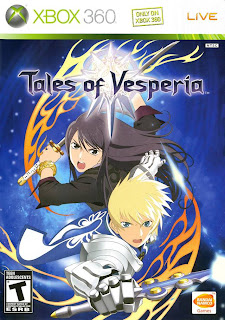
Review: Tales of Vesperia (360)

Topics: , ,
Tales of Vesperia, from Namco Bandai

Genres: Adventure, Role-playing game
Designers: Kiyoshi Nagai and Eiji Kikuchi (General Directors), Takashi Hasegawa (Project Leader)
Developer: Namco Tales Studio
Publisher: Namco Bandai
Platforms: PS3, Xbox 360
Release Dates: Aug. 7, 2008 (X360 JP), Aug. 26, 2008 (NA), Jun. 26, 2009 (EU), Sep. 17, 2009 (PS3 JP)
ESRB Rating: T for Teen

Tales of Vesperia is an impressive, original JRPG that follows a sarcastic yet compassionate 21-year-old named Yuri Lowell. The game begins with players watching Imperial Guards fighting rabid animals, followed by the beginnings of a secret plot in the Imperial capital Zaphias. The opening then turns to the Lower Quarter, a poor section of Zaphias whose inhabitants are tormented by the Imperial Guards, where an aque blastia (magical machine to create clean drinking water) has been stolen and is causing chaos. Yuri attempts to retrieve it only to be captured by one of the Commanders of the Imperial Knights, the leading organization that protects the Empire, and he is thrown into jail. Through making his escape, he runs into a noble named Estellise who is trying to run away for her own personal reasons. A very naïve and sensitive girl, Estellise becomes very crucial to the storyline, as the story progresses to become a power struggle over the blastia technology between the Empire, the Guilds, and all who inhabit the planet.

The plot is very original and highly in-depth. The main protagonists stray away from general archetypes, and the voice acting adds a layer of realism and depth to their characters. Special dialogue options triggered with the Select button reveal small discussions between certain characters which brings to life their daily thoughts and feelings. While this may seem a bit useless at first, it does add a new dimension to the plot, revealing the character’s thoughts and feelings in a way without overloading players with cut scenes. These dialogues are shown through boxes revealing the characters involved, and the presentation may appear a little out-dated to some players. Many of their actions reflect the hard decisions between right and wrong, values over necessity, and the storyline forces players to reflect on their own morals, asking themselves what they would have done in such a scenario. There are just as many scenes of laughter as there are of remorse and sadness, and Namco Bandai does a god job of keeping it from becoming childish and cliché while still driving a point home. In the end, unlike most RPGs where the group simply goes their own way to save an unsuspecting population, the protagonists work together with world leaders in order to accomplish a common goal. For such an unrealistic plot, the game’s realistic problems faced, both with individuals and in society, grab players in an astounding way.

Like any JRPG, the game is not just about the main plot; side quests are a must, and in a game that spans 60+ hours, there are certainly some side quests to be accomplished. There are a good number of things to do, such as puzzles, extra exploration, and special monsters to defeat, but the game does very little to present such events. The side quests offer a good amount of extra items, money, and, surprisingly enough, plot, meaning that parts of the main storyline are solved by looking for a side quest players would never have known about. With so many extra cut scenes and information available, it would have been nice if such events were given a bit more advertisement. Instead, they are hidden away and must be followed in a specific order, creating confusion and a bit of frustration for players.

The sights and sounds of the game are very well done. The graphics are very bright, and while Namco Bandai strays away from making the game look realistic, the looks of the game are very sharp and clean. Environments are nicely done, and the music played in each area evokes a certain ethos that contributes to the environment. With four large continents and many smaller areas to explore, the variety of music and atmosphere is refreshing.

Tales of Vesperia utilizes a very efficient system of combat. You initiate battles by running into stationary enemies and are transported to a circular area of combat, where you can use 3-D movement to jump, run, and attack enemies. You can choose to set the battle system to manual, where you control everything, semi-automatic, in which the computer sometimes determines attacks or motions, or automatic, where the computer fights the battles for you. Added to this are a large number of attacks, spells, and items available during combat, which includes moves called ‘Artes’ that utilize Technical Points, or TP. The camera is a bit annoying sometimes during battle, particularly when using 3-D movement, but overall it follows the characters well. At the end of each battle the game lists several properties of the fight, including experience, money, and Grade earned. Some of these properties do not make sense until much later in the game, particularly Grade, which is used at the end of each run to purchase abilities to be used in the next playthrough.

A very large part of the game is synthesizing materials, and Namco Bandai made the system both fun and innovative for players. Each character can be equipped with specific weapons and armor, and by visiting stores around the world, players can enhance older weapons or create entirely new ones, allowing characters to learn new abilities. Accessories to outfits can also be synthesized, which adds a bit of humor to cut scenes. One in particular gives Yuri Lowell a large moustache and old-school pipe, which is hilarious to see when he is arguing with the Commander of the Imperial Knights. Added to this are Titles characters can earn, which sometimes changes a character’s attire, and players can make some pretty interesting outfits. Synthesizing occurs throughout the game, and while it may seem overwhelming at first, the fundamentals are easy to understand, and players quickly learn how to master the system.

All in all, the game is a classic JRPG that features unique content to keep players interested. Despite its length, the game stays fresh the entire way through, and the plot offers enough twists and turns to satisfy even the most die-hard RPG fan. Multiple run-throughs for such a long game may seem tedious, but the rewards are great, and it takes more than one run to truly appreciate the plot of Tales of Vesperia.

[Highly Recommended]

This review is based on a retail copy of the Xbox 360 version, purchased by the reviewer.

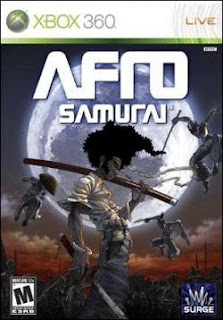
Review: Afro Samurai (360)

Topics: , , , ,
Afro Samurai Genres: Action
Designers: Dave Robinson (Senior Producer)
Developer: Namco Bandai Games
Publisher: Surge
Consoles: Playstation 3, Xbox 360
Rated: M for Mature

The original anime version of Afro Samurai provides the perfect formula for a video game. The premise: in its world, there are 2 headbands (#1 and #2), which are blood-lusted after by anyone who wants everyone to know of their god-like fighting skills. This creates a perfect hack-and-slash mentality: those without the #2 headband are always chasing after whoever wears it; the #2 simultaneously (and constantly) has to both defend his legacy as #2 while trying to dethrone #1; and the #1 sits pretty waiting for #2 to find him (while somehow not letting his skills dull – perhaps by taking on line-cutters). Like I said: the perfect formula for a hack-and-slash video game, especially when the player is cast as the #2. And even though hack-and-slash action button-mashers can get real tiresome real fast, when you take into account the tremendous storyline, voice acting, soundtrack, graphics, and even novelties such as “Body Part Poker,” you have one hell of a game in your hands that maintains interest for however long the batteries in your controller last.

Graphics are definitely the pretty part of what keeps the average gameplay session to nothing less than hours. It’s pretty – real pretty. It’s not polished Ninja Gaiden-beautiful, but then again it isn’t meant to be. Its cell-shaded anime/manga blend makes the playing experience feel something like navigating a cut scene. At times, some of the techniques used can be frustrating or distracting, but it all works in the end to create a totally immersive environment. It’s what makes this video game become the hybrid movie/game it is intended to be.

Afro Samurai employs a very unique HUD. Usually such a thing would clutter the game screen with such non-prettiness as scores, life meters, and maps, but here it doesn’t even appear as part of the game. Who cares about score, anyway? The point of this game, which stays mostly faithful to the anime (and only excels at diverting from it), is to take on anyone in your way on your path to the #1... in the name of vengeance... in the name of your father. So, instead of distracting from the story’s catharsis by cluttering the screen with obvious game-oriented indicators, the HUD turns Afro’s clothing into the life meter, becoming more or less bloodied as his health decreases or increases, respectively. Another stroke of brilliance is the casting of Afro's imaginary partner, Ninja-Ninja, as a GPS/where-the-hell-do-I-go-now system, who spontaneously appears as a puff of smoke calling to you from the general direction in which you need to head (and waits patiently until you find him) during the more maze-oriented phases of the game.

Aside from the non-reversible horizontal camera control that is annoyingly opposite of most action games, fight scenes are superb. Even the most basic enemies will take advantage of a turned back and are agile enough to give Afro a run for his sanity. Instead of tutorials, players learn techniques via select boss battles and memento collection. Getting combos aren’t all that crucial, though...just fun, so don’t worry if you’re not a Dead Or Alive master. Another aspect of gameplay that helps in executing some of the more complex moves is "Focus Mode," which lets the player slow down time enough to concentrate on which enemies to slash first and aim for select body parts (and even time mid-air slashes). That's not to say the action is always slow-able or so simple that fights become boring, but Focus Mode helps keep everything manageable. A mix of cut scenes as well as watered-down Prince of Persia-esque puzzles and mazes help to break up what might otherwise become monotonous button mashing.

Overall, this is a great example of how an anime should be adapted for interactivity. Its blend of great graphics, non-stop action, and enthralling story is simultaneously immersive and awe-inspiring.


good.

Beautiful Katamari 360 Exclusive

Topics: , , , , ,
A fact sheet from Namco-Bandai seems to confirm what many had feared. Microsoft has grabbed yet another exclusive franchise, this time not just from Sony, but from Nintendo as well. Beautiful Katamari, originally slated for release on PS3, 360, and Wii, is nearly confirmed to be only an Xbox 360 release. The Xbox 360 is gobbling up so many important third-party franchises from the other two consoles, I wouldn't be surprised if Nintendo and Sony were left at the end of this console generation with only their first-party franchises to keep them company.
[via Kotaku]
Save This Page   SlashdotSlashdot It!   |Share on Facebook|