The evocation of the overly dramatic — personifications of taste, an omnipresent and oppressive sense of urgency, the soul's weight from a worldly wager — is what embodies this manga centered around wine. It is this characteristic that serves Drops of God Volume 2 in three ways: as page-turner, commentary, and comic relief. The picture to the right is one I use to exemplify this manga to anyone who'll tolerate my overenthusiastic ramblings about it. Taken by itself, the image comprises two panels featuring an exuberant examination of wine in a glass (right) and the reaction of awe by a witness to said act (left).
Taken by itself, the image of Kanzaki Shizuku contemplating the color of the wine embodies the dramatic. It’s a simple and benign act made into an action shot. A huge splash of white showcases the glass of wine by erasing everything around it, save Shizuku's hand. The line formed by the accentuation of the glass and Shizuku’s hand continues through his arm and links the reader's eye to a strong white line a little further downward. Thus the reader's line of sight is redirected to the raised glass, implying swift motion. The reaction shot in the following image compounds on the effect of this action. The angle and position of Shizuku's bent arm points to the next panel of an astounded Watanuki Suzuka, who looks on in slack-jawed amazement (note the superfluous "!" surrounded by naught but white in a word bubble). All this implied action and disproportionate accentuation lends to the manga's sweet, humorous irony. Drinking wine, after all, is never that exciting to watch. However, Drops of God is illustrated as to infuse action where there is none, thereby creating a compelling read out of an everyday act as simple as observation.
That's probably why so many modern video games are so easy — people just don't like to lose. Losing, however, is an integral part of the learning experience in Advance Wars, the turn-based strategy series that started on the Gameboy Advance and has since moved over to the DS. Advance Wars: Days of Ruin on the DS follows a ragtag group of soldiers in a post-apocalyptic world as they fight back raiders and other nasty enemies. Between the thematically dark main missions (which are uncharacteristic for the Advance Wars series) the player can also tackle "Trial Missions," which are much more difficult and usually feature specific gimmicks in the arrangement of the terrain and/or units.
One such mission, T35 or "Center River," uses the Fog of War mechanic, which obscures enemies a certain distance away from the player, thus making it difficult to react to the opponent's moves. Like, really difficult.
Case in point: I deployed some footsoldiers, captured a few cities, and set up a tank or two. BOOM, out of nowhere the enemy started bombarding me with rockets and artillery shells from ... somewhere in the Fog of War. Then giant "war tanks" (the most powerful land units in the game) emerged from the fog, barrelling down upon my base and supporting the infantry units that would eventually overtake my headquarters.
Every permutation of moves I tried, every strategy, met with defeat. The most frustrating times were the ones when I felt like I was about to win, only to be struck down by a surprise volley of long-range rockets and anti-tank attacks that drove me back to my base! I simply turned the game off in anger quite a few times.
I searched online for ways to beat the mission, to drive into the heart of the blue team's side of the river and take their HQ. Forum posts provided some nice tips, but my lack of Advance Wars experience made it difficult to fully implement a lot of their strategies. The parade of failures continued.
One more time. One more time. I sent troops across the river and tried to take the island in the center. I set up rockets in major cities. I pushed across the southern bridge with a tank. After dozens of attempts these sorts of things had become second nature. The enemy came at me on the island, and then I made the one important change to my strategy: I sent some decoy troops along the northern bridge, as someone had suggested in a forum post. Instantly the CPU redirected its troops to fight in the north, and my campaign to take the island in earnest had begun.
After over an hour of plugging away at this slow fight, producing units constantly to keep up with the enemy's barrage of attacks, I finally made it across the southern bridge. By redirecting the blue team back and forth with false threats of capturing cities, I managed to sneak an infantry unit into the headquarters and capture it once and for all. A week of frustration and anger and failure ended in glorious victory, and I was reminded of why I dedicated so much of my time to something so frustrating.
Winning is awesome.
Snapshots is a monthly column here at Ani-Gamers in which one of our writers describes and analyzes a particular moment from a piece of media. To read previous entries, click here.
Snapshots is a monthly column in which one of our writers describes a recent moment in anime, manga, games, or another medium that really made an impact on them. To read previous entries, click here.
Osamu Tezuka's contributions to the manga world are innumerable, but I have always been particularly struck by his innovative panel layouts and narrative strategies. Recently, in reading my copy of Swallowing The Earth (reprinted after DMP's wildly successful Kickstarter campaign), one specific chapter served as a sharp reminder of the brilliance of Tezuka's visual storytelling.
In the early chapter "Light Motif," the story turns away from the dangerous seductress Zephyrus and her quest to destroy the world of men, flashing back to the origins of the far-reaching revenge plot. It is 1940, in Locarno, Switzerland, and stock Tezuka villain Acetelyne Lamp is about to steal away his father-in-law's fortune, much to his wife's chagrin. In the midst of a howling storm, she runs away, taking her six daughters with her. We learn that her name is Zephyrus, and thus the Zephyrus that we see in the modern day is a persona taken up by her daughters.
Here Tezuka begins to experiment with full black page backgrounds and a cinematic zoom effect, with each successive panel getting smaller and smaller (or larger and larger) to simulate a film camera. After one such zoom out and another zoom in, we have moved in both time and space to Lyon, France. The year is 1939, and Lamp has sold his father-in-law's scientific research to the Nazis. As if Acetelyne Lamp's typecast villany isn't established enough, Tezuka has now convinced us that he is not a man to be trusted. His wife is heartbroken.
Zoom! Cut! It is now seven years earlier, and Zephyrus is introducing her boyfriend, Lamp, to her father amid a field of flowers. He would like to marry her, and her father happily acquieces. Zoom in on butterflies, cut to two arms in a bedroom, the lights dimmed. They are in Nice, in the winter of the same year. For two pages here Tezuka shows us the intimacy of these two lovers with nothing more than a series of horizontal panels, framing their arms as they talk. Lamp is having financial difficulty and wants to sell Zephyrus's father's research. Her arm shrinks away from his.
More black panels bring us to Lyon in 1940, where Lamp informs his father-in-law that, on the Nazi's orders, he is sending him to work for them. In a page exclusively composed of vertical panels, Lamp moves from the bottom of the panel to the top, and we see him speaking down not only to Zephyrus's handicapped father, but to her as well. He is an ambitious, ruthless man, completely in control of the situation.
Another cacophonous black page takes us from Zephyrus's father's suicide to the birth of a baby to Locarno again, in 1940. Canted shots of trains show Zephyrus's frantic flight.
Finally, we come to rest in 1943, on a small island near Guadalcanal. A caretaker rushes back to Zephyrus's bedside, watching as she relays her final words to her daughters. They must destroy money, law, and men in order to get revenge on the father who destroyed their lives. Zephyrus passes, and we zoom away from her crying children and finish the story on one final black panel.
In just 24 pages, we see the beginning, middle, and end of a marriage, with time and space jumbled up in the subjectivity of memory. In the hands of a clumsier manga artist, such temporal and aesthetic changes would surely be confusing, but it is a testament to his genius that Tezuka is able to tie it all up into a fast-paced, digestible, and entertaining package.
This post is a part of the Osamu Tezuka Manga Moveable Feast (MMF), a week-long celebration of the manga work of Osamu Tezuka, hosted by The Manga Critic. Check out the extensive archive for this week's MMF at The Manga Critic.
Monthly Snapshot is a regular column here at Ani-Gamers in which one of our writers chooses a moment from some anime, manga, game, or other media that really made an impact on them in the past month. It's a valuable chance to compare the subjective ways in which we all experience and analyze media. To read previous entries, click here.Based on Yuki Urushibara's manga, the Mushi-shi anime directed by Hiroshi Nagahama follows "mushi master" Ginko as he observes and learns about the various mushi he comes across during his endless travels. Mushi are simple beings, the purest form of life. Basically, think of them as the myriad microorganisms which developed from primordial soup. While humans cannot usually see mushi, these creatures can reap effects that range from the physical to the supernatural.
Episode 22, "Shrine in the Sea," starts with a soft female voice that says, "Give birth to me once more. I want to meet you all over again," while a small wooden boat drifts on a calm body of dark gray water. A resigned splash is heard as a body, with arms floating upwards as if reaching out, sinks further and further downward into an abyss that swallows the scant light of a half moon.
![]() |
| Mana Isana |
Via flashback, Mio remembers her father ferrying his terminally ill wife to the Dragon's Palace, a place that enables those who lose their lives to its deep, glowing waters to be reborn in the exact same visage. Mio's father tries to justify this act to his daughter by explaining that no-one has ever recovered from the disease with which Mana is afflicted, and Mio's mother further insists on giving herself to the deep to ease her own fear of "going away forever." As the boat starts to leave, Mio stands in the water beside her mother, looses contact with her mother's hand, and weeps into the sea.
The next scene in the flashback reveals Mio's father pleading with his daughter to consider giving birth to the "uminaoshi" (the resurrection of someone taken by the Dragon's Palace) of Mana to appease all the family members who eagerly await her return. Mio agrees for the sake of the others' wishes but is adamant that the resulting child will not be considered her mother in any way aside from aesthetically nor bear her name.This is how Isana was born as Mio explains it to Ginko, but she wants to know exactly what Isana is. Also in the dark, Ginko says he thinks it best if Isana's simply considered a child who looks a lot like her grandmother. But for Mio, the incarnation of her late mother addressing her as mom is maddening, especially considering Isana's growing likeness in appearance and mannerisms to those of Mana as well as the disassociation Mio feels by having given birth but not really having her own daughter.
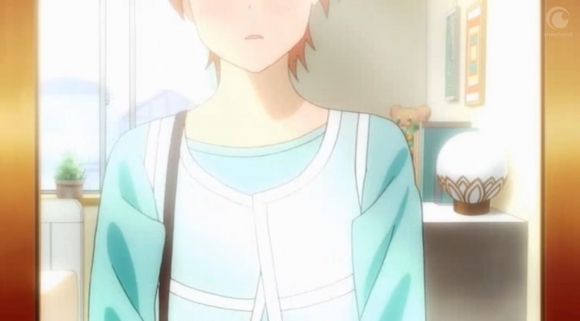
This episode of Mushi-shi speaks to my love of stories of the sea and family and evokes a rocking motion that emulates the very waves it so often depicts. The episode is as turbulent theoretically as it is emotionally and culminates in a choice made by Isana. The theoretical rocking stems from the debate on paradise. Is the act of giving the dying the hope of rebirth while simultaneously filling the void of those left behind worth the emotional trauma inflicted upon those very same survivors by granting their wish with an empty vessel and subsequently sacrificing the individuality and destiny generally demanded or expected of the uminaoshi? The emotional rocking starts with a daughter (Mio) not wanting her mother (Mana) to go away despite her parents' wishes. That daughter then becomes mother to her mother (Isana), a child whom Mio simultaneously loves and resents as a reminder of the loss and circumstance that's been forced upon her. Finally, there is the daughter (Isana) who was the mother (Mana) of her mother (Mio) and is forced to decide at one point whether to risk her own existence to try and save her mother from the very mushi responsible for the village's fabled resurrections or become a mother herself to Mio's uminaoshi. Out of love for the experiences that carved Mio's soul rather than a genetic makeup, Isana chooses the former.
Monthly Snapshot is a regular column here at Ani-Gamers in which one of our writers chooses a moment from some anime, manga, game, or other media that really made an impact on them in the past month. It's a valuable chance to compare the subjective ways in which we all experience and analyze media. To read previous entries, click here.
First off, I apologize for this article being very late (I mean, it's basically an entire month late — not ideal for a monthly column). I've already explained why our posts were delayed after the new year, so I'll get right into things here.
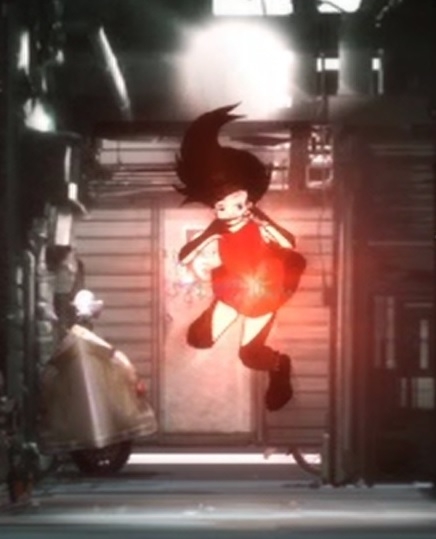
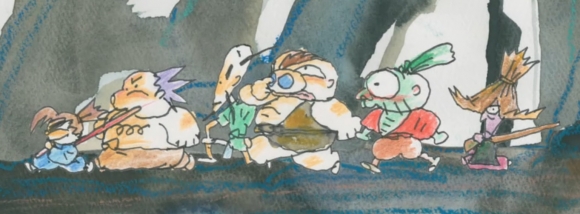
During the course of my research for my "Satoshi Kon Tribute" panel, which I am going to run at Genericon this February, I have been watching through many of the director's influences as well as the anime he worked on. So, after viewing the 1972 Slaughterhouse-Five movie and Terry Gilliam's Time Bandits (1981), I came to Roujin-Z, a 1991 OAV conceived by Katsuhiro Otomo (Akira, Domu), directed by Hiroyuki Kitakubo (Blood: The Last Vampire, Golden Boy), and featuring background art by none other than Satoshi Kon.
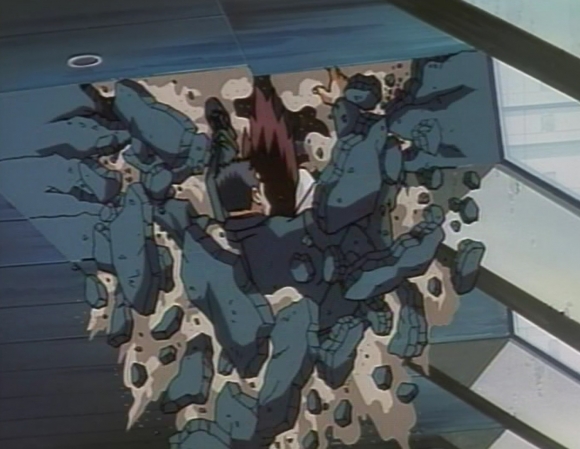
The show presents itself with an equal dose of black comedy and social commentary, similarly to Kon's own Tokyo Godfathers and Paprika. This tendency to mix the seriousness of the situation — a runaway machine originally intended to act as a caretaker for the elderly — with its inherent silliness manifests itself in what is easily the most spectacular turning point of the entire film.
Dedicated nurse-in-training Haruko has been trying to rescue her patient, the elderly Mr. Takazawa, from inside the Z-001 machine throughout the movie, but has run up against stiff opposition from the two bureaucrats in charge of the project, Terada and Hasegawa. As the two men board a helicopter to track the movements of the Z-001, Haruko hops in next to them, despite Terada's fierce protests. Meanwhile, we realize that Terada legitimately cares about the elderly as he berates Hasegawa for not letting him know that the Z-001 was actually a military prototype.
Suddenly Haruko spots the Z-001 speeding along a monorail track, and Terada orders the helicopter to go in for a closer look (never a good idea if Bubblegum Crisis is to be believed). As they approach, Terada throws open the door to yell out at the machine over a megaphone, but Haruko quickly attempts to jump out of the helicopter, screaming desperately to get the old man's attention.
What happens next is a brilliant expression of the essential messages of the entire film: Terada, who has been working to arrest Haruko throughout the story, grabs her before she can fall out of the helicopter, and holds her to keep her from jumping out again. She calls him a pervert, in typical anime style, yet Terada's immediate response to latching onto her is not to blush or get embarrassed, but to yell "You idiot! You'll get yourself killed!" In this brief moment of crisis, Otomo deftly shows the passion with which Haruko will protect her patient as well as the strength of Terada's conviction that all human life is sacred.
To cap it all off, the helicopter hits some trees while Haruko and Terada struggle, throwing the man out of the vehicle and toward the Z-001. Haruko immediately screams for Mr. Terada, only to see the machine reach out and grab him. (Indeed, even after he is safe aboard the Z-001, she tries to keep the helicopter flying low so they can safely extract him.) There is a cascading series of split-second acts of kindness in just these 45 seconds of film, all of which express a more optimistic twist to this ostensibly dark portrayal of the human condition.
Monthly Snapshot is a regular column here at Ani-Gamers in which one of our writers chooses a moment from some anime, manga, game, or other media that really made an impact on them in the past month. It's a valuable chance to compare the subjective ways in which we all experience and analyze media. To read previous entries, click here.Honestly, I'm not even sure if it's worth issuing a spoiler warning for this snapshot, because what made my jaw drop in Fable III happened in the first five minutes of the game, which is all of a minute or so of cumulative gameplay linked together by several cut-scenes. Before purchasing this game, I heard that it offered up some pretty hard choices and thought myself fully prepared for whatever it had in store. Man, was I ever wrong.
It's a fine day to be a prince. I've slept away the greater part of the morning, when my dry-humored butler wakes me for an appointment. The all-important first major decision of the day? What will I wear for my rendezvous with Elise, a "friend" who is currently awaiting me in the castle's garden? When I meet with her, she tells me about some rather unpleasant rumors concerning a factory worker's execution that was condoned by the king (my brother) and the staff's subsequent sense of uneasiness.
On our way back into the castle, I entreat the kitchen staff to a rousing speech in an attempt to make amends for the lack of appreciation shown them of late. Lauded for my generous words, I then head off with Walter for a bit of casual swordplay. On our way to practice, we come across some protesters in the castle lobby. In sympathy, I sign their petition for better living conditions and continue on with Walter, whom I finally beat in mock battle!
No morning that good can last forever, however, and soon there is news of a ruckus directly outside the castle. "This won't end well," says Walter, who’s keen on the king's ill temper of late and rushes to his side to be his voice of reason. Elise and I eavesdrop on the meeting, and I interrupt when Walter is brought low for advising against the king's demand for mortal consequences regarding the non-violent protest. As punishment for me intrusion, my brother, determined to make an example of someone, demands that I make the choice: who will die, Elise or a representative sampling of villagers from the ruckus?My jaw hit the floor. The A button would send Elise to her death, while the X button did the same for the villagers. What?! This is just about five minutes into the game, and already players are faced with the decision of who would be better to kill to satiate the king's bloodlust. I thought for sure this was a test of being a benevolent person, so despite the king's warning that all parties would die if I didn't choose at all, I decided to test his mettle and wait out the decision. I chose no one, and the controller vibrated with ever quickening pulses until the allotted time to decide had expired. Then the villagers and Elise were all dragged off to their deaths. No trick questions. No got-your-noses. Everyone died because of my own indecision. I failed to save anyone.
| Choose who must die: Elise (left) or the villagers (right). |
In that moment, I felt the gravity of Fable III. Just like a prince or other pampered person of privilege removed from any real consequences, the decision I had faced and its ramifications served as a wake-up call. My chest sank, just as the playable hero's did in the game, in knowing that I was going to have to make decisions, for better or worse, to avoid further catastrophes in the future. I could no longer call the sidelines my home or my inaction anything less than hurtful to those that needed help the most. This was the perfect setup to a game that makes players experience the thrill of revolution as well as the decisions that besmirch the perceived polished glory of rule.
EDITOR'S NOTE: Welcome to our newest feature here at Ani-Gamers — the "Monthly Snapshot." In this article, published at the beginning of each month, one of our writers will detail a particular moment that made an especially large impression on them. It can be an anime, manga, or video game, and the scene can be anything from a hilarious comedy bit or a serious monologue. This month we begin the series with a Snapshot of the Genshiken OAV from Ink.Near the end of the first of 3 OAVs that link Genshiken's first and second seasons, there is a scene that involves Ogiue walking into the empty clubroom, where Ohno's "homo dōjinshi" is spread across the main table. The material is meant as a trap designed to expose Ogiue's hypocritical loathing of yaoi. To the dismay of Genshiken members Sasahara, Madarame, Tanaka, and Ohno watching from across the quad, Saki innocently shows up and accidentally ruins the scheme by making Ogiue self-conscious just as she was reaching for a volume. What is seen as a detriment to the plan quickly becomes more effectively subversive to Ogiue's core character as Saki starts her not-so-rhetorical reflections on why girls would want to read magazines like those.
Feeling the situation at a standstill, Ohno — somewhat forced into action by her own ineptitude at telling lies and Saki's powers of remote manipulation — relinquishes a passive role of observation for an active one of instigation to get results. My anime moment of the month comes when Ogiue cracks from being harangued by the relentless Saki-Ohno tag team. The snowball effect thereafter, which stems from Ohno's intimate admission that made me laugh so hard as to miss the next minute or so of dialog, is a complement to how well the series can betray its characters' nominal traits for a belly laugh.
If the line of gunpowder is traced back from the erupted barrel, it starts with Sasahara recognizing "the birth of Evil Ohno," who is depicted as maniacally obsessive in her attempt to ensnare Ogiue. In addition to being shown as the primary binocular-holder, the usually shy and quiet Ohno makes outlandish suggestions, such as putting a bug in the room as to eavesdrop on audio, and bubbles over with maddened giggles that border on demented laughter ... the surgeon mask only adding to the effect.
Later, the confrontation itself is a betrayal of Ohno's character. In fact, Bizarro Ohno's characteristics are taken to such lengths that her constant pressing and egging-on is depicted as akin to Saki's usual behavior. And to top everything off, once Ohno starts acting like Saki, Saki starts getting a little more defensive and wallflower-ish. This shrinking back contrasts Ohno's sudden boldness for even more layers of subliminal laughter. The scene continues to steamroll, with Saki acting kinder to the nigh-exposed yaoi lover by defending her honor against the intrusiveness of Kuchiki's surveillance (and then pressing Ogiue about it herself) and a sadistic Ohno punctuating the intensely personal prodding with an example of Ogiue's shame. This pushes Ogiue over the figurative and literal edges. It is here that Saki prevents Ogiue from jumping from a third story window out of embarrassment while Ohno dances gleefully in the background, pleased as proverbial punch at the shade of red in Ogiue's cheeks.This episode is all about introducing Ogiue, and the story structure manages to bring this about humorously by a long setup involving the reversal of key characters' weaknesses and strengths.