Hosts: Evan "Vampt Vo" Minto, Hisui and Narutaki
Topic: Code Geass: Lelouch of the Rebellion (both Season 1 and R2) (2006)
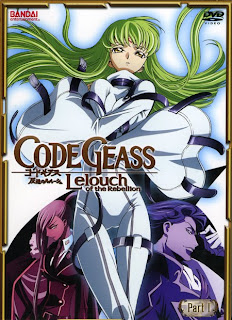
In part two of the Reverse Thieves' podcasting extravaganza, I chat with them for a lengthy hour-plus podcast about the 2006 TV anime Code Geass, from studio Sunrise. The show, a modern take on the classic 50-episode Sunrise mecha formula, follows the events of a political and military revolution, masterminded by the exiled prince Lelouch Vi Brittania. We get pretty in-depth regarding the series, so a massive SPOILER ALERT is in effect throughout the episode.
Let us know what you think of the episode, and please feel free to chime in with your own thoughts on Code Geass in an e-mail or the comments thread. Show notes and links are after the break.
(Runtime: 1 hour, 22 minutes)
[00:00] Opening Song: "COLORS" by FLOW (Code Geass Season 1 first OP)
[00:20] We've got the beat! And we've got the Reverse Thieves back on for more anime podcasting shenanigans.
[01:46] Let's get right into things with the summary of Code Geass, provided by Alain because Evan gets too confused when he tries to sum up all of the ridiculous events going on in this show.
[7:53] Is Lelouch a hero or a villain? Is he neither? We also begin comparing him with Light Yagami from Death Note, who is also a morally gray mastermind, despite distinct differences in their personalities.
[20:01] Discussion of Lelouch's blind, parapalegic sister Nunnally, and how she's totally the best character in this show.
[25:48] Everybody else seems to hate Suzaku, but we find him really interesting, especially in how he interacts with both Lelouch and Nunnally.
[35:14] Evan's not a huge fan of C.C. (pronounced "C-Two"), but Al and Kate are fascinated by her vague past and subtly revealed motives.
[44:01] Promo: Viga the Otagal Podcast
[44:33] A big argument ensues around our hosts' opinions about Princess Euphemia. Evan hates her "stupid pink hair" and the "accidental Geass" scene, while the Thieves think she's a particularly strong character.
[52:30] We discuss how much we love the ending of Code Geass, while reminding shippers and wishful thinkers of THE TRUTH about the ending. Shut up Cart-Driver-Theorists, we will hear none of your lies!
[1:03:10] Finally! Time to talk about the robot fi aw never mind, the fights suck in this show. It's not really about the robots. Also, we make fun of Kallen (a.k.a. Karen) and her badonkadonk for about five minutes.
[1:10:10] Uh-oh, now we're talking about Ashford Academy. Evan thinks it's a ridiculous waste of time, but Alain cites Shakespeare in defense of the comedy episodes.
[1:19:20] End of the show. The Reverse Thieves pimp their awesome blog and their new podcast, The Speakeasy. Follow us on Twitter (Ani-Gamers, Evan, Alain, Kate) and please leave us a review on iTunes.
[1:21:59] Ending Song: "WORLD END Instrumental" by FLOW (Code Geass R2 2nd OP)
[1:22:15] Enabled by the story of a futuristic robot revolution, Kate's trying to usurp Evan's host powers once again!
Medium: TV Anime (25 episodes)
Genres: Action, Mecha, Political, Science Fiction
Director: Goro Taniguchi
Studio: Sunrise
Original Run: Oct. 5, 2006 – Jul. 28, 2007 (MBS–Japan)
Release Date: Apr. 27, 2008 (Bandai Entertainment–N.America)
Rated: PG-13
Sunrise's 2006 anime series Code Geass, in addition to being about a revolution, happens to be a prime representation of a real-world revolution in anime fandom — namely, a merge of the demographics for shōjo and mecha anime. It's a revolution that has been in progress at least since the '90s, when Mobile Suit Gundam Wing provided male fans with explosive robot battles and female fans with attractive, possibly homosexual robot pilots. Sunrise (the studio behind the Gundam franchise) has once again brought these two aesthetics together in a show that combines the studio's experience with giant robots and the character designs of shōjo superstars CLAMP (Cardcaptor Sakura, Chobits, Tsubasa). The revolution is under way, for better or for worse.
Code Geass's melodramatic protagonist is Lelouch vi Britannia, a former prince of the Britannian Empire who escaped with his younger sister Nunnally after witnessing his mother's still-unsolved murder. The siblings now live a fake life as students in Area 11 (the conquered province formerly known as Japan) with childhood friend and Britannian soldier Suzaku Kururugi.
But Area 11 has some problems of its own, in particular a populace forced into Britannian rule and brutally discriminated against, causing a variety of fringe groups to crop up and oppose the occupying force. After an unfortunate run-in with one of these terrorist groups, Lelouch meets a strange, green-haired girl named C.C. who grants him the power of "Geass" — the ability to command the actions of anyone via eye contact. With his newfound power, the prince rises up under the masked persona of "Zero" and leads the revolution of Japan, with the intention of uncovering the truth of his mother's death and making a new world for his sister.
Indeed, that IS a mouthful! In reality, the story can be summed up in a simple comparison: Code Geass is what happens when you smash the original Mobile Suit Gundam together with Death Note. Zero is essentially Gundam's Char Aznable (a son of royalty who wears a mask to protect his identity) mixed with Death Note's Light Yagami (a teen gifted with a strange, highly manipulative power). All three shows also examine the idea of justice attained through a personal vendetta, and the consequences therein.
With such a strange combination of influences, Code Geass is one of those modern anime that can appeal to a broad range of fans. Girls can ogle CLAMP's tall, thin pretty-boys, while fans of the intricate plotting of Death Note will find more than enough to love. Unfortunately, mecha fans will find that, despite the number of robots in Code Geass, the show is not really about them. Kenji Teraoka's (Ghost in the Shell, Gundam 00) mechanical designs for the "Knightmare Frames" are certainly interesting, but their battles are often fought with overpowered one-hit-kill weapons or by no-name redshirts, so they lack the gravity and personal investment of most fights in the Gundam series.
Don't get fooled by the presence of robots, though. Like an anime version of 24, Code Geass is all about the twists and turns. The entire fate of Japan can hinge on the momentary impulse of its viceroy or a carefully thought out move by Zero, and that inevitable modification of the status quo is what makes the show so compelling. I found myself feverishly watching episode after episode, just to see what Lelouch would do next to extricate himself from situations in which failure is nearly guaranteed. Naturally, the constant stream of twists can get tiring, and lend the series a sizable air of absurdity, but they sure do manage to keep it interesting episode after episode.
Geass's art and animation are sharp, brightly colored, and stunningly clean, and the the robot fights — animated in CGI with cel-shading — are surprisingly well-integrated into the 2-D environments. Still, where the show really shines, technically, is in its depiction of CLAMP's character designs. Their distinctive aesthetic provides for some wacky hair colors and costumes, but Sunrise's more angular approach to the designs creates powerful depictions of emotion (usually anger) when the need arises. Lelouch and Suzaku in particular manage to look distinctive yet believable, a difficult feat in a show where two lead female characters have pink and green hair, respectively.
Of course, don't miss out on Bang Zoom!'s (EDIT: Animaze's) fantastic dub, which utilizes the series' Western cultural aesthetic to implement English dialogue that fits its context much better than the Japanese. The dub also happens to be quite sonically accurate to the Japanese, thanks in no small part to an appropriately dramatic performance by Johnny Yong Bosch as Lelouch and an irritatingly high-pitched, yet accurate, depiction of Princess Euphemia from Michelle Ruff.
When it comes down to it, the glue that holds the show together is the three-way relationship between Lelouch, Suzaku, and Nunnally. Lelouch's desire to create a new world for his sister puts him in direct conflict with his childhood friend (albeit anonymously), and since both of them care deeply for Nunnally, this secret war between friends creates some truly affective melodrama. Lelouch is the main character, but his haughtiness and willingness to sacrifice almost anyone for his goals make him a villain, making Suzaku a hero and mucking up the show's moral thermometer. Such bold moves on the part of series writer Ichiro Okouchi (RahXephon, Stellvia, Turn A Gundam) are commendable despite many of Geass's other failings.
Through all of the rebellions and back-door dealings, Code Geass is ultimately a show that see-saws between bursts of genuine quality and entire episodes of unbelievable silliness (i.e. every comedic episode that takes place at Lelouch's school). At its best, it is a dark moral and political drama that emphasizes the consequences of war and asks if and when good ends can justify evil means. At its worst, it is a dumb sitcom about a superhero and super-villain who happen to go to school together.
Available now on Bandai Entertainment's YouTube channel, the first season of Code Geass is an enjoyable ride overall, despite quite a few frustrating bumps along the way. Fans of fast-paced political dramas who enjoy some interesting moral questions in their anime should find much to love here, though the occasionally inane plot twists and weak mecha tie-in might set a few people off.
This review is based on Bandai Entertainment's YouTube stream of the series.
good.
I apologize for the lateness of this article. A full month of straight Otakon coverage cut right through the gap between this and the previous article in this series, so that volume 5's entry ended up being postponed over and over again. The next Bebop post should be up relatively soon.
In its penultimate volume, Cowboy Bebop picks up some of the steam that it lost in the previous four episodes. The action is brought back in full swing, as is the great writing that defined the earlier episodes. But most importantly, the stories have more weight to them than the previous volume's episodes.
The first episode, "Wild Horses," is without a doubt the best on the DVD. Its combination of space action, a puzzling enemy, and great side-characters are the things that make people remember Cowboy Bebop long after they watch it. The episode's primary side-character, a young, energetic black mechanic named Miles, is a big fan of the baseball team the Blue Socks, and he religiously listens to their games over the radio. This theme of Miles' love for his radio and his baseball team is strewn throughout the episode, and the way it ties in with the plot that unfolds on the Bebop is pure brilliance. Plus, Bebop surprised me once again with yet another reference to 20th century culture, in the form of a refurbished space shuttle Columbia. It only alluded to until the end, and the revelation is worth quite a gasp.
The two middle episodes, "Pierrot La Fou" and "Boogie Woogie Feng Shui," are fun, but lack in particularly compelling side-characters. The villain of the former is nothing but an insane murderer, though the conclusion of the episode bears Bebop's trademark subtlety just as Spike kills his enemy, Jet discovers the secret behind him, leading Spike to dismiss Jet's now-meaningless discovery. The latter episode features a weak connection between Jet and a young girl, and does little to progress the characters (though I was very interested in its noir-style narration). Finally, "Cowboy Funk" seems like a simple comedy episode, but in reality it gives us an interesting look at an aggravated Spike who has met someone just a bit too similar to him. As I've come to expect from writer Nobumoto, the hilarious ending ties in a bunch of off-hand comments from earlier in the episode.
I feel the quality ramping up, but where's the story? I haven't seen any sort of central narrative forming yet, so I wonder how the plot will come to a satisfying conclusion in one disc. I've definitely seen it done before, but will Bebop be able to pull it off with such a disjointed story? We'll find out next time!
Stop by soon for my continuing analysis and opinions of Cowboy Bebop. I will publish one article for each DVD that I watch, followed by a review of the series as a whole, and possibly even a review of the movie. See you next time!
I'm not sure what to think at this point. I mean, it's certainly good. Great even. But Cowboy Bebop seems to have lost some of its kick by the fourth volume. It's hard to pin down, but it feels almost like the episodes have less significance than they did before. The earlier episodes might have seemed like stand-alone vignettes, but they all had an ending that was important. I felt as if the crew of the Bebop had left their mark on the universe, for better or for worse.
In volume 4, Watanabe and Nobumoto seem to lapse into what I can only describe as a filler arc. While most Naruto fans consider "filler" to be tantamount to "Believe It!" on the Kakashi-sensei Evil Words Scale, I'm not trying to say that these are completely inconsequential episodes that are hastily put together without regard for the main story. I just mean that they predominantly serve as meaningless fun. Two of the episodes are backstory-related, but neither provides any very compelling information, as "Ganymede Elegy" did for Jet or "Ballad of Falling Angels" did for Spike. Another has a twist that ties it into one of the characters' backstories, but it mostly serves as a prolonged joke about twentieth century video formats.
Of course, it bears mentioning that this volume also contains the famous "mushroom episode," titled "Mushroom Samba," which is without a doubt the highlight of the DVD. Unfortunately, this eccentric, frenetic Ed-centered story is, despite its high-energy fun, utterly lacking in any sort of meaningful or satisfying conclusion.
My complaints here may seem harsh, but in reality this DVD is still leaps and bounds above most other anime series. Sure, it might be the weakest volume of Cowboy Bebop so far, but that's sort of like being the dumbest person at MIT.
Stop by soon for my continuing analysis and opinions of Cowboy Bebop. I will publish one article for each DVD that I watch, followed by a review of the series as a whole, and possibly even a review of the movie. See you next time!
The fun continues as I delve further into the classic nineties anime series Cowboy Bebop. In volume 3, I began to notice something very fascinating about Bebop. Of course, it is clear to any first-time viewer that Yoko Kanno's distinctive music pays tribute to a wide variety of musical styles. One episode, titled "Asteroid Blues," will feature the bouncing beats of the blues, while another, titled "Heavy Metal Queen," will showcase rocking metal music. But what really makes Cowboy Bebop fascinating is that is extends this allegiance to a variety of styles, incorporating it into film-making genres as well.
The first episode on the disc, "Toys in the Attic," is pure horror-movie, with its sparse depictions of a mysterious creature that poisons the ship's crew members one by one, until Spike must face it alone. The next two episodes form a distinct arc revolving around the backstory of Spike and his longtime rival Vicious. In this story, titled "Jupiter Jazz," Kanno focuses her attention on the slow, contemplative sounds of jazz, while director Shinichiro Watanabe and writer Keiko Nobumoto create a film-noir narrative full of sin and suffering. Finally, episode fourteen, "Bohemian Rhapsody," imitates the over-the-top pastiche that is Queen's famous song. The kinetic music serves as a strange but not altogether inappropriate backdrop to the light-hearted crime drama that unfolds in the plot.
Cowboy Bebop is never formulaic because, despite its name, it is only occasionally about either cowboys or bebop music. Instead, the show blends different styles of music and film to create an entirely new experience in every episode. Such an approach remains groundbreaking to this very day not just in anime, but in television production in general.
Stop by soon for my continuing analysis and opinions of Cowboy Bebop. I will publish one article for each DVD that I watch, followed by a review of the series as a whole, and possibly even a review of the movie. See you next time!
I'm finally watching Cowboy Bebop. I know, I know, it's been a long time coming, but I hadn't picked up the DVDs until a recent 50% off sale in the Best Buy anime department spurred me to grab the classic late-90's anime series. And so far, I love it.
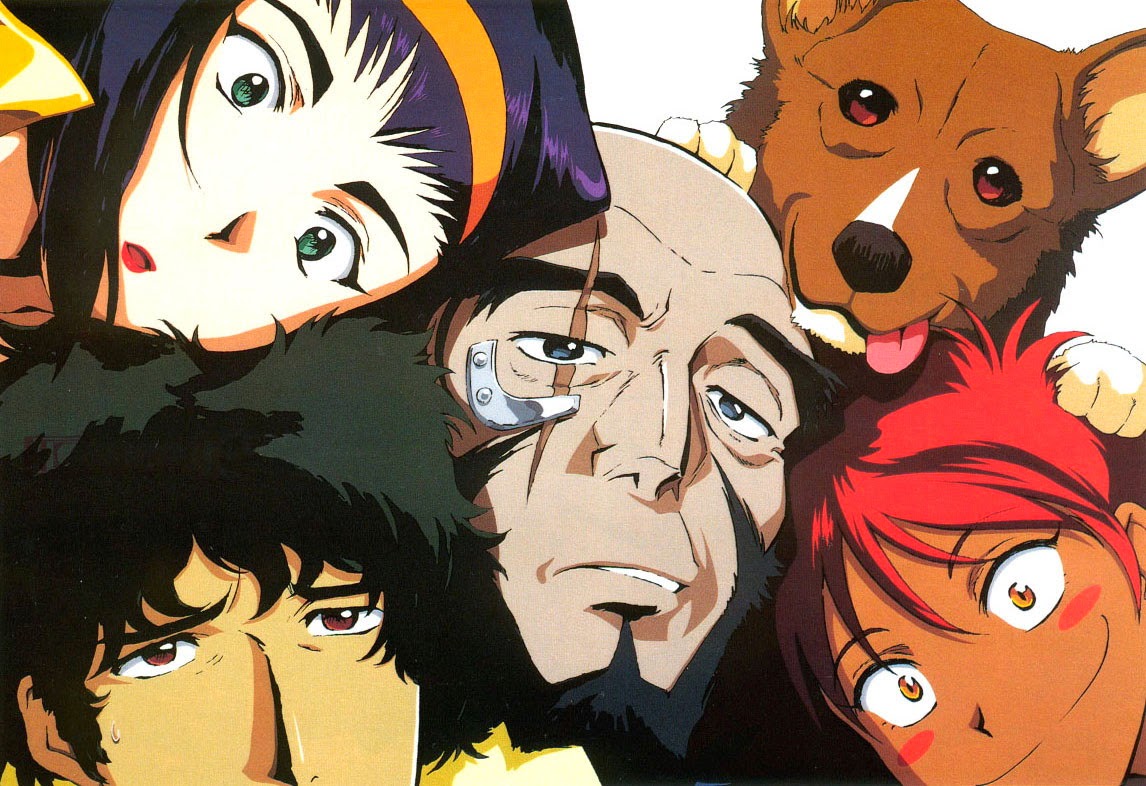
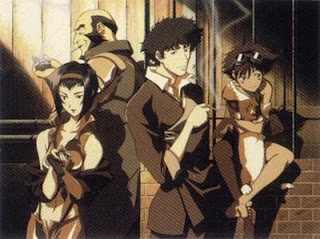
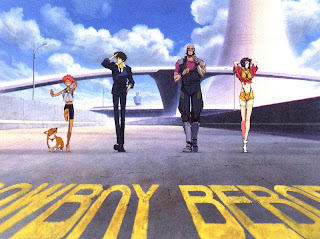
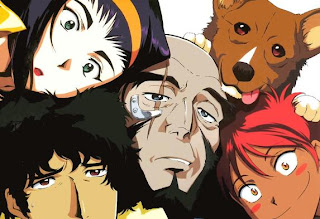
The first two volumes serve primarily to introduce viewers to the characters and standard situations that will presumably define much of the rest of the series, which revolves around a crew of misfits and bounty hunters on the spaceship "Bebop." By the end of the second volume, there has been at least one episode devoted to each member of the Bebop's crew laid-back bounty hunter Spike, his calm, collected partner Jet, beautiful thief Faye, crazy super-hacker girl Ed, and cyber-dog Ein.
What has astounded me so far about Bebop is that Keiko Nobumoto and Shinichiro Watanabe's screenplay does something that I so rarely see in anime: episodic storywriting. The medium is often defined by its linear storylines, but it can be truly refreshing when a show works fully-formed stand-alone episodes into that framework. That's not to say that Bebop is nonlinear it is certainly building toward something, but each little half-hour vignette also has its own set of characters whose (extremely well-crafted) interactions lead to a satisfying conclusion that stands independent from the central story.
The animation (part cel, part digital) looks incredible for its time, except for a couple moments on the second disc when it looks like some people in both the art and animation departments took a nap for the day. These few scenes are missing shading or lighting, show specks in the cels (characteristic of earlier eras of anime), or have choppy cel transitions, but then again, these are the exceptions to the rule.
Stop by Ani-Gamers again soon for my next four articles, in which I will briefly chronicle my disc-by-disc journey through this classic anime series.
Code Geass, the popular Sunrise anime featuring character designs by CLAMP, is finally making its way to America. Under the licensing of Bandai Entertainment (dubbed trailer above), Code Geass will premiere on Cartoon Network's Adult Swim block this April, on a currently unannounced date. I sadly missed out on Code Geass when it was fansubbed, so I'll definitely try to catch it on Adult Swim. Anyone here a fan of the show?
[via ICv2]