Today, Kodansha USA, the American subsidiary of Japanese publisher Kodansha, announced that, as of December 1, 2010, it will be taking over licenses held by Del Rey Manga, the division of Random House that formerly published a large number of Kodansha titles. Random House Publisher Services will now be directly interfacing with Kodansha to bring its manga titles to the American market.
According to Kodansha USA's press release, "Del Rey's ongoing manga titles which were licensed by Kodansha will be gradually taken over by Kodansha USA Publishing on a per-title basis." As such, fans of ongoing series like Moyashimon and Tsubasa: RESERVoir CHRoNiCLE will probably be able to get their hands on new Kodansha versions of these series in short order. Unfortunately, the release says nothing about completed Del Rey licenses, which may result in some (though likely not all) of Del Rey's former series going out of print.
As big a change as this is, it's admittedly not very surprising, since Kodansha USA began releasing republications of Akira (Katsuhiro Otomo) and Ghost in the Shell (Masamune Shirow) — both former Dark Horse titles — last fall, while Del Rey Manga has been facing a number of problems since then. Notably, their number of licenses have dropped, they've significantly reduced their number of convention showings, and Marketing Manager/"Awesome Bow-tie Dude" Ali Kokmen was laid off this past July.
On the bright side, Associate Publisher Dallas Middaugh will remain with Random House as he coordinates the new partnership between the publisher and Kodansha, though it would seem that he will be the only person left over from Del Rey Manga.
[via Anime News Network]
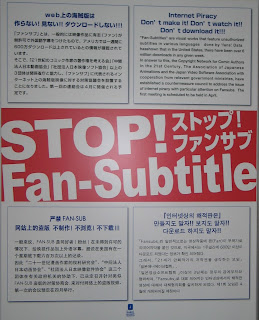
So it seems that fansubs have become a big topic of debate yet again among Internet anime fans, thanks to a recent message to fans from Eric P. Sherman, President and CEO of Bang Zoom! Entertainment. In his message, Sherman described the state of the anime industry in North America, claiming that, if fans don't stop downloading fansubs, "anime will die." A bold claim to be sure, but does it hold some truth?
In the comments thread for the post, fans lashed out against Sherman, claiming that the North American anime industry might be in danger, but anime as a whole is safe and sound. Among all of the arguments, however, I noticed that there was a prevailing idea that the industry needs to justify its existence to the fans. Well I've got a different idea. Fansubbers and fansub viewers, justify the existence of fansubs to me!
That's my question: Why do fansubs exist? Why are there legions of people ready and willing to rip anime from TV and DVDs, add their own subtitle tracks, and distribute them illegally to fans around the world without permission from the original rights holders? I ask partly out of innocent curiosity, though I certainly am a personal supporter of the North American anime industry.
Nobody denies that fansubs served a useful (if not exactly necessary) purpose in the 1980s and 1990s, when fansubbers brought over series that fans would probably never get to enjoy. They were risking illegal action in order to provide access to a medium that had little to no American industry to aid in legal distribution. So if fansubbing exists to give fans a way to watch unlicensed series, why does the practice continue to this day, and with such high participation?
Surely 480p Hulu streams or free simulcasting on Crunchyroll (together, an ever-increasing total of nearly 300 series that include over 50% of each new TV season) is enough to displace fansubs, right? If the content is out there, fans don't need to turn to illegal methods, right? Or is this about something else? Has this become an issue, not of obtaining unobtainable material, but of acquiring material at the highest possible quality for completely free? You give an inch and they take a mile, as they always say.
But really, those are just a few of my personal thoughts on the matter. I swore off nearly all but the most retro fansubs a couple of years ago, so maybe I "just don't get it" when it comes to modern fansub usage. I'd love to hear some theories from both sides of the fence on this issue. Why do we still have fansubs? Are they serving a worthy purpose to fans? What would happen to the North American anime industry (and/or the Japanese industry) if fansubbing stopped altogether?
Medium: Manga (9 volumes, 2 reviewed)
Author: Yukito Kishiro
Genre: Action, Science Fiction
Publishers: Business Jump – Shueisha (JPN), Viz Media (NA/UK)
Release Dates: Dec. 1990 - Apr. 1995 (JPN), Dec. 2003 - Apr. 2005 (NA/UK) [Dates indicate initial print run of this edition, currently being re-printed]
Age Rating: Older Teen (15+)
I feel I need to coin a new, admittedly dumb, phrase to describe my reaction to Battle Angel Alita: a guilty displeasure. I told you it was dumb.
Ido Daisuke is a doctor/mechanic, and a damn good one at that. As far as I can tell, the source of his power is his colossal chin, which is magnificent in its magnitude. One day he finds half of a robotic female torso on a massive cyborg junkpile and decides to rebuild her. As her brain is still intact and this is the cybernetic future where flesh is a novelty, the process is a roaring success. The girl, christened Alita, has amnesia, which is understandable when your recent state was that of a head and a shoulder. Alita then sets out to discover herself and to forge a path in the bleak future with only her natural abilities and pronounced pout that never leaves her face. Sounds pretty cool, right? I thought so too.
There are plenty of reasons why I should love Alita, such as the backdrop. The series is set in a far-flung dystopian future, where a giant floating city called Tiphares houses the privileged while everyone else lives upon the blasted wasteland that Earth has become. The story is set in the junkyard directly below Tiphares, which is a literal garbage site for everything tossed away by the city overhead. The author manages to avoid going over the top with how grim and dark it is, creating a plausibly bleak future world.
The art plays a large part in the world-building — Kishiro puts painstaking detail into every character and part of the backdrop, bringing a richness to the world and making it all appear as a unified whole. Given the diversity in the buildings, people, and every small item strewn about in the panels, this is no small feat, and is quite simply arresting in its magnitude. You can get a real feel for the city just from a quick look at the rotting signs, the dirty streets, and the contents of every overflowing trashcan.
The main reason I dislike reading Alita, though, is the cast, in particular the titular Alita and her dumb pout. All the main characters in the series have an invisible mantle that sets them apart, making them feel like tourists or guest stars. Their motivations and actions overshadow the rest of the cast and the setting itself, relegating them to being inconsequential extras. Ido is a good example of a character with this special quality, as in addition to being an expert doctor and cyber-surgeon he is an awesome bounty hunter to boot. All these details weigh the character down and take away any interest you may have had as he is so limitless in his abilities. Not only that, but he uses a rocket-powered sledgehammer as his weapon of choice, which is a damn sweet weapon but makes you wonder why no-one else has thought of the same idea. I know for a fact that I would have rocket roller skates and pimp rocket tonfa in the rocket-infested cyborg future.
Alita is even more infuriating when it comes to shenanigans like switching motivations and changing her reactions to other characters at the drop of a hat. There is a very short side storyline where the doctor toys with the idea of marrying Alita, but this idea is thrown out the window in a very confusing conversation where character intentions do a 180 on both sides. So the good doctor chucks a wedding dress into a sewer in frustration, leaving me wondering where the hell he dug up a wedding dress in the blasted wasteland.
This gets even nuttier with the appearance of the first main antagonist, who loves eating brains with his gigantic tongue. Okay, that's cool; I can get behind a slavering cyborg endorphin junkie. Sadly it doesn't take very long for the plot mantle to land on this person as well — Alita takes his body out in a cool but disjointed fight which costs her most of her cyborg body, displaying moves that the wounded doctor magically identifies out of nowhere as a robotic martial art, "Panzer Kunst," of which there are supposedly no users. Until now!
Makakau, the antagonist, escapes from the fight scene with a sudden and rather contrived stroke of luck, quoting Nietzsche as he gets away. This is something you don't expect from someone reduced to a head-and-change, and takes you out of the drama entirely.
Alita then receives a crazy body that was intended for military purposes that the good doctor had lying around conveniently. This — combined with Alita's super fighting style — smacks of the author trying really hard to make you care about the character, but giving her too many bizarre power-ups in the process.
As the series continues events become more and more disjointed to the point that I was forcing myself to continue as I simply could not bring myself to care about the characters one jot. Multiple individuals whom I trust recommended the series to me, and so even though I didn't enjoy the first volume, I picked up the second in order to give Alita a fair shake. I can easily see how someone would have a different reaction to myself and utterly fall in love with the characters, the setting, and the outlandish storyline and read it over and over again. Sadly, even after repeated attempts to read the series, my negative reaction still remains. I would honestly suggest borrowing a copy of the first volume to see if it grabs you. If it does, then please feel free to leave a comment below outlining how I am crazy for not liking Battle Angel Alita.
[Bad]
This review is based on a set of Viz graphic novels purchased by the reviewer.
It is a sad day for the anime industry. We have watched far too many companies go out of business in the past two years, and last week, another was officially added to the list of the deceased. A.D. Vision (parent company of ADV Films) has joined the ranks of Geneon and Central Park Media as it has dissolved its entire organization, splitting its assets and most of its employees between a network of companies, many of which are owned by former ADV VP of Business and Legal Affairs Griffin Vance.
Some significant translation of the PR-speak in ADV's September 1 press release reveals that "selected programming from ADV's film library" has been transferred to an "AEsir Holdings, LLC," though it is currently unclear which anime titles are now owned by Aesir. (Evangelion and CLANNAD are a few titles we're curious about.) However, the "account servicing" and distribution (i.e. the stuff consumers care about) for these Aesir titles will be handled by a separate home video distribution company called SXION 23, LLC (Section23 Films). The Anime Network, ADV's anime television channel subsidary, has been acquired by Valkyrie Media Partners, LLC, while ADV's dub and DVD production unit, Amusement Park Media, has been acquired by Seraphim Studios, LLC.
So, looking beyond the simple doom-and-gloom predictions that this news provokes in the minds of most anime industry pundits, let's consider what this actually means for consumers and the industry as a whole. The most pressing concern that comes along with this split that ADV has performed is not that the company is out of business (they've been struggling for a long time), or that there are a bunch of people in the industry who are out of work (many employees from ADV have been hired back by the companies that now own ADV's respective parts). The real concern is that, even though ADV is technically out of business, the company is STILL NOT GONE. Rather than selling their assets to anime companies that are nearly guaranteed to distribute them to the masses, they have sold them off to a company that, as far as I can tell, has never worked in the anime industry before. What's left over in this deal is a "zombie" ADV, split into various parts but refusing to die.
Luckily, it looks like Section23 is off on the right foot, with fall releases already planned for Blue Drop, Polyphonica, Special A, Tears to Tiara, and You're Under Arrest Season 2. With ADV's significantly shrunken catalog, I'm happy to see that Section23 has been left with something to release while Aesir (hopefully) works on acquiring new licenses from Japan.
But Section23, Aesir, and the other pieces of this puzzle still face some looming, long-term problems: namely that the split between licensing and distribution that has occurred thanks to the nature of ADV's breakdown is the kind of thing that is bound to backfire years down the line if anything ever comes up between Aesir (licensing) and Section23 (distribution). The last thing we want is Evangelion or some other big former ADV show to be caught in a licensing black hole for the next couple of decades.
Now I definitely don't mean to discourage the efforts of Section23, who could turn out to be a great anime distribution company to be honest, I wish them nothing but the best! I only fear that their existence represents not a new force in the anime industry, but a headless ADV zombie, an entity that exists only as a last-ditch effort to save what is left of a broken company. As this zombie lumbers on, we can only hope that all of the pieces of what was once A.D. Vision can work together to bring themselves back from the brink. We cannot afford the cost of them slowly decomposing as ADV did, holding onto stagnant licenses and sapping the optimism from a market already steeped with pessimism.
[via Anime News Network]
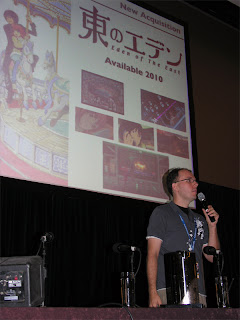
Otakon 2009 seemed to be slightly lacking in the way of major announcements. Bandai blew their big license on Thursday with the surprise announcement of Kannagi, but FUNimation kept their big guns held for their Saturday morning panel. After Adam Sheehan went through the anime distribution giant's most recent titles, he finally got to his three-part new announcement segment.
First was Daytime Drinking, a Korean comedy about... well... drinking, apparently. Then he busted out a new envisioning of an old classic: Casshern Sins, which finished up in Japan this past March. The biggest announcement of all, though, and the one that I was the most excited about, was Eden of the East, Production I.G's new political thriller, which finished in Japan no more than a month ago.
Next, Adam teased us all with the lead-in to a Dragonball license that was not what we hoped it would be. Instead it was the Dragonball Z "Dragon Box," a special edition of the series from Japan featuring the uncut original episodes, each remastered "frame-by-frame." Additionally, the box features the original Japanese episode previews and an 80-page hardcover collector's booklet. The box, which will contain the first 42 episodes on 6 discs, will also automatically default to Japanese language with English subs, which Sheehan pointed out, was proof that the Dragon Box was for the hardcore fans only.
EDIT: Daytime Drinking and Eden of the East will release sometime in 2010. Casshern will hit retailers next year in two 12-episode sets, and the Dragon Box will be out at $79.98 on November 10, 2009.
After that, Sheehan entertained the room with some questions and answers. One of the first pieces of info that we gleaned was that "September sounds like a good month" for the release of the Fullmetal Alchemist Brotherhood dub, though release format (DVD, streaming) was not discussed. On a slightly related note, Sheehan said that we will have an "update very soon on the online status" of One Piece, which has been missing from the FUNimation video portal for about a month now due to online video pirates (har har). Phantom, which has been airing on the video portal as well, will also see a dub and a DVD release in early or middle 2010, though Sheehan seemed to be leaning toward earlier in the year.
Finally, when I asked him about the potential for FUNimation picking up some of Central Park Media's titles (the company went out of business in April), he replied: "We'd love to, we'd love to. There's some stuff that CPM left out on the table that's just great, great stuff. So we're going to be looking at that."
That's about it! Look forward to some more Otakon 09 coverage of a considerably less industry-centric bent in the coming weeks!
UPDATE: Some of this article was cut off by an HTML error when it was first published. Sorry, it's all good now.
It's been a while since the last time Central Park Media released something, and fans of the anime/manga distributor will have to wait a whole lot longer for their next release: forever in fact. The company, which was once the leader in promoting anime and manga properties in the United States, has filed for Chapter 7 Bankruptcy and has officially closed its doors, citing "assets of $126,282 vs. secured liabilities of $908,173 and unsecured liabilities of $277,531." This comes at a time when the entire American economy faces a slow but grueling contraction, and the anime industry has seen two former industry-leaders (Geneon and ADV) essentially dissolve.
Central Park Media (often simply called CPM) was founded in 1990 by John O'Donnell, and led the charge for anime distribution in America with such titles as Area 88, Here is Greenwood, M.D. Geist, Patalabor, Project A-Ko, Slayers, Urotsukidoji: Legend of the Overfiend. Many of these titles defined the anime market in America (for better or for worse), and created the fans that would later form anime clubs and conventions. M.D. Geist (whose mecha is responsible for CPM's "U.S. Manga Corps" logo) was one of the first anime that many fans saw, though its terrible quality has become a sort of in-joke among older fans. Urotsukidoji gained popularity through its controversial explicit content, and set the stage for anime being stereotyped as being "that hentai stuff". On the flipside, the American otaku culture today, which highly values light action and comedy series like Fullmetal Alchemist, spawned in part from CPM shows like Here is Greenwood, Project A-Ko, and Slayers.
Additionally, a significant number of people still working in the anime and manga industries have worked for CPM at one point or another. When Musicland (owners of Sam Goody and Suncoast) went bankrupt in 2006, CPM lost almost all of their retail presence, and the company was forced to lay off many of these folks, who have since spread out to other anime/manga distributors.
It is not only a terrible shame to finally see this former giant of the industry disappear it also signals a significant danger for the anime and manga industries. Imagine the ideas running through a potential investor's head. Why would they possibly put any money into an anime distributor when about half of the industry has gone up in smoke over the course of a year? And if CPM one of the guys who STARTED anime in America couldn't even hold out for twenty years, why would an investor put any money into a similar company?
These sorts of problems are going to manifest soon, if they haven't already begun to, and distributors will find that one super-strong company (FUNimation) is not enough to keep an entire industry afloat. It remains to be seen if FUNimation will not only keep the industry alive, but also prove to outside observers that "anime = profit". For now, though, we wish all of the folks at Central Park Media the best of luck in finding new jobs. In an economy like this, they're sure gonna need it.
[via Anime News Network and ICv2]
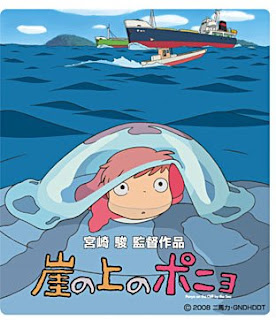
Wow, I blink and all the news flies past me. In the last couple weeks, we've seen some nice expansion of the anime industry with video distribution and theatrical plans announced for a whole slew of new shows. First off is today's announcement from Disney of a release date for Ponyo on a Cliff by the Sea, the newest anime movie from award-winning director Hayao Miyazaki and Studio Ghibli. Disney will release film in a currently unspecified number of theaters on August 14, 2009, the only week when it will face no major box office competition in the animation category. I haven't gotten a chance to see Ponyo yet (seeing as I don't live in Japan and didn't indulge in fansubs), but it looks like a movie that can really sell to the American family audience. Make sure you support Ponyo by going out to see it this summer!
In celebration of Hulu's first birthday, FUNimation has announced three new titles that will stream on the website, now the second-most-popular video streaming site (behind only YouTube). Those three titles are the baseball anime Big Windup (a.k.a. Ookiku Furikabutte), the sci-fi Heroic Age, and the full-length film Origin: Spirits of the Past. Clarissa of the Anime World Order podcast is a pretty big fan of Big Windup, and Uncle Yo recently gushed over Origin in an Ani-Gamers review, so I'm excited that FUNi has given us a chance to watch these titles for free.
On the topic of GDH (Gonzo Digital Holdings, the studio behind Origin), FUNimation has finally solidified a new deal with the struggling studio, which cut its anime production in half just a few months ago in response to economic and industry pressures. The company has been attempting to reap a profit from streaming its shows for free on websites like CrunchyRoll, but most reports are saying that the endeavor has not brought in much money for Gonzo. Oddly enough, the move to CrunchyRoll was seen by many as a betrayal of FUNimation, which has so often handled the American distribution of Gonzo's properties, but was now out of the loop as the studio dealt directly with video distributors.
In response, the apparently forgiving (or just smart) folks at FUNimation have agreed to pair up with GDH and take over North American distribution for all of its properties. That includes video streaming sites, presumaly meaning that FUNi would regain its place as the middleman between GDH and CrunchyRoll, which Hulu would probably also see an increase in Gonzo titles hosted on its service. The first titles to be taken over by FUNimation are The Tower of Druaga and Blassreiter, the first series that GDH ever broadcast simultaneously.
I think that it is simply amazing that Gonzo took such a risk in moving to a simultaneous broadcast, streaming video model, and despite their losses, were able to hold out until this new development. Now FUNimation has followed in GDH's footsteps and even supported the studio, and the entire anime industry (FUNi pretty much controls the whole thing) is finally participating heavily in the video distribution market the true future of the industry in this blogger's opinion.
Finally, AD Vision, once the most preeminent anime distributor in the country, now nearly license-less and struggling to maintain relevance, has put some of its Anime Network titles on the iTunes store. While I don't think that this will have a big effect on the company's fortunes, it should be able to provide some income from their anime properties, since the sales through the iTunes Store are almost pure profit. The titles now available for download are Angelic Layer, Mahoromatic, Pet Shop of Horrors, Saiyuki, and Tsukihime.
And with that, I think that I can confidently say that the anime industry is finally moving in the right direction, with video streaming, simultaneous broadcasts, and direct downloads all options for those who want to watch their anime for free or cheap online (and without fansubs). Now that's change we can believe in. (I couldn't help it!)
Yeah, these panel reports are late, but I had a few things that I wanted to say in relation to them. First up are the actual announcements. After that I'll have my little analysis.
Bandai Entertainment
Bandai is one of the few anime companies holding on in the struggling anime industry, thanks in no small part to licenses for fan-favorite shows like Gurren Lagann, Code Geass, and Gundam 00. On that topic, the only big announcement made by Bandai at the New York Comic Con was their license of the Gundam 00 and Gundam 00F manga, as well as the light novels based on the series.
One of the more interesting things that Bandai rep Robert Napton let slip was that the first presses of the Akira Blu-ray release have already sold out to retailers, and the next presses will be in "a couple months." Also, Robert confirmed that Bandai will NOT be distributing Makoto Shinkai's award-winning 2007 film 5 Centimeters Per Second, previously licensed by ADV before they went under. Who's going to pick it up then? The only possibility seems to be FUNimation, but if they wait too long, the buzz might completely wear off. (it already has to some degree) I'd hate to see 5cm/s come out years late and experience terrible sales numbers.
FUNimation
FUNimation also only felt the need to send one representative, the ever-charismatic Adam Sheehan. He began his presentation by showing some charts to illustrate FUNi's growth in a bad economy, hoping to reassure anime fans who fear that our little niche will be crushed under a failing global economy. (I don't blame them, we're all scared.)
Other than that, Sheehan just went over FUNi's new releases and answered some questions. Among his answers to those questions was word that the FUNimation podcast has been put on hiatus until "things get better," Baccano will probably be released in a 13-episode boxset, and FUNimation hasn't licensed Hellsing Ultimate yet because it quite simply "hasn't been offered to us."
What really struck me about both of these panels was a single quote, spoken word for word by both Adam and Robert: "Single-volume releases have gone the way of the dodo." Hearing this exact same sentiment said in the exact same way from the two biggest names in anime got me thinking about what that says about the anime industry. Dare I say it?: the New York Comic Con 2009 was the site of the official death of the single-volume release. And you know what?
Good riddance.
The single-volume release has always been one of my biggest problems with anime releases. Yes, I understand that people want their anime quickly, but even if you released DVD Volume 1 of some show on the same day as it was released on Japanese television, what are the odds that the average otaku will buy that $20 DVD instead of watching an HD-quality fansub? Exactly.
The box set release is where the real purchases come in. If anime companies like FUNimation released shows in cheap boxsets and scrapped the single-volume releases entirely, they would save quite a lot of money on DVDs that are probably not selling very quickly during their first few runs. Luckily, this seems to be happening, so hopefully FUNi and Bandai should see the improvements immediately Bandai especially, since the combination of Code Geass on TV and boxsets in stores is exactly the kind of model that has worked for American television for so long.
I will admit that I don't have the sales numbers for any of these companies, so I don't know how single-volume releases sold when they used to be all over the market. Still, I can say from personal experience that the average 15-year-old otaku will not buy six $20 DVDs, so the strategy is inherently flawed.
It is said that necessity is the mother of invention, and this recession just might be the very necessity to spur the kind of invention that our industry needs right now.
Earlier tonight, I sat in on the panel for manga/Japanese book publisher Vertical, Inc. (MW, Black Jack, To Terra...), hosted by Vertical's Executive Editor Ioannis Mentzas. He was pretty much just going over the company's latest releases, so there were no new titles announced, but there was also a juicy bit of industry news:
Vertical is in the process of solidifying "a new investment, and an alliance with a Japanese publisher." According to Ioannis, who did his best to beat around the proverbial bush, the new deal is all about "acquiring rights" - Vertical will remain an "independent company" rather than a subsidiary of their partner. In these tough economic times, Vertical is having trouble with their previous investors (almost all banks), so a new investment from a Japanese publisher will give them a renewed source of cash that will help them stay afloat. More important to the average reader is the impact that this will have on Vertical's ability to publish manga. An agreement with a publisher means guaranteed titles, without all of the haggling (and hence added costs) of getting a title from a greedy Japanese manga company.
Who is the mystery publisher? All of the big three (Kodansha, Shueisha, and Shogakukan) are already taken, and even Yen Press has scooped up a valuable asset in Square Enix. Could Vertical be securing more retro manga? Or will they instead be trying out new titles? I can't see Vertical moving that far into the mainstream, so I'll take a bet that they're going for a publisher that will net them some seinen and josei stuff. Check out the full list of possible publishers (via Wikipedia) after the break, and let us know who you think it's gonna be.
- Akita Publishing Co., Ltd.
- Chuokoron Shinsha
- Enterbrain
- Fujimi Shobo
- Fusosha
- Futabasha
- Gentosha
- Hakusensha
- Hayakawa Publishing
- Kadokawa Shoten
- Kobunsha
- Mag Garden
- MediaWorks
- Shinchosha
- Shinshokan
- Shodensha
- Shonen Gahosha
- Tokuma Shoten
- Wani Books
According to a press release from Japanese anime company Geneon's parent company, Dentsu, the latter will be selling a majority ownership of the former to Universal Pictures International, effectively making Geneon (yes, including the American division) a part of Universal, one of the largest studios in the United States. At the end of November, Geneon Entertainment will join Universal Japan, where it will most likely continue to distribute Universal's films in Japan.
What does this mean for anime fans here in the U.S.A.? Well, I would think that Geneon's status in the American market probably won't have a chance to regain its former glory. Their anime distribution department in America has ceased operations, so a huge Geneon comeback is quite unlikely.
However, since the dead American wing of Geneon is owned by proxy by Universal Pictures here in America, this merge could have a positive effect going into the future. Think of the fact that FUNimation is owned by large, profitable company Navarre. If Geneon can begin to distribute anime in America again (even if only in small quantities), Universal can surely keep it going throughout good times and bad, as Navarre has done for FUNimation.
Here's hoping, Geneon!
[via a geek by any other name]As if you needed more proof that FUNimation, which gobbled up dropped Geneon and ADV titles a couple months ago, was taking over your anime industry, here are some hard numbers from respected pop culture site ICv2. FUNimation sold approximately 32.7% of all anime sales for the first half of 2008, with the other major companies falling far behind. ICv2 notes that VideoScan's data does not include Wal-Mart sales, but FUNimation's "significant presence" at the retailer would likely increase its percentage.
The new anime industry heirarchy has FUNimation with 32.7%, Viz Media with 15.9%, ADV Films with 10.5%, Bandai Entertainment with 7.7%, and Media Blasters with 5%. Most startling is that ADV, which is generally considered to be going out of business, sold more than Bandai, which has acquired such popular titles as Gurren Lagann, Gundam 00, and Code Geass.
For more reading on FUNimation's new status in the industry, make sure to check out Scott's post over at the Anime Almanac, The FUNizoid - The Industry’s Last Hope.
[via ICv2]
After months of anticipation from analysts, internet pundits (i.e. us), and bargain-searching parents, Microsoft finally announced a price drop for the Xbox 360 which went active as of September 5, according to an official press release. The main focus was of course on the lowest-priced Xbox SKU, the Arcade, which aims to bring casual and family gamers into the Xbox 360 fold (and, naturally, out of the Wii one).
The Xbox 360 Arcade, previously $279.99, moved down to $199.99, undercutting the Wii's price - static since launch - which has so stymied Xbox breakthroughs into the casual demographic. The 60GB Xbox 360 also moved down from $349.99 to $299.99, and the Elite was cut by $50 from $449.99 to $399.99.
Microsoft's Interactive Entertainment Business senior vice president Don Mattrick made it clear in the press release that the Arcade price drop is a direct stab at Nintendo's Wii sales, saying with pride that Microsoft is "thrilled to be the first next-generation console on the market to reach $199[.]"
When last we heard, game developer Tecmo, who has fallen on hard times, was facing a “friendly takeover” by RPG giant Square Enix - who was offering to purchase the majority of Tecmo’s stock at 30% over market value. Earlier this week, Tecmo announced that it was rejecting Square Enix’s proposed buyout in favor of a merger agreement with developer Koei (Dynasty Warriors). Both Tecmo and Koei have expressed their desire to strengthen and maintain their corporate identity and believe that this merger will help do just that.
In response, Square Enix issued an inquiry to Tecmo as to why their offer was rejected, to which Tecmo supplied no response. Square Enix has since officially withdrawn their offer, along with a follow up offer to buy up Tecmo of $206 million which expired Thursday. Tecmo also announced that it has finally settled its lawsuit with Hiroaki Ozawa and Tatsuki Tsunoda of Team Ninja, who were suing the company over missed over-time pay, though official details on that settlement are unavailable.
With one suit down and Tecmo on the upswing, all that remains is to settle the disputes with former employee Tomonobu Itagaki.
[via Gamasutra, Kotaku]
Last week, Square Enix announced that it was seeking a friendly takeover of troubled developer Tecmo. The takeover in question would have Square Enix buying up the majority of Tecmo’s stock at 30 percent above the August 28th closing price of $6.52 – which puts it at $8.80 per share. The takeover also comes with a deadline of September 4, 2008, at which time Tecmo will either merge with Square Enix or, if they deny, the company will withdraw its offer and will not seek a buyout.
In a press release by Square Enix the company reflected on the troubles surrounding developer Tecmo, stating that: “We…cannot be optimistic about the future of [Tecmo], given the current circumstances surrounding it...We are planning to position Tecmo as a wholly-owned subsidiary of Square Enix Holdings maintaining Tecmo's current organization and brand as in the cases of Square Enix and Taito.”
While this news might come to some as a surprise, know that Square Enix president Yoichi Wada has been in discussion with both Tecmo’s former and current presidents about this merger since May.
[via Gamasutra]
Tecmo’s president, Yoshimi Yasuda, resigned today amidst a heated legal battle with former Tecmo employee Tomonobu Itagaki. Itagaki, creator of Dead or Alive and Ninja Gaiden, is currently suing the company, along with two other employees, for missed overtime pay and not delivering on other promised incentives. He states that it was Yasuda who is promised him these added bonuses, while Yasuda argues that such promises were made on an informal basis that did not meet approval from the Board.
Since then, an incriminating tape has come to light from Ninja Gaiden II producer Yoshifuru Okamoto, which has Yasuda launching personal attacks on Itagaki as well as admitting that he was owed incentives approved by the Board. Hoping to wash Tecmo’s hands of all this and get the company out of such a negative spotlight, Tecmo's Chairman of the Board, Yasuharu Kakihara, will be stepping up as president effective September 1st.
[via 1UP]
Tokyopop, among the top manga publishers in North America, announced yesterday that the company would split into two distinct entities: Tokyopop Inc. (for manga publishing) and Tokyopop Media LLC (for comics-to-film and digital media). Both companies will be held by the "Tokyopop Group."
Stuart Levy, CEO of Tokyopop, Inc. and Chief Creative Officer of the Tokyopop Group, also announced that the publisher would cut its publishing output by 50%, in order to "overcome current market challenges" and avoid "cannibalization at retail." Additionally, the companies will lay off 39 employees (presumably due to the production cut). Japanese operations will also be split, but European ones will remain the same.
While the executive and corporate changes might not directly affect consumers outside of us seeing more comics-to-film and other material from Tokyopop, the production cut will surely be felt in bookstores everywhere. Tokyopop currently controls a large portion of the manga market, so halving their production will definitely mean considerably less manga for consumers to buy at bookstores.
[via ICv2]
If you clearly look at the extremely high numbers for Iron Man, you'll notice this is clearly not the case! [via Variety]
Sometime last week it was announced that CrunchyRoll, the popular Asian media streaming website, acquired over four million dollars of funding, most of it from Venrock, whose partner David Siminoff will join CrunchyRoll's Board of Directors. According to an interview with blog Kokoro Media, CrunchyRoll has been negotiating licensing deals with a "select number of Japanese firms" in order to legally license the anime content that is often posted illegally to their site.
So what does all this business jargon mean for you, the average anime fan? Well, it means that the anime episodes you're watching on CrunchyRoll will now most likely have ads either at the beginning or in the middle of them, but the huge upside to this is that you will be watching your anime legally. If CrunchyRoll can market themselves well among major Japanese anime companies, they could easily help springboard the anime industry into the world of legal digital distribution. And that, my friends, means more anime for you, licensed quicker, and sold cheaper (if not totally free). Future of the industry, here we come!
[via Kokoro Media]
Four days ago, Toshiba made the fateful decision to cease support for the HD-DVD high-definition media format. This decision makes Blu-Ray the official winner of the "format war" of the past few years. This also marks the first time Sony has defeated another format for domination of the market. It has yet to be seen, however, if Blu-Ray can win over consumers in the face of the sleeping giant of digital distribution.
Today, Microsoft finally caved in and announced that they are ceasing production of all HD-DVD player units for the Xbox 360. They will still provide warranty and technical services to owners of the peripheral.
[via Joystiq]
According to ICv2 Guide #51, North American anime sales took an over 20% drop across the entire market this past year (2007). Furthermore, the amount of new relases went down by 21%, as opposed to the 19% drop in 2006. ICv2 was not able to ascertain the manga sales numbers, but estimates that while manga had another good year in 2007, its growth was noticeably less significant than in 2006.
All of this represents the continuing problems facing the North American anime industry due to--among other things--high DVD prices, low numbers of licenses, and the proliferation of digital media. With the anime industry taking a significant drop (hopefully only temporarily), how will the remaining companies (yes, ADV's still in the game) hold on to the American anime fandom and increase sales in the coming years? Here's hoping that the industry bounces back bigger and better than ever in 2008 and 2009!
[via ICv2]
During an ICv2 conference call with Navarre, parent company of FUNimation, Navarre Corporation CEO Cary Deacon revealed that FUNimation was "in very early stages of negotiations to acquire some of the Geneon library of titles."
Also mentioned was the "downward pressure on pricing" of newly licensed series due to Geneon's departure from the industry. (This could conceivably result in lower DVD prices, though there is absolutely no guarantee of that)
Finally, Navarre detailed the earnings of FUNimation, one of the few American anime companies showing a considerable amount of success (primarily due to its Dragonball Z, Fullmetal Alchemist, and other important licenses). FUNimation is expected to bring in up to $3.3 million a year from Atari until 2010 through royalty payments on the Dragonball Z license.
[via ICv2]
In a tale of increasing woe for ADV Films, the seemingly struggling American anime licensing company today saw the mysterious removal of over fourteen [EDIT: Now 37] titles from their online store and nearly all sections of their website. Some of the trailers for these titles are still viewable on ADV's trailers section, but they do not appear anywhere else on the site.
The missing titles include (emphasis on important new licenses added by me):
- 009-1
- 5 Centimeters per Second
- Ah! My Goddess: Flights of Fancy
- Air Gear
- Air movie
- Air TV
- Best Student Council
- Blade of the Phantom Master
- Comic Party Revolution
- Coyote Ragtime Show
- Devil May Cry
- Tengen Toppa Gurren Lagann
- Guyver: The Bioboosted Armor TV
- Innocent Venus
- Jing, King of Bandits: Seventh Heaven
- Jinki:Extend
- Kanon
- Kurau: Phantom Memory
- Le Chevalier D'Eon
- Magikano
- Moeyo Ken TV
- Moonlight Mile
- Nerima Daikon Brothers
- Pani Poni Dash!
- Project Blue Earth SOS
- Pumpkin Scissors
- Red Garden
- Tokyo Majin
- UFO Princess Valkyrie
- Utawarerumono
- Venus Versus Virus
- The Wallflower
- Welcome to the NHK
- Xenosaga
Will they go the way of Geneon, essentially defunct until a way can be found to bring them back into the industry? I sincerely hope not, since the anime industry definitely cannot take another blow in the form of a failed company. Good luck to all those at ADV in these turbulent times!
EDIT 1: More titles disappeared yesterday, bringing the total list to 37 missing titles. Soon after, an ICv2 article detailing financial problems between ADV Films and their parent company, ARM Corporation, appeared. According to the article, ARM has pulled funds from ADV, placing the company in a temporary limbo. ICv2 has since pulled the link from their site (read it cached on Google), claiming that it was a draft not meant to be published.
Finally, ADV Films replied to Anime News Network's attempted contact, and made the following statement to the website and anime fandom in general:
"We know there are a lot of rumors swirling about, and that fans are looking for assurances that ADV will continue to distribute the anime series they know and love.[via Anime News Network]
While we can't go into any detail at this time, please know that ADV is working through a few short-term challenges and fully intends to continue our releases.
We thank you for your patience."
Okay, so a Vivendi and an Activision walk into a bar. And guess who walks out? That's right, An Activision Blizzard.
You see, there's a legitimate reason for that terrible bar joke. Activision, huge publisher and owner of such franchises as Tony Hawk and Guitar Hero, has announced a merger with none other than Vivendi Games, the company that owns--drumroll please--Blizzard, creators of World of WarCraft and StarCraft. (Note: If Blizzard=WoW is news to you, please hit "x" on your browser right now) We could try to sound intelligent and tell you this was completely predictable and a normal business move, but instead we'll stick with our gut reaction, namely "OMGWTFBBQ!!?"
In a deal of nearly $19 billion, Vivendi Games merges itself (and Blizzard) with Activision in exchange for a 52% stake in the newly-named company, the inspired "Activision Blizzard." The new company now controls the rights to a huge portfolio of games, including most importantly World of WarCraft, StarCraft, and Guitar Hero, but also Tony Hawk, Spiderman, and (like you still care) Spyro and Crash Bandicoot. Activision Blizzard will seemingly attempt to challenge EA's spot as the #1 games publisher on all platforms, and the battle
Blizzard has assured that World of WarCraft (and Blizzard's entire operating procedure) will be unaffected by the merger, but that won't stop the complaints of lot sof addicted girlfriend-less nerds. While many fear the use of in-game advertising in Blizzard's games, what I'm most interested in is a possible move to consoles. If Blizzard is pressured correctly by their new publishers as Activison Blizzard, the developer could end up making console games alongside its famous PC lineup. The effects of this change could be quite interesting. Just as Bungie, previously developing Marathon games on PC and Mac, created the prodigious Halo franchise after their acquisition by Microsoft, Blizzard just might create something extraordinary on consoles in the near future.
All that's left to do is wait and see. As industry consolidation looms ever-closer, we have seen things like Bungie jumping the MS ship and EA eating their fill of BioWare/Pandemic. While the implications of this merger have great potential, the problem remains that there is now one less game publisher out there, and one more massive mega-publisher. Electronic Arts, Ubisoft, Activision Blizzard: Let the games begin.
[via Joystiq and Business Wire]
The once-powerful game company Atari, which has faced major losses over the past few years, has finally announced its exit from the game development industry this Wednesday. The company's CEO David Pierce resigned as well, and he will be replaced with chief restructuring officer Curtis G. Solsvig III. From now on, Atari will only be concerned with licensing, publishing, and distributing games by it's parent company, Infogrames.
This is a sad event, but it's not like nobody saw it coming. Atari has been struggling ever since its consoles were beaten by Nintendo and the girth of other competition in the early 90s. Let's just hope that we still get some awesome Budokai Tenkaichi games.
[via Joystiq]
Mythwear, manufacturers of a popular brand of anime-themed bags, has not been responding to contact from RightStuf, the large online anime store. RightStuf, which previously sold many of Mythwear's products, wrote in a site message that they:
"...have made numerous, repeated attempts to obtain this merchandise on our customers' behalf, but Mythwear's phone is currently disconnected, their personnel have not responded to our e-mails, and ultimately, we have not received the products we ordered."RightStuf considers all ties to and agreements with Mythwear to be cancelled as of Tuesday, November 13. Mythwear's website is also down with no notice informing us of the reasons.
Most important for many consumers is how RightStuf is dealing with items already ordered and paid for by customers. As far as we know, there are currently no plans to refund consumers who ordered Mythwear items that were not in stock.
[via AnimeOnDVD]