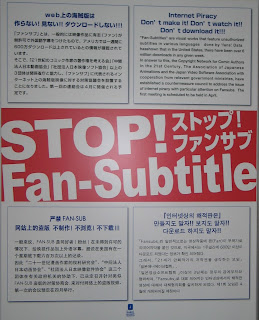
So it seems that fansubs have become a big topic of debate yet again among Internet anime fans, thanks to a recent message to fans from Eric P. Sherman, President and CEO of Bang Zoom! Entertainment. In his message, Sherman described the state of the anime industry in North America, claiming that, if fans don't stop downloading fansubs, "anime will die." A bold claim to be sure, but does it hold some truth?
In the comments thread for the post, fans lashed out against Sherman, claiming that the North American anime industry might be in danger, but anime as a whole is safe and sound. Among all of the arguments, however, I noticed that there was a prevailing idea that the industry needs to justify its existence to the fans. Well I've got a different idea. Fansubbers and fansub viewers, justify the existence of fansubs to me!
That's my question: Why do fansubs exist? Why are there legions of people ready and willing to rip anime from TV and DVDs, add their own subtitle tracks, and distribute them illegally to fans around the world without permission from the original rights holders? I ask partly out of innocent curiosity, though I certainly am a personal supporter of the North American anime industry.
Nobody denies that fansubs served a useful (if not exactly necessary) purpose in the 1980s and 1990s, when fansubbers brought over series that fans would probably never get to enjoy. They were risking illegal action in order to provide access to a medium that had little to no American industry to aid in legal distribution. So if fansubbing exists to give fans a way to watch unlicensed series, why does the practice continue to this day, and with such high participation?
Surely 480p Hulu streams or free simulcasting on Crunchyroll (together, an ever-increasing total of nearly 300 series that include over 50% of each new TV season) is enough to displace fansubs, right? If the content is out there, fans don't need to turn to illegal methods, right? Or is this about something else? Has this become an issue, not of obtaining unobtainable material, but of acquiring material at the highest possible quality for completely free? You give an inch and they take a mile, as they always say.
But really, those are just a few of my personal thoughts on the matter. I swore off nearly all but the most retro fansubs a couple of years ago, so maybe I "just don't get it" when it comes to modern fansub usage. I'd love to hear some theories from both sides of the fence on this issue. Why do we still have fansubs? Are they serving a worthy purpose to fans? What would happen to the North American anime industry (and/or the Japanese industry) if fansubbing stopped altogether?
Last Wednesday I took part in a small eruption of discussion on Twitter about "moé," one that primarily revolved around @janaiblog and @DarylSurat's heated argument. Moé, for those of you unaware, is typically defined as an anime and manga aesthetic that includes cute girls, slice-of-life settings, and/or submissive female characters. (Let's not even get into the obvious generalities of that statement, and the varying opinions among fans in regards to that definition.)
The most interesting point that was brought up, in my opinion, was the idea of looking at moé not through art/entertainment criticism – as many of its supporters and detractors have tried to do – but through an economic lens. In other words, we can throw away questions such as "does moé make a story better/worse?" and "is it a valuable form of character development?" Instead, we can tackle the "debate" (quoted because it's really more of a nebulous conversation than any sort of defined, concrete debate) by examining moé's effects on the Japanese animation industry.
Now, what I'm putting forward here isn't exactly new. Matt Alt wrote a great post roughly a year ago on his blog, detailing what's wrong with the anime industry. According to his assessment, the industry is "dying" due to an endless cycle. No one is really sure if this started with the chicken or the egg, but pretty much it goes like this: Animators are paid slave wages while their jobs are exported to Korea, so naturally the only people who want to work in animation in Japan are the hardcore fans who love anime more than anything else. These people are already hardcore fans, so they are most comfortable creating shows for fellow otaku. However, in aiming for the super-niche audience, anime studios produce moé series that only appeal to people who are already fans. Since they aren't creating enough new fans, the fanbase shrinks and the profits go down. And look at that! When profits go down, they pay their animators less, and the cycle continues.
That is the big problem here. Forget about moé being bad storytelling or anything like that – it shrinks the market! And it's not like I'm trying to bring down other people's favorite shows here. For example, the hit series The Melancholy of Haruhi Suzumiya, a show that I enjoyed, is made by otaku for otaku, so it too is contributing to the problem. If you've ever tried to show Haruhi to a normal, sane human being, you have probably realized that all of the jokes it makes in reference to anime stereotypes don't work so well unless you're already a die-hard anime fan. News flash: not all Japanese people are fans of anime. In fact, some of them would probably react similarly to your own parents when seeing something as ridiculous as Haruhi.
You want proof? Take a look at the top grossing films in Japan from 2004 to 2008. See any moé on the list? No, but you do see a lot of Studio Ghibli films (Howl's Moving Castle, Ponyo), shōnen series (Death Note, Detective Conan, Naruto, One Piece), and children's properties (Doraemon, Pokémon). In this Japanese DVD sales chart from the Anime News Network, only one moé show makes it into the top 30 DVDs sold in Japan (at #25), and there are only three moé shows on the entire list. Meanwhile, dozens of more mainstream anime properties like Pokémon, Bleach, Naruto, Ponyo, My Neighbor Totoro, and Space Battleship Yamato are scattered throughout the list. Despite this, more than half of the winter 2010 season is comprised of fan-pandering moé, and the remainder are mostly non-moé shows that are also aimed at niche audiences. There's a disconnect here between what's being produced and what's being consumed.
Just imagine if the money put into making those shows was instead put into making more series like the ones we see represented on the box office and DVD sales charts. What if that money was put into making more series like Fullmetal Alchemist, one of the biggest overseas anime success stories in history? I'm willing to bet that the struggling industry would be doing a lot less struggling.
(For the record, I don't live in Japan and don't pretend to have an intimate knowledge of the ins and outs of the Japanese animation industry. If you've got a more compelling argument for why moé is good for the industry – as well as the facts and the credibility to back it up – I'd love to hear it!)
It is a sad day for the anime industry. We have watched far too many companies go out of business in the past two years, and last week, another was officially added to the list of the deceased. A.D. Vision (parent company of ADV Films) has joined the ranks of Geneon and Central Park Media as it has dissolved its entire organization, splitting its assets and most of its employees between a network of companies, many of which are owned by former ADV VP of Business and Legal Affairs Griffin Vance.
Some significant translation of the PR-speak in ADV's September 1 press release reveals that "selected programming from ADV's film library" has been transferred to an "AEsir Holdings, LLC," though it is currently unclear which anime titles are now owned by Aesir. (Evangelion and CLANNAD are a few titles we're curious about.) However, the "account servicing" and distribution (i.e. the stuff consumers care about) for these Aesir titles will be handled by a separate home video distribution company called SXION 23, LLC (Section23 Films). The Anime Network, ADV's anime television channel subsidary, has been acquired by Valkyrie Media Partners, LLC, while ADV's dub and DVD production unit, Amusement Park Media, has been acquired by Seraphim Studios, LLC.
So, looking beyond the simple doom-and-gloom predictions that this news provokes in the minds of most anime industry pundits, let's consider what this actually means for consumers and the industry as a whole. The most pressing concern that comes along with this split that ADV has performed is not that the company is out of business (they've been struggling for a long time), or that there are a bunch of people in the industry who are out of work (many employees from ADV have been hired back by the companies that now own ADV's respective parts). The real concern is that, even though ADV is technically out of business, the company is STILL NOT GONE. Rather than selling their assets to anime companies that are nearly guaranteed to distribute them to the masses, they have sold them off to a company that, as far as I can tell, has never worked in the anime industry before. What's left over in this deal is a "zombie" ADV, split into various parts but refusing to die.
Luckily, it looks like Section23 is off on the right foot, with fall releases already planned for Blue Drop, Polyphonica, Special A, Tears to Tiara, and You're Under Arrest Season 2. With ADV's significantly shrunken catalog, I'm happy to see that Section23 has been left with something to release while Aesir (hopefully) works on acquiring new licenses from Japan.
But Section23, Aesir, and the other pieces of this puzzle still face some looming, long-term problems: namely that the split between licensing and distribution that has occurred thanks to the nature of ADV's breakdown is the kind of thing that is bound to backfire years down the line if anything ever comes up between Aesir (licensing) and Section23 (distribution). The last thing we want is Evangelion or some other big former ADV show to be caught in a licensing black hole for the next couple of decades.
Now I definitely don't mean to discourage the efforts of Section23, who could turn out to be a great anime distribution company to be honest, I wish them nothing but the best! I only fear that their existence represents not a new force in the anime industry, but a headless ADV zombie, an entity that exists only as a last-ditch effort to save what is left of a broken company. As this zombie lumbers on, we can only hope that all of the pieces of what was once A.D. Vision can work together to bring themselves back from the brink. We cannot afford the cost of them slowly decomposing as ADV did, holding onto stagnant licenses and sapping the optimism from a market already steeped with pessimism.
[via Anime News Network]
It was a feeding frenzy. Lots of sweaty men crowded around a small TV screen, watching the blood splatter as a stylized video game character was thrown into a saw twice his height. The crowd cheered as bullets broke through the carapace of a giant alien bug. A startled gasp was heard as a zombie leapt out toward the camera. And in the hands of these gamers was not a black gamepad, but a remote control: sleek, white, and all-too-familiar.
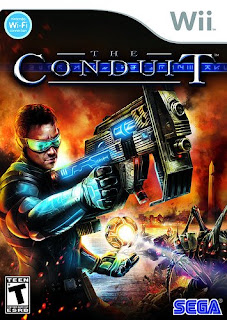
There were no grandmas playing these particular Nintendo Wii consoles, which were on display at the 2009 New York Comic Con. In fact, your grandma would probably disown you if she ever caught you playing the brutal cartoon action game MadWorld. I'd venture a bet that she wouldn't be too keen on the zombie game House of the Dead: Overkill either, and the science fiction shooter The Conduit is quite a far cry from Wii Bowling.
Welcome to the new SEGA on Wii.
Japanese publisher SEGA's move toward "mature" Wii games has struck a major chord with Nintendo fans and gaming journalists alike. On its release, the Wii split Nintendo fandom in two, as many disillusioned gamers felt that the game maker had abandoned them, choosing to focus its efforts on titles appealing to a "casual" demographic. Nintendo has tried in the past few years to hold onto its image as a publisher that appeals to all types: casual and "core" gamers, Nintendo's euphemism for the more commonly used "hardcore."
Early in the console's life cycle, Ubisoft released Red Steel, a violent first-person action game on the Wii that was already riding a hype wave that it couldn't handle when it crashed into gamers' homes in late 2006. The game was pulled down to a Teen rating due to the removal of blood (and the necessity for "Red" in the name), and the gameplay attracted widespread ire from video game critics. Ubisoft's highly-publicized flop seemed to spell certain death for mature games on the Wii.
It is natural, then, that the gaming community jumped straight out of its seat when High Voltage Software announced almost a year ago today that they were developing a science fiction first-person shooter along the lines of Perfect Dark or Halo. The game, called The Conduit, had no publisher when it was announced. This bizarre decision was made in order to give the developers (who self-funded the venture) complete creative control, so that they could make a Wii game "that we ourselves wanted to play," according to High Voltage's Chief Creative Officer Eric Nofsinger, who I spoke with at the New York Comic Con this February.
Mr. Nofsinger animatedly explained his team's creation, to the extent that sometimes it was possible to forget that I was talking to a developer and not a fellow gamer. When asked about the stigma against mature games on the Wii, he spoke with an optimism that I have heard only sparingly since the launch of the console. "The Wii deserves it," he said quite bluntly. "[The Wii] is a powerful enough system in order to make compelling content, but more importantly, it's a really unique input peripheral, and provides you a type of gameplay that you can't do on the 360 or PS3."
Months ago, fans began to fret over The Conduit, worrying about when it would get a publisher, and who that publisher would be. Mr. Nofsinger described the unusual process of development-sans-publisher as "scary as hell. We believed really strongly in what we were trying to do," said the designer. "We put our money where our mouth was." In November of 2009, High Voltage reached a publishing agreement with SEGA, and The Conduit finally had a home amid the publisher's growing libary of "hardcore" Wii games.
These included MadWorld and House of the Dead: Overkill, which were both on display beside The Conduit at the New York Comic Con 2009. Overkill built on the existing House of the Dead arcade franchises in an attempt to bring light gun zombie action to the Wii. MadWorld, on the other hand, was to be an outrageous, cel-shaded action game about a man trapped in a twisted game show and forced to kill his opponents in order to survive, in a game that is equal parts The Running Man and Sin City.
Nofsinger seemed very happy with High Voltage's publishing partner, telling me that even after the publishing agreement had been made, SEGA "let us continue to do our thing." And naturally, he thought that SEGA had just the right environment for an aspiring hardcore game on the Wii. "I don't see a lot of third parties really pushing the system outside of SEGA," said Mr. Nofsinger. "SEGA's doing some really cool stuff, and I'm really proud to be a part of that."
But can a game like The Conduit succeed on a system in which most hardcores seem to have lost all hope? When even the gaming press has largely given up on the console (well, not everybody), it's hard to argue that "core" gamers are still flocking to the Wii (or even turning them on).
Mr. Nofsinger hopes that The Conduit will solve this problem by relying on the philosophy of a game made by gamers, with input from gamers. "We realized that even within our own office, there were a lot of opinions about what a good Wii first person shooter could be. So we reached out to a lot of the fan community, the Nintendo fans, and the media, and we got a lot of opinions," said Nofsinger. "What we landed on was [that] there was no one right answer, so we opted for a great deal of customization." That all-inclusive development style is a break from the practices of most third-party Wii developers, and it shows High Voltage's acute understanding of how important its game will be. The Conduit, MadWorld, and House of the Dead are all referendums on the demand for mature gaming on the Wii. Their rise or fall will ultimately determine if there is truly a viable market for games on the Wii that break outside of the casual.
House of the Dead and MadWorld have received some great press desite a lack of promising financial performance. SEGA said that the former has "absolutely met our expectations" and described the sales of the latter as "very encouraging," but the numbers tell a different story. Both games have performed significantly under par, with each taking only a middling or low position on the top 50 charts for its respective release month, then promptly dropping off the chart. It is not clear if SEGA's strategy will ultimately find success in the fickle world of game sales. Will The Conduit be the saving grace in SEGA's desperate pursuit of the "Exiled Hardcore"?
No one knows just yet. But one thing at least is clear: These aren't your grandma's Wii games anymore.
The Conduit hits stores in North America on June 23, 2009. MadWorld and House of the Dead: Overkill are currently available wherever video games are sold.
Ever since its release, skepticism has shrouded Sony’s PS3 and the viability of its Blu-ray drive. The Blu-ray format is essentially the evolution of today’s DVD. With high definition televisions rapidly becoming standard in many of today’s households, the demand for HD movies and games has increased as well. Media that is displayed in high definition requires a much higher storage capacity in order to be contained on a single disc. This is essentially where the difference between Blu-ray and DVD can be found. A standard dual-layer DVD can hold approximately 8.7 GB of data while a Blu-ray can hold about 50 GB. While there is no doubt a substantial difference between the two formats, we find ourselves questioning the necessity of so much space on a single disc.
Let’s take a look at Grand Theft Auto 4, an ambitiously large game that runs flawlessly on both DVD and Blu-ray formats. When looking at such an enormous game that comfortably fits on a single DVD, one begins to wonder if additional space is needed. After all, do gamers really need games larger than GTA4?
With that in mind let’s consider the PS3’s flagship game, Metal Gear Solid 4. According to game developer Hideo Kojima, MGS4 fills up an entire Blu-ray disc. That means it would require nearly 6 DVDs to run on the Xbox 360, which unlike the PS3 contains only a standard DVD drive. A game like Metal Gear Solid 4 requires such a large data capacity because of the cinematic experience it seeks to provide. Containing over 10 hours of cutscenes and one of the most technically impressive visual and audio performances to date, it is no surprise Kojima needed all 50 GB of data.
Another, more recent game that makes use of the storage capacity of Sony’s Blu-ray format is Rage, an upcoming title by id Software. According to company spokesman John Carmack, the Xbox 360 version of the game will require 3 DVDs while the PS3’s single Blu-ray disc will suffice. The clincher here is that the production of three discs will require a “royalty fee” that id Software is unwilling to pay. As a result, the Xbox 360 version must be compressed into 2 discs, resulting in a version inferior to the PS3.
This increasing need for Blu-ray has not only been apparent within the gaming realm. The triumph of Blu-ray over HD DVD has been a huge win for Sony and the PS3. With the high definition video format in their back pocket, Sony’s console has become more appealing than ever. As the bar for quality rises among both games and movies, the demand for more storage capacity will continue to increase, making Sony’s console much more “future proof” than the competition.
So while it may not be immediately apparent that Blu-ray is a necessary format, down the road the quality of games will undoubtedly increase – along with their data size. While Microsoft provides an experience that caters to the public’s current expectations, Sony works to push the envelope further and deliver what gamers want for the future.
The original PlayStation introduced the CD format into the gaming world and became the highest selling console of its generation. Likewise, its successor the PS2 trounced its competition by being the first to utilize the DVD format. This time around the format of choice is Blu-ray and if Sony plays their cards right, history is destined to repeat itself.
[via Videogamer.com]In today's video game market, there is a lot of talk of "console wars" and choosing the "winners." And after all, who doesn't want to know who's "winning" the "war?" Is it Microsoft, with their heavyhanded business practices and overwhelming number of titles? Nintendo, with one of the most powerful crazes in gaming history? Or perhaps Sony, with a technically mind-blowing console that's quickly gaining steam?
Maybe though, we don't need to choose a winner. Maybe the "console war" not only isn't over yet (by a long shot), but it has also turned from a single fight to a multifaceted conflict. World War II and the Pacific War, if I may.
Kevin published an article recently over at Anime Explosion detailing his opinions on the "True Winner of the Console War." The Xbox 360, claimed Kevin, is the clear-cut winner of the current business battle. There is one major fact omitted from that assumption: The popularity of a little thing called the Wii.
So, how do we define a winner in the console wars? Consoles sold? Games sold? Total profit? Consumer mindshare? The truth is, these are all separate concepts that must be seen as different parts of what makes a winner, and some winners might pull something completely new out of the hat.
The Xbox 360 has clearly won over the "hardcore" demographic, with millions of predominantly male gamers aged 13 to 30 purchasing the console. Halo 3 sold phenominally, and with tons and tons of triple-A exclusive titles on the system, it is hard not to give the Xbox the gold medal offhand.
Nevertheless, do you see your grandpa playing the Xbox 360? Is your girlfriend or wife sitting down to play some video games with you, the one thing you never thought you'd see her do? Or perhaps you are one of those people, and you are finding that games are not the complex, violent testosterone-rides you always thought they were. This is the power of the Wii.
Nintendo's unique, even revolutionary, new console has taken the world by storm, selling out left and right, defying expectations set by industrial analysts, the gaming press, and even fans. That's not to say that everything is fine and dandy in the Nintendo camp. There have only been five to ten truly high-quality titles released on the Wii. (Some would even argue for less)
The Wii has failed to pull in the hardcores as the Xbox 360 has, but why should it? Nintendo never really developed their console for you to buy mature titles on it. The platform has done exactly what it was supposed to: bring new audiences into the gaming fold, and drastically expand the video game market.
As for Sony's Playstation 3, it is sadly not a contender in the "war" at the moment. While the console is very powerful, and has a lot of potential (and quite a few potential hits), it is lacking the games library and sales that the Xbox 360 and Wii have respectively.
So who is the winner? As you might have surmised, there are two. The Xbox 360 is winning with its vast library of hit titles, thriving online community, and ability to captivate gamers. The Wii ties the 360, though, because it has created a new branch of the console war all its own. Neither of the competing platforms are convincing non-gamers to pick up a controller, so the Wii wins by default, in a category of its own.
Clearly this is all speculative, and only time will tell what changes are in store for the gaming market. We are only one (or two depending on your reckoning) years into a five- to six-year process, so things could really turn around. Meanwhile, fanboys are taking up weapons, and the companies have begun their arms race. Get inside your fallout shelter with your favorite console, because it's going to be a long war.
Jeff Gerstmann has quickly moved from relatively unknown GameSpot writer to gaming celebrity nearly overnight. He was Editorial Director over at GameSpot until just recently, when he was dismissed from the site after 11 years of service, allegedly for writing a very critical review of "Kane & Lynch: Dead Men," a game being heavily advertised on GameSpot. (I wrote a detailed article on the controversy over at the blog, so you can read up on the major events there) The main thing that has been troubling gamers and writers alike is the underlying reasons for Gerstmann's firing. If one man is promptly sacked for simply criticizing a game sponsoring his site, how are we supposed to trust reviewers on websites like IGN, 1UP, which also contain heavy amounts of ads. What does a GameRankings or MetaCritic score even mean when faced with the possiblity of reviews being skewed to fit a publisher's desires? These are questions for us to ponder, but what gamers must first do is organize some way to fight back.
Gerstmann-gate, as many have dubbed the controversy, is more than an example of GameSpot's often less-than-honest advertising practices; it is a stern reminder of what is happening with video games as they come of age as a true mass media. We cannot continue to sit idle as positive game reviews become nothing more than a trophy of companies with lots of purchasing power.
GameSpot user Subrosian had the right idea when he started the mass boycott of GameSpot titled "Blackout Monday." I not only support Subrosian's desire to boycott the site for a day, but I also support a long-term boycott of the website. If we, as gamers, are to make our voices heard, we must show websites like GameSpot that we do not support the corruption of honesty in games journalism. It is for this reason that I provide a furthering of Subrosian's ideas. We shall institute a full boycott of GameSpot and other CNET websites, permanently ceasing all page views on the site, until they admit to their guilt.
The problem of skewed reviews and dishonest reporting is growing, as we see from the high reviews given to clearly flawed games. Hype is not the only factor here. There are more sinister forces at work here, as the truth is silenced by those who wish to profit from an innocent hobby. Do not sit back and watch gaming be destroyed by corporate greed. Do not show your support for the seedy business practices at CNET. And most of all, never let other people control our industry. We all play video games for different reasons; some to stave off boredom, some to experience a powerful piece of art, and others simply to escape reality. Whatever our reasons, we must band together to keep the gaming press as the honest and trustworthy entity it is today.
For Honesty, Truth, and Jeff! Boycott CNET!