Ani-Gamers is publishing a handful of messages from our bloggers expressing our personal reactions to the great loss that is the death of anime director Satoshi Kon. For the final installment, Evan remembers his experiences with his favorite Kon film.
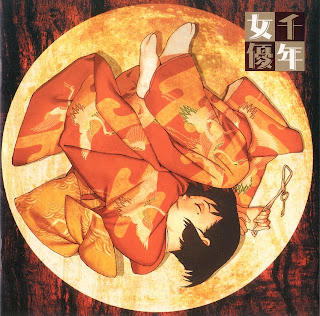
Though many anime fans know Satoshi Kon for his more recent, more publicized works such as Paranoia Agent (2004) and Paprika (2006), the celebrated anime director has been my favorite since the credits rolled on one film: Millennium Actress (2001). The story of two documentary filmmakers' quest to recount the life of an aging Japanese film actress struck me from the very first time I saw it, and its poignant ending now holds even more meaning to me in the wake of Kon's untimely death.
When I first experienced Millennium Actress, I cried (a rare occurrence for me). Its structure leads up to an incredibly tense series of scenes so infused with emotion that even my reviewer's mind couldn't help but get caught up in the feeling of it all. I was so blown away with it that I purchased the first copy I could find and showed it to my family, friends, and high school anime club. In fact, during the four years of my tenure as president, the club showed the film every year, and I personally watch it at least once or twice a year. It is, without a shadow of a doubt, my favorite movie of all time.
Thinking back, though, the life and death of the main character, actress Chiyoko Fujiwara, is almost an accidental analogue to Kon's. Kon's career was also defined by spectacular, critically-acclaimed pieces that often told stories with similar, overarching themes. Both were deft at eliciting strong emotional reactions from their fans.
But the most heartbreaking connection comes in death. Both the fictional character and the real man died with only a small number of people around them, with their oncoming demise hidden away from the rest of the world. Nevertheless, they leave us with the understanding that it is often the journey, rather than the destination, that provides us with true happiness.
While Satoshi Kon may have left us, he also leaves us a number of monuments to remember his life by. Through them we must remember the man, through them we must honor the journey. With such thoughts in mind, there is surely no better memorial to Satoshi Kon than Millennium Actress.
Ani-Gamers is publishing a handful of messages from our bloggers expressing our personal reactions to the great loss that is the death of anime director Satoshi Kon. This time manga/game reviewer Elliot Page graces us with a Kon-related story from his university days.
I wanted to write about a way that Satoshi Kon affected my life for the better, and at the same time share my first experience watching his work. Thankfully these events are one and the same.
In my first term of university, I was confused and without direction. I had moved halfway across the country to undertake a course that was beginning to look terrifying and was almost completely alone except for a few rocky friendships I had made.
I attended the university anime club, with all its bizarre personalities and rather questionable programming decisions, and was on the verge of giving up on it (and anime as a whole, really) when one week I strolled in for “a very special presentation”.
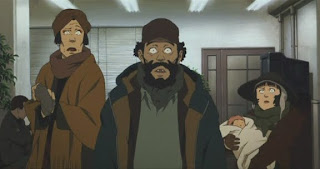
That presentation was Satoshi Kon’s Tokyo Godfathers. I didn’t know then it was directed by him, and I didn't even know the full title because the guy with the huge head who sat in the front row obscured the title.
The movie was wonderful. Utterly wonderful. I’ll save you the gushing attempt at a review and simply say the characters enraptured me completely and it had complete control of my heart-strings after five minutes.
Not everyone loved it. Some people, including the club chairman, left outright or started to gossip amongst themselves and were tersely asked to leave. One rather irritating specimen gave a theatrical yawn before strutting out, adding “Well, have fun kiddies!”
I don’t remember any of these people. I didn’t have much interaction with them in the anime club or outside of it.
The people I do remember were those who remained until the end of the film. Once the credits ended and the harsh, cheap lighting came back on I sat with a core contingent of survivors, most of whom I got to know over my time in the anime club and while I was at university in general.
Sat is the wrong word however — I was hunched over, sobbing like crazy. I cry easily at films, and Tokyo Godfathers did the emotional equivalent of running over my heart. To my left was a man who looked much like a bear due to his amazing beard — he was having a hard time holding back his own tears and give me a spare tissue. This dude became one of my best friends at university and we still stay in contact as best we can. To my right was someone gently patting my shoulder and managing to remain somewhat stoic, although she admitted later that she cried once she was out of sight of the congregation. We later entered into a rather rocky romantic relationship but remained good friends to this day. The rest of the room, approximately ten people, I became at least good acquaintances with over time. Perhaps we had undergone a shared experience, although no one ever pointed it out.
The president of the club came in, said “See you next week!”, and took her DVD player home. I came back the next week and the rest of my first two years of university, my faith in animation restored by the film. I made some solid friendships, some of which remain to this day and all of which helped me through the uncertain period while I was starting university.
Satoshi Kon made my life better, and for that I am eternally thankful.
Ani-Gamers will be publishing a handful of messages from our bloggers expressing our personal reactions to the great loss that is the death of anime director Satoshi Kon. We begin with a brief post from anime/game reviewer Ink.
Ultimately, the inherent value of artists is what they manage to leave behind in terms of creative output once they shed their respective mortal coils. From directing and writing stories to taking part in the animation thereof, surely something of Satoshi Kon’s struck a chord with my soul. If not, I wouldn’t own a copy of almost everything with which he’s been involved.
In honor of Kon’s passing, I watched the first four episodes of Paranoia Agent (2004), a series that consistently stands out as one of the examples of anime I offer to any friend seeking segue into the world of Japanese animation. Kon’s ability to bridge genres lies in the fact that his work stands apart as potent film rather than frivolous serial. Even though Paranoia Agent is a series, it is structured via vignettes that showcase Kon’s ability to imbue disparate yet complete stories with a similar sense of desperation and resolution while collectively using them to build a complete statement on societal pressures and coping mechanisms. His feature-length animations — Perfect Blue (1997), Millennium Actress (2001), Tokyo Godfathers (2003), Paprika (2006) — further justify the man’s proficiency as a writer/director by rivaling the complexities of plot and character found in most of today’s live action films.
His works are some of the most outstanding examples of what anime can be when not bowing to the lowest common denominator and serve as a bar over which future animators, writers, and directors should aspire to proudly vault.