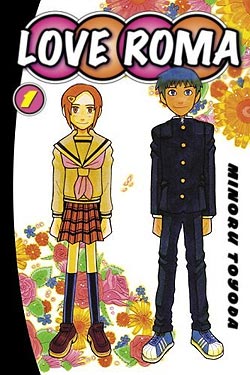
Medium: Manga (5 volumes total, 1 volume reviewed) Author: Minoru Toyoda
Genre: Comedy, Romance
Publisher: Del Rey Books (US/UK), Kodansha (JP)
Serialized in: Afternoon (JP)
Release Date: Aug 2005 - Feb 2007 (US/UK), 2003-2005 (JP)
Sometimes, you just want things to be nice and straightforward. Perhaps you are sick of stories where the main couple dances around each other for chapters on end, afraid to say a word to each other. Other times you may find yourself utterly frustrated by the fact that its been two whole volumes and the hapless lovebirds still haven't kissed yet. Even better, they cant even hold hands without one of the pair erupting into a bright beetroot color from the sheer, unrelenting embarrassment of the act. Give me a break.
First things first, Love Roma is not the prettiest of manga. In sharp contract to the majority of romance manga, the series forgoes the usual painstaking detail and instead opts for a chunky, thickly lined look. The simplistic designs and lines make the characters look youthful as well as downright cartoonish, establishing the series firmly as a romantic comedy rather than a hyper-dramatic weeping fest. As an upside, all of the characters are readily identifiable due to large differences in individual character designs, something I usually have problems with in romantic or more ornately drawn series with extended casts. Expressions are clearly readable on characters faces and body language is obvious, making the emotional aspects of the story much more accessible and, frankly, more enjoyable to read. The art is full of other nice flourishes, such as the white outline that surrounds characters and so pops them out of the background, the effect differing depending on situation or mood, a nice extra touch to the art. The whole presentation has a levity to it that that makes it hugely enjoyable and immediately accessible to me.
I already touched on this, but one of the main reasons I enjoyed Love Roma was the main couple—both are honest, slightly dull normal people. Hoshino, the main male, is flat out blunt with his thoughts and feelings where as Negishi is straightforward while still having a tendency to get embarrassed over romantic things. Its a nice coupling that leads to a lot of amusing situations both between the pair and interacting with the extended cast of their friends. An extra bonus is that they start going out at the end of the first chapter. Holy hell! A series where the main couple don't dance around each other for 2+ volumes, its a bloody miracle. Of course, they are still high-school kids, so its not like they are discussing mortgages or other dull junk in chapter three. In fact, the slapstick comedy is actually quite sharp, making me laugh out loud quite a few times while reading.
The rest of the cast are enjoyable to read as well, and strike a nice balance between developing their own relationships and personalities at their own pace while the main romance storyline is told. An issue that arises with some series that that the secondary characters become more interesting than the supposed main characters, something that is neatly sidestepped in Love Roma while avoiding the pitfall of relegating them to background filler.
One worry I have is that the premise may not last—in the first volume alone the couple go on their first date, have their first kiss, and are introduced to one of the sets of parents. While there is a more than plentiful set of side characters who are introduced and are able to have their own adventures or spice the main plot up, I worry that the series may run out of ideas and fizzle out too soon. I intend to continue buying the series, and will let you know what I find. However, as a first volume on its own it is a refreshing read that I would heartily recommend, particularly if you want to have a laugh while going "Awww...."
We were out of the picture for a little while, so here is one of our articles from 2011 that we never got around to posting. Enjoy!
One of the last panels of the Otakon weekend was the grandly named "The Fine Print on the Contract: the Themes, Philosophies, and Birth of a Legacy in Puella Magi Madoka Magica." I must admit to being fan of the series itself I was curious to see if such an ambitiously named panel could live up to my expectations. The panel was aimed squarely at people who had already seen the balance of the show and it pulled a very respectable crowd into its mid-sized panel room, especially given that Madoka is currently (EDITOR'S NOTE: when this was written in August 2011) only available via fansubs.
The panel started very strongly, and I feel I have to give the panelists top marks for their ambitious introduction, which clearly showed that they had put a lot of thought into the content that they wanted to cover. Also praise-worthy was the miniature AMV that one of the panelists put together which set the tone of the panel as a whole — exploratory but still humorous.
The panel hit on a number of different points — the use of magical girls as a allegory for puberty, an examination of gender relations presented in the show, altruism, the existence of the Ubermensch and role of a deity (if there is one) in the shows universe. All of the individual points were well presented, in particular during the altruism and "Where is God?" sections where the panelists had some very good exploratory discussions amongst themselves. I would have greatly enjoyed more instances of this as opposed to the sections where the three panelists took turns handing off the same argument between each other. The panel certainly had enough meaty content to live up to it's name and presented it in an approachable, engaging manner.
Sadly, this is the part where I write up a small laundry-list of niggling issues I had with the panel, none of which "ruined" the presentation but taken together weakened it. Primary among my irritations was the over-use of PowerPoint slides — at some points the panelists exhibited my pet hate habit of reading directly off of the slides and not adding anything to the text on screen. This, combined with the aforementioned lack of debate between the panelists left some very interesting points relatively unexplored. The slides also contained numerous typographical errors — not a major issue in itself but combined with previous niggles was indicative that the content presented could have done with an additional critical look to shore up the arguments presented and provide a more "solid" talk overall. In particular the lack of a proper conclusion before the floor was opened up for Q&A at the end of the panel left me feeling somewhat unfulfilled.
An additional misstep was taken in the middle of the panel when the audience was asked to respond to a small question — sadly this did not go as planned as instead of answering the question participants instead rushed the mic to present their own theories and have miniature discussions with the panelists. This took a lot of the momentum out of the discussion and it never fully recovered.
To be frank, I did not expect great things from this panel — rather cynically I presumed the discourse would be at the level of message board chatter and I was very pleased to be proven wrong. The panelists here have some very good ideas and discussion points tobring to the table, and if they can take what they currently have and iron out the kinks then they will have a very robust and intriguing panel.
Let me be blunt: I am a massive fan of the Touhou series of vertical-scrolling shoot-em-up games, and all the fan-works that surround it. It would take an entire another article to explain the sheer breadth of the phenomenon for a primer/overview check out the piece I wrote for Evan Krells Ancient Technology is Always Superior Magazine.
Being a giant fan I jumped at the chance to attend a panel that explored the series, and as the program guide pegged the panel as being accessible no matter what your familiarity with Touhou, I dragged my friend Gerry along with me to see how the panel would be for someone who knew next-to-nothing about the franchise. So how did we fare, the utter newbie and the jaded fan?
The panel was headed up by five separate hosts, and was sadly a victim of the too many cooks spoil the broth adage as the panelists would often stumble during transitions from one part of the panel to another, asking each other what came next in the program. A lack of tight forward planning was made apparent around 20 minutes into the panel when an impromptu Q&A was called with the inviting phrase Just ask something, to fill time.
The actual content presented in the panel was well chosen, if marred by one instance of bad judgment. This included both the original Touhou games and some of the more famous fan-made games that use the series as a basis, all of which worked flawlessly on the projector screens. Seeing an average player, a rank newbie, and then a frighteningly skilled player each play one of the games in turn was a good idea and entertaining for everyone in the room. Commentary on the games shown while in progress was insightful, but demanded some familiarity with the franchise to understand. More basic background information on the games and aspects of fandom would have been helpful to make the subject more approachable for total newbies. In particular a greater mention of the Touhou music scene would have been very welcome, as this was relegated to a few offhand mentions.
The one instance of critically bad judgment came halfway through when one of the panelists showed an example of the many fan made doujins the series has spawned. This particular example was called Miss Yukari, Please put on some clothes! and was primarily about a small subset of characters getting buck naked and having mundane adventures while strategically placed word bubbles and sound effects covered their naughty bits. Frankly, this was a terrible choice of material to present and soured me on the panel. If you have to yell Its safe for work! at a bemused crowd then something has gone very wrong.
The Q&A session at the end of the panel was surprisingly insightful half of the questions asked were memes that were quickly dispatched by the panelists and the other half were very pertinent comments such as how to legally purchase Touhou goods, and the best starting point if you are interested in playing the games themselves.
At the end of the day, the panel was a success as it did persuade my friend Gerry to try out one of the games in the series. One thing that could be improved in future instances of the panel would be to provide a more comprehensive initial introduction to introduce the franchise and its self-contained world to people. Another aspect that would certainly help would be a stronger connecting narrative to guide the viewer from one item to another.
Click here for more of our Otakon 2011 coverage
Have an iPad? Want to play games on it? Don't want to throw your money around the app store like a madman in search of a decent purchase? You've come to the right place, my good friend! Pull up a chair and I'll give you some more rapid-fire reviews of iPad games!
iPowa
($0.99 – US App Store link – UK link)
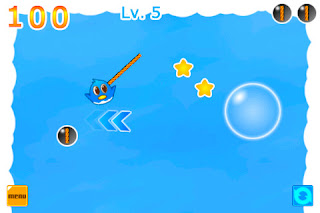
iPowa was released with zero fanfare onto the App Store, and I picked it up day one on a whim. It’s an endearing little puzzle game where you flick a tiny penguin around the screen to collect stars, using bubbles that act as launch pads and various randomly placed power ups to keep from falling off the bottom of the screen and ending the game. There is no overacting structure or plot line, just a fun little time waster with a global scoreboard and infinite replayability due to its randomly generated levels. iPowa has given me hours of enjoyment playing it on the bus, and the low price even includes an iPhone port in case you own one of those as well.
War of Eustrath
($5.99 – US App Store link – UK link)
War of Eustrath is a turn-based strategy RPG which very closely follows the mold of Super Robot Wars and Fire Emblem. You control a small number of very powerful but specialized mechs and get thrown into pitched battles against hordes of other mechs as ... you do something or other. I have to admit that while the world is well realized, the plotline is instantly forgettable and I often found myself skipping past the character conversations between battles. This is not entirely the fault of the plot itself — in fact it is quite interesting — but it is horribly copyedited and reads like a Google-Translated version of the original script. Putting this aside, the combat itself is very enjoyable and well balanced except for a few brutal encounters that you will have to throw yourself at over and over again to get past. There is a robust leveling and customization system, as well as multiple plot paths and endings that depend on your choices and how well you play. A rather pricey offering, this game is still well worth a look if you are a fan of strategy games. You may want to wait for an update if you can’t stomach Engrish, though.
NOTE: Since this review was originally written a major patch has been released that corrects many of the problems with the script. The story is still inconsequential, but at least now it is in legible English!
Dominion HD
($4.99 – US App Store link – UK link)
Remember the first iPad game article, where I reviewed Strategery, a game much like Risk but not quite? Well, Dominion is a straight-up clone of the modern rule set of Risk with a cleaned up visual aesthetic. If you have ever played the wonderful nuke-em-up game Defcon you will recognize the clean, faintly glowing look instantly. The AI is a bit dense and so the single-player mode is best used as an extended tutorial beyond the basic one provided, or as an exhibition mode to view the different maps provided. Multiplayer is where the meat of the game lies, especially at the time of writing as the game has a dedicated player base viewable via the game browser. There is one glaring oversight however — if, on the first time you start the app, you turn off Push notifications, you are unable to enable them later on. Due to this I now have an abysmal online record as I have no idea when I am supposed to take turns in the games I have signed up to. One upside is that the game is updated frequently with new maps and other goodies, something that looks likely to continue in the future, even if the additions are nothing earth-shattering.
Warpgate HD
($7.99 – US App Store link – UK link)
This is going to date me, but this game is an awful lot like the old spacefaring game Elite. You are given a spaceship, dumped into an open map, and it's up to you to trade, shoot and mine yourself to the top of a dog-eat-dog galaxy. Sadly, Warpgate does not quite live up to the comparison, as the whole thing feels disappointingly sterile. Even in hostile areas where the locals want your head on a space-pike, things feel very empty and inconsequential. The tutorial plot chain drags out endlessly, both by screen after screen of empty dialog and by the clunky menus and interface. Combat feels almost random and it is hard to intuit if you are succeeding or not, or even if strategy would help more than simple button mashing. All of this is a shame as behind all these clunky elements is a well-constructed core with an interesting universe to explore. Sadly it is slathered in a thick layer of gloop that makes the game unpleasant to play, even excepting the frequent crashes. I would still recommend trying the Lite version if space exploration is your cup of tea, after all inscrutable interfaces are almost a point of pride for the genre at this point. In all seriousness, you may find yourself in love with it and able to overlook the flaws in favor of the depth of experience on offer here.
Tweet Defense HD
($7.99 – US App Store link – UK link)
I must admit that I am rather fed up with tower defense games, and unless they do something exciting I tend to tire of them quickly. Tweet Defense’s gimmick is that it links to your Twitter account and changes gameplay variables based upon the status of your account. In particular there is a "booster" function where you get a large buff for following a particular account each day. An important thing to note here is that one of the driving forces behind the game is a marketing firm and so this particular game mechanic feels rather invasive and unsettling. But never mind all this, how does the game play?
Well, poorly. First off, the game is bloody ugly. The general design is not very pleasing to the eye and without a spark of originality. The game plays out at a painfully slow pace and it is worth noting that it is a great deal harder if you eschew the Twitter account linking, making this slightly unsavory feature a must to actually play the game. I was honestly hoping for a more inventive use of the Twitter association, such as having enemies or towers procedurally generated by incoming tweets.
I only downloaded this game because it was free for a day, and even for free it feels like a waste of time. The original price of $8 sounds like daylight robbery. Avoid.
Uzu
($1.99 – US App Store link – UK link)
This is a bit of a cheat, really. Uzu is not a game, but an experience. It calls itself a "kinetic multi-touch particle simulator" and that's exactly what it is. You tap the screen with one or more fingers and a sea of multicolor particles whirl around the screen in various patterns and motions much like an interactive music visualizer. The effect is amazingly entertaining, and heightened by listening to good music at the same time. I have lost an hour of my life so far playing with the app while utterly enraptured by it. Plus, it's a dollar. I've paid much more than that before for less entertainment, like when I saw Transformers 2 in the cinema. Get this now, and amaze your friends with it.
We Rule
(Free – US App Store link – UK link)
I have a theory as to why this game exists. It goes like this: Developers NGMoco took one look at Farmville and the other Facebook free-to-play micro-transaction games and said, "hey we should get in on that too!" The result is a rather daft-looking clone which is more abrupt at demanding you pay money for features and blackmailing your friends into signing up as well, cutting short the tutorial into what could have been an interesting fantasy kingdom sim. The game has an irritating tendency to crash, and this coupled with an utter lack of charm and the horrendous loading times meant that I found it hard to be bothered with playing after my second session was abruptly ended. If you must play a time-sink game, you would be better off playing a more established and well-known example.
Author: Nagaru Tanigawa
Publisher: Little, Brown and Company
Rated: 15+
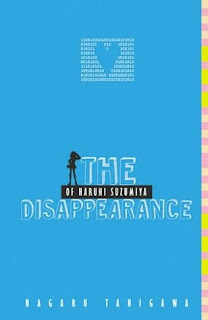
Reading the new Haruhi book is a lot like wearing an old jumper. Don't run off! Let me explain myself. Opening the book, everything feels warm and familiar. Sure, it feels kinda worn in and doesn't fit perfectly, but it's very comforting to come back to something you know well and enjoy.
Such was how I felt sitting down to read The Disappearance of Haruhi Suzumiya. After a brief re-introduction to the cast and their various characteristics, Protagonist Kyon (real name unknown) is thrust into another bizarre adventure against his will. This time, Kyon finds himself thrust into a world devoid of Haruhi or any of the other ragtag band of crazies who make up the SOS Brigade after-school club. Kyon goes on a trek to find out what on earth happened and to figure out how, and if, he should fix everything to how it was before.
This new story has a welcome improvement from the previous volumes in that all of the strange events of the story directly affect the first-person narrator Kyon. You get to watch his sarcastic outlook get put through the wringer instead of having him relate events that are happening to others, leading to much more engaging prose overall. It provides a welcome change from having the main character be a disaffected observer of bizarre events yet again and allows for some interesting development of his character and motivations throughout the book. The rest of the characters also receive their fair amount of the spotlight, and you learn a little more of the interrelations between them.
The plotline, which I am trying to skirt around in case of spoilers, moves along at a reasonable pace and answers all reader questions, but notably stumbles at the climax of the books events. Shortly after the climax, which for me made perfect sense and opened up some exciting possibilities, the author calls the book to the halt so he can clearly spell out the events that occurred just in case you weren't paying attention. This cheapens the ending a great deal, as instead of merely hinting as to the outcome a great big red arrow was instead used to point it out. Kyon further dwells on the climax in the final pages, adding big flashing lights to the sign saying "This is what the ending means, doofus!"
I feel I should mention here that the majority of the plot itself is highly engaging and enjoyable, and it is only because the way the climax is handled is such a noticeable drop in quality compared to the rest of the book that I feel the need to bring it up. The characters are still enjoyable to spend time with, the events presented are interesting, and the whole story is an page-turner even when you take into account its errors. There is one further sin the book commits, but that will need a bit of explanation.
If you watch anime you may be familiar with characters saying "That Person" instead of using someone’s name as a way of increasing tension in a plotline, or just to draw events out. It is usually used poorly, and sadly Disappearance falls into this trap as well. The first time it happens in the book it is actually used sparingly and to some decent dramatic effect, however it is used again later on across four whole pages when it would have been best to not bother with the gimmick. Given that the reader should have already figured out who the person in question is in this second instance, having so many mentions of "that person" in bold text at such a key point in the story ruins the tension that has been building and left me rolling my eyes.
For readers of the previous Haruhi books, Disappearance will feel like a comfortable continuation of the series with nothing truly earth-shattering but a lot to love nonetheless. Those who have not read the previous books may find themselves adrift somewhat as while the prologue does a great job of catching you up on the principle characters and setting, the story proper draws on a lot of elements expanded on in previous volumes. The book will still be a nice, enjoyable read, but will not be as engaging for fulfilling overall due to the lack of prior knowledge. If you have already watched the TV series, then this may well be a good place to start if you were put off of reading the first three volumes as you had already seen the events in animated form.
I have not seen the theatrical version of the story, and I am now even more excited to see it after reading the book, but I have to wonder how the movie can have a run time (2 hours, 45 minutes) longer than the amount of time it took me to read the source material.
One last thing I want to bring up is that I really like the colorful presentation of the paperback edition of the book, which along with the earlier volumes now has a vibrant little corner on my bookshelf next to some drably presented sci-fi.
Barring a few preventable mishaps, Disappearance is a great read and I utterly devoured it during my commute to and from work. I would recommend it to anyone, even if they had never heard of the series or anime as a whole.
[Highly Recommended]
This review is based on a retail version purchased by the reviewer.
Medium: Manga (2 volumes)
Author: Inio Asano
Genre: Drama, Slice of Life
Publishers: Shogakukan, Inc. (JPN), Viz Media (Viz Signature imprint) (NA/UK)
Release Dates: May 19, 2003 (JP), Oct. 20, 2009 (US/UK)
Age Rating: âOlder Teenâ (16+)
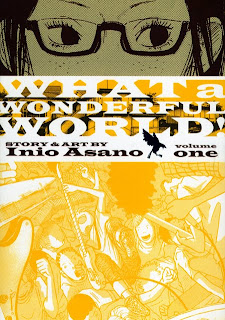
Because I love starting reviews with some kind of admission, I want to say here that I have been putting off reading this manga for a long time. Since May, in fact. (Ed. Note: The review was written in August.) Itâs not because I was rushed off my feet with other manga, but simply because I was afraid to crack it open for fear of it being too powerful for my weak psyche. Author Inio Asano also wrote Solanin, an amazing manga that I have a very hard time reading simply because it is emotionally powerful and I have to put the book down every 30 pages or so for fear of collapsing into a sobbing wreck.
Yes, Iâm a wuss. Deal with it.
What a Wonderful World, or World as I shall shorten it from here on out for the sake of brevity, is thankfully not as emotionally harrowing as Asano's other works in part due to it's fragmented structure. The manga is split into individual vignettes, each focusing on a single character and giving you a brief moment in their life before moving on to someone else.
Each story is wonderfully crafted, effortlessly introducing you to the new main character so you connect with them instantly each time, often with just a single panel. One such story shows you a girl staring listlessly at the split ends in her hair, and suddenly you are right there with her for the duration for her tale.
From there on you are hooked, each panel containing just the right amount of (or lack of) art, speech and action to keep you fully engrossed. Like having a door opened to find a tiny snowman with cigarettes for arms, with nothing else to clutter the page in between. The easy flow of the storytelling on the page is remarkable, as you'll find your eyes being drawn to the right place each time by the layout of both the panels and the items contained within. This helps the art pull off some amazing shifts in perspective to get you right into things without noticing how much the viewpoint has shifted.
All this helps you enjoy the stories on offer effortlessly, and break down any barriers between you and the drama playing out on the page.
The main theme the manga explores is that of thwarted dreams or expectations, and how the colorful cast of characters deals with them, or fails to do so entirely. The storylines contain just the right amount of grit and texture to give them depth without needing a cumbersome back-story to the issues that are presented, and at the same time they give you something meaty to chew on. The characters feel like actual people who have lived rather than blank slates who only begin to live when they are drawn. It's very refreshing in general to read something that is not just about dreams coming true but instead about opportunities lost, or times when things have slipped away. It also manages to avoid feeling grim for the sake of it, maintaining a very welcome air of absurdity whether in the form of death taking the likeness of a crow, or a turtle climbing out of its shell to escape it's owner. Everything presented as part of the human characters feels instantly relatable and, if it hits close to home, rather personal. Well, except the whole thing with the turtle. I would probably need some form of therapy if that happened to me.
Not all is sunshine and rainbows, however. Reading a whole volume in one sitting, even with its amazing pacing, can get very wearing due to the poignancy of emotion that is on display. There is only so much biting realism I can take before it begins to cause my soul to ache and thoughts to turn to happier things, and for this reason I would recommend spacing out your reading of World. Another problem is that the stories can begin to feel predictable as you are immersed by the atmosphere of the manga. After a few pages of a new story you can guess how events will play out in a vague sense. This sucks a lot of the magic out of the stories and so is best avoided by putting the book down for another day.
There is also some confusion surrounding the overarching plotline, or perhaps lack of one. Multiple times even in this first volume you will see characters recur, but in their new appearance the situation will have changed and so any previous experiences with the character have to be thrown out in favor of the new story being told. When this first happens it is very disorienting, and I found myself exclaiming "Heyyyy, wait a second! Wasn't she supposed to be in a band now?" before I realized what was happening.
So would I recommend it? Sure. World is a solid and very enjoyable manga to read, for me because it feels like a more manageable version of the Inio Asano I know from reading Solanin. It is also the first manga Asano published (Note: according to Wikipedia and other research) so it is useful to see the author's development from here into his later works.
World is a welcome shot of reality packaged just right to prevent it from hurting if things strike too close to home. You'll come out of reading it feeling a little wiser, if perhaps wearier.
[Recommended]
This review is based on a retail copy purchased by the reviewer.
For the five days leading up to the New Year, Ani-Gamers is posting an un-ranked list of our favorite titles from the year 2010, featuring up to two choices from each writer. Be sure to check back throughout the week to find out what geeky stuff our contributors really dug this year! We now present the choices from manga and video game reviewer Elliot Page.
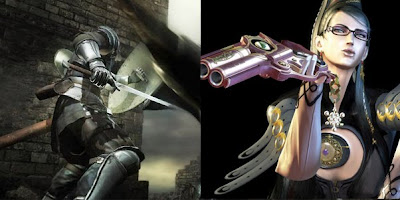
Demon’s Souls (From Software): While this came out in the US in 2009, its only this year that Europeans like myself have had the pleasure of being humiliated by the ruthless gaming experience that is Demon’s Souls. There are just so many things that make me love this game — the atmosphere in particular. The ravaged, demon-filled lands of Boletaria and the few people who still cling to life set an excellent tone for your character’s adventure, making you truly feel like the last hope for the world. Not that saving the world is an easy task — the game’s controller-smashing difficulty is well documented, but it never feels punitive. This, combined with the tight direct-action combat and lack of hand-holding, makes playing the game all the more satisfying, especially when you kill a major demon. I barely have time to mention the game’s amazing online system, where players can leave notes for each other as advice or enter another player’s game to either assist or antagonize them. Plus, Demon's Souls has buckets of re-playability due to the breadth of character options available, and the fact that you will grow to love the pain the game inflicts.
Bayonetta (Platinum Games/Nex Entertainment): It’s hard to come up with a fitting opening line to fully encompass the wonder that is Bayonetta, but here goes: Bayonetta is a game where you play a nine-foot-tall woman who wears clothes made out of her own magical hair, has control over time, can summon massive demons, and spends her time destroying hundreds of freakish angels in order to do something or other. I don’t remember the plot very well — while hilarious and a great way to string the action together, it is so insane that your mind rejects it the second you stop playing. Bayonetta is what is known in the trade as a “Character Action Game” — somewhat like Devil May Cry, God of War, that sort of thing. That means a third-person camera, a combo system using different weapons including ground and aerial moves, quick time events, and button-mashing special attacks. Except, Bayonetta is the only game of this genre I have enjoyed, let alone completed twice over. The controls feel so tight and accessible, saving you from being constantly being reminded that there is a plastic knob in between you and the game. The game also has a great sense of fun all over, in its level design, enemies, and weapons. (Even the in-game shop will make you crack a smile when you visit.) The sheer amount of love put into the game shines through especially well in the final levels, during which I could not stop grinning for the entire two-hour session.
A side note: make sure to play the Xbox 360 version of this game, as the PS3 version has some horrible loading issues that rapidly suck the fun out of it.
Extra Bonus Item! (Likely to annoy Evan! This is done in the name of beefing out the amount of anime in the year-end picks.)
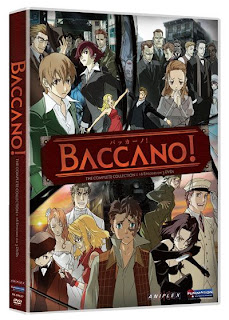
Baccano! (Brain’s Base): Seriously, go and read my Anime Secret Santa post on this series. After reading it, it should come as no surprise to learn that as soon as I had moved into my new house I unpacked Baccano! to re-watch it. To be precise, it was the fifth thing I unpacked, coming after the sofa, the DVD player, the TV and the kettle (for tea, of course). My love for this series only grows as I watch it this second time, and I heartily recommend it. (Ed. Note: Baccano! was released in the UK during 2010.)
Baccano! is also recommended by Ani-Gamers editor Evan "Vampt Vo" Minto.
See Also:
Medium: TV Anime (13 episodes + 3 DVD-only OAV episodes)
Genres: Drama, Adventure, Mystery, Comedy
Adapted from: Baccano! (ongoing 2003 light novel series)
Director: Takahiro Omori
Studio: Brain's Base
Release Date: Jul. 26 – Nov. 1, 2007 (JP – WOWOW), December 2009 (US – FUNimation), Oct. 2010 (UK – Manga UK)
Rated: 18 (UK BBFC, due to frequent swearing and frequent intense violence)
Ed. Note: Welcome to our fourth and final "Anime Secret Santa Review." Our reviewers were given review requests as gifts from their Secret Santas, and are now unveiling their opinions of the shows they chose. For more information, check out our 2010 Anime Secret Santa introductory post.
Before I talk about Baccano! proper, I'd first like to thank my Secret Santa, whoever they may be. All three of your choices were excellent. I had already seen and loved Kino's Journey (2003), but when it came to choosing between Baccano! and Eden of the East (2009), it was a close run contest. What made my mind up for me is the following sequence of events, which I shall dramatize for you:
![]() |
: "Hmm, I want to watch both Eden of the East and Baccano! - what to do?" |
| : "Hey, Hey Elliot!" | |
![]() |
: "What's that?" |
| : "Hey there!" | |
![]() |
: "What the?" |
| : "Hey there, Elliot, we think you should watch Baccano!. That would be for the best." | |
![]() |
: "Why?" |
| : "Well, look how happy we are! Don't you want to find out why we are happy, and be happy yourself?" | |
![]() |
: "I guess..." |
| : "Do it!" | |
![]() |
: "Agh! Okay, okay." |
| : "Excellent....." |
It went something like that. What I present here is more something of a trip report than a full review.
Now onto the show itself. Having watched the main 13 episode series, I have come to regard Baccano! as a series of victories and small wonders, furnishing the viewer with a massively entertaining show that manages to satisfy without outstaying its welcome or stretching too far.
I will admit that until sitting down and watching it I have avoided all discussion or reviews of Baccano! (Including the Ani-Gamers review) as whenever someone has mentioned the show they have taken pains to point out that almost anything is a spoiler when it comes to the shows twisting plotline. I even avoided reading the synopsis on the back of the DVD set before watching. (I'm glad I didn't—whoever wrote the one on the Manga UK DVD set appears to have been drunk.)
To outline the show: set primarily in the early 1930s, Baccano! follows the exploits of a wide range of characters in both Manhattan and the transcontinental express train "The Flying Pussyfoot" as they all go about their personal business. The narrative jumps between different time periods and different characters with such frequency that the show's creators saw fit to make much of the first episode a primer for what is to follow. For most of this episode, Norio Wakamoto (with full R-rolling in effect) and his assistant prepare the viewer by discussing in a broad sense the different time periods, settings and characters that you are going to spend the following 12 episodes with, as well as showing the viewer some juicy snippets of what is to come.
This initially flummoxing first episode nearly turned me off of the show. It felt like a warning, telling me "Hey, if you aren't down with whatâs going on now maybe you should just give up and put this back on your shelf. Oh, here is a quick cut of a young boy getting shot in the head. Bet you're interested now, eh?" Then, at the end of the episode something awesome happens (that I won't spoil) and I was hooked.
To cut to the chase, the plotting works marvelously. The highest praise I can lavish on Baccano! is that even with all the switching of character, time period and setting, the entire plotline comes together into a coherent whole that is massively satisfying, like watching a good detective story. The timing and placement of character and time zone transitions feels meticulously thought out and perfectly judged to maintain viewer interest without causing confusion or irritation. When transitioning between different time periods the show will throw up a black static image with the year that the following events take place in - the genius of these cuts are that they act as welcome breathing spaces in the action, heightening tension. The presentation reminds me an awful lot of the Guy Ritchie film Snatch (2000), which also uses multiple viewpoints to weave together a coherent and thrilling tale. I was worried towards the end that Baccano! would contract a fatal case of "Dumb Anime Ending" syndrome, but I was proven completely and wonderfully wrong. The ending was not bombastic or laden with sudden twists, but was immensely satisfying and ties the disparate plotlines up wonderfully.
The characters themselves also do a lot of the lifting when it comes to drawing you into the story, in part because there are so damn many of them but also because they are genuinely interesting. One particular character is called Jacuzzi Splot, and when I first saw him, i hated his guts. He had a dumb tattoo, a whiny voice, and a melancholy outlook on life. His one redeeming feature was that listening to Japanese voice actors try and pronounce "Jacuzzi" was endlessly amusing. But after a few appearances I began to root for the guy as his development on screen was so engaging and interesting to watch. This happens a lot with the characters â you might not like them, but you come to understand them through their actions. I can honestly say that Baccano! is one of the few shows that have had me rooting for a mass murderer. Multiple mass murderers, in fact.
Not only are the characters interesting because of their actions, but they also look great. Everyone is stylishly drawn and with a great deal of care, something that really helps out not only in learning names but also in deciphering expressions and intentions of the cast and helping you connect with them. This ability to empathize with the characters really pulls you in, and I feel is best outlined by two of its best characters, Isaac and Miria. I love these two, so very much. Isaac and Miria are a pair of loud, boisterous, idiotic and immensely lucky thieves and the fact that they feel like believable characters while acting in such an absurd manner for their entire time on screen is a credit to the series. They are used just the right amount â too little and they would become a throwaway gimmick, too much and they would take over the show and ruin the magic.
I mentioned that the characters were stylish before. In fact the whole series is damn stylish. Every character, backdrop and action has style in spades. What makes this work is that the style is completely cohesive and well thought out to work as a single whole experience: no sudden SHAFT-style insanity, no winks at the camera, no snickering to itself behind the stage curtains. Every element presented on screen has a purpose and it was put there to contribute directly towards viewer enjoyment, drawing you into a coherent world that has a tangible feeling of authenticity to it.
To sum up my thoughts on Baccano!, after the end of the 13th episode in my third non-stop viewing session, I stood up to retrieve the DVD from the disc tray and thought to myself: "Wow. That was really enjoyable. I wish more things were made this well." I only regret I waited until I had to be pushed by Santa to actually sit down and watch it!
[Highly Recommended]
This review is based on the Manga UK DVD box set, purchased by the reviewer.
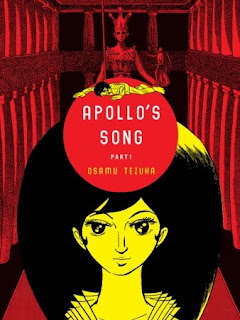
Medium: Manga (1 volume)
Genres: Drama, Romance
Author: Osamu Tezuka
Publishers: Shōnen Gahōsha (JPN), Vertical Inc. (NA/UK)
Release Dates: 1970 (JPN), 2007, re-release in 2010 (NA/UK)
Age Rating: 16+
Given that the main focus of Apollo's Song is love and all the strife that results, I could get away with writing a "Love is a crazy thing, isn't it?" type of intro for this review. But I won't, because the manga does a much better job of doing that in its own introduction, which shows anthropomorphized sperm in a marathon race to reach the egg. That probably sounds absurd, but the reverence shown to love and procreation comes through the page, letting you know you are reading something rather special.
The main character of Apollo's Song is Shogo Chikaishi, a teenage boy who is brought in to a psychiatric hospital with a rather bizarre malady that is the focus of much of the story. You see, Shogo hates the concept of love. He is incapable of feeling it himself, and the mere sight of love or affection of any kind disgusts him so thoroughly that he feels an unstoppable urge to kill those involved, be they human or animal.
The doctor who takes Shogo on as a patient is rather troubled by this and so decides that a suite of tests and treatments are in order, including a terrifying session of electroconvulsive therapy. It is during this therapy that Apollo's Song introduces it's key element that sets it far apart — the Goddess. Taking the form of a massive female statue she scolds Shogo for his hatred of love and forces him to confront the root of his problem. Then, as a punishment for his transgressions against the sanctity of love, Shogo is condemned to a never-ending series of trials — over and over he must come to know love, but every time it is within his grasp it will be snatched away from him. The more cynical among those reading probably just laughed and yelled “Oh, just like real life then!” out loud.
What follows this proclamation is a series of discrete tales that follow the template that the goddess outlines — each time, Shogo comes close to being cured but is ultimately thwarted, usually in a harrowing fashion. You would think this pattern would get dull, but there is another facet to the story; you are never fully sure what is “real”, or what is a dream, a hypnotic suggestion, or even if Shogo is actually dead or alive for the majority of the manga. The different trials Shogo experiences also have their own back-story and love stories within them, further muddying the waters about what is taking place in reality and what is confined to his imagination. Even the ending of the story is wonderfully ambiguous and ends on a rather depressing note for Shogo, but leaves it up to the reader to decide what the ending entails.
I am a massive fan of this sort of reality-bending fiction and so Apollo’s Song scores lots of points with me, enough to make me overlook some of its nagging flaws. The biggest among these is the repetition of the individual stories within the overall plot arc — as mentioned before, they all follow the exact pattern that the Goddess outlines. In addition, some of the stories are instantly forgettable, and even on my fifth reading I am confronted with entire chapters I had completely forgotten and am beginning to forget even as I write this review. Another, more egregious issue is that Shogo himself is an unpleasant dick who keeps undoing his own character development. While this can be seen as a normal human character flaw, especially for someone as seriously ill as he is, it can become exasperating after he fails to even attempt to reform himself for the umpteenth time in the face of great pressure to do so.
This frustration with Shogo is eased by getting know him through the art, with all emotions laid bare on the page for you to see and feel as you read. Simply put, the facial expressions and body language in the manga are among the best I have seen. At one key moment in the story an entire page is set aside at time for a single facial expression of sorrow — a powerful moment hammered home by a very simply presented image. The rest of the art (especially the layout) is equally superb, with many nice touches and unique pages added to keep you interested. The emotional highs and lows (mostly lows, in this case) are wonderfully captured on the page, with each moment given time to breathe over multiple pages and clear layouts to heighten the impact. The main triumph of the art is that each separate story told within the overarching plot looks and feels like its own separate series. You can tell from a glance what the setting feels like and how it differs from every other story presented in the manga.
While I pointed out some flaws earlier in this review that may sound like deal-breakers to some, I am still a fan of Apollo's Song due to how much it rewards revisiting. While not a short book by any stretch of the imagination, the story is just the right size to pick up and read for the hell of it without without the investment of time that MW or Ode to Kirihito demand. Due to its very powerful message and reality-bending storyline, each reading can give you something new to chew on.
I have read this story in a multitude of personal states and attitudes towards love — while happily in a relationship, in a failing relationship, and shortly after a break-up, and each time it has given me something new to think about and an uplifting feeling despite its grim storyline.
[Recommended]
This review is based on a retail copy purchased by the reviewer.
Medium: Digital Manga Application
Publisher: Viz Media
Release Date: Nov. 2, 2010 (North America)
App Store Link
The first thing that popped into my head when I heard of the Viz app was, honestly, "aw, man, another discrete app? I already have half a screen of various comic reading apps!" Thankfully, the app more than makes up for this minor complaint, as I will outline in this review. The reason for this appears to be that Viz wants to tie the user up with a vizmedia.com account rather than putting its inventory on one of the other comic book marketplaces — presumably in order to collect market data and directly monitor usage.
Signing up for such an account is the first thing you have to do in order to view any of the manga, adding yet another login and password to your life. Thankfully the process is very swift, asking a minimum of questions and requiring only an e-mail activation to complete.
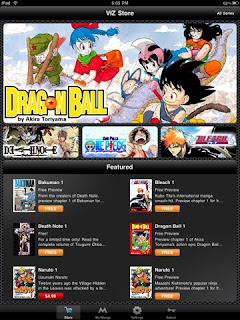
The layout of the app itself follows the normal mold for iPad comic apps that has now been established by comiXology, with a grand total of three viewable tabs, one each for the store, your library of content, and the settings. The app feels greatly streamlined with very few settings available to the user, although it must be noted that I did not find myself wanting for anything and found the app easy to navigate.
The library itself is also very streamlined, with six titles available, each with one to two volumes available at present. These titles are Viz's biggest, such as One Piece, Dragon Ball and Naruto. Each series also has the first chapter available to preview for free, which is a welcome feature. The title-browsing interface is very simplistic and I hope that this is developed further as more titles are added — while the interface works fine for six series it could quickly become cluttered and difficult to navigate as more are added.
As a gift, the first volume of Death Note is available to download for free to users who sign up for new accounts (at the time of writing). Downloading is as simple as pressing the appropriate link and letting the data come to you — however sadly this is marked with a few problems. First of all, there is no downloads menu — the only indication that anything is happening is a sluggish blue bar pasted at the bottom of the volume cover which you can sit and watch creep across the screen. You cannot view a volume that is being downloaded, something that is easily possible on other (sadly less scrupulous) manga viewers. You are still free to navigate around the app, but the experience is noticeably slower and there is a lack of anything else to actually look at while you wait. Exiting the app causes the download to reset, which is irritating but is perhaps more due to the fact that iPads are still running iOS3.2-OS4.2 and multitasking will not be available until some time in November according to Apple. Re-entering the app automatically restarts the download, which is a nice touch, but as downloads don't show up in your library until they are finished and there is no downloads pane, it’s a rather long-winded process to determine how your download is doing. For my part, I went and played with my cats while the download was ongoing.
One thing I want to quickly praise here is the error messages. This sounds like an odd thing to mention, but each time I ran into an error with the app (not often), the message presented was clear, direct, and to the point. When I bought and downloaded Volume 1 of Bleach to test the purchasing system there was an error with the download. The message that appeared reassured me that all was well, nothing was lost, and I only had to restart the app. This extra effort is greatly appreciated, as when errors of this sort occur it can be bewildering as to where your money and content have gone.
So, enough of all of this infrastructure stuff — what about the actual comic-reading part of the app?
First of all, the image quality looks fine. Even when zoomed in the pages look clear and legible with no artifacts in sight. Holding the iPad in landscape mode creates a two-page spread that mimics a physical manga volume, while holding it portrait gives you a view of a larger single page. Both work well and are comfortable to read — the biggest compliment I can give is that I happily read the entire first volume of Death Note and Bleach with no major issues.
One nice thing that made me laugh is that the generic "you are reading the wrong way!" advisory message you find on the last page of manga volumes pops up when you try and turn the first page as if you would a western book. These touches show Viz has been thoughtful when constructing the app.
There are still small niggles with the presentation, however — reading landscape introduces a small time lag in-between page turns as the app renders the next two pages ahead of you, and skipping to a distant portion of the volume causes the app to tick over for a noticeable amount of time before displaying the desired pages. However, It should be noted that this behavior was only apparent when I stress tested the application.
Another small complaint with the manga viewing, at least with Bleach, is the massive size of the spine margins present on the pages — in either landscape or portrait view they take up a not-insignificant portion of the screen and once you see them you can't help noticing that they are there. Cropping these would really benefit the reading experience.
Prolonged reading was comfortable on the eyes, but sadly not on the arms — the iPad is still just a little too heavy to be fully comfortable as a reading device, but this is a fault of the hardware and not Viz.
A quick note here on the price: US $5 a volume at present. This feels, to me at least, a very fair price to charge with the caveat that I expect purchases to carry over onto other digital platforms as they become available. I see no reason why not as your purchases are tied to the Vizmedia.com account you have to create when you start using the app.
All in all, the app does what it says on the proverbial tin, in an approachable and streamlined manner. I have no real complaints that would prevent my continuing to use the app, other than a frank request that they port it to other territories ASAP — if this was available natively in the UK I would gladly use it to finally buy and read One Piece. The series is just too big at present to buy in physical format due to the sheer bulk of the books.
I hope Viz continues to improve the app; adding more and a greater variety titles would be a great start, but adding in community interaction such as forums, reviews and such would really boost interactivity and provide something to do while waiting for downloads to complete. For now, though, it’s a great start.
[Highly Recommended]
Note: This review is of the first publicly available version of the Viz Media iPad app, and thus the app itself is liable to change via updates and patches. Please also note that this app is only available at present within the US and Canada — being in the UK I had to obtain the app via gray market means which, while relatively easy, should only be attempted if you are fully aware of the possible drawbacks of such an approach.
Having found out that Yotsuba&! was this month’s selection for the Manga Movable Feast a little late in the game, I scrambled to re-read it to celebrate alongside everyone else who was picking up this title — whether revisiting it or starting anew. Devouring a volume or two at a time in-between a rather hellish work schedule, I found myself amazed that I never tired of Yotsuba’s cheery antics despite reading it at a breakneck pace. The work presents you with a rapid-fire series of idealized events and adventures that would normally become tiring in a long reading session of manga. Even Sunshine (Hidamari) Sketch, a favorite of mine, gets tiring after a few chapters of consistent reading.
Yotsuba&! is soothing to read, and as the Reverse Thieves have already pointed out a part of that is due to the pervading nature of nostalgia that suffuses the work. Another part, I feel, is that even despite her many actions and traits, the titular character Yotsuba Kowai is someone who we know next to nothing concrete about. In this way she is a great character to act as an observer for the reader, even when she is the one initiating the actions or making the discoveries.
First of all, we are told very few solid details about about Yotsuba’s origin, and even her father is rather sketchy on the particulars. We know she is an orphan (as outlined in Chapter 6), but when pressed for details her dad tells us that he “met her while overseas, and just kinda started looking after her”. Fuuka fills in for the reader here by admitting that she doesn't really understand, but then something much more interesting happens (a thunderstorm) and the topic is dropped as Yotsuba runs outside to play in the rain. The main theory paraded around about this can be seen in a well distributed piece of fan-art that shows Yotsuba as a ragged orphan in a war-torn country. Whether this is anywhere near the truth, or even if there is a canon answer, is unknown.
We don't even know for sure what Yotsuba’s age is, and she and her adoptive father even have a confused conversation about it when buying a bike. Any mention of a mother goes right over Yotsuba’s head without comment, and the manga then typically shifts to a different and much more fun topic. It is refreshing to have a character without any parental issues present in their personality, and this makes it a lot easier to relate to the nostalgia present in Yotsuba&!. After all, no one wants to be reminded of the bad stuff in a whimsical tale.
Linking in with her origin is Yotsuba’s appearance. Many characters, especially incidental ones, question whether she is a foreigner upon first meeting her, a not unexpected reaction given what little we know of her origins, and also how she acts. There is an additional reason as well — her trademark green four-pigtailed hair. While crazily colored hair is nothing new in anime or manga, the world of Yotsuba&! is grounded in real life, and no one else has their hair in such an outlandish hue or style. Characters even marvel at the bizarre style, further re-enforcing how much the energetic little girl differs from the norm.
Then there are the more mundane, common sense reasons that make Yotsuba stand out. She never tires of looking for adventure each and every day, is enthusiastic about absolutely everything, and is for the most part impeccably behaved apart from the odd, endearing, and quickly forgiven mischief . Yotsuba is the perfect little friend to explore the world with, a fountain of endless curiosity and enthusiasm that makes the world a better place. Even her tantrums are (mostly) well founded, in stark contrast to normal children. (I remember being a selfish little brat myself when I was five-ish.)
Yotsuba is an outsider in her own manga, and it is because of this that the reader never gets sick of her antics. We don't know much about her, and don’t care to find out beyond the basics presented as it may disrupt the warm fuzzy feeling that the manga provides. Hell, what if Kiyohiko Azuma went crazy one day and decided that Yotsuba’s origin is that she is a 1,000-year-old vampire stuck in a tiny body? All the fun would leave the title faster than air out of a popped balloon.
Knowing nothing about Yotsuba lets us get on with the very important business of enjoying her company in her magical, whimsical adventures full of cardboard robots powered by money and flower cupids. It’s much better this way.
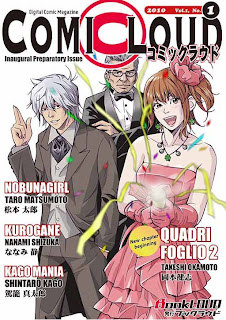
Medium: Digital Manga Anthology
Publisher: Bookloud
Release Date: July 28, 2010 (Worldwide)
Kindle marketplace link
I would not have known about the existence of the digital-only manga anthology Comicloud if not for @animeresearch on Twitter. So, all due respect to him for alerting me to it. Comicloud is published via the Amazon Kindle online marketplace, and as I have both an iPhone and an iPad with the Kindle application installed I was instantly curious.
First of all, I wanted to get all discussion of the application itself out of the way. Buying and downloading the eBook is seamless; the application takes you to the Kindle marketplace and back again straight away after a purchase. Downloading the book, even on multiple devices, is utterly painless. However, viewing the magazine itself has its issues — zooming into the pages is rather cumbersome and once zoomed in (especially on the iPad) you have to revert the page to its native size to turn the page. This issue is exacerbated by the fact that each page is shown at less than the full viewable area of your device so you get massive margins around each page.
Now, onto the anthology itself. The file size is rather dinky (9 MB, to be exact). While this is great for quick downloading on the move, the image quality suffers from this small size as zooming in even a little on the pages makes image compression readily visible. The size of the images that make up the anthology are rather small, resulting in massive margins around the pages on the iPad and noticeable amounts of unused space even on the smaller iPhone. This fact, combined with the previously mentioned issue of being unable to turn pages while zoomed in, makes reading the magazine a chore.
Another much more irritating issue is that both the translation and the editing feel lazy. The former is at least functional despite its poor use of punctuation, but the typesetting of the dialogue and sound effects feels very poorly handled and is detrimental to enjoyment of the magazine. All the text is presented plainly, sound effects outside of speech bubbles are untranslated and there is nothing to differentiate between sound effects and dialogue that are placed inside bubbles. The actual presentation of the content feels like an afterthought.
But what about this content then?
Quadrifoglio 2 (By Takeshi Okamoto)
The longest of the individual contributions, Quadriofoglio follows the genius mechanic Yotsuba (no relation to the adorable character from the manga of the same name) as she joins a university car racing club and helps out at her family garage. I must admit I had severe flashbacks to Initial D while reading this due to the very impressive, photo-realistic drawings of the cars, and thankfully the people didn't look half bad either and were an engaging bunch to read about. The main problem I have with the series is a lack of any feeling of motion either within or between the separate panels, making it feel more like a series of stills than an ongoing, unfolding drama. In a manga about things that go “Vrooom!” around a track very fast this saps some of the fun out of it. Still, it’s a fun read and I would be I happy to see how it develops in further chapters. Searching for information of its predecessor (Quadrifoglio) has left me empty-handed, sadly.
So, let me outline the premise here: loser guy meets hot dense girl out of nowhere and has to live with her, and she inexplicably likes him. If you just passed out as a result of how generic that sounds, then you know how I felt reading it. The series even ticks the additional otaku bait box of having a trap turn up in the first 10 pages. Sadly the clunky translation hurts this series, making the main expository pages of this chapter read like a garbled mess and so I’m not sure if the premise has anything going for it. The art looks serviceable enough (especially the breasts of the main female character), but in general the whole package is woefully forgettable. It does however have the best sound effect in the anthology: "Hug!!" Two exclamation marks! Wowzah.
Nobunagirl (By Taro Matsumoto)
Time for brutal honesty: Nobunagirl has terrible, awful art and is hard to take seriously. Both lineart and shading are all over the place and panels that should be badass inspire more laughter than awe. The plot jumps from a demon infested Warring States era featuring Oda Nobunaga into an even weirder sci-fi setting which has very little thought or care put into it. The last panel is so bizarre it has to be seen to be believed: a young girl riding on the back of a terribly drawn ripoff of the alien from ... Alien (1979). I think I uttered "Are you serious?" while reading it. Skip this.
For me, the promise of content from the surreal mind of Shintaro Kago (who is called a "fantastic idea cartoonist" in his own bio) was the "killer app" that pushed me over the edge when buying this anthology. Imagine my surprise when the content supplied had much higher quality drawings than his usual fare, but then also imagine my disappointment when I discovered that he had only four pages in the magazine! Each page is a single, full-page image of a surreal idea given flight, and while I enjoyed them, it was all over too soon. What a shame.
Overall, I feel conflicted about Comicloud. While I love the idea and dearly wish for it to find an audience, the content just isn't there yet. Over half of the 80 pages delivered are skippable and the rest feel cheapened by the small image size and poor typesetting.
Personally I am looking forward to the next few issues to see how the magazine develops, and hope that the hard work and enthusiasm that the editors clearly have for their product pays off.
[Bad]
This review is based on the Kindle release, purchased by the reviewer.
Medium: OAV (50 Minutes)
Genres: Action, Drama, Fantasy
Director: Shinobu Yoshioka
Studio: Ordet
Release Date: July 24, 2010 (JPN, bundled with magazines)
Rated: Not Rated
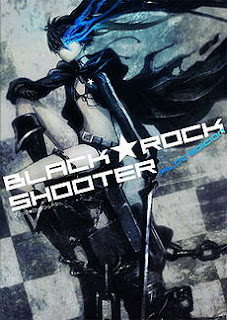
Black Rock Shooter is a rather odd thing in this day and age. It is a 50-minute OAV, initially distributed with a selection of magazines based primarily off of a Vocaloid song created in response to a drawing of the same name. A real, live OAV in 2010! Is it the savior of anime? Is it going to blow everyone away, as the hype before release insisted? Well, no.
The narrative of the feature (from Shinobu Yoshioka and Haruhi Suzumiya author Nagaru Tanigawa) is split into two halves: one showing a mundane reality that provides the background and setup, and a second set in a bizarre other reality which shows the action and resolution as a result of the developing background. The two separate plotlines eventually resolve, providing the convergence point and the grand ending to the events at around the same time. If you have ever read Haruka Murakami's Hard Boiled Wonderland and the End of the World you will instantly recognize this structure. This can be very effective if pulled off well, as it keeps you invested in seeing how the separate worlds resolve, as well as seeing how they intersect.
In the case of Black Rock Shooter (or BRS, as it will now be known for the sake of brevity), this structure is a bit of a mixed bag. The animation's two halves comprise an idyllic school day story on one hand and a fantastical action flick on the other. I went into this full well expecting to love the half made of bombastic crazy action and hate the flat school day crap but it soon turned out to be the exact opposite. The parts set in reality show a poignant, if slow to start, exploration of friendship and jealousy, while the action portion is a limp, boring attempt at being badass that forgets to engage the audience.
What is the cause of this discrepancy then? In short, it is the lackluster animation quality that persists throughout. More than once I checked the integrity of my copy to ensure I was not missing anything due to video/DVD player issues. While the individual frames look fine quite often it feels like frames are missing from the timeline, making the animation flow look cheap and nasty overall. This became obvious to me in one scene where the main character fumbles with a hot piece of toast fresh from the toaster. Both the toast and her hands teleport from one place to another in pursuit of each other; this made the scene look absurd and broke me out of the viewing experience. This issue exists throughout, though during the quieter and more measured slice-of-life segments it is much less of an issue due to the obvious lack of action. During the other half of the OAV, the supposedly action-packed half, the laziness in the animation really hurts the presentation. Action scenes appear poorly thought-out and lack any snap or pop in the proceedings — instead of drawing you in, the fight scenes leave you feeling like a bemused bystander watching something mildly bizarre happen, such as a pensioner dancing at the bus stop. Even things that should be bad-ass will leave you feeling nothing due to the cheap and distracting skips in animation, the Michael Bay-style camera angle shifts, and the slow pace of the action.
Something else that irked me about BRS was the music. In short, I can't remember a single note of it. Every track is utterly forgettable and as soon as it stops playing you are left with nothing. For something born from the seething crazy morass of the Vocaloid fandom, surely they would be able to rope in some decent musical talent to bolster the soundtrack? Well, apparently not.
One last annoying thing, just to get it out of my system — the last scene of the OAV, the "stinger" if you will, is the same kind of inane cheap shot as was used in the closing scene of the US Godzilla film. I'm surprised a narrator didn't suddenly burst in bellowing "Everything is safe now... Or is it? DUN DUN DUN" when this scene played out.
So, what did I actually like? Well, as mentioned before, I found myself enjoying the slower, school life half that was used for character setup. As it develops, this plotline begins to take on a very effective, melancholic feel that reminded me a great deal of 5 Centimeters Per Second and The Girl who Leapt Through Time. This was especially true in regards to the themes expressed, reflecting on the distance that can grow between people through the passage of time or inaction. The great shame of this is that as soon as it looks like the emotional storytelling is starting to get going, the two plot arcs converge, the story transitions to the other half you have seen play throughout the OAV, and the story ends. As blasphemous as this may sound, perhaps this film would have been better served with a strictly linear narrative, with the emotion-heavy first half able to carry to action-based second half.
Did I enjoy it? I suppose so, although I was dangerously close to shutting off the OAV multiple times due to sheer indifference at what was occurring. I almost wish that the crew behind the animation could be given a second go at making this product to do justice to all the hype and expectation, but that's not how the world works. Would I watch a second episode? Sure. Would I watch this one again? Probably not.
[Passable]
This review is based on a DVD release, purchased by the reviewer.
Ani-Gamers is publishing a handful of messages from our bloggers expressing our personal reactions to the great loss that is the death of anime director Satoshi Kon. This time manga/game reviewer Elliot Page graces us with a Kon-related story from his university days.
I wanted to write about a way that Satoshi Kon affected my life for the better, and at the same time share my first experience watching his work. Thankfully these events are one and the same.
In my first term of university, I was confused and without direction. I had moved halfway across the country to undertake a course that was beginning to look terrifying and was almost completely alone except for a few rocky friendships I had made.
I attended the university anime club, with all its bizarre personalities and rather questionable programming decisions, and was on the verge of giving up on it (and anime as a whole, really) when one week I strolled in for “a very special presentation”.
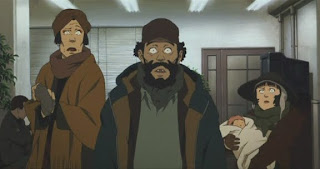
That presentation was Satoshi Kon’s Tokyo Godfathers. I didn’t know then it was directed by him, and I didn't even know the full title because the guy with the huge head who sat in the front row obscured the title.
The movie was wonderful. Utterly wonderful. I’ll save you the gushing attempt at a review and simply say the characters enraptured me completely and it had complete control of my heart-strings after five minutes.
Not everyone loved it. Some people, including the club chairman, left outright or started to gossip amongst themselves and were tersely asked to leave. One rather irritating specimen gave a theatrical yawn before strutting out, adding “Well, have fun kiddies!”
I don’t remember any of these people. I didn’t have much interaction with them in the anime club or outside of it.
The people I do remember were those who remained until the end of the film. Once the credits ended and the harsh, cheap lighting came back on I sat with a core contingent of survivors, most of whom I got to know over my time in the anime club and while I was at university in general.
Sat is the wrong word however — I was hunched over, sobbing like crazy. I cry easily at films, and Tokyo Godfathers did the emotional equivalent of running over my heart. To my left was a man who looked much like a bear due to his amazing beard — he was having a hard time holding back his own tears and give me a spare tissue. This dude became one of my best friends at university and we still stay in contact as best we can. To my right was someone gently patting my shoulder and managing to remain somewhat stoic, although she admitted later that she cried once she was out of sight of the congregation. We later entered into a rather rocky romantic relationship but remained good friends to this day. The rest of the room, approximately ten people, I became at least good acquaintances with over time. Perhaps we had undergone a shared experience, although no one ever pointed it out.
The president of the club came in, said “See you next week!”, and took her DVD player home. I came back the next week and the rest of my first two years of university, my faith in animation restored by the film. I made some solid friendships, some of which remain to this day and all of which helped me through the uncertain period while I was starting university.
Satoshi Kon made my life better, and for that I am eternally thankful.
Ed. Note: Welcome to the second half of Elliot's iPad Video Game Review Round-up: iPhone Edition. This time Elliot will again be looking at some iPhone games and how well they play when scaled up to the iPad. Next time, we'll be back to native iPad games.
Chaos Rings
($9.99 – US App Store link – UK link)
If you were to write down a list of generic Square Enix RPG elements, you would end up with Chaos Rings as the result. Random, quasi-turn based battles with experience points and leveling, bland characters that have amnesia, dull puzzles and a big bad that stepped out of a crazy goth fashion catalog. Still, it’s a well put together package even with its lack of surprises, and blowing the app up on the iPad screen makes you appreciate the detail present in the graphics. Sadly the game is still rather expensive, so unless you already possess this or have a very long bus journey to fill, you may want to save your money for more inventive fare.
Hook Champ
($2.99 – US App Store link – UK link)
Remember the ninja rope from Worms? Bet you would love a whole game of that with some Indiana Jones flavor and humor thrown in! Hook Champ is a game where you use a grappling hook to go right towards an exit while a demon tries to eat you. The pixel art graphics look great on the larger screen and the game is still great fun, but enlarging it has had the small side effect of putting the various buttons too far apart for comfort. This can lead to a lot of unintended deaths and frustration when your little dude falls into lava within grasping distance of the ending.
Beneath a Steel Sky: Remastered
($2.99 – US App Store link – UK link)
If you recognize the name of this game, odds are you remember it from playing it on the PC years ago and have already bought it again. For those who do not know, Beneath a Steel Sky is one of those old-time point and click adventure games where you combine items and people to make your way through various puzzles. In this case, the main character Foster is kidnapped and taken to a city controlled by an omnipresent commuter called LINC, and you must strive to escape. This version includes a hint system, some updated graphics, and all the voice work from the original.
Blowing it up onto the iPad screen actually helps the game, as it makes interaction with items, especially those close together, much easier. A word of warning, however: this game, like many from its genre, suffers from rather inscrutable puzzle design and so you may find yourself using the hint system quite a lot, especially toward the end.
Breaking: Today at 7PM GMT, thousands of slaving Internet denizens flocked to an unsuspecting website and fleeced it without mercy for its precious bandwidth, thus frustrating one another in the attempt to view a 180-second-long trailer (embedded in this post after the break). Our man on the scene*, frustrated beyond any reasonable human limit, exclaimed “DAMN YOU INTERNET GO AWAY” as he frantically tried to acquire the bandwidth needed to behold the video clip. Even once the video presentation had begun, our man on the street found himself waylaid by errors and inconvenience, reaching a point at which he implored the website “DONT STALL AT THAT MOMENT. [...] COME ON.” To the credit of the website hosting the video, it held strong against the tide of users and reports of it collapsing against the strain have been isolated and minimal.
Dropping the irreverent tone, the real news story is that Irrational Games, creators of SWAT 4 and the original Bioshock, have released a teaser trailer for their upcoming game Bioshock Infinite. The trailer follows on from a low-key teaser site campaign hosted on www.whatisicarus.com and a behind-closed-doors presentation in New York earlier this week. Large quantities of additional media have now been released about the game, in particular on Joystiq, who also have an interview with studio founder and creative director Ken Levine. From details that have been released, the game is set in 1912 onboard a floating city called Columbia, held aloft by comically large hot air balloons.
On a personal note, I must say that I find myself ambivalent towards this announcement as I am not very enthused by the environments presented in the trailer, and have been unimpressed overall by previous entries in the Bioshock series. In addition, the game is not scheduled to be released until 2012, and between now and then there are many other video games that I am personally much more excited by.
*A person I follow on Twitter and fellow Ani-Gamers writer, Mitchy D.
One of the main reasons why I decided to go against my better judgment and buy an iPad was because I already had a glut of applications and games that I could transfer from my iPhone. With some minor exceptions, the iPad can run most software originally made for its smaller cousin, emulating them at either the original screen size or blown up to fill the iPad screen. The results of doing this can be somewhat mixed and so I wanted to run through some of the more popular games or apps (at least the ones I have) in order to highlight those apps that are well worth sticking on your iPad, whether you have an iPhone or not.
Canabalt
($2.99 – US App Store link – UK link)
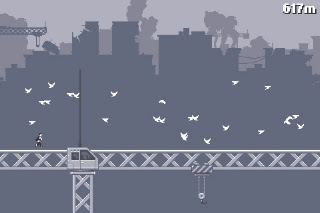
One of the best examples of one-button gaming, Canabalt has you running from a shadowy menace by jumping from rooftop to rooftop. The game both benefits and loses something by blowing it up on the iPad, as the distinctive art style losing some of its charm through the process of being enlarged. The gameplay remains as tactile as ever, and I must admit I have reached higher scores on the iPad because I don't have so much of the screen covered up by my huge thumbs. The game is still great fun and well worth picking up.
Note: in the time since this review was written, Canabalt has now been made to work natively on both iPhone and iPad in a single download!
Espgaluda II
($8.99 – US App Store link – UK link)
Espgaluda II is one of those crazy "bullet hell" games you may have heard about. I am a massive fan of these due to the challenge and unique art styles they present, even though I am utterly terrible at playing them. Fitting a fully realized shoot-em-up on the iPhone is already a marvelous achievement, even if everything feels a little cramped and at times it is hard to navigate through bullet patterns unless you squint and bring the phone right up to your face to see what is happening on screen. Running the game on the iPad alleviates this issue, and the blown up graphics look more impressive on the larger screen as you can see all the detail with greater clarity. Sadly the game is still rather short and on the easy side, but still well worth a look due to the high replayability on offer.
Space Invaders: Infinity Gene
($4.99 – US App Store link – UK link)
Sticking an already wonderful shoot-em-up with minimalistic graphics and a seemingly endless array of unlockables onto the iPad has encouraged me to play the whole thing through all over again. The whole package looks amazing on the larger screen and the controls work marvelously. If you somehow missed this before, get it now.
Drop 7
($2.99 – US App Store link – UK link)
A particular favorite of mine, Drop 7 is a slim, elegant puzzle game where you make horizontal and vertical rows with numbered blocks to rack up points, kind of like Tetris. Sadly, the massive iPad screen makes the game feel rather clunky, changing from a simple one-handed game into an unwieldy overblown mess that is uncomfortable to play, and ruining the simple graphics that work so well on the smaller screen. Stick to playing this one on your iPhone or iPod.
Note: In the time since this review was initially written this game has now been updated to work natively on the iPad screen. It still suffers from the issues outlined above, sadly.
Ace Combat Xi: Skies of Incursion
($4.99 – US App Store link – UK link)
At some point a while ago Konami decided to do something rather crazy and create an iteration of their air combat series for the iPhone, with this as the result. They also ignored getting the game text proofread and decided to nickel and dime customers by charging for DLC in the app, but that is beside the point.
While the game still looks and sounds great blown up onto the larger screen, the control system has suffered horribly. Given that many of the control methods rely on tilting the device, an easily accomplished exercise on the iPhone, the game is harder to control than a truck doing 100mph on an icy highway. You'll find yourself overcompensating constantly trying to control your plane and this combined with the tiny dead zone in the tilt sensor makes the game painful to play.
Tilt to Live
($2.99 – US App Store link – UK link)
This game also relies entirely on tilting to control it, and to a higher degree of precision than in Ace Combat, or any other tilt-based game for that matter. Not only that, but you'll look an utter tit swaying your iPad around trying to engage with the Geometry Wars-style gameplay. Stick to playing it on the iPhone.
Ed. Note: The show will go on in a week or so with the second half of the iPad edition of Elliot's iPad game review series. Plus, we've got even MORE reviews of full iPad games coming as well.
You may have already noticed, but there is a lot of hullabaloo on the Internet at present about the presence of illegal manga scanlation aggregation sites (we won't link to them here for the sake of integrity) as well as the recent formation of an industry coalition to fight this particular practice. One response to this, and one I have personally echoed in my own vehement and nerdy voice, is that there needs to be a legal equivalent to fill the obvious market that exists for digital manga. There have already been some steps in this direction, as you will have seen from my review of the Astro Boy Magazine (Soon to be provided in iBooks, I hear!), but this is only available for Apple platforms in selected countries at present.
I want to outline how a digital marketplace for manga would make me a more lucrative consumer for the manga companies.
The first problem that can be solved by digital distribution is availability. There are two parts to this, because I can't help overcomplicating things.
Part number one: Retail availability can be a double-edged sword. Every few weeks I make a circuit of the two remaining manga booksellers that exist where I live and pick up things that interest me. This has led to some wonderful impulse purchases I would not have otherwise made, but as time has gone on this practice has declined just as the available space for manga has shrunk within these stores. More often it poses an issue — you see fragmented series missing volumes you wish to purchase, or only the very latest volumes of something you may be interested in. Ordering in copies can, depending on the service, be a royal pain and the time until delivery is often worse than shopping online.
Talking about online, these same issues are amplified in the digital bookstore, where ordering out-of-stock items is often a lot less transparent and impulse purchases are all but non-existent. I don't know about you, but most of the suggestions that Amazon offers me on its front page are for books I have already purchased from other vendors. Still, this shows that their system works.
With a digital product there is (barring a freakish technical fault) no such thing as “out of stock”, or “available in 7-14 weeks” — just a digital file on a server that is waiting for me to fork over my cash. While you lose some of the romance and physicality of a brick-and-mortar store, the instant and obvious availability of stock makes for a much easier purchasing experience overall.
The second part of the availability issue comes in when a manga is no longer in print, or hard to find. You may end up having to pick up volumes from many different places, both from physical bookstores and online counterparts, and trying to order unavailable volumes can be a lottery. I’m sure many of you can think of a time you have heard an exciting series described to you by a friend, enemy, or podcast with the soul-crushing words “Oh, but it’s hard to find now” appended on the end. Wouldn’t it be nice for there to still be an option available to obtain the series while still ensuring that the publisher feels the love?
For a personal example of this problem, I had a hell of time picking up Buddha recently. While not strictly scarce, the wildly fluctuating availability of individual volumes in the UK made picking it up for a reasonable (i.e. RRP or less) price a hellish endeavor. I ended up ordering it from four separate places, one of which was a bookstore in Croydon who did mail-order but had no e-mail and so I had to phone the (very pleasant) shop assistant.
How nice would it have been to simply press a big button on a digital delivery service labeled "Buy Series"? I would have done that in a heartbeat.
A digital option would also have cut out a big additional cost and inconvenience of manga purchasing — physical delivery. Instead of waiting 3-5 working days and/or paying a varying sum for delivery, the manga can come direct through your Internet connection at minimal cost. This immediacy would allow for an even greater volume of impulse purchases — something I am already highly susceptible on the iTunes Store and on Steam.
The next, and main, reason is amazingly boring and a bit obvious: Manga made from dead trees takes up space. Once you start a collection, the amount of space needed tends to skyrocket. I currently own the first 6 volumes of Fullmetal Alchemist, and while I would love to continue reading the series, I have no space to house it. I already have two full bookcases, and purchasing a long series like FMA would cause me no end of headaches trying to find a home for it. Note that this does not mean that I will stop buying physical manga volumes, but I have to be more selective about what I buy, especially longer series.
This leads me to a secondary item — while I enjoy reading Fullmetal Alchemist, I am not desperately chomping at the bit to devote the not-trivial amount of money and shelf space to the rest of the series. With this current state of affairs, I have no (legal) method of reading the series and the publisher is missing out on the money I would happily pay them for a digital version.
These are all issues with the current model that can be remedied by a digital marketplace, and would not displace my existing desire to buy physical copies. I haven’t even started to talk about ways that manga could be enriched and enhanced in a digital marketplace, but that is within the scope of a different article.
Editor's Note: Digital Manga Publishing is currently running eManga, a site offering digital distribution of manga through a rental system.
At the time of writing, the Apple iPad has only just come out in the UK and a smattering of other countries. Like the impressionable gadget nut I am, I bought one on release date, foolishly believing that all my existing iPhone applications and games would have up-scaled versions available to download right away. This was sadly not the case, and some of my favorite iPhone games look flat-out ugly on the larger screen. Being as impatient as you expect someone with a new £430 gadget would be, I decided to splash out on a few games on the App Store, further lining Apple's pockets. Here are some miniature reviews of the games I downloaded to assist anyone else who is interested in using their new touchscreen paperweight as a gaming platform.
After the break, check out reviews of Plants vs Zombies HD, Strategery, Words With Friends HD, and Geared HD.
Plants vs Zombies HD
If you have already played the PC version of this PopCap-developed game, odds are you’ve already bought this version too.
Plants vs Zombies is a streamlined take on the "tower defense" genre, wherein you place aggressive plants in your back garden to fend off invading hordes of humorous zombies who are after your sweet, sweet brains. The game oozes charm, and looks even better on the iPad than it ever did on my PC, primarily because the graphics have been optimized for a single screen resolution rather than the innumerable screen resolutions of monitors. Another thing optimized for the iPad is the interaction; controlling everything directly through the touchscreen makes the game much easier and more pleasant to interact with than using a mouse. Like the original, PvZ has a perfectly tweaked learning curve that eases you into the many different gameplay facets that keep the experience fresh for level after level. The only problem is that once your opening strategy is perfected, the game can feel excruciatingly dull running through the same motions every time and you will find yourself wishing for a "speed up" button.
The game is priced at £7, and so can be said to be rather pricey, but considering the amount of hours you can sink into it and the high production values, I would say it is well worth a go.
[Recommended]
Strategery
No, that name is not a typo, honest. Strategery is, as you may guess, a strategy game in the vein of the board game Risk. You invade regions with troops, conquer them, and then place more troops down in your captured regions in preparation of the enemy counterattack. The main draws of the game are its neat, clean art style and randomly generated maps. Every game map looks subtly different, and there are a few options available when starting that slightly alter the way the game plays
Strategery feels well made, moving along at a brisk pace you could never achieve with a physical war game, but this is where my praise ends. The strategy core of the game feels rough and unrefined, lacking any advanced planning potential due to the basic blocky maps it draws. With its current mechanics, every game boils down to making the biggest blob of a county possible and then throwing obscene numbers of troops with no fear of effective counterattack. This inevitability sucks a lot of fun out of repeated play, especially as there are few options available that would spice this up. Including continents or encouraging conservation of troops would go a long way to solving these issues.
Sadly I have been unable to test the online multiplayer as there is no matchmaking and I could not manage to con anyone into playing with me directly. Local multiplayer works fine, but the game boils down to the pattern described above.
While the game includes both an iPad and iPhone version together, I would suggest spending your time and money elsewhere.
[Bad]
Words With Friends HD
For those who have never heard of this before, Words With Friends is a competitive 2-player version of scrabble where you send moves back and forth between each other in a way reminiscent of play-by-email strategy games.
The game handles everything effortlessly, including in-game chat, a complete and accurate dictionary and very nice presentation throughout.
Anyone who has played the iPhone version: yes, it is the same as the iPhone version with an updated interface and shinier graphics. Yes, it is well worth your money even if you forked out for the iPhone version. You can use the same account and play games between both devices.
I heartily recommend it to anyone who enjoys word games but can’t get people to sit still long enough to play a tabletop version of Scrabble. If you fancy it, you can play against me; my username is "Elliotpage."
[Highly Recommended]
Geared HD
Geared is a wonderfully simple puzzle game wherein you use a set of gears to link a moving starter gear up to one or more target gears. More gameplay twists are added at welcome intervals to help keep things fresh, and the difficulty curve is exceptionally well tuned. The game has grown considerably since I first bought it on the iPhone and now sports 150 levels as well as a helpful level skip function for when you get really stuck. The graphics are clean and simple, allowing you to concentrate on the puzzle. It even has a very nice win chime once you complete a stage, an encouraging little extra when you have spent 5 minutes staring blankly at the screen.
Geared HD is cheap as hell and amazingly addictive. I can attest to its grabbing power as both my parents love playing it and getting my iPad back from them once they start playing is like drawing blood from a stone.
[Highly Recommended]
Let me know in the comments if any of you find these helpful, and perhaps I'll check out another batch of iPad games.
Note: This article assumes that you have already read To Terra, or at the very least have an understanding of the main characters within the story. If you go to Kate Dacey's compilation page for the To Terra edition of the Manga Moveable Feast you will find a wealth of reviews and other articles about To Terra that you can sink your teeth into.
While re-reading and chewing over To Terra for the now-passed Manga Moveable Feast, I found myself drawn to something I had not considered in such a concentrated manner previously: the upbringing of the characters and how this drove their actions in very different ways.
The majority of the characters are raised under the Superior Domination (SD) system, a computer-moderated society put in place to produce pure, productive members of humanity. With echoes of Brave New World, To Terra quickly introduces its chilling, dystopian social environment where children are planned and conceived by computer before being passed to foster parents and raised without knowing their true origin.
Once the children reach their 14th birthday they are taken unawares for a "Maturity Check", administered by a central computer. The Maturity Check functions as testing and preparation for the child's adult life, with some of the intricacies left unexplained to preserve the mystery of it. Sounds an awful lot like puberty, doesn't it? The main difference is that the Maturity Check doesn't cause hair to suddenly appear in new places, and if anything it makes the characters immaculately drawn hair even more lush. During this enforced coming-of-age the child is told that their childhood was a fabrication produced for the sole purpose of providing them with a healthy emotional background and that their early memories are to be wiped.
This forces an identify crisis onto the children, one which is intended to clear the way for training that will form them into pure subjects willing to work for and perpetuate the Superior Domination Order, with the aim of restoring the now-ravaged planet Earth under the guidance of the Mother Computer.
It is worth noting here that the phrase "Mother Computer" would, at the time that To Terra was written, have sounded utterly outlandish and more than a little disturbing. While computers these days are benign things you have on your desk, in 1977 the microprocessor had only recently been produced, ARPANET was new, and the CRAY-1 supercomputer was the machine to beat. This new technology would surely have had a vague air of magic and threat, and to hand over the most basic of human interactions — the creation and care of children — to such constructs would feel abhorrent.
Firstly, I want to focus on those characters in the story who I believe most closely mirror how "normal" people such as you or I would react in the SD system: Seki and Sam. Both undergo the typical SD upbringing and we meet them early on in the story as classmates of Keith Anyan on a educational station having recently undergone the Maturity Check.
Seki is an intelligent child, though he is earmarked for greatness and is prideful and arrogant as a result. He is emotionally sensitive and coupled with his outspoken distaste of the SD order he is considered a troublemaker and, even worse, a potential telepath. The source of his discontent is very basic and understandable; Seki resents the SD system for stripping him of his childhood, clinging onto the angelic memory of his mother despite knowing it was a fabrication. This grief accelerates Seki's frustration with his situation playing second fiddle to Keith and causes him to act in an increasingly impulsive manner to try and assert himself as an individual and to validate his upbringing. These actions spiral out of control, eventually leading to his death. For being intelligent and sensitive, the SD order drove Seki to self-destruction, wasting a potentially world-altering person due to its deception.
On the other end of the spectrum, Sam is dead average. He squeaks passes in his exams, neither dissents or swears by the regime that produced him, and doesn't sweat the small stuff. His main responsibility is to his friends, and sticks by Keith through thick and thin. An upstanding citizen, he graduates with average grades and takes a job as a space trucker, something that sounds even more boring than normal truck driving. Through this job he comes to meet the Mu and in particular the main protagonist Jomy, who he was childhood friends with. Faced with a filthy telepath, Sam acts upon the information that the computer education has drilled into him and freaks the hell out, attacking Jomy in a fit of primal fear. Jomy is horrified how his old friend has been warped and over-reacts, causing a massive explosion and injuring Sam.
We are later re-introduced to Sam and find out that this encounter has left him crippled at a mental age of 14. All the ingrained fear is gone, replaced by a much more carefree outlook. While this may be a bit of a stretch, I believe that this shows that the overbearing influence of the Maturity Check, illustrating that the computer education had left Sam without the mental tools to cope with adult life. The shock encounter caused him to revert to a simpler time without the choking influence that had warped him into a form so horrifying to Jomy.
Jomy, the main protagonist of the story, also goes through the normal SD upbringing experienced by Sam and Seki, and like them he is abducted at 14 to undergo the Maturity Check. For him, however, things change when he is rescued by the leader of the Mu and made their new leader. Faced with so much responsibility and hostility from both the SD order and from his own people, it would make sense for Jomy to seek a return to the halcyon days of his youth, even while knowing that it was a fabrication. For the majority of the story he tries to bring happiness to the Mu by creating a stable home for them, free from the overbearing computerized system that hunts them.
Following a major tragedy Jomy finally heeds his predecessors' imperative to bring the Mu to their homeland of Terra and to destroy the computer system that is warping humanity.
The first step on this journey is for Jomy to put his own past to rest by attacking his old childhood world and destroying the computer that oversees the Maturity Checks there. It it only with the destruction of that machine that Jomy matures both as a person and a leader, shouldering his burdens and doing what must be done to save. Not just his own people from the oppressive Mother Computer, but humanity as a whole as well.
One of those burdens is Tony, who is the product of the first natural birth among the Mu, and an exceptionally powerful telepath. Brought up with utmost love and care by his mother Carina, he is overcome with grief when she dies. The resulting shock causes him to overreact and accelerate his physical growth in order to be of greater use to Jomy, the young leader who encouraged his birth and whom he now regards as his family. This change makes him as an abrasive, irritable person who is still very much a child emotionally, traits exaggerated by being the cornerstone of the Mu military due to his immense psychic power. This combination of personality and ability causes Tony and the few others like him in the Mu population to be treated as outcasts. They eventually leave the Mu to begin a dreamlike existence among the stars, having grown up too fast without the grounding to cope with the harsh reality they live in.
Finally, there is Keith Anyan, who is perhaps the most interesting of all of the characters in To Terra. Keith is the result of a more advanced version of the SD program — he is engineered to have a theoretically perfect genome and grown in a tank until 16 under the direct care and attention of the educational computer. He cannot recall his childhood, something which sets him apart from his school friends, and when he discovers the truth there is an initial shock at the confirmation but no great change or revelation takes place. This is, in my mind, because there is no subterfuge involved. Instead of having an illusionary childhood life stripped from him, Keith is left to ponder his existence as someone created for the express purpose of leading the SD order. While he does follow orders of the computer, Keith develops throughout adulthood, free of any anxiety or doubts lingering in his mind about his origins. In the end, it could be argued that Keith has the fewest issues with his childhood, primarily because he did not have one in the strict sense, and he had no other alternative but to adjust to his circumstances. He spends a large amount of time reflecting on the people he has met throughout his life, allowing these events to affect him rather than being a prisoner to his childhood and the computer overlords that he starts to question as time carries on.
With all this out of the way, what was Keiko Takamiya trying to say? I submit that the message is that there should be no lies in childhood, as this only causes mal-adjustment and traps people in a cycle of trying to reconcile reality with what they experienced and viewed as fact, thus stunting their development. In this story the computers are one thing used to provide and enforce this lie, but they could be swapped out for any real-life examples that you care to produce, such as an overbearing Nationalistic agenda. Even now, many years after publication, this message feels very relevant and lacking in due consideration, making the series all the more important to read and reflect on.
Medium: Manga (3+ in Japan, 2+ in US/UK)
Author: Satoko Kiyuduki
Genre: 4koma, Comedy
Publishers: Comic Gyutto! (Now discontinued), Manga Time Kirara Carat – Hōbunsha (JPN), Yen Press (NA/UK)
Release Dates: July 2004-present (JP, includes hiatus), April 2009-present (US/UK)
Age Rating: Teen (13+)
At a recent convention, I came down with a rather peculiar illness which only manifested itself within the Dealers’ Room. The main symptom was a need to throw money at the stall staff, and even after getting the items I desired, the illness persisted. One purchase I made while in this haze of feckless consumerism was Geijutsuka Art Design Class (abbreviated as GA), which I snatched up with very little consideration. In fact, the full thought I put into these books before buying them went as follows: “Oh sweet, it's set in an art school? Maybe it'll be charming and enjoyable like Hidamari Sketch!” Only after I was safely home and the illness had subsided that I realized I had made a terrible mistake.
The main issue I have with GA is that it is very hard to determine what purpose it serves. Is it a comedy, a character-focused series, or a lighthearted instruction manual on artistic techniques? The synopsis and cover design make it appear to be a little of each. The manga is laid out in vertical 4-panel (4koma) strips, which are usually the mainstay of comedy series, but the series rarely elicits a laugh. This is simply because they are genuinely not very amusing, and in some cases hampered by a large cultural boundary that the translation, even with its impressive translation notes, does little to help you overcome. While the jokes are never gut-bustingly funny, the main problem that hampers the humor is the ham-fisted delivery and in particular the art.
While vibrant and detailed, the art is completely ruined by rampant overcrowding. Characters, and their humongous heads, fight for precious little space against speech bubbles as well as all background elements or props in panel. The end result is a very hard-to-read mess that leaves you exasperated and grasping for clarity instead of laughing. In a more whimsical moment I imagined the art bursting out of its tight square confines and using the full page instead of the 4-panel model, something I believe would have benefited the series. In the infrequent moments when this does happen, the overall flow of the manga is a lot more enjoyable.
But perhaps I have it wrong. Maybe the series is not supposed to be amusing, but instead endearing — "moé", perhaps? After all, the manga is serialized in a seinen (young adult male) anthology in Japan. The all-female cast of cute, strangely-proportioned girls are all instantly forgettable despite multiple attempts to differentiate them from one another and establish them in the mind of the reader. There are two splash pages in the first volume alone dedicated to introducing the cast and their individual traits in the most straightforward manner possible, but even these failed to make an impression on me. I can say that, without hyperbole, I would put the manga down for five minutes to make some tea and in that short time I would forget the names of the entire cast. Part of the problem is that they are all so archetypal and bland that it is hard to take them seriously or bother taking notice of them. There is the tomboy, the nervous one, the childish one, the mysterious one, and the other one so nondescript that I can't even remember what her archetype is — let alone her name. All this made it exceedingly difficult to bring myself to become invested in the characters’ antics on the page or care about the lackluster jokes they made.
Finally, there is the possibility that the series is instructional, using the characters and attempts at humor to help you learn real-life artistic techniques. Sadly this falls victim to the ham-handed art and some downright confusing dialogue, which leaves you unsure as to whether the advice is sincere or not. This is not helped by multiple author notes imploring the reader not to take the artistic advice seriously.
All these problems quickly left me baffled, uninterested in the manga, and unable to determine the actual point and audience of the series.
It is hard to find more to say about GA, despite having read both volumes multiple times to ensure I was not missing anything. The whole series feels horribly confused, unsure of what it wants to do and unable to provide any enjoyment as a result. Had I been in my right mind I probably would not have bought these volumes, but then again hindsight is always 20/20. I really can't recommend it to anyone, and it should serve as a warning to people to keep a calm head on your shoulders when you are in a convention Dealers' Room lest you too end up buying a clunker of a manga.
[Terrible]
This review is based on a set of Yen Press graphic novels purchased by the reviewer.
Medium: Anime Film (108 minutes)
Genres: Action, Drama, Mecha, Science Fiction
Directors: Hideaki Anno (Chief Director), Kazuya Tsurumaki, Masayuki (Co-Directors)
Studios: Studio Khara, Gainax, et al.
Release Dates: June 27, 2009 (JP)
Rated: Not Rated (appropriate for 13+)
Before I get into the review proper I want to bring up a conflict of interest that I feel is important for readers to bear in mind. I am a massive fan of the original Neon Genesis Evangelion TV series, and as such am predisposed to enjoy this movie. I will try my best to put aside my preconceptions for the purposes of this review, but I wanted to point out this potential bias at the first instance. I consider it only fair to do so.
Like the first film, Eva 2.0 is a reimagining of the original Neon Genesis Evangelion TV series which follows the exploits of a small group of teenage pilots conscripted to fight in massive humanoid weapons (Evangelions) against monstrous creatures hell-bent on destroying humanity (Angels), and how they cope with this crushing responsibility. You can read an excellent review of this first installment by Uncle Yo on Ani-Gamers here. In the case of this second film, there is a large twist applied to the events from the series, which allows the film to emerge as its own fresh creation. The beloved core of the characters, robots, and events are still there but with refreshing changes: fat is trimmed, plot elements are tidied up, and entirely new material is added. In fact, those expecting a straight-up remake will find that the film will play on your expectations and fake you out to great effect, although thankfully these hints are packaged in a way that do not run the risk of wrecking the film for someone new to the franchise.
The extraneous elements removed from this adaptation are many in number, but none are worth mourning the loss of. The main beneficiary of this trimming is, rather surprisingly, the quieter moments in between the massive robot battles which have greater deal of clarity and impact due to the tighter writing. In particular, the fluctuating relationship between Shinji and his father is explored in a new depth, making it a much more tangible element in the storyline than simply a sterile case of “whiny brat hates his asshole dad.” One downside of this compression is that the relationships between Shinji and Rei/Asuka lose much of their subtlety. At some points the movie feels like it has switched genre to a harmless harem comedy show following a love triangle of socially useless robot pilots.
The film itself looks utterly amazing, with almost mind-wrecking detail lavished into the art and the robot models in particular. The Angel designs have had a complete overhaul and some pivotal examples have been re-worked with almost sick levels of care. The fights themselves sport amazing CG animation and are utterly engrossing in how they are presented for the most part — unlike other recent films that shall remain nameless. You can easily follow the fight and appreciate the overall tide of the battle, drawing you in. Fans of the original, who may think they know how every fight turns out, will be met by some surprising variations that keep the film feeling fresh and punish you for assuming that it is merely a remake of the original series. While the music during the quieter moments follows the previously used themes and leitmotifs from the TV show, the fight scenes have an all-new pulse-pounding score that amplifies the impact of the action to explosive levels.
It’s not without flaw though — there are times when the movie loses its way and forcibly ejects you from the experience. Most notable of these is the entirety of the first fight scene, which feels very roughly conceived and edited. You are introduced to a new character, mecha, and setting, but are never given time to absorb and appreciate what is being shown on the screen. I, for one, have no clear recollection of what the new Evangelion featured in this battle even looked like! One particular gripe, and one I assume will be fixed for the DVD/BD, is that most of the characters in this scene speak in mumbling "Engrish" at a level just barely louder than the surrounding battle.
Thankfully this poor presentation does not infect the rest of the film, but then neither does the newly introduced character. Strangely, she only appears and interacts with the principal cast twice for the entire rest of the film. While the things she does are important to the overall plot, you can’t help but feel that she was roughly shoehorned into the proceedings by an over-eager intern who would burst into meetings waving his new character design around. I imagine him saying something like:
“Duuuuuudes! You gotta include her; she has glasses and a ponytail! Plus, she has a bigger chest, so we can use her for the trademark Gainax Bounce!” At which point everyone cheered and went out for a round or five of drinks.
When they got back from having nine drinks each, the staff set to work on my personal pet peeve of the entire movie: CG people in the background of scenes. It wrenched me out of the film entirely to see tiny, stiff polygonal people from Quake 2 stuttering in the background of scenes that needed to include some humans for atmosphere. I hope they fix this for the inevitable revised version as in this theatrical version it looks just plain cheap and nasty.
These small flaws are all utterly forgotten, however, in the exuberant blur of activity that is the last 30 minutes or so. At this point the movie stops joking around and ramps every setting it can up to 11, utterly destroying any doubts you may have had festering about the film or the direction of the series overall. In remaking what was already a pivotal part of the original TV series, the creators went all out in providing a mind-blowing ending that left the cinema audience cheering through the end credits. I dare not spoil a single second of it, but I implore you not to leave your seat until after the credits are done or else you will miss the single craziest thing of the entire film, one which bodes well for the two that are to follow. I already can't wait to get my hands on the Blu-ray version so I can see it all again.
[Highly Recommended]
This review is based on a theatrical version of Evangelion 2.0 shown at the London BFI Cinema as part of its Biannual Anime Weekend. Admission and all related expenses were paid for by the reviewer.
Platform: iPhone, iPod Touch
Publishers: D-Arc, Inc. Tezuka Productions
Release Date: Oct. 2009 (US), Mar. 2010 (UK/AU/etc.)
During Tezuka Month you may have seen my breathless news post about how the Astro Boy iPhone app had been expanded to new countries, including my own native land of Great Britain. As previously mentioned, I had been aching to get my hands on the app since learning of its existence and cursing the arbitrary barriers preventing me from doing so.
So now that I actually have Weekly Astro Boy Magazine firmly installed on my iPhone, was the wait worth it?
To recap, the app allows you to read translated chapters of famous Tezuka manga such as Black Jack, Astro Boy and Dororo, on your iPhone or iPod Touch through a devoted e-reader application. The chapters are arranged into volumes which are released weekly for $1 (or your local equivalent) each, with the selection of manga on offer differing each week. You can pick and choose which volumes you download, so there is no obligation to keep forking out money.
First things first, this application is only available for the iPhone and iPod touch — no other handset types are covered so it you just bought a shiny Android (or any other mobile OS) device you are out of luck. Sorry!
In the app store you will find two versions of the program — a free version with a single issue of the magazine and a paid, $1 version with the first two issues. This is a rather confusing decision given the two could have easily been rolled into one free app that charged you for the second issue. Of course, this could be due to some bizarre rule on Apple's part regarding in-app purchases. Once downloaded, you can buy additional issues of the magazine from within the program, which would be a wonderful way to take the hassle out of getting more content if it was not for two major problems.First, the purchasing and downloading system is very slow, and it often takes multiple attempts to confirm your purchase of a new volume. The app then takes an irritatingly long time to download your purchased content and has a tendency to fail to complete a download. These frequent failures are infuriating; it is a blessing that the application can resume partial downloads otherwise I would have quickly given up on using it. Due to these frustrations I tend to only download new issues of the magazine when I am work, where I can abuse the powerful wireless connection to get issues in a quarter of the time with fewer errors. A minor note to add here is that, without fail, each time I have downloaded a new issue I have received “Download failed” error at 99% complete only to have it show up, completed, in the program.
The second major problem with the program, and one that is entirely out of the hands of the publishers, is that while the app is downloading you are unable to do anything else on your device. Remember, no multi-tasking on iPhone OS! (At the time of writing, using OS 3.2) This includes viewing already downloaded issues. Add this to the frequent failures experienced while downloading and the entire process begins to become more and more unappealing.
With all that technical rigmarole out of the way, how does it perform when you view the manga you have downloaded? Very well, actually. I must admit I was rather dubious about viewing manga on the iPhone screen as I presumed it would involve an awful lot of moving the page to view the art in detail. I was pleasantly surprised to find that you can read a full page in the portrait orientation quite easily, although the finer details are lost on the more lavish titles included in the magazine. Zooming in/out and moving around the page are smooth and responsive and feel no more obstructive than using a physical book. There is a small delay when displaying a new page as the program loads the image, although this only manifests should you have your device playing music at the time and does not impact the viewing experience. It is also easy to confuse the application at times — should you accidentally turn the page, any attempt to stop it will confuse the program and you have to wait for the transition to complete before making any additional movements on the touchscreen. This may be an issue of an idiotic user however, as I am rather clumsy and tend to use the app while on a bumpy commute.
So far it feels like I am griping, but all of my complaints are incidental points - slip-ups on the path to greatness. The simple fact that this app exists and that it works as intended is a small marvel. For the equivalent of $1 you get a sizeable chunk of manga from a range of Tezuka's works, some of which may be difficult to get a hold of where you live. I personally have never seen a physical copy of Adolf, and the opportunity to read it in any form is wonderful even with the niggling issues attached. Plus — and this is a definite positive for me — it will not clutter your already overloaded bookshelf.
[Passable]
NOTE: At the time of writing, the iPad is not available in the UK, and so I have been unable to review this app on this new platform. The iTunes store lists that Weekly Astro Boy Magazine is compatible with the iPad, however. If you are lucky enough to have an iPad, please try the free version of this app and let us know how it is in the comments below!
This review is based on the March 2010 version of the iPhone application, purchased by the reviewer.
March 25-27, 2010
Park Inn, Northampton, UK
Attendance: 650 (full capacity)
Official Site
AUTHOR NOTE: I apologize for the delay in presenting this report — a house move dragged out the editing process. –Elliot
First of all, I wish to give a small disclaimer. I am assuming that the majority of people who view this site are from the US and so I want to make obvious here that UK anime conventions are a lot smaller than what you may be used to hearing about.
At 650 attendees, Kitacon is a respectably sized fan-run con by UK standards, fitting snugly into the confines of the conference rooms of Northampton's Park Inn. (Sometimes a little too snugly, as with the exception of the main events hall many of the other event rooms were often packed out with attendees during panels.) The games room in particular was a victim of this, and while the staff running it (DDR:UK) did a stellar job setting up the room, there simply was not enough space for it to accommodate everyone who wished to enter.
Thankfully this kind of crowding never became a major issue, due in part to the 16+ age requirement that the convention enforces. This age requirement is starting to spread among fan-run conventions in the UK, and as someone old enough I heartily endorse this measure. It helped to set a much more mature, measured tone for the convention, as well as a marked lack of idiotic “Hug me” signs and random glomping. From talking to staffers it appears that this move was made in order to prevent insurance costs from crippling the convention, so don't think this was an act of ageism!
While some of the convention rooms were rather small, the events within them were excellent. The main defining event of the convention, and something I want to see stolen and put on at all anime conventions, was something called “Build-a-Mecha.” Provided with a basic set of materials such as cardboard, tape, pens and wallpaper, different teams were tasked to build a robot shell around one of the team members. The whole thing was great fun, with lively joking and a great sense of humor throughout. Not to brag, but my team won the event. Shout-outs to Zelly, Caroline, Chris, and Guy, my teammates! You can see our horrific entry, “Ravager, Warrior of Love”, below.
Another of the stand-out events was "Kita's got Talent?!," a send up of the recent trend of reality talent shows that are on UK TV. This differed from the usual "Omake" event at conventions as none of the sets were anime-based, and because it was actually good. I could write a whole additional review of this single panel, but it would just be a thousand words of me gushing about how pleasantly surprised and genuinely entertained I was by the event.
Some fan-run panels were available, such as the “Cosplay On the Cheap” panel, the “Metal Gear Solid Fan Panel”, and more than a few boisterous quiz events. All those I attended were good fun, well presented, and well received by the audience. Personally I would have liked to seen more on the timetable, but the practice of putting on a panel is not as widespread in the UK as it is elsewhere, sadly.
I also presented my own panel “Anime You Should See”, to introduce fans to a wide variety of well-regarded anime. (Credit to Geeknights for the name.) This was my first time putting a panel on and I was nervous as hell, especially as there were a few difficulties with the equipment and the timing of the event. Despite initial nerves the panel went over well, and at one point I remember mimicking the signature “Piston Punch” move from Big O to an amused crowd. Rather predictably, some experienced fans attended (not the target audience!) and after the panel gave me some very solid advice for developing the presentation. One kind person even bought me a drink, which shows you the friendly atmosphere of the convention.
There were a number of problems early on with event scheduling, including for my own panel, due to one simple issue: The printed con guides that staffers handed out at registration were out of date mere hours after the convention started. One inspired idea that the convention had was to provide a constantly updated copy of the timetable in xhtml format on the website, which was a great help when planning what events to attend. However as not everyone present at the event had a smartphone like myself, there was some confusion with events until halfway through Saturday. At this point updated color-coded printouts of the revised timetable suddenly appeared next to every set of doors and convention room and all confusion was dispelled.
The convention staffers handled registration (usually a horrific rigmarole at UK cons) with the utmost efficiency. The staff even put on an impromptu pre-registration session the day before the convention started, and I was one of the lucky 50 people who were present for this.
The hotel staff was helpful for the most part, with the notable exception of the cleaning staff. These brave souls were also acting as room checkers for the duration of the convention to prevent over-capacity hotel rooms. I am not against room checks in principle (and will admit I have stuffed a room with extra people at other conventions to lower the price of the stay), but they border on insulting when they occur at 7:45 in the morning. We were then told to vacate the room, along with our hangovers, so that the staff could start cleaning. There was no budging on this demand.
A good measure of a con is how willing people are to return next year. At the bombastic closing ceremony the staff announced next year’s convention date and venue to roaring applause. I have to admit that this is a masterstroke — get people when they are most pumped and sell them on the next event. Kitacon was, without a shred of hyperbole, the best convention experience I have had to date, and I cant wait for next year!
Evan: Oh man, this ship just keeps on sinking! For the second entry in AniMayday, our collection of bad anime reviews in celebration of the beginning of May, we've got Elliot's mini-review of the awful 2004 anime series Girls Bravo.
My pick for May Day is Girls Bravo — a truly wretched piece of dross. I was roped into watching this show when it was presented at a University Anime Club showing, with the chairwoman reassuring us that it was “a real cute show!” She even did a little joyous hop after saying “cute.”
She lied! This show was not cute at all, and instead was so terrible I had to leave the room for fear of having my mind rotted away. To sum up the show, it’s a harem comedy. Loser guy who looks like a girl goes to magical land full of nothing but women, meets a dumbass priestess lass and brings her back to the real world. Suddenly everyone in the show is after his junk and wacky hijinks ensue.
I honestly don't have anything against harem comedies — done well they can be really funny, and it is a shame that most examples of the genre, like this show, are lazily produced. The harem itself is full of forgettable interchangeable characters orbiting the most useless excuse for a person ever created. Every piece of lackluster comedy falls flat or comes off as creepy, as do the show's frequent ecchi elements, which feel forced and pandering to an embarrassing degree. You may have already seen the animated gif of the main heroine “taste-testing” a banana, which is so blatant in its pandering that you’ll want to bury your head in your hands.
Even together these elements would not normally be enough to make me run away from a social gathering, but the final straw is that the show is entirely without charm of any kind. Utterly devoid of any hint of love, warmth or thought in the final product, it is clear that the creators of Girls Bravo did not give a damn about what they were creating.
This show is a truly wretched piece of garbage you should stay away from as best you can.