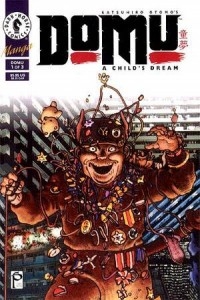
Otomo's Psychic Showdown
Domu: A Child's Dream is a single volume manga whose original run in Young Magazine finished only months before the beginning of its author (Katsuhiro Otomo)'s more famous contribution to the same magazine: Akira. It's a very interesting read that uses many of the themes and visual stylings that would be dramatically expanded upon in Akira. On its own, Domu is a highly enjoyable speculative romp focusing on dark atmosphere and action sequences of cinematic execution.
In what is assumed to be contemporary Tokyo, the Tsutsumi Housing Complex has experienced a series of unexplained deaths over the last three years. Responsible for the string of death is an old man, called “Old Cho” by his neighbors, with a child-like mind and strong extrasensory powers. His motives are that of a child — he sees something he wants, and takes it at the expense of the life of the owner. This may seem a spoiler, but despite the mystery tone of the narrative's first half, it is clear to the audience who is responsible very early on. The first half deals with the investigation of one of Old Cho's recent victims, switching between different members of the team encountering befuddling clues and strange events. Tensions deepen as a policeman and the head detective become the next victims. Simultaneously, another story unfolds as a young girl, Etsuko, who also has unexplained powers, becomes aware of the old man's actions. The situation escalates as “Old Cho” reacts defensively to the threat of another being with similar powers. Midway, the story shifts from the slower paced mystery to a frenetic sequence of events, leading to a violent telepathic showdown between Cho and Etsuko.
The investigation angle is played throughout, but ultimately adds little to the narrative. It is intended as a way to explore the mystery of the unexplained deaths, helping the audience piece together facts over time, but it would have been more effective if the audience weren't already aware of the culprit's identity. Furthermore, the activities that prompt the climactic confrontation and eventual resolution are entirely independent of the investigators. Etsuko recognizes Old Cho's powers without any prompting from the investigation, as she just happens to notice his silent manipulations while playing in the park one day. It would have been more sensible to focus on developing Etsuko and exploring the mind of Cho, downplaying the investigative element.
As for Etsuko, the audience never really gets to learn much about her, making her more plot device than person. Where the graphic novel truly succeeds, however, is in the latter half, the battle between Cho and Etsuko. The pacing rapidly accelerates, and becomes an unrelenting feast of manga action as the two wreak havoc in their attempt to destroy the other. This confrontation is one of the better action sequences in manga, without any of the messy linework or problematic pacing that often hurt the flow of such scenes. The final pages are absolutely brilliant with an eerily low-key finale that highlights the theme of the mysterious mind of children.
This hyper, telekinetic thriller defines Domu, and leaves little room for anything else — Otomo's tale doesn't use the story as a platform to tackle issues with any significant depth. That said, he does utilize some interesting concepts throughout, but as setting and not commentary. For example, link between a child's mind and psychic powers is the central theme of the story, but Otomo didn't really explore this until his work in Akira. Still, setting is an important facet of a story, and used effectively in Domu to develop the atmosphere of his work. Inspired by Otomo's own experience moving to Tokyo, the apartment complex in Domu evokes the feelings of congested urban life. In an interview with Yomiura, Otomo commented on the people living in a recently developed public housing complex, saying that they "never seemed to adapt to this sort of crowd urban living, but they found themselves trapped in that world." That feeling comes across very well in Domu, and serves as an effective backdrop for the story.
Domu is very much in the tradition of science fiction short stories, such as those found in “zines” like Amazing Stories and Analogue Science Fiction. This style of SF generally de-emphasizes characterization in order to focus on ideas. In the case of Domu, this is the battle between two extrasensory “children.” My attraction to Domu most likely comes from to my fondness for this mode of classic science fiction. Otomo weaves a clever narrative comprised of Old Cho, the subtle noir-esque atmosphere surrounding the apartment complex, and the captivating energy of the explosively violent climax. One strength of the lack of relatable characters is that there isn't really much impact when they are killed; this may sound like a bad thing, but I appreciate that I can enjoy the story for what it is without being weighed down by emotionally manipulative drama. My only significant complaint is that I wish the investigative aspect were better weaved into the overall narrative.
As expected of Otomo, the artwork is incredible. The character designs stand out against manga's tendency toward over-the-top designs; Otomo's story is populated by everyday Tokyo residents who are appropriately plain, but readily distinguishable from each other. I find it amusing that, simply by resembling ordinary people Otomo's designs seem out of the ordinary in manga. Outside of character design, the visuals are extremely capable at presenting the feel of the story. During the slower-paced beginning, the level of detail is adequate and realistic in a way that doesn't really push the reader forward or force the reader to slow down and carefully examine the scenery. Many of the more dramatic scenes take place at night, when Otomo utilizes high black and white contrast to maintain a consistently foreboding atmosphere. Many panels in these night scenes feature well-formed lit apartments that create geometric visual interest and highlight the urban claustrophobia. As the pacing increases during the battle, the artwork elevates to a cinematic feel with further gorgeous night scenes and thought-out aesthetic composition that adds a certain stark beauty to the rampant urban destruction.
The entirety of the manga is highly readable, with a level of visual clarity that allows the reader to easily follow the story without ever getting dragged down. Panels instantly fixate the reader's eye on the key detail, and even the scenes of destruction are structured in a way that the reader doesn't get lost in speed lines and rubble. Otomo often uses sharp contrast and minimal shapes to create panels that are instantly comprehensible for an energetic reading of the plot, but are designed with enough artistic merit to reward a slower re-reading. According to Frederick L. Schodt in his classic text Manga! Manga! The World of Japanese Comics, manga is a medium meant to be digested quickly. While there are many titles that seem to disagree with this assertion, if this is accepted as an ideal for the medium, then Domu is a demonstration of Otomo's mastery of the “language” of manga — balancing clear readability with high-quality aesthetic design.
Dark Horse's 2001 release is long out of print, but you can find an inexpensive copy online. Ebay currently has copies up for the startling prices of upwards of $45 and one Amazon listing shows even higher. However, I discovered that Domu is listed on Amazon twice, with the second featuring much better prices — as low as $1.65 for a copy described as “dirty” and another for $13.99 that claims to have been kept in a protective sleeve, “since day 1.” Domu is completely worth picking up for fans of Otomo and dark speculative fiction who enjoy works outside of hard sci-fi. Many anime fans demand high characterization to be a focal theme to enjoy a piece of writing, but Domu absolutely excels at what it is trying to be — a strong example of short story comic writing that is able to capture a compelling atmosphere and engaging action in a tremendously fun way.
Medium: Manga (1 volume)
Author: Katsuhiro Otomo
Genre: Science Fiction, Action, Mystery
Publisher: Kodansha (JP), Dark Horse (US)
Serialized in: Young Magazine (JP)
Demographic: Seinen
Release Date: 1982 (JP), 1995 (US)
Age Rating: Not Rated (we'd say about 16+, though)
Medium: Anime Film
Director: Mamoru Hosoda
Studio: Madhouse
Genre: Romance, Science Fiction
Publishers: Kadokawa Group (JPN), FUNimation (NA)
Release Dates: 2009 (JP), 2011 (US)
Age Rating: PG (MPAA: action violence, some suggestion content, language, mild thematic material, and incidental smoking)
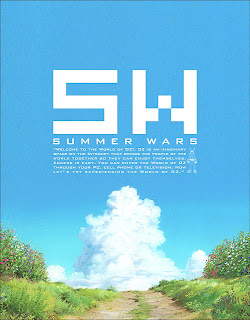
With every new season, the saturation of anime series continues to expand. If your tastes are fairly broad, there is plenty to keep yourself occupied with from currently running shows and a backlog spanning several decades. For theatrical films, however, the market is significantly thinner. If you don't count films based off of an anime series — original plots or condensed story arcs — the choices are rather limited. The big names are Ghibli, Otomo, Oshii, Kon, and Shinkai. Tragically, Satoshi Kon has passed away which will leave a noticeable void in Japan's animated film output. Otomo's last works include the disappointing Steamboy and oddball live action Mushi-shi adaptation. Shinkai is hard at work on a film that seems to be a (welcome) departure from his usual fare. Miyazaki and Takahata aren't getting any younger, and man cannot live on Ghibli alone. Thankfully, 2006 saw the release of The Girl Who Leapt Through Time as the feature length debut of Mamoru Hosoda. He went on to direct Summer Wars in 2009, establishing himself as a key industry director.
Kenji Koiso, a high school student and mathematics enthusiast, is recruited by a girl at his school to help her out with some job. Despite his current part-time work with the infrastructure of virtual-reality super-network OZ, he decides to help her out without asking details. He helps carry her things as they travel to the traditional Japanese family mansion to celebrate her grandmother's 90th birthday. The girl, Natsuki Shinohara, asks Kenji to play along as she announces him as her fiance to her grandma. He now finds himself in the awkward position of being a pseudo-newcomer to this tight-nit and very large family descended from a warrior clan. During his first night there, he receives an email with a large string of characters that he is asked to decrypt by an unknown entity. Being almost Japan's representative for the Math Olympics, he wastes no time in pulling out some paper to work out the problem, which takes him all night. What he did not realize is that he was being asked to break the security that would breach the main OZ server, and in the morning he finds that his account is being used by the hacker to cause chaos in OZ. With most major government and official institutions being dependent on OZ, the hacker is able to cause damage not only online, but in physical space by taking over the person's privileges. For example, by obtaining the account of the president it would be possible to launch a nuclear missile.
Kenji discovers that one of the family members, Kazuma Ikezawa, is the infamous OZ gaming champion King Kazma. The pair find themselves in a battle against a dangerous artificial intelligence being tested by the US Army within OZ. Meanwhile family drama arises as the problems online are connected to the family in ways they did not expect.
Beyond the themes of online action, what lies at the heart of Summer Wars is a thoughtful portrayal of family life. The members of Natsuki's massive family all believe Kenji to be her fiancé, and welcome him to the family in different ways. Hosoda relates his own experiences from when he suddenly became a member of a family due to marriage through Kenji's awkwardness at being accepted into their close group. Indeed, the closest thing to a human villain in the story is the one family member who drifted away from the rest and went to America. The two major aspects to the story — family life and Internet action — seamlessly intertwine, and neither is pushed into the background or feel tacked on to the other. Summer Wars is ambitious in the broadness of its scope, but this natural connection is what really makes the story stand out. If anything, it is much more realistic. In Summer Wars, world-changing events are caused from computers sitting in the middle of a traditional Japanese mansion, not an underground hacker cave with fifty monitors and a nonsensical cooling unit. The heroes are awkward mathematicians, well-connected grandmas, and working class dads with years of video game experience, as opposed to trenchcoat-wearing dudes with BitTorent and bad attitudes. (See: every movie about hackers ever to compare)
One of the most common complaints made toward Summer Wars is criticism of its technical inaccuracy. The story revolves around an incredibly advanced Internet structure, called OZ, that can be connected to through all types of devices and thus has became an extremely integral part of business, culture, and communication. Users create avatars and are able to interact over OZ in various ways: chatting, shopping, business, learning, etc. Additionally, languages are instantly translated to allow communication with anyone. Even the least technically minded viewer can see that it is an unrealistic view of the Internet. This leads to many lumping it together with WarGames and Hackers with their over the top, glamorized distortion of real technological advancements. However, this is completely missing the point of the story. Summer Wars may not be realistic in its details, but that is not the point. It is an exaggerated stylization of computer communications and should be treated as such. Like much good science fiction, it is able to make very relevant points that concern real world technology in a highly fictionalized setting.
A major theme of Summer Wars is communication. OZ's primary function, like the internet, it to connect people and services from all over. The film demonstrated both the dangers of over-reliance on digital networking, as well as celebrating the positive aspects of everyone being able to work together towards a goal. The theme goes beyond modern technology; the grandma was able to use contacts from a lifetime to make phone calls and encourage family members and important decision makers to take action during the crisis. Throughout the movie, communication is key in solving problems — online and off.
One aspect that many viewers should be able to relate to is the contrast between the characters taking initiative and using their computers to fight the AI, and the other relatives who can't understand why they are wasting their time with "video games" during this time. For Kazuma, Kenji, and the dads who pooled their resources together, nothing is as important as stopping that threat inside OZ. They realize, especially after what just took place in their own lives, that what goes on in the wires does affect what goes on the "real world." It isn't until tragedy is -literally- looming over their heads that the non-techie relatives finally realize the gravity of the situation.
Hosoda touches on plenty of scenarios throughout the movie that could have been pulled straight from Slashdot. Compromised users were being assured that the security was impenetrable even after the hacking took place. Online accounts held enough power that stealing their account granted the hacker the user's government privileges. A dangerous artificial intelligence program was developed which questioned the responsibility of the developer who didn't actually implement it himself. A hacker was causing problems through an account that had been taken over, leading to the arrest of the innocent true owner of the avatar. While the movie itself may be an implausible action movie with pseudo-technological workings, the points it makes are often grounded in reality. The actual computer use is done in a way that can be approachable to the average person, but the technically inclined viewer should be able to appreciate its themes with a deeper understanding. Instead of seeing it as dumbed down or inaccurate, I adored the stylization of the Internet and artistic interpretation of technical concepts through Superflat imagery. The last thing I would have wanted is if it became an Nmap documentary.
Summer Wars has very impressive production values with smooth, detailed animation and a high degree of artistic merit. Two distinct art styles are used to easily distinguish the real world and OZ: The real life characters are designed by Yoshiyuki Sadamoto, whose work contains the same appeal and quality that he is known for, and I've noticed since The Girl Who Leapt Through Time that his style has become even more distinct and refined. The background artwork is composed of beautiful countryside scenery and convincing realistic settings. The visuals are extremely detailed, which provides a noticeable contrast to the Superflat style used in OZ. This style, mostly associated with the work of Haruki Murakami, is frequently used in Hosoda's work and has been become a trademark of his style. Even his work with Digimon incorporated a very similar (if less ambitious) Superflat world for the Digimon to fight in. Summer Wars takes it to a new level, with a fantastic stylized world with bright, flat colours against a largely pure white canvas. I've always been a big fan of the Superflat style, and Summer Wars delivered a truly spectacular example of the craft.
Hosoda has obviously been holding onto this premise for a while — after all, his work with Digimon uses almost the same plot. In Digimon: Our War Game, a virus-type Digimon is infecting all of technology through the Internet and causing chaos by manipulating everything it can. Some of the first season's cast meet up to stop the threat by sitting at their computers and working with their Digimon partners who are battling inside a Superflat-style online world. The conclusion practically mirrors that of Summer Wars with the virus launching a nuclear missile (the possibility of this was even alluded to in Summer Wars, I'm assuming as a reference). In the end, people around the world send emails in support of the Digimon. There are so many emails that Izzy/Izumi forwards them to the virus who is then slowed down (DDoS?) enough for them to finish it off. It is good to see that Hosoda was eventually able to fully flesh out the concept with the experience he has gained since then.
I absolutely love this film. It follows a fairly typical action blockbuster formula, but with a level of craftsmanship, intelligence, and social satire that elevates it above the expectations of the genre. I have no doubt that there will be criticism of its typical action film influences, but it really does Summer Wars a disservice to lump it with the mindless action film crowd. If anything, it takes the elements that makes such films so entertaining, but loses the pedestrian brainlessness associated with them. Instead, it presents a thoughtful, realistic, and charming portrayal of family life in addition to the cyber-warfare action plot. Summer Wars is a film that embraces a video gaming, highly connected culture and equally the importance of everyday family life. It is a near-perfect representation of the joys of living in the information age, presented in a wildly unique and enjoyable package.
[Highly Recommended]
This review is based on a retail Blu-ray disc purchased by the reviewer.
For the five days leading up to the New Year, Ani-Gamers is posting an un-ranked list of our favorite titles from the year 2010, featuring up to two choices from each writer. Be sure to check back throughout the week to find out what geeky stuff our contributors really dug this year! We now present the choices from video game reviewer Evan "BakaTanuki" Krell.
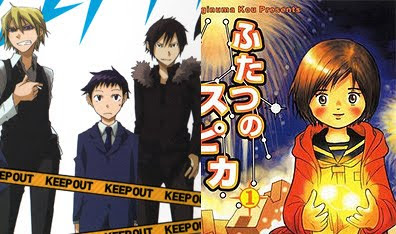
Durarara!! (Brain’s Base): This oddball show is a bit hard to describe within a few sentences. In fact, even naming the protagonist is complicated with so many characters and plot threads. From the director, studio, and original author of Baccano!, Durarara!! is rather similar, as it is built upon a huge and interesting cast of characters, their interactions, and how their own stories all intertwine into the overall weirdness of Tokyo's Ikebukuro district. The series begins with a high schooler from the country moving into Tokyo, and leaves the impression that it will be about his experiences with his new surroundings and how he will be become involved in them. While not completely inaccurate, everything in Durarara!! has some sort of twist to it — often many. Later episodes introduce and focus on other characters, and eventually these pieces all begin to fit into the puzzle. There is a ton going on in this show, and keeping up with it all is part of the fun. Things can get pretty convoluted, but the atmosphere is laid back and fun enough to not really worry about it. Durarara!!'s urban fantasy setting makes little attempt (if any) to stay grounded in reality, and it manages to pull of some over-the-top fantasy played completely straight. The visuals are all quite distinctive with a certain dark-urban aesthetic to it. The music is also very good with both jazz and rock elements throughout. Durarara!! is extremely enjoyable, and I was thoroughly captivated with it as I followed it through Crunchyroll's simulcasting. Despite only being released this year, I am currently on my third viewing and keep finding more to love about it.
Durarara!! is also recommended by Ani-Gamers editor-in-chief Evan "Vampt Vo" Minto and contributor Ink.
Twin Spica (Kou Yaginuma): This story of a young girl pursuing her dream of becoming an astronaut is easily the best manga I have read this year. Asumi, a 13-year-old girl, has always wanted to be an astronaut like her mother was. The interesting thing about this goal is that her mom died in a rocket accident when Asumi was a baby. Twin Spica is a character drama at its core, as Asumi has to deal with various relationships with others as well as her own personal development. As expected, her father has trouble supporting her ambition to follow the career that lead to his wife's death, and she has to deal with a group of new classmates at the space training academy. There is also a mysterious boy with a Lion mask on that appears to be a figment of Asumi's mind. Twin Spica tells a heartfelt story with an extremely likeable lead. Asumi is very sweet, but has more depth than the typical cutesy anime girls. The astronomical elements add a realistic science fiction aspect to the story that enriches the experience without becoming tacked on “sci-fi.” The artwork is simplistic, but becomes more refined as the artist, Kou Yaginuma, progresses. Twin Spica has four volumes out and is off to a strong start. I find it to be an extremely compelling read, and another great release from Vertical, Inc.
Twin Spica is also recommended by Ani-Gamers editor-in-chief Evan "Vampt Vo" Minto.
Medium: Original Anime Video (OAV) (1 episode, 23 minutes)
Genres: Drama, Science Fiction
Director: Yasuhiro Yoshiura
Studio: Studio Rikka
Release Date: Jan. 18, 2006 (JP), Jan. 8, 2007 (Crunchyroll – NA)
Rated: Not Rated
Ed. Note: Welcome to the third of our four "Anime Secret Santa Reviews." Our reviewers were given review requests as gifts from their Secret Santas, and are now unveiling their opinions of the shows they chose. For more information, check out our 2010 Anime Secret Santa introductory post.
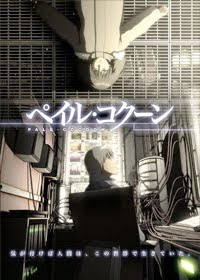
Pale Cocoon is a short (under 25 minutes), OAV by Yasuhiro Yoshiura that seems to mainly serve as an animation and concept demonstration. The story itself is quite simple, despite being told through vague, psuedo-deep dialogue. The message is one many would describe as "moving" or "profound," but all I saw was tiring environmentalism and juvenile artsy writing. Also, the dialogue is bland and the pacing needlessly drawn out. As a reader of magazines like Galaxy Science Fiction and Asimov's Science Fiction, I certainly enjoy a good piece of SF short story, but Pale Cocoon's premise lacks the impact it should have. From a social SF standpoint, the environmental aspect of humans being driven away from the Earth due their own mistakes is a dime-a-dozen plot that has been much better done elsewhere. As a character drama, the two protagonists seem like they could be interesting, but not enough depth or background to their relationship is present for me to feel emotionally invested. Despite an interesting SF concept, it needs a lot more fleshing out to be enjoyable.
In the future, human society has been forced underground by environmental destruction. Archeologists have now dedicated themselves to archiving and researching photos and other documentation from the surfacebound past. Photographs of a green, living earth captivate the protagonist of the story, while everyone else is questioning the necessity of the historical discovery and feel as if it is better if humanity doesn't know what it was once like. Despite his female friend encouraging him to abandon his work, the protagonist discovers an old music video that compels him to seek the truth about the human race's previous life.
My issues with the plot are largely irrelevant since the entire OAV is a technical demonstration, but as a vessel for displaying Yoshiura and the studio's animation talent it succeeds quite well. The animation is gorgeously detailed with intriguing cinematography. The aesthetic is built around, well, technology looking cool, and as such it features lots of detailed shots of wires, pulsing light towers, computer desktop screens, and related. Naturally, it is impossible not to make the obvious Serial Experiments Lain (1998) comparison with its technical, cyber-cool focus. Interesting camera angles and panning may serve as animation shortcuts at times, but are effective stylistic choices at others. Aside from the amateurish character designs, Pale Cocoon is a strong demonstration of atmospheric, technological animation.
It is easy to compare it to Makoto Shinkai's Voices of a Distant Star (2002), as both are these are short works that showcase the director's budding talent. However, since Pale Cocoon is a studio production, it features better quality animation that Shinkai's home made effort, but there is a similar spirit between the two. In fact, both manage to pull off a "Macross" by using cheesy pop music to reinforce a climactic scene. Voices of a Distant Star, however, executes a very effective character drama built around strong SF themes, whereas Pale Cocoon's plot comes off as mere structure to show off pretty graphics.
If not for the Secret Santa recommendation, I would not have even bothered to review Pale Cocoon. I see it as a piece of experimental filming, used as practice for the director's "real" debut. Reviewing it seems equal to browsing through an accomplished director's early archives and giving criticism on their practice projects. I can understand commenting on it when it was first released, but now it should be left alone and treated only as historical documentation. Where Pale Cocoon succeeds is in whetting the appetite for future projects from the director.
Despite its flaws, Pale Cocoon has attracted a surprising amount of enthusiastic viewers. With its short length and ease of access through Crunchyroll streaming, it requires no significant commitment. I believe that it also represents anime fandom's interest in good science fiction anime, and people watch it in hopes of filling a void. Thankfully, Yoshiura went on to release Time of Eve (2008) that uses even better animation with similar elements and overall vibe. Time of Eve is a strong science fiction series that has the appeal that Pale Cocoon only hints at. I would recommend skipping out on Pale Cocoon, and diving straight into Time of Eve. Pale Cocoon could then viewed as a piece of historical interest to fans interested in the director's developing ideas.
[Bad]
This review is based on the Crunchyroll stream of the series, provided by Studio Rikka.
Genre: Platformer
Director: Koichi Hayashida
Developer: Nintendo EAD Tokyo
Publisher: Nintendo
Console(s): Nintendo Wii
Release Dates: May 23, 2010 (NA), May 27, 2010 (JP), Jun. 11, 2010 (EU), Jul. 1, 2010 (AUS)
Rated: E for Everyone
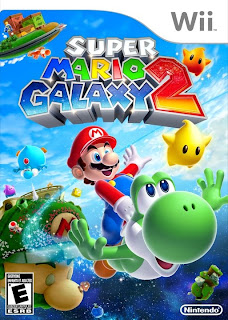
Super Mario Galaxy 2 was certainly an unexpected announcement from Nintendo, considering the series past releases. On N64 we had Super Mario 64 (SM64) and on the Gamecube we had Super Mario Sunshine. Super Mario Galaxy 2 breaks the trend both by releasing another main series 3-D Mario on the same platform, and by making it so closely related to its predecessor Super Mario Galaxy.
The most obvious aspect of Galaxy 2 is that it is built completely off of the original Galaxy's engine. Thus, instead of reinventing the wheel for their newest title, the development team was able to focus completely on making improvements and crafting the best game possible. Now, the level design is more focused, interesting, and varied than ever before — the best aspects of Galaxy have been amplified, the lesser portions revamped or tossed aside, and new gameplay mechanics have been introduced that show off the skills of the team. The player is thrown enough gameplay mechanics to keep the game constantly interesting without any one element sticking around too long.
The addition of Yoshi is much more than Mario fan service, as he plays an important role in the game; his abilities are interesting and the control tight. Yoshi's presence in New Super Mario Bros Wii felt tacked on as he had too few appearances; I actually remember talking to someone who had played the game, but forgot that Yoshi was even in it. Here, the dinosaur gets plenty of exposure, but not enough to make the game too Yoshi-centric. The only Mario power up that I could really do without is Spring-Mario; awkward controls and its small role in the game could have been better used giving other powers more time in the spotlight.
Thankfully, the difficulty has been kicked up since Mario's last 3-D outing, as the easiness of the original Galaxy was one of my main issues with it. The only times it was very hard were when you were searching around for purple coins, but the platforming itself was too simple. While much of Galaxy 2 isn't very different from Galaxy, there are plenty of challenging spots. Purple coins, timed challenges, and stages populated by these infernal mini-Mario enemies can be delightfully tricky, but the hard parts are not reserved for such bonus areas. The difficulty in Galaxy 2 is comparable to Sunshine, besides a few of Sunshine’s infernally hard platforming stages.
One interesting aspect of the game is the attempt at expanding the audience through gameplay help. When this was first announced, gaming blogs and forums were already making a huge fuss over it, but honestly in the game it is completely unobtrusive. If you are continually dying in one stage, Roselina asks if you require assistance. That is it. There is no hand-holding or dumbing down the gameplay at all. If you wanted some help then the option is there, but completely ignorable. While I never used the feature, I read that stars collected by having the game play for you are not in the usual gold, but instead a bronze star to differentiate between legitimate victories.
Galaxy 2 has stronger gameplay diversity that the preceding game- There are the stages built around collecting purple coins, often with time limits. There are timed challenges given to you by a chimp with shades. There are ball rolling levels, flying levels, and all kinds of different gameplay. Often timed and collecting stages in games feel like distractions from the main quest in a game, but Galaxy 2 manages to blur this line by keeping everything fun and nothing feeling extracurricular from the normal play. Even simple concepts such as timed speed-runs of previous missions or single HP boss fights come off as completely legitimate and entertaining additions to the game.
An atmosphere of delight has been achieved in Galaxy 2 that I have not felt since Super Mario World 2: Yoshi's Island for SNES. Everything about the game contributes to an overall aura of joy and whimsy. The music is beautiful with even more studio pieces and high quality synthesized compositions, and while the arrangements of classic Mario music are present and fantastic, they don't overshadow the impressive new scores. I'm also personally very happy with the upbeat big band influence on the soundtrack. The graphics are the same as the original Galaxy, but with certain visual flourishes that make this game stand out even further. It may not have that HD goodness of the other consoles, but the creativity and aesthetics stand out as something more appealing and inspired than a lot of what is out on the market.
The game has a certain energy and excitement to it, thanks to the masterfully crafted level design, well-focused linearity, and appropriate music and visuals. Certain moments are especially captivating — blasting through the star-lit sky toward the next planet, turning the watery world of “Cosmic Cove” into solid ice and looking down at the now-frozen world below, navigating the dangers of “Supermassive Galaxy”, watching the flowers grow underneath Mario's feet ... There were many moments in the game that I just had to pause for a moment, forget about the mission, and just appreciate the spectacle.
I know many will disagree, but I can't help but question the inclusion of “Throwback Galaxy” — a SM64 stage slightly remixed but enhanced with Galaxy graphics. It is gorgeous and an interesting look at how the game would look if made today, but I dislike that kind of obvious fan pandering. Having arrangements of classic Mario music is great, but duplicating entire levels is a little too nostalgia-fueled for my liking. It isn't a big deal though, as most people will love it, and it's too unobtrusive to be that offensive to cranky gamers such as myself. If I wanted to play SM64, though, I would be playing SM64.
The story of the game is hardly worth mentioning, but people seem to find it enjoyable to make fun of its simplistic tale (as if anyone plays Mario for the plot). The important thing is that it fits right at home with the atmosphere of the game, and doesn't have any significant standout cheesiness. It gives a reason for the gameplay without any annoying intrusions, and that is all I require from most platformers.
I was admittedly skeptical at first towards Super Mario Galaxy 2. Super Mario 64, Super Mario Sunshine, and Super Mario Galaxy were very different from each other and worked together to create a franchise that could vary wildly across the games. I was worried that the magic would deteriorate with Galaxy 2 being a rehash of the first. Fortunately, I was wrong; sure, it's the same assets and engine, but if that allows for more creative design and attention to detail then I welcome it. After all, was not my favorite Zelda game — The Legend of Zelda: Majora's Mask — even more guilty in that regard? The game not only ran on the same engine, but re-used character models by giving them new names! What the game delivered was an adventure with more exploration, more character interaction, and a more sophisticated overall production. If it allows for games such as Majora's Mask and Galaxy 2 then I hope the next platform's big series get a second game using the same engine.
Unfortunately, Galaxy 2 was unable to launch with the same impact and excitement that surrounded Galaxy. With its strong similarity to the first game, it isn't revolutionary, but it is certainly an evolutionary title in that it expands and fine-tunes what Galaxy started. Many gamers have either skipped out on Galaxy 2 or at least put the purchase on hold, unable to get enthusiastic over a second serving of “Mario in Space”. I hope that it will be remembered, though, as not the “other” Galaxy, but the “better” Galaxy.
[Highly Recommended]
This review is based on a retail copy purchased by the reviewer.