Medium: Original Animated Video (OAV) (8 episodes)
Genres: Action, Science Fiction
Director: Katsuhito Akiyama
Studio: AIC
Release Dates: Feb. 25, 1987 – Jan. 30, 1991 (Japan), Remastered Edition: 2004 (AnimEigo–N.America)
Rated: Not Rated (Appropriate for 16+)
Some shows stand the test of time perfectly, and arrive in the modern day as ageless, critically-acclaimed classics that are watched again and again. Others fade away just as quickly as they sparked dully into existence. Bubblegum Crisis, the 1987 8-part OAV series that stormed the small American anime market in the early '90s, isn't really either one.
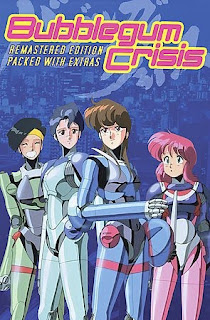
The series' vision of a futuristic "Mega Tokyo," crushed under the weight of its own sprawling mass, feels like a low-budget animated Blade Runner, complete with a special police force (the AD Police) that exists only to track down and destroy renegade worker robots called Boomers. The divergence from Blade Runner's iconic setting comes in the form of the Knight Sabers, a half-vigilante, half-mercenary squad of four women who typically take Boomer-related jobs from the highest bidder, donning robotic "hardsuits" and doing battle by night while holding inconspicuous day jobs like "lingerie shop owner" or "cyberpunk Hannah Montana."
The first four episodes of Bubblegum Crisis are little more than character building exercises for the Knight Sabers (Priss, Sylia, Linna, and Nene), featuring a variety of adversaries for the fearless foursome to take down. For example, one features a team of Boomer kidnappers masquerading as humans, while another one revolves around a murderous driver seeking revenge against one of Mega Tokyo's local motorcycle gangs. Arguably, the show has a consistent conflict between the Knight Sabers and the evil Genom corporation, but the screenwriters’ attempts at cohesion are weak at best. Meanwhile, the main plot in each episode is usually relatively predictable, with its pulpy, film noir-esque mystery framework, but that's not really the important part.
What is important? The sweet robot-on-robot action of course! The scenes in between the fights often consist of low-framerate animation or static images, but when the girls get into their hardsuits (created by influential '80s character designer Kenichi Sonoda*), the metal shines, the lasers fly, and the AD Police helicopters start exploding.
What I keep trying to figure out is why I love this show so damn much, even though it's just so damn bad. Even in the later episodes, when the animation takes a significant turn for the better, the episodic plots retain their maddening predictability. One of the Knight Sabers meets and befriends another woman who happens to be tied into some sort of evil Genom plot. Then someone hires them for a job and their new friend is brought into the fray. Rinse and repeat.
There's something special about Bubblegum Crisis, though. If nothing else, the Knight Sabers themselves are memorable, with Priss the hotheaded motorcyclist and indie rock musician, Sylia the lingerie shop owner and leader of the Sabers, Linna the boy-obsessed gymnast, and Nene the incompetent AD Police officer and hacker. Their expressive, distinctive character designs by Kenichi Sonoda (Gunsmith Cats, Riding Bean) bring the four to life, and their clashing personalities make for some genuinely funny moments of conflict between the girls. And then there are the robot fights. Nearly every one is filled with classic action-movie "Oh Snap!" moments, as robots (and people) are ground under motorcycle wheels, blasted with machine gun fire, and punched with EXPLODING PUNCHES. Priss even uses a rocket-powered kick in episode 6!
Of course, since each episode is its own self-contained story, directed, animated, and written by a partially new staff every time, the show frequently see-saws in terms of quality. Nevertheless, the two episodes that really stood out to me are episodes 6 ("Red Eyes") and 8 ("Scoop Chase"). The former, directed by Masami Ōbari (Gravion), features a sexoroid, a guy with control over an orbital laser, and the previously mentioned rocket-kick. The latter, directed by Hiroaki Gohda (Ah! My Goddess), is what I like to call "Nene's Aquaman episode," since it's clearly tailor-made to create a situation where Nene can contribute in a meaningful way to the Knight Sabers for once. Despite clearly being made for her, the episode still fleshes out her personality in a way that no other episode does, making Nene (to my great surprise) the most well-developed character in the show!
As far as I'm concerned, this is a show that, for all rights and purposes, nobody should like. It is simple-minded, trashy late-'80s pulp entertainment, created as a way to cash in on the cyberpunk boom that directly followed Blade Runner, but somehow, some way, I was — completely un-ironically — entertained by it.
So we're back to the big question: why do I love Bubblegum Crisis so much? After putting quite a lot of thought into it, I realized that the answer is really quite simple: It's fun. No symbolism, no emotion, no deeper meaning. Just good old-fashioned robot-smashing fun.
[Recommended]
* According to the information I have available to me, Kenichi Sonoda seems to be responsible for the initial hardsuit designs, despite not having a "Mecha Design" credit for the series. (Thanks, Daryl Surat!)
This review is based on a copy of the AnimEigo "Remastered Edition" DVD box set release of the series, borrowed from the Rensselaer Sci-Fi Assn. anime library.
Medium: TV Anime
Number of Episodes: 12
Genres: Action, Science Fiction, Supernatural
Director: Ei Aoki
Studio: AIC Spirits
Licensed? No
"Will you kill someone you love because of love?" No: it’s more fun to torture them.
When you have thirteen episodes to develop a show, good writers stick to one story. Great writers multi-task. With Ga-Rei -Zero-, Yomi and Kagura's friendly sisterly rivalry turns bittersweet upon the intervention of Oedipus' good buddy, Fate. The story's road takes a clever fork as one sister’s coming-of-age is achieved at the cost of the other's fall from grace.
When the story begins in medias res, you feel like you've missed something big. Characters appear and emote without context, and I found myself re-watching episodes in chronological order to feel the full impact of each major battle. A clever bookend, though it leads you in the totally wrong direction, considering the entire cast of episode one is dead by episode two. What begins as Ghost in the Shell-esque dialogue with demons becomes schoolgirls with demons...without tentacles.
Basic premise: our world today is being attacked by invisible spooks, monsters, the whole nine yards. Only a handful of families possess enough spiritual energy to see and slaughter said monsters. One such team is the covert Special Tactical Squad Section One. Their newest member will soon be Kagura Tsuchimiya, though there is little a traumatized ten-year-old can do for herself, let alone the world. It is up her to uncle and adoptive cousin, Yomi, to save her from despair. They both use swords to combat the undead (and dead-ish) as well as inherited beasts of their own. Yomi has Ranguen (manticore on steroids), while Kagura’s father bears the family legacy of burdening his soul with the white, fluffy chain dragon of unspeakable horror, Byakurei.
The animation is magnificent, with smooth movement, flashy fights and great weather effects. Whether in a forest, underground sewer, or on the streets of Tokyo, I believe this world, which is why the 3-D graphics of some of the monsters are so disappointing. Many of the monsters are stock (or unionized, it's hard to tell with animated monsters) and the fights are disappointingly one-sided, although seeing Yomi fight with a holy water-spraying iron at one point was pretty grand.
It is not all skirts and flirts, though. There are several comedic moments in the series (including a Comedy of Errors episode) that are uniquely humorous. Master Michael I choose to say no more than "yes." The humor is very well-spaced and does well to soften the net emotional impact. As Yomi descends into darkness and eventually becomes an adversary, she becomes a walking massacre in a skirt that really ends up tugging your heart. Her fights with Kagura (especially episode eleven) redefine swordplay...and arm-drills.
While Ga-Rei -Zero- has intriguing domestic insurrection, the majority of the series revolves around Kagura and Yomi's reactions to both of the series' major events, which if you know anything about anime, usually mean the passing of the torch, passing of legacy. The series is masculine in its gritty nature, but very feminine in its habit of focusing too long on Kagura crying, or lamenting, or grieving. If I had to give this anime a song, it would have to be "All The Things She Said."
The main problem with this season is its waiting-for-a-sequel ending, which to me dismisses Yomi's purpose as a character beyond the threshold guardian for Kagura. Do I want more? Not without Yomi. As the first two episodes indicate, Yomi becomes the bad guy. Her descent is slightly more believable than Anakin Skywalker's, but far too easy. The nameless main villain corrupts her far too easily. Yomi was a great ally and a supportive, loving sister, which made her such a sinister villain, but to have her switch gears so easily feels like a quicker 180 than Will Smith in I Am Legend. Go ahead and watch, but tell me if you disagree with the "puppet-master" treatment of Yomi.
A cool story of sisterly love and the hardship of legacy. It is hinted with political manipulation and topped with fun monster-slaying; Ga-Rei -Zero- was a nice surprise, though I can’t imagine it generating a large following.
good.
Media: OVA
Genre(s): Action, Adventure, Fantasy
Director: Katsuhito Akiyama
Studio: AIC
Number of Episodes: 6
Licensed? Yes (Pioneer)
When I see a 6-episode mini-series sitting alone in the pre-watched $10 bin at my local EA Games and I've got a free Friday night, I like to take a chance. When I brought Bastard!! before my tribunal of friends at both high school and college, it was met with overwhelming approval for being one of those shows so bad, but so reluctant to take itself seriously, that it becomes amazing!
Bastard!! is an epic, big-haired, high-fantasy anime with occasional nudity and imposing sexuality, hence its mature rating. It follows the very basic plot of "evil group seeking to resurrect god of destruction" until the greater evil, the wizard Dark Schneider, is released after being imprisoned within a small boy. Dark Schneider is Chaotic Neutral and has the imposing sexual drive and uncompromising ego of Aerosmith and the Rolling Stones combined. And he shoots out lightning from his hands! And gets it on with almost every female character. What's not to love?!
During his quest to re-conquer the world (as he was about to do before his imprisonment) Dark Schneider and the young girl who released him, Yoko, set off to reunite his Four Lords of Havoc (including a ninja master and a high-level half-elf lightning sorceress). Along the way, they encounter epic-level beasts such as Beholders, minotaurs, vampire, werewolves, and the greatest slime of all time. Gary Gygax would be proud.
While not a super-deep anime (which it never claims to be), Bastard! is unparalleled in its hilarity and heavy metal references: all the spell names are heavy metal bands or at least references to a more metal time. Bastard! is the illegitimate child of the music Dragon Force and The Darkness.
It's Slayers for boys! It's Vampire Hunter D with a sense of humor! It's everything horrible and amazing about early '90's anime. Bastard!!, being just as over-the-top as anything from the fantasy genre, rolls a critical hit for cultic awesomeness!
![]() |
||||
| Animation: | 1.5 |
Average:
(1.9 stars) |
||
| Plot: | 1.5 | |||
| Voice Acting: | 1.5 | |||
| Sound: | 2.5 | |||
| Overall: | 2.5 | |||