-

Secret Santa Review: Last Exile (Hyb)

Topics: , , , , , , ,
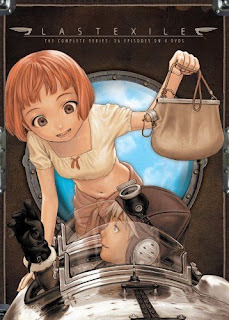
DVD box set for GONZO's Last Exile

Medium: TV Anime (26 episodes)
Genres: Adventure, Fantasy, Military, Science Fiction
Director: Koichi Chigira
Studio: GONZO
Release Date: Apr. 7 – Sep. 29, 2003 (TV Tokyo – JP), Nov. 18, 2003 (Geneon/FUNimation – NA)
Rated: Not Rated

Ed. Note: Welcome to the second of our four "Anime Secret Santa Reviews." Our reviewers were given review requests as gifts from their Secret Santas, and are now unveiling their opinions of the shows they chose. For more information, check out our 2010 Anime Secret Santa introductory post.


You know you're in for a polarizing show when one of the biggest pieces of praise people can give is "it's one of the few shows by this studio that's actually worth watching!" Unfortunately for anime studio GONZO (Gankutsuou, Welcome to the NHK, Linebarrels of Iron), that's basically the compliment granted to any relatively successful series that they create, and for better or for worse, Last Exile (2003) sits among this short list of "not terrible" GONZO series.

The show begins in a vaguely steampunk era in which giant airships have become the primary tool of war. Our heroes are two young pilots who make their living as couriers on the wings of their small fighter plane-esque craft called a "vanship." Claus Valca is a quiet, kindly pilot with a penchant for finishing everything he starts, while Lavie is his hot-headed, impetuous, and intelligent navigator. As the guy piloting the vanship, Claus is naturally the hero GONZO chooses to focus on, while Lavie serves simultaneously as his childhood friend, romantic interest, and moral compass.

These two couriers are living a simple life in the shadows of their legendary fathers (couriers who flew together until their untimely deaths) when they find themselves tasked with transporting a young girl named Alvis to the "Kill 'Em All" Silvana, a notorious mercenary airship thought to suck the souls out of anyone who comes aboard. After narrowly escaping attacks from the Guild, a shadowy organization that exerts subtle control over all the world's militaries and governments, the two vanship operators end up joining the Silvana's not-so-scary crew in a mysterious mission to strike the very heart of the Guild.

Some of the cool concept art for Last Exile

On paper, Last Exile seems like an exhilarating modern military tale, set in the skies of a unique world bound by strange rules — and it almost is, too. Unfortunately, GONZO's execution is painfully uneven, to the point that I often wondered if the writers knew where they were going when they created the original concept. The story is roughly split into three acts: 1) introduction of major cast and factions, 2) the Silvana wanders around doing things and battling some people, and 3) final confrontation with the Guild. As you might be able to guess, the second act features no central narrative or even an attempt at a formula (which would have made it much easier to follow). Instead the characters just meet a few unrelated challenges and overcome them, all the while developing ever so slightly as both individual characters and as a team.

Unfortunately, that individual development often leads to dead ends, as with two of the show's seemingly important romantic threads that simply die out before the introduction of the third act. The overall development of the cast, however, is one of the Last Exile's defining characteristics. The sense of cohesion between the Silvana's crew might not be apparent at first, but the motley crew of pilots, mechanics, and bridge personnel really start to feel like one big team by the end of the series. The most apt comparison that comes to my mind is original Gundam (1979), though Last Exile certainly doesn't pull it off quite that well.

Despite the compelling sense of overall camaraderie, some of the individual characters can get truly grating after 26 episodes. Let's start with Claus: his personality is so meek and boring that he is effectively the same as any of the cookie-cutter protagonists in harem anime. Underscoring this unfortunate truth is his harem of girls, including Lavie, Alvis, the cold-hearted pilot Tatiana, and even the strong-willed Vice Captain Sophia. To make matters worse, Tatiana turns into a mushy little lovestruck schoolgirl when Claus so much as lends her his jacket, and Sophia's romantic encounter comes from so far in left field that you'll likely be throwing things at your screen in frustration. To be honest, by episode 15 I was convinced that Last Exile was a harem show in disguise.

Meanwhile, there are a few characters who really shine despite their disappointing company. Alex Row, the stoic captain of the Silvana, rocks all kinds of socks with his grumpy demeanor and tortured past, but cracks begin to show in his emotional armor as we learn more about his history and see him lose control near the end of the show. Dio (no, not that one) and Lucciola, two runaways from the Guild who join up with the Silvana, and Mullin Shetland, a musketeer-turned-mechanic, provide an interesting counterpoint to the rest of the crew as outsiders coping with the stress of turning away from their previous loyalties. On the bad guy's side, the sinister Guild leader Maestro Delphine comes off as a poisonously sweet version of Gundam's Haman Karn.

Lavie Head, the surprisingly well characterized female lead of Last Exile

But as far as I'm concerned, the real star of Last Exile is Lavie Head, Claus's energetic navigator. Originally she seems like nothing more than an obligatory bossy love interest, but by episode 8 or so it is clear that her personality reaches depths far beyond those of her lame childhood friend. Even when she decides that she doesn't want to be Claus's navigator as long as he is flying in combat (a brave and unexpected decision that throws a fascinating wrench in the works), she remains one of the most well-developed members of the crew. Lavie feels with a magnitude that nobody else in the show does, careening between nurturing love for Alvis, passionate concern for Claus, and unexpected bravery in the face of danger. Through it all, she manages to be both completely admirable and believably flawed, a feat that I'm frankly surprised GONZO managed to pull off so well.

While Japanese voice actor Chiwa Saito's performance as Lavie certainly gets the job done, Kari Wahlgren truly makes the role her own. Especially compared to Johnny Yong Bosch's typically overwrought Claus, Wahlgren's Lavie is always believable, no matter where she is on the emotional spectrum. In terms of the rest of the English cast, despite some clunky deliveries they mostly stack up well, especially thanks to spot-on Japanese-to-English voice matching by Bang Zoom.

Nearly all of the technology in the show (intricately researched and designed by character designer Range Murata and Gankutsuou's Mahiro Maeda) is animated using GONZO's notorious CG style, which only rarely blends with the two-dimensional character animation used throughout. Movement is also irritatingly choppy during the fight scenes, undercutting the clear quality of the original concepts. The skilled 2-D animators who realized Murata and Maeda's beautiful character and costume designs likely could have transformed most of the storyboards for the battle scenes into thrilling dogfights, but as it stands the 3-D fights are merely passable (though GONZO gets points for including ZERO Gundam-style monologues or pilot-to-pilot arguments during fights).

One of the CGI battle scenes in Last Exile

While I don't usually comment on such things, Last Exile's sound design is actually one of its greatest strengths. The sound effects used to represent the creaking and turning of machinery and the movements of the wind are far more visceral (and frequent) than the effects used in most other anime. This, combined with Maeda and Murata's unique and complex designs for clothing and machinery, makes for a lot of fascinating world-building potential. Unfortunately, spotty explanations of the factions and technologies often make it difficult to understand who is fighting whom and for what reasons. By the time the series reaches its exciting finale, it might still take a Wikipedia visit or two to understand just what was going on in the skies of Claus and Lavie's world.

Last Exile, like many GONZO series before it, is a valuable lesson in wasted potential. It's clear that the concept designers put a lot of work into the series during pre-production, and the animators' love for their material shines through in rare moments that belie Last Exile's most glaring flaw, which is that it doesn't really say or do very much with its own material. In the end, the exquisite presentation, the attempts at world-building, and the moments of genuine humanity come together to produce a work that is nothing more than the sum of its parts. We are left with a vaporous story about people in airships who fight each other.

[Passable]


This review is based on the Hulu streams (both dub and sub) of the series, provided by FUNimation.

Review: Gankutsuou – The Count of Monte Cristo (Dub)

Topics: , , , , , ,
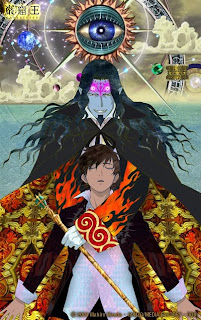
The Count (top) and Albert (bottom)

Medium: TV Anime (24 episodes)
Genres: Drama, Political, Science Fiction
Based on: Alexandre Dumas's novel
Director: Mahiro Maeda
Studio: GONZO
Release Date: Oct. 5, 2004 – Mar. 29, 2005 (Japan), Oct. 16, 2007 (Geneon/FUNimation – N.America)
Rated: Not Rated (appropriate for 16+)

Adaptations are one of my favorite types of stories to review due to their ability to show one story from multiple perspectives and through the eyes of multiple generations of writers. Thus, Gankutsuou, Gonzo's 2004 anime adaptation of Alexandre Dumas' seminal novel The Count of Monte Cristo, is simply irresistible to my sensibilities as both an anime fan and a fan of the original novel.

Unlike many others of its ilk, Gankutsuou goes above and beyond slavish imitation, changing a number of relatively important parts of the story from the get-go. Naturally this can confuse most readers of the book as they try to figure out how the plot could possibly work out with all of the changes. When I began watching, I, too, was a skeptic. Though I am certainly not a total believer now, the 24 episodes of Gankutsuou: The Count of Monte Cristo have shown me a fascinating approach to adaptation that maintains (and in some cases improves) the depiction of the central theme while not fretting over the nitty-gritty details of the original work.

On the topic of omitting grit, Gankutsuou skips Dumas's entire set of introductory chapters, which serve to construct the tragic back-story of the mysterious, fantastically wealthy Count of Monte Cristo. Instead, scriptwriters Natsuko Takahashi (Fullmetal Alchemist, Romeo X Juliet) and Tomohiro Yamashita (Afro Samurai, Red Garden) drop us into the Carnivale on Luna, a strikingly science-fictiony replacement for the original setting of Rome. As if the book purist in me wasn't already crying out at the omission of Edmond Dantes’s/Monte Cristo's unjust 15-year imprisonment, giant CGI blimps and reveling space colonists seem to state immediately that this is not Dumas's original (and, very importantly, that it is not trying to be).

The switch in the starting point, however, actually serves to set up the first of many important narrative shifts; the focus of the story is transferred from the Count of Monte Cristo to the anime's new protagonist, Viscount Albert de Morcerf (who plays an important role as a side character in the novel). While partying on Luna with his best buddy Franz d'Epinay, Albert finds himself in trouble with bandits, only to be saved by the Count. Before long he becomes close friends with the rich aristocrat, who ends up living in Paris, forging bonds with many of the most influential families in the city (including Albert's).

But as tragedy befalls Albert's friends, acquaintances, and enemies, it becomes clear that something sinister is afoot. Some see the Count as a prime suspect, but Albert cannot believe that the man who once saved his life would be out to cause harm to him or any of his friends.

The Count (top-left) and his slave-girl Haydee (bottom-right), displaying Soejima's unique textile style

The true strength of director Mahiro Maeda's (Blue Sub Six, "Second Rennaisance" portion of Animatrix) retelling lies not in simple translation. He might miss essential pieces of what Dumas was trying to say, but through these changes he creates an entirely new story, rooted in the basics of the original but not necessarily tied down to its themes or messages. Indeed, this contemporary version of The Count of Monte Cristo has its own moments of storytelling and aesthetic brilliance. Textile designer/digital director Yasufumi Soejima (Last Exile, Ristorante Paradiso) captures the opulence of Parisian aristocratic life using a fascinating and unique visual technique involving brightly colored textures that seem to remain stationary as the characters and objects they are attached to move around the frame. The effect is disorienting at first, but it lends the series a distinctive air of gaudiness that suits the setting. Meanwhile, the Count himself is the most striking image of the entire anime, with his almost vampiric blue face, pointed ears, and protruding canines. In the novel he is described as being so intriguing that he is the center of attention whenever he enters a room, so it is impressive that character designer Hidenori Matsubara (Bubblegum Crisis Tokyo 2040, Sakura Wars) was able to maintain this feature while not adhering strictly to Dumas's other descriptors.

Unfortunately, Gankutsuou's anime trappings don't always work to its advantage, especially when it comes to an overuse of exposition. The original Count of Monte Cristo revels in its mystique, never making an explicit connection between the Count and Edmond Dantes (nor with his own revenge plot) until the novel's final act. In Gonzo's version, the connection is made within the first episode, and though Albert is given an incredibly wide swath of incriminating information regarding the Count, it takes him around 20 episodes to finally discover the (then quite obvious) truth. Admittedly this kind of exposition is necessary due to the omission of Dantes's back-story, but it doesn't make the dramatic irony any less frustrating.

Geneon's dub doesn't exactly help matters either, with Johnny Yong Bosch's predictably overwrought performance adding a bit more intensity than necessary to Albert's character. The Count, however, finds a quietly sinister portrayal in Jamieson Price, one that I would even say fits Dumas's original version of the character. Backing up Bosch's occasionally effective performance is Ezra Weisz, mucking up nearly all of Franz's lines with mood-crushing wooden acting. Luckily, he's one of the few stinkers in the cast, but that doesn't diminish the damage Franz does to the dub version every time he's on screen.

Gankutsuou's most effective moments come when Dumas and Maeda's sensibilities play off of each other. A scene of a girl suffering from poison, lit only by lightning bolts, expresses Dumas's supreme melodrama with a profound visual language not available to the author. Even scenes with sweeping changes, such as the aftermath of the duel near the end of the series, carry emotional weight thanks to Maeda's choice to continually compound his own calamitous plot threads and Dumas's own acute sense of tragedy.

At its best, Gankutsuou can produce just such moments of silent collaboration between Maeda and Dumas, but in between the high points are scenes of bland anime exposition and maddening, poorly executed dramatic irony. Through it all, the series maintains a quick pace, fueled in part by Takahashi and Yamashita's propensity for cliffhanger endings in each episode, which pulled me along in much the same way that Sunrise's Code Geass did. This might not be hailed as the kind of timeless classic that its source material is, but Gankutsuou: The Count of Monte Cristo is certainly a compelling, firmly above average anime melodrama, not to be missed by any genre aficionados.

[Recommended]


This review is based on a Netflix streaming video version of the series provided by FUNimation and viewed through the reviewer's personal Netflix subscription.

News Briefs - Ponyo dated, new FUNi and ADV shows on Hulu and iTunes

Topics: , , , , , ,
Ponyo on a Cliff by the Sea

Wow, I blink and all the news flies past me. In the last couple weeks, we've seen some nice expansion of the anime industry with video distribution and theatrical plans announced for a whole slew of new shows. First off is today's announcement from Disney of a release date for Ponyo on a Cliff by the Sea, the newest anime movie from award-winning director Hayao Miyazaki and Studio Ghibli. Disney will release film in a currently unspecified number of theaters on August 14, 2009, the only week when it will face no major box office competition in the animation category. I haven't gotten a chance to see Ponyo yet (seeing as I don't live in Japan and didn't indulge in fansubs), but it looks like a movie that can really sell to the American family audience. Make sure you support Ponyo by going out to see it this summer!

In celebration of Hulu's first birthday, FUNimation has announced three new titles that will stream on the website, now the second-most-popular video streaming site (behind only YouTube). Those three titles are the baseball anime Big Windup (a.k.a. Ookiku Furikabutte), the sci-fi Heroic Age, and the full-length film Origin: Spirits of the Past. Clarissa of the Anime World Order podcast is a pretty big fan of Big Windup, and Uncle Yo recently gushed over Origin in an Ani-Gamers review, so I'm excited that FUNi has given us a chance to watch these titles for free.

Big Windup (Ookiku Furikabutte)

On the topic of GDH (Gonzo Digital Holdings, the studio behind Origin), FUNimation has finally solidified a new deal with the struggling studio, which cut its anime production in half just a few months ago in response to economic and industry pressures. The company has been attempting to reap a profit from streaming its shows for free on websites like CrunchyRoll, but most reports are saying that the endeavor has not brought in much money for Gonzo. Oddly enough, the move to CrunchyRoll was seen by many as a betrayal of FUNimation, which has so often handled the American distribution of Gonzo's properties, but was now out of the loop as the studio dealt directly with video distributors.

In response, the apparently forgiving (or just smart) folks at FUNimation have agreed to pair up with GDH and take over North American distribution for all of its properties. That includes video streaming sites, presumaly meaning that FUNi would regain its place as the middleman between GDH and CrunchyRoll, which Hulu would probably also see an increase in Gonzo titles hosted on its service. The first titles to be taken over by FUNimation are The Tower of Druaga and Blassreiter, the first series that GDH ever broadcast simultaneously.

I think that it is simply amazing that Gonzo took such a risk in moving to a simultaneous broadcast, streaming video model, and despite their losses, were able to hold out until this new development. Now FUNimation has followed in GDH's footsteps and even supported the studio, and the entire anime industry (FUNi pretty much controls the whole thing) is finally participating heavily in the video distribution market – the true future of the industry in this blogger's opinion.

Finally, AD Vision, once the most preeminent anime distributor in the country, now nearly license-less and struggling to maintain relevance, has put some of its Anime Network titles on the iTunes store. While I don't think that this will have a big effect on the company's fortunes, it should be able to provide some income from their anime properties, since the sales through the iTunes Store are almost pure profit. The titles now available for download are Angelic Layer, Mahoromatic, Pet Shop of Horrors, Saiyuki, and Tsukihime.

And with that, I think that I can confidently say that the anime industry is finally moving in the right direction, with video streaming, simultaneous broadcasts, and direct downloads all options for those who want to watch their anime for free or cheap online (and without fansubs). Now that's change we can believe in. (I couldn't help it!)

Review: Origin - Spirits of the Past (Hyb)

Topics: , ,
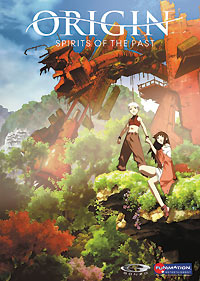
Origin: Spirits of the Past Medium: Anime Film
Genres: Drama, Romance, Science Fiction
Director: Keiichi Sugiyama
Studio: Gonzo
Licensed? Yes (FUNimation)

When FUNimation claims a gem from Gonzo, they put their heart and soul into doing a great job. Origin: Spirits of the Past is a great anime for new fans or people waiting for the next Miyazaki flick.

Origin's post-apocalyptic storyline is easy enough to follow. Years ago, "the forest" became a dragon and attacked from its secret base: the moon! Now, the remains of mankind live in the overgrown ruins of toppled-over cities, trying desperately to coexist with a very dominant and sentient forest. If they do not respect the forest’s authori-tah, the forest will go Swamp Thing on mankind’s ass and steal back the remaining water. Our protagonist, a young boy named Agito, discovers a girl from the past sealed in suspended animation, Toola. Together, they will learn what caused Earth’s drastic shift and discover a way to bring the forest and man together. For hardcore environmentalists, this is yet another film that caters to your self-righteous dogmas.

Origin is a bit of Princess Mononoke without the animals, a bit of Nausicaa without the flying, and has a walking volcano fortress. Thus, something for everyone. It follows a perfect three-act structure, though several scenes and character choices and seem unearned and rushed for the sake of preserving an hour-and-a-half runtime. The visuals are astounding, from tidal waves to the vehicle designs to the encompassing forest, which is as gentle as it is hostile. This film really captures the beauty of a skeletal sky-scraper sheathed beneath a mossy skin. The soundtrack has the heartfelt ambiance you’d expect from an anime aimed at Japanese teenagers. Which is fine for me considering I still think of myself as a teenage Japanese girl.

The American voice acting is superb, and the script matches very well with absolutely no awkward translation errors, so kudos to John Burgmeier’s work. Burgmeier also provides the voice of Shunack, the film’s very believable and sympathetic villain. Great performances also spring from the well of talents in Christopher Patton (Agito) and Carrie Savage (Toola).

Where Origin really succeeds is in creating an original world of decay and growth, destruction and creation. It is particularly effective as a cautionary tale about the corruption of power (both by the forest and man’s technological drive for success.) Frankly I wasn’t expecting such a well-constructed argument. The philosophy of Origin lies somewhere between Transcendentalism and Buddhist detachment from past desires; and oddly enough the difficult dramatic decision lies with both Agito and Toola. Still, in the end, forest equals good, fire equals bad, and drop-kicking a flaming hunk of magma equals badass. This was an all-around excellent visual romp that planted its seed in my heart and took root.


excellent.

Review: Basilisk (Hyb)

Topics: , ,
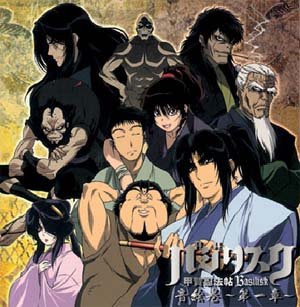
Basilisk Medium: TV Anime
Genres: Action, Drama, Fantasy, Romance, Supernatural
Director: Fumitomo Kizaki
Studio: GONZO
Licensed? Yes (FUNimation)

“To the one I love: prepare to die.”

A time of ninjas and shoguns. The 400-year-old peace pact between the warring Iga and Kouga ninja clans has been abolished. Now, to decide the political fate of Japan, the top ten of both clans must battle to the bitter bloody end. Yes!

Tragically caught in the middle are Gennosuke and Oboro, leaders of each clan, who must bury their love and hopes of peace to carry out the bloody fate of their clans. No, not love! It’s West Side Story without the dancing. Yes! It’s Romeo and Juliet except Romeo could use Samurai Jack as dental floss! Hallelujah!

What sets Basilisk apart is its stunning production budget. Fast-moving action scenes are balanced with white-outs, magnificent landscape shots and surrealist super-powers that make Naruto’s displays of power look like a dollar-store Christmas wreath.

Basilisk, despite being a ninja show about ninja blowing apart other ninja using ninja techniques, is loaded with driven, believable and empathetic characters. By halfway through the series, when we are down to the final five on either side, trust has been betrayed, loyalties have been forsook, and slaughter is impending. Granted, the ninja powers defy logic in a way that would make Stan Lee blush, but it doesn’t worry about creating a magic system for the sake of marketing and video game copyrights. Sure, the old guy with the elf ears can stretch his arms infinitely and the paraplegic has a 12-foot sword down his throat, but so what – bloodshed!

The deaths can be just as sudden and surprising as the narrow escapes. You feel the imminent danger in every scene, and the consequences are palpable. These are awesome fights that are spaced out very well with compelling, though predictable, scenes of loyalty, fury, and startling compassion.

FUNimation grabbed a hold of this series as soon as they could, though its constant soft core rape scenes and oceans of blood will keep it off of Adult Swim indefinitely. I chose to watch the whole series dubbed, and it turned out far easier to follow than the subtitles. Though some characters seem mismatched, and the choppy rhythm falls short as it many dubs, it still holds together well. What hurts Basilisk is the melodramatic performance on both ends for the part of Oboro, who is sadly a flat, generic innocent girl, and there is only so much you can do with imaginative dialogue like, “I love you too much to fight you,” and “Anakin, you’re breaking my heart.” Hint, hint, George Lucas.

I didn’t expect much from Basilisk, but now I have seen its true power, and I will never underestimate Gonzo again.

Animation: 3.5 Overall:

(4.0 stars)
Plot: 3.0
Voice Acting: 2.5
Sound: 2.5

Review: Tower of Druaga - The Aegis of Uruk (Sub)

Topics: , ,
Tower of Druaga: The Aegis of Uruk Medium: TV Anime
Genres: Action, Adventure, Fantasy, Parody
Director: Koichi Chigira
Studio: GONZO
Licensed? No (but available legally)

The Japanese studio Gonzo introduced a breakthrough in intercontinental television when it announced that two of their shows would be released online with English subtitles the same night as they premiered on television in Japan. So apparently they got my letters... Gonzo 1, Santa 0. Tower of Druaga can be found (and bought) legally by download or watched on www.crunchyroll.com for fewer than three dollars an episode. Spoiler: it’s worth it!

Revolutionary marketing set aside, I found Tower of Druaga to be a magnificent classic high fantasy setting with memorable characters, ground-breaking scenery (gotta put a penny in the pun jar again), and a masterfully told story. This twelve-episode first season now owns my heart, hugging, teasing and scratching it like a middle school relationship.

Druaga centers on a land ruled by King Gilgamesh, who, ages ago, scaled the Tower of Druaga, the epitome of evil, and by using every cliché in the book, saved the princess and became king. Problem is that the Tower still stands. Cities live in constant threat of the monsters that pour out of it, and much of the population dedicate themselves to becoming Climbers, adventurers who seek to climb the monstrosity and claim the Blue Crystal Rod on top.

Sounds like the set-up to every video game besides Pacman, doesn’t it? It is. In fact, Druaga was made in homage to an 8-bit video game of the same name. Just like in every story, our main character is a bright-eyed, loosely drawn “I-wanna-protect-my-friends-no-matter-what” type named Jil, whose only strength is his physical resilience and unbreakable shield. After being dumped from his powerful yet cold big brother Neeba’s party, Jil gathers a rag-tag band of losers in hopes of scaling the tower and becoming a hero.

This is a world filled with classes but no leveling up, magic but no MP. In short, Druaga is a world where the video game is the world. Jil is joined by a dark-haired priestess named Kayaa, her patient powerhouse partner Amrey, the boastful aristocrat mage Melt and his assistant, Coopa, who is the greatest intern of all time. Once their party is assembled, they must compete with Uruk’s national army, a guerilla army of other Climbers, Neeba’s epic gang, and a malicious wind sorcerer.

So how did the script writer for Full Metal Panic, the character designer of Burst Angel and the director of Last Exile handle such material? With the tact, charm and humor of true fans. There are dramatic episodes which are well-written and full of pathos, but the true majesty of this series comes from the comedic episodes, which not only make video game references but turn the world into a classic 8-bit parody of the original game! I recommend episode five. That is all you need to know. Do not be scared away by the ridiculous delusion that was the first episode; it’s the greatest parody of action/fantasy anime I have seen this year.

Fantasy fans are in for a treat. Cosplayers should start milking this teat before next year’s season two premieres. Anime fans will have a great series to introduce their fantasy friends into anime. Why? Because the script, specifically its humor and ability to transform old jokes rather than rely on stereo-types and repetition. I stand in awe of Coopa’s comedic timing and golem-like strength that never gets addressed seriously. The animation is so pristine, I’d almost accuse Gonzo of putting all their eggs in one basket. Shading and weather effects are gracefully added, though the occasional computer-rendered monsters (Druaga himself, ew) prove distracting.

It’s a great climb, full of danger, magic missiles, dragons, knights, wizards, wizard interns, backstabs, and meaningful demises that build up to the single most evil cliffhanger since the first season of Code Geass. Tower of Druaga wins, finds the Master Sword and obtains epic status.

Animation: 4.0 Overall:

(3.5 stars)
Plot: 2.5
Voice Acting: NR
Sound: 3.0

GONZO premieres first ever simultaneous anime releases

Topics: , , , ,
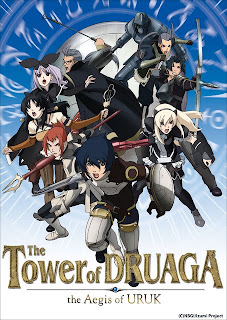
The Tower of Druaga: The Aegis of URUK, the first anime to simultaneously release in the US and Japan As mentioned in a previous post, Asian media streaming website CrunchyRoll received over $4 million in funding, and has announced its partnership with oft-criticized Japanese anime studio GONZO (Gankutsuou, Trinity Blood, Samurai 7).

GONZO planned to release their new series nearly simultaneously in English and Japanese on various streaming websites, and on Friday, April 4 they did just that with the release of The Tower of Druaga: The Aegis of URUK (pictured). The three lucky(?) websites that streamed the subtitled first episode were YouTube, BOST TV, and of course, CrunchyRoll. In addition, GONZO released another anime (Blassreiter) in much the same way, utilizing all three services to deliver the first episode.

If anybody didn't catch that, that would make these two series the first ever anime to be released (essentially) simultaneously in both Japan and the United States.

While many critics (i.e. Daryl Surat) are apt to decry the alleged vapidity of GONZO's plotlines or shadiness of CrunchyRoll's business practices, one cannot deny the important impact an event like this will have on the domestic anime industry here in America.

Two things are (hopefully) about to happen here: One, legal releases will mix with illegal ones until the unwashed masses will end up watching predominantly licensed anime, paid for with online advertising. Two, GONZO will force the hands of not just other Japanese anime companies, but American companies like FUNimation (who they essentially screwed over after having years of licensing deals) as well. Now, even though these companies don't appreciate GONZO's backstabbing, they will be forced to enter the new realm of digital distribution or face the uncertain future of continued physical media distribution.
[via Anime News Network]

The Tower of Druaga: BOST TV - YouTube (CrunchyRoll's video is currently down for unexplained reasons)
Blassreiter: BOST TV - CrunchyRoll - YouTube