to

Spring 2012 Anime Impressions Part 1

Space Brothers, Mysterious Girlfriend X, and Kids on the Slope

Topics: , , , , , , , , , ,

The 2012 Spring anime season is in full swing, and we've got some impressions of the latest series. Wondering whether you should examine the effect of zero-gravity on the power of brotherly love in Space Brothers? Thinking of checking out the saliva-tasting romantic shenanigans of Mysterious Girlfriend X? Or maybe you want to dance along to some swingin' jazz music in Kids on the Slope. Well, Phillip and Evan are here to run down some of this season's hottest shows JUST FOR YOU.


Space Brothers 

Studio: Hoods Entertainment
Director: Ayumu Watanabe
Now Streaming on Crunchyroll


Mutta and Hibito Nanba are close brothers. One night, as children, they witness a UFO in the night sky as it streaks toward the moon. At that moment, they both promise to get to the moon. But 19 years later, while Hibito is on a fast track to being the first Japanese person on the moon, Mutta’s life has hit an impasse. That is until his younger brother helps him remember the promise he made to himself, all those years ago.

How to describe Space Brothers? How’s this: I never bothered with the thematically similar Moonlight Mile, so when Space Brothers was announced, I wasn’t too interested. But, much to my surprise, it’s a pretty good series. Hibito is the kind of person I’d like to be: determined, energetic and fun. However, Mutta is the person I’ll probably end up being: down on his luck, unmotivated, and a killjoy. But there’s hope for Mutta. Being fired from his job means that his promise that he and Hibito made to become astronauts has suddenly become a real goal for him to strive towards, however impossible the task is. This first episode has the beginnings of a good story of the greatest of adventures happening to the most ordinary of blokes, and the deadpan humor nicely complements the serious bits. The animation isn’t particularly impressive, but at least it’s competent. I like the leads and I’m looking forward to watching them grow over the course of the series.

Hey I just realized how to describe the series! Moonlight Mile is an anime set in space for people who liked Apollo 13 as kids. Space Brothers is an anime set in space for people who liked SpaceCamp as kids. So there!

— Phillip


Mikoto plops herself down on Akira's bed.Mysterious Girlfriend X

Studio: Hoods Entertainment
Director: Ayumu Watanabe
Now Streaming on Crunchyroll

(EDITOR'S NOTE: That's not a typo. Watanabe and Hoods Entertainment are producing both Space Brothers AND Mysterious Girlfriend X.)

You knew we were going to have to talk about this show eventually. Akira Tsubaki is a typical teenager. He meets a weird girl, Mikoto Urabe, who transfers to his school. One day he finds her asleep at the end of school classes at her desk. After she leaves, he sticks his finger into the pile of drool she left behind on her desk and puts it in his mouth. He gets sick afterwards and she visits him at home to explain that he’s suffering from love-sickness and only her drool will cure him. So he and she become boyfriend and girlfriend.

There, I said it.

Mysterious Girlfriend X is a weird series, from its circus organ score to the insane nature of Akira and Mikoto’s relationship. I mean, she tells him that a little voice told her he would be her first sex partner! There’s a glacial pace to the first episode. Nothing happens with any kind of speed (other than the fundamental ways that Akira’s life changes once Mikoto comes into it). Akira's dream sequences are well animated and they are excellent next to the relative normality to his real life. Plus the character designs are quirky. Unlike some reviews that bash the fanbase for liking something like this, I prefer to simply marvel that something like this exists. We’re usually treated to Japanese school kids having nice, safe relationships, and this is definitely different. It’s both repellent and fascinating and I’m compelled in a strange way to see how this all falls into place. Just don’t ask me to talk about it in anything but relative terms.

— Phillip


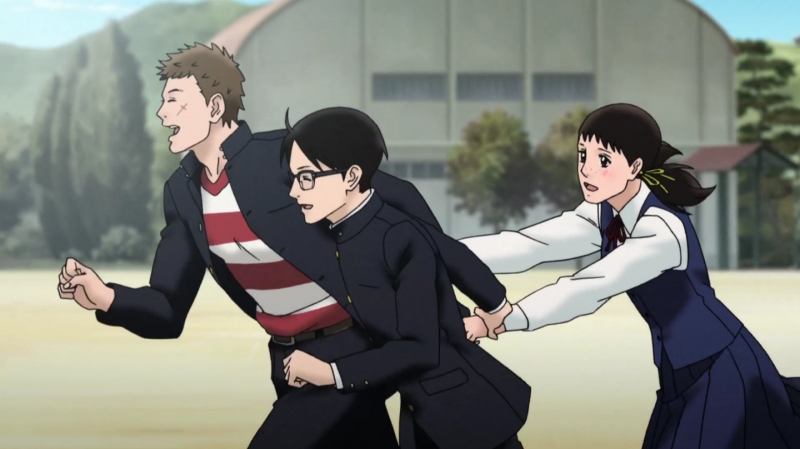
Sentaro and Kaoru argue about music while Ritsuko watches in the background.Kids on the Slope

Studio: Tezuka Productions, Mappa
Director: Shinichiro Watanabe
Now Streaming on Crunchyroll


In 1998, director Shinichiro Watanabe created one of anime's enduring classics, the jazz-infused space western series Cowboy Bebop, and in 2004 he came back for more genre-bending antics with Samurai Champloo, a hip-hop samurai adventure. Now Watanabe returns to the director's chair for yet another musical number, but this time it's a little different. Kids on the Slope (Sakamichi no Apollon), based on a josei (women's) manga by Yuuki Kodama, isn't exactly a slice-of-life to the tune of jazz music — it's a slice-of-life about jazz music.

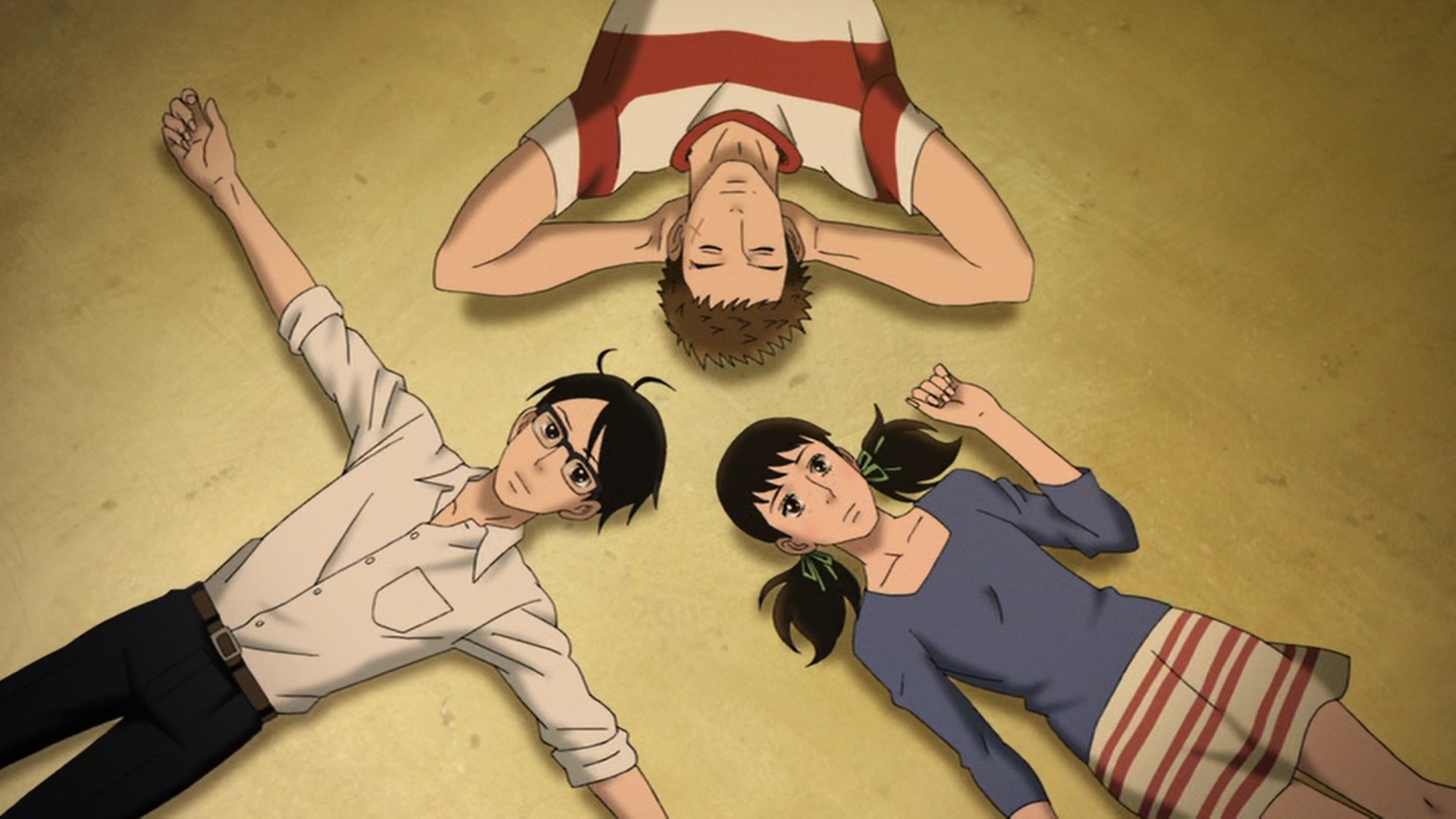
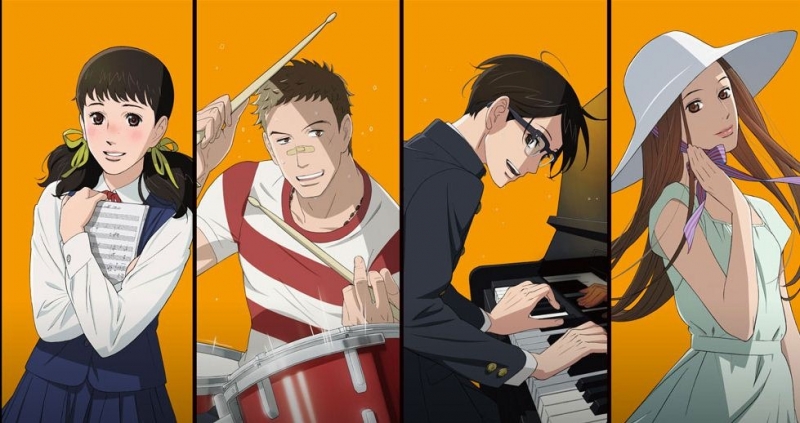
Kaoru has been moving from school to school for his whole life, and after years of meeting new people and getting rejected by local cliques, he's developed an acute case of what appears to be social anxiety. Despite a less-than-warm welcome from his classmates, however, within the first few hours of school Kaoru finds himself in the company of not only the pretty class representative Ritsuko, but the intimidating delinquent Sentaro. Kaoru plays classical piano and Sentaro plays jazz drums, so while their decidedly Boys Love-friendly personalities clash left and right, they're clearly destined to play some sweet jazz music together, thanks in part to some prodding from Ritsuko.

Watanabe's deft touch is already on full display in Kids on the Slope, with excellent pacing, beautiful, slightly shaky camera work, and some expertly placed musical cues. Nobuteru Yuki's character designs retain their angular charm without his conspicious noses, and the animators at Tezuka Productions make great use of soft, watercolor-esque shading to give the show a distinct painterly quality. Realistic, heartwarming, and funny (in an "awww, awkward teenagers" sort of way), Kids on the Slope should be at the top of your list of must-watch shows this season.

— Evan

Cowboy Bebop live-action announced, Keanu Reeves to star

Topics: , , ,

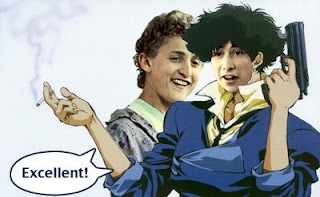
We've all heard the rumors since spring/summer 2008, so it shouldn't come as too much of a surprise that Fox is making a live-action film adaptation of anime classic Cowboy Bebop. However, the part that has caught a lot of people by surprise is the official casting of Keanu Reeves in the lead part of Spike Spiegel.

What's really interesting is that, despite the casting of Reeves (who doesn't have the most sparkling acting resume), most of the upper-level staff who worked on the original anime will be producers and consultants for the Hollywood film. Cowboy Bebop director Shinichiro Watanabe, Sunrise President Kenji Uchida, and original script supervisor Keiko Nobumoto are associate producers on the film, while animation studio Sunrise and their former producer Masahiko Minami will be production consultants.

While we all know the potential of Hollywood studios to ruin beloved franchises, the team selected to help with production seems like they can really steer the film in the right direction. Reeves is of course the most pressing problem for most anime fans, but his casting isn't a kiss of death on the film – after all, The Matrix was great, and Keanu was front and center for that one. If he is directed well, and the film is made with a love for the original anime intact, this can truly be a step in the right direction for Hollywood anime adaptations. That said, I remain cautiously optimistic about it. What do you guys think?

[via Anime News Network]

Guest Review: Samurai Champloo (Sub)

Topics: , ,
Samurai Champloo Media: TV Anime/Manga
Genre(s): Action, Adventure, Comedy, Drama
Director: Shinichiro Watanabe
Studio: Manglobe, Inc.
Number of Episodes: 26
Licensed? Yes (Geneon, future uncertain)

Originally posted by Space Cowboy.
Read the original review.

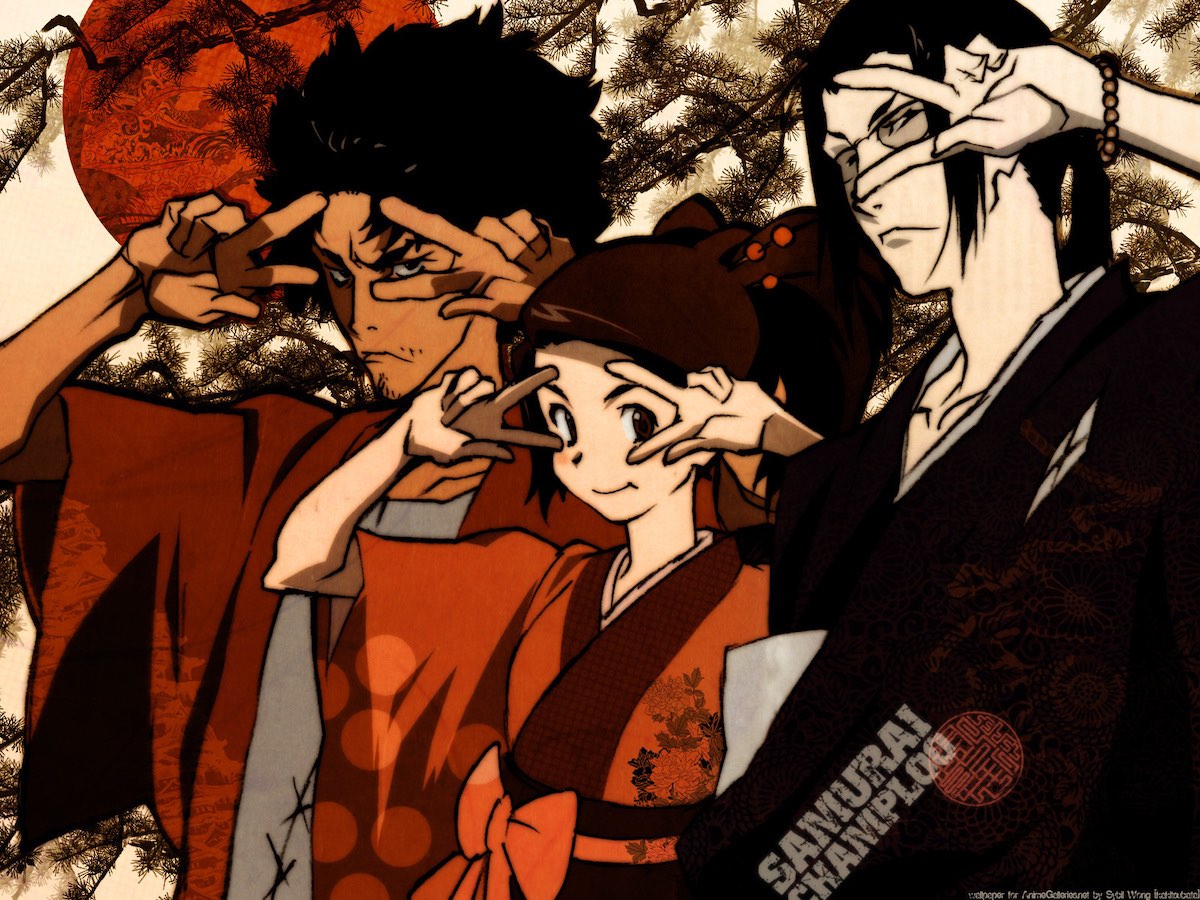
Created by legendary Cowboy Bebop director Shinichiro Watanabe, Samurai Champloo is a samurai action-adventure with a twist. The story, infused with many modern hip-hop elements (both musically and thematically), follows the adventures of the displaced waitress Fuu, the wild swordsman Mugen, and the mellow ronin Jin. The two swordsmen are indebted to Fuu, and so are helping her to find a mysterious "Samurai who smells of sunflowers." Throughout their travels they run into strange situations, and Mugen and Jin--who typically do not get along with each other--are forced to fight for the safety of Fuu.

This is a very hard show for me to review. After all, it comes from Shinichiro Watanabe, the guy behind Cowboy Bebop, which is quite possibly my favorite anime ever. So I had really high hopes, and consequently, really high expectations for this show. Still, I will do my best to review it stand-alone, without factoring expectations into it.

Champloo starts out strong, with an exciting and fast-paced first episode, but soon settles into common stereotypical samurai plots, with the main characters rescuing wronged innocents from various unsavory bad guys, from crooked officials to charlatan cult leaders. Most of these episodes are unfortunately, surprisingly predictable, and any real emotional impact the situation could have had is lost because it’s so obvious how everything will turn out. Case in point: The second episode features a really ugly bad guy that turns into a good guy when he realizes that Fuu cares for him even though he’s ugly. Come on here. Isn’t this supposed to be edgy? Is Disney writing the plots for the episodes!? Most aren’t so laughably cliché, but others are.

When the main plot does kick in, towards the end of the show, it's certainly very exciting and filled with a lot of great fights. However, the actual plot elements seem rather flimsy. We never get any kind of real explanation of what motivates this show’s equivalent of the ‘evil boss’ except that some faceless entity 'ordered' him to do it. The show also plays with our heads multiple times in the final several episodes, having certain characters miraculously recover from injury after injury that really should be fatal, especially in an age where medicine was relatively undeveloped. According to this show, no matter how bad a wound is, if you just wrap it in lots of bandages, you'll recover in a day or two, even if you lose several buckets of blood or are blown up with dynamite.

The best episodes of this show are the ones that blend elements of modern culture into the traditional samurai story, resulting in some very fun sequences, such as when the characters play baseball against a team of unscrupulous Americans, and another in which they deal with a Night-of-the-Living-Dead-esque zombie invasion. This show really needed more episodes like that — episodes where the wonderful style of the show compensates for its other failings. There, I said it. All in all, in the pastry shop that is anime, this show’s substance is only mediocre yellow cake, albeit covered with a wonderful icing of delicious, creamy style.

The animation is definitely one of the best parts of the show. The characters and backgrounds are all very stylishly drawn, with a lot of attention to detail and tone. This comes across best in episodes where mood plays a big part (like the zombie episode), as the animation does the brunt of establishing that mood. Color is well-utilized throughout the show, and details like eye movements and body language receive a lot more attention than you’ll see in practically any other anime TV show. Even little touches like the freeze-frame shots in the baseball episode add a lot to the show’s overall feel.

The fighting animation is also great, and when the frequency of battles in the show goes up towards the end, they're very well-executed in general; Except possibly in a few episodes of Peace Maker Kurogane, I haven’t seen samurai fighting animated better than this. It’s the pacing of the fights that’s the most impressive. Unlike more traditional samurai shows like Kenshin, where characters will each do one attack and then stand there for a few minutes, talking to their opponent or thinking about their next move, these fights are actually fast-paced! That’s right, enemy samurai don’t stop to allow the main character all the time he needs to plan out his next move and give us a 10 minute flashback to expound on what he’s feeling at the moment. Amazing.

But really, the impact of the animation on this show goes far beyond simply "quality" alone. This is a style show; a show about a certain vision, a merging between two very disparate and historically distant themes, and the visuals accomplish that rather difficult task admirably.

The sound is clearly a big part of the style here, as this is supposed to be a sort of 'hip-hop' samurai show, and the soundtrack does not disappoint. Champloo has tracks ranging from upbeat to sad, all done in a distinct style and flavor that I can’t say I’ve heard in an anime before. They fit the tone of the show well, even if I myself am not a huge fan of the brand of the J-rap often used, and consequently found the OP and similar tracks kind of annoying after a few listens.

The voice acting is quite good, as can be expected from a high budget show like this. And hey, they even brought in real English-speakers for when a few characters speak English! You can tell from the accent that they're probably still Japanese actors that just speak English fluently, but it's still way better than the terrible 'Engrish' I've heard in most other shows that attempt this.

Champloo primarily deals with three characters: Fuu, a girl out on a quest to find the "samurai who smells like sunflowers" and two samurai who escort her: the rough and rowdy Mugen, and the proper and honorable Jin. In general, the characters are pretty well done. Fuu, to my surprise, ends up being the "lead" of the show, as the character that receives the most development, the one whose emotions and thoughts we have the most access to, and the one that ultimately drives the plot towards its climax and conclusion. Jin and Mugen are her opposite (yet similar) super-powerful warrior sidekicks. There are also many side characters introduced throughout the show, both as temporary friends/allies and as "bad guys". These bad guys range from the overtly silly “Christian” priest—a sort of evil Don Quixote—to the very interesting Sara, whose two episodes are easily the best of the show.

So in the end, we’ve got a mixed bag. Fuu is a good lead, Mugen and Jin are "cool" if undeveloped, and the side characters are very much hit-or-miss. Try as I might, I simply could not find the depth I was hoping for in any characters except Fuu; not in the temporary allies, not in the bad guys, not even in Jin or Mugen. It’s the latter two that are the most disappointing. In the end, they’re skilled swordfighters, they like Fuu and want to protect her… and they fight. With swords. To protect Fuu. That’s about it. By the end, we learn a bit more about their backstories, but they as characters don’t feel any more developed than they were at the end of the very first episode.

If I were this picky about the character development in every anime, I’d end up hating 90% of shows out there. Still, this is Shinichiro Watanabe. This show has about as much visual creativity, flair, and plain old budget as you can hope to find in an anime. So I expect more.

This is one of those shows where if someone asks you "What is it about?" you have them watch an episode instead of answering, because it’s about the style. If you try to answer in words, you’d have to settle on something like, "It’s about three friends who travel the land on a quest, fighting bad guys along the way." And that sounds pretty much like every other action/adventure anime out there. So watch this show for the animation, for the music, for the great fights, or just for the opportunity to see graffiti artists and human beat boxes in a samurai anime. But don’t watch it for a breakthrough in storytelling or character development—this is the same old tried-and-true samurai show, just in a flashy set of hip-hop clothes.

Animation: 3.5 Average:

(2.875 stars)
Plot: 2.5
Voice Acting: NR
Sound: 3.0
Overall: 2.5