-

Review: Ayako (Manga)

Topics: , , , ,
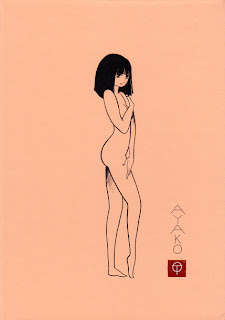
Ayako, by Osamu Tezuka

Medium: Manga (1 volume, 704 pages)
Genres: Drama, Historical, Suspense
Author: Osamu Tezuka
Publishers: Shueisha (JPN), Vertical Inc. (NA/UK)
Demographic: Seinen (ran in Big Comic)
Release Dates: Jan. 25, 1972 – Jun. 25, 1973 (JPN), Fall 2010 (NA/UK)
Age Rating: 16+

It's no secret at this point that Osamu Tezuka's reputation as the "Walt Disney of Japan" is fairly inaccurate. His corpus of English releases, which began with his more well-known children's works like Astro Boy (1952), has grown in years past to include a lot of the artist's more racy material, serving as a reminder that Tezuka was able to tackle a wide variety of styles. Ayako (1972), which came to American shores just last month in a new hardcover translation from Vertical, Inc., illustrates this better than nearly any other Tezuka manga I have read.

Gone are the science-fiction themes of most of Tezuka's other works. Even in his darkest of moments, such as the gripping Ode to Kirihito (1970), there are twinges of the fantastic that betray Tezuka's love for science fiction. In Ayako, Tezuka focuses on the harshness of a historical reality in which there are no robots or aliens or mysterious diseases — only humans are to blame for our misfortunes, and only we can pull ourselves out of them.

The Tenge family is reeling in the wake of the post-war American occupation. As they watch their lands in the Japanese countryside get sold off to tenant farmers, the once-rich clan sees the return of P.O.W. son Jiro, who is now working undercover for the American occupation forces. He comes home to find a family rife with sin and dark secrets. His brother Ichiro is letting his own father sleep with his wife in return for the family fortune, resulting in Jiro's new four-year-old sister/niece Ayako. After Jiro is implicated in a high-profile murder case, with Ayako’s testimony serving as the only evidence toward his indictment, the family decides to preserve their honor by locking her away in the storehouse cellar, to be kept there until she dies.

It is a testament to Tezuka's tight cast and vibrant characterization that he manages to keep the story interesting despite its frequent jumps in both time and place. The Tenges eventually spread out into different places and careers, but the connection to the original reasons for Ayako's imprisonment remain a burden upon all of their consciences, thus keeping everything centered around the title character. The small cast helps you create a deeper connection with them, as their relationships and feelings are all easily understood within the structure of their acutely dysfunctional family.

Ironically, though, Ayako herself is little more than a caricature. She emerges from her 23-year imprisonment as an emotionally stunted young woman, completely ignorant of many customs and ideas that come naturally to most people. This simplistic personality can get a little grating after a while, and it certainly makes her character hard to connect with, but Tezuka makes it clear that he intends her odd behavior as an expression of her tragic upbringing.

Speaking of tragedy, Ayako is horrifically sad beyond any other Tezuka manga I have ever read, and in fact beyond most other manga, period. With murder, rape, and incest throughout, this is not a book for the faint of heart. Sometimes it feels like Tezuka is just throwing in more tragedy for the sake of making you sadder, but it all ends up serving the author's ultimate message: a condemnation of secrecy and hidden sin. In the end, what destroys the characters is a compounding of everything they have ever done (and not done) to other people. As the vessel for the Tenge family's sins, Ayako gets the brunt of their love, hate, compassion, and anger, making its conclusion all the more impactful.

Throughout Ayako, Tezuka revels in the vastness of the Japanese countryside, providing beautiful full-page drawings of hills and fields alongside meticulously drawn cityscapes. Additionally, he tries his hand at recreations of photographic images, a technique that accentuates the historical relevance granted by his frequent references to real events during the Japanese reconstruction. It's also worth noting that only a single character from Tezuka's Star System (the detective Geta) shows up in Ayako, a very deliberate choice that serves to detach the characters and their predicaments from the sometimes whimsical worlds of Tezuka's other works.

Vertical's translation is great as always, but this time they've brought on Mari Morimoto, well-known translator of manga like Dragon Ball (1984) and Naruto (1997). The one notable facet of the translation, which may be credited to either Morimoto or the editors in charge of revising her translation, is the depiction of the characters' country accents. All of the Tenges speak in a Southern American accent, depicted phonetically in what I can best describe as the manga equivalent of a Mark Twain novel. I find that it adds a welcome sense of place to the work that manga often don't have, but some might find that they can only read "Naw!" so many times before it gets a little grating.

EDIT: Naturally, no review of Ayako can go without mentioning that it is flipped (i.e. reads left to right) and features beautiful art direction — from Peter Mendelsund — both inside and on its striking hard cover. Clearly Vertical did both of these things in order to promote it among literati types (as opposed to your average teenage manga fan in Barnes & Noble) as they did with Buddha (1972), and it does a great job. The flipping is an unfortunate consequence of this, but it should hopefully help the book find an audience outside of the manga crowd.

Ayako isn't quite perfect, mostly due to Tezuka's over-reliance on tragic twists and the title character's flat characterization, but as an examination of sin and long-term guilt, it is a powerful story, almost Shakespearean in its penchant for melodrama. Fans of Ode to Kirihito will find much to love here; in fact, its dedication to only a few locations and a centrally connected cast of characters makes it a little more accessible than the sprawling epic that is Kirihito. Be warned, however: Ayako is manga at its most tragic — in this seemingly endless bout of sin and suffering, no one is safe from the taint of evil, and no one is spared its consequences.

[Highly Recommended]


This review is based on a complimentary review copy, graciously provided by Vertical, Inc. (and given away to an Ani-Gamers reader after this review was written).

Reminder: Ani-Gamers is giving away copies of Ayako to two lucky readers. Check out the contest rules to enter!

Review: Battle Angel Alita, vol. 1-2 (Manga)

Topics: , , , ,
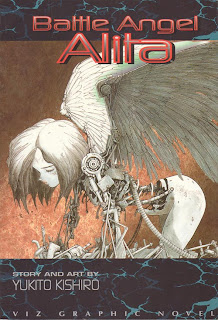
Battle Angel Alita, volume 1 cover

Medium: Manga (9 volumes, 2 reviewed)
Author: Yukito Kishiro
Genre: Action, Science Fiction
Publishers: Business JumpShueisha (JPN), Viz Media (NA/UK)
Release Dates: Dec. 1990 - Apr. 1995 (JPN), Dec. 2003 - Apr. 2005 (NA/UK) [Dates indicate initial print run of this edition, currently being re-printed]
Age Rating: Older Teen (15+)

I feel I need to coin a new, admittedly dumb, phrase to describe my reaction to Battle Angel Alita: a guilty displeasure. I told you it was dumb.

Ido Daisuke is a doctor/mechanic, and a damn good one at that. As far as I can tell, the source of his power is his colossal chin, which is magnificent in its magnitude. One day he finds half of a robotic female torso on a massive cyborg junkpile and decides to rebuild her. As her brain is still intact and this is the cybernetic future where flesh is a novelty, the process is a roaring success. The girl, christened Alita, has amnesia, which is understandable when your recent state was that of a head and a shoulder. Alita then sets out to discover herself and to forge a path in the bleak future with only her natural abilities and pronounced pout that never leaves her face. Sounds pretty cool, right? I thought so too.

There are plenty of reasons why I should love Alita, such as the backdrop. The series is set in a far-flung dystopian future, where a giant floating city called Tiphares houses the privileged while everyone else lives upon the blasted wasteland that Earth has become. The story is set in the junkyard directly below Tiphares, which is a literal garbage site for everything tossed away by the city overhead. The author manages to avoid going over the top with how grim and dark it is, creating a plausibly bleak future world.

The art plays a large part in the world-building — Kishiro puts painstaking detail into every character and part of the backdrop, bringing a richness to the world and making it all appear as a unified whole. Given the diversity in the buildings, people, and every small item strewn about in the panels, this is no small feat, and is quite simply arresting in its magnitude. You can get a real feel for the city just from a quick look at the rotting signs, the dirty streets, and the contents of every overflowing trashcan.

The main reason I dislike reading Alita, though, is the cast, in particular the titular Alita and her dumb pout. All the main characters in the series have an invisible mantle that sets them apart, making them feel like tourists or guest stars. Their motivations and actions overshadow the rest of the cast and the setting itself, relegating them to being inconsequential extras. Ido is a good example of a character with this special quality, as in addition to being an expert doctor and cyber-surgeon he is an awesome bounty hunter to boot. All these details weigh the character down and take away any interest you may have had as he is so limitless in his abilities. Not only that, but he uses a rocket-powered sledgehammer as his weapon of choice, which is a damn sweet weapon but makes you wonder why no-one else has thought of the same idea. I know for a fact that I would have rocket roller skates and pimp rocket tonfa in the rocket-infested cyborg future.

Alita is even more infuriating when it comes to shenanigans like switching motivations and changing her reactions to other characters at the drop of a hat. There is a very short side storyline where the doctor toys with the idea of marrying Alita, but this idea is thrown out the window in a very confusing conversation where character intentions do a 180 on both sides. So the good doctor chucks a wedding dress into a sewer in frustration, leaving me wondering where the hell he dug up a wedding dress in the blasted wasteland.

This gets even nuttier with the appearance of the first main antagonist, who loves eating brains with his gigantic tongue. Okay, that's cool; I can get behind a slavering cyborg endorphin junkie. Sadly it doesn't take very long for the plot mantle to land on this person as well — Alita takes his body out in a cool but disjointed fight which costs her most of her cyborg body, displaying moves that the wounded doctor magically identifies out of nowhere as a robotic martial art, "Panzer Kunst," of which there are supposedly no users. Until now!

Makakau, the antagonist, escapes from the fight scene with a sudden and rather contrived stroke of luck, quoting Nietzsche as he gets away. This is something you don't expect from someone reduced to a head-and-change, and takes you out of the drama entirely.

Alita then receives a crazy body that was intended for military purposes that the good doctor had lying around conveniently. This — combined with Alita's super fighting style — smacks of the author trying really hard to make you care about the character, but giving her too many bizarre power-ups in the process.

As the series continues events become more and more disjointed to the point that I was forcing myself to continue as I simply could not bring myself to care about the characters one jot. Multiple individuals whom I trust recommended the series to me, and so even though I didn't enjoy the first volume, I picked up the second in order to give Alita a fair shake. I can easily see how someone would have a different reaction to myself and utterly fall in love with the characters, the setting, and the outlandish storyline and read it over and over again. Sadly, even after repeated attempts to read the series, my negative reaction still remains. I would honestly suggest borrowing a copy of the first volume to see if it grabs you. If it does, then please feel free to leave a comment below outlining how I am crazy for not liking Battle Angel Alita.

[Bad]


This review is based on a set of Viz graphic novels purchased by the reviewer.

Shueisha brings us English-language Bakuman for free

Topics: , , ,
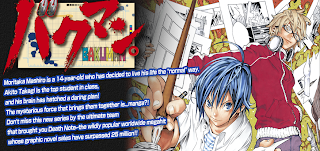
Bakuman banner image

Remember a couple weeks ago when we told you about the announcement of Tsugumi Ohba and Takeshi Obata (Death Note)'s newest manga series, Bakuman? Well, Shueisha announced yesterday that they have posted a fully translated version of the first chapter of Bakuman online for free. You can check it out at their official website, where you can also find totally legal versions of Death Note, Bleach, and D.Gray-man. The manga (all four titles) will be accessible until August 31st, and they require a Windows PC to view. (Sucks for my Mac-using self...)

As the text of the promotional image to the right implies, this new manga is about... manga? Seemingly a sort of Comic Party minus the "Party," this series looks like it's taking a big turn from the authors' last work - Or perhaps not. Something about this whole pen and paper motif rings a bell...

Interestingly, this seems like a direct challenge to the complaints made by many champions of scanlations, who claim that manga isn't licensed fast enough in America. This manga wasn't even licensed; it was simply republished by the original publisher online only a week after its August 11th release date. Yeah, a WEEK. Graphic novels are sure to follow this online release, but make sure you get the (free, legal) taste test in before the 31st.

[via Anime News Network]

Death Note manga creators launching new series

Topics: , , ,
Bakuman Tsugumi Ohba (writer) and Takeshi Obata (artist), creators of critically acclaimed and intensely popular manga series Death Note, have confirmed through Shueisha's Weekly Shonen Jump that they are working together on a new manga series titled Bakuman, to be premiered in the same magazine on August 11th.

The only information that has been given is a cryptic statement that the new series will be "explosive." (A clear play on words, since "bakuhatsu" is Japanese for "explosion") While this series will only be premiered in Japan on Augest 11th, Viz's Shonen Jump magazine is sure to pick it up, considering the massive popularity of Ohba and Obata's Death Note. Make sure you give it a look when it legally comes out in America, because we know nobody here will be reading any scanlations...

[via Anime News Network]

Digital manga to be released via WiiWare

Topics: , , , , , , ,
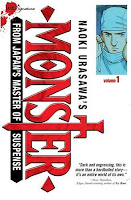
Monster, by Naoki UrasawaAs reported in the New York Times yesterday, four of Japan’s major manga publishing houses have come together to form Librica, which will distribute manga via the Nintendo Wii’s WiiWare channel. The four houses that make up Librica are Kadokawa (Cowboy Bebop, Neon Genesis Evangelion), Kodansha (Akira, Sailor Moon), Shueisha (Death Note, Dr. Slump), and Shogakukan (Monster, Mobile Police Patlabor).

Very few details are available about the service; however, Librica has stated that it’s open to adding more publishing houses after the service has launched. There is also talk internally of expanding the service to including distribution on the DS as well. As for information on the pricing structure or release date of the service, no details are yet available. And if you’re wondering whether the service will be coming state side, just keep in mind that all four of these publishing houses have seen their works released in North America.

[via Kotaku]