Lupin III: The Secret of Mamo
Hi all! Welcome to my new column, "The Trap Door," where I hope to explore the titles that have been released to little fanfare, gotten old, or gone out of print. Some I will have watched before and some I'll only have heard of once or twice. In The Trap Door, I want to communicate my personal thoughts on titles, rather than speak about whether or not they are necessarily "good" or "bad." I want to see where they sit in the great hallways of media we find ourselves in these days. Do they deserve to escape the trap door that audiences have dropped them into, or should they remain there, imprisioned and forgotten? Now, just so you know, I won’t be covering evergreen titles like Neon Genesis Evangelion or Dragonball Z. They keep being reprinted so they don’t count in my book. Not every title will be available from places like Amazon, Best Buy, Barnes & Noble, or Right Stuf (but I will try and put links up where I find them). Right, with that in mind, let’s do this!
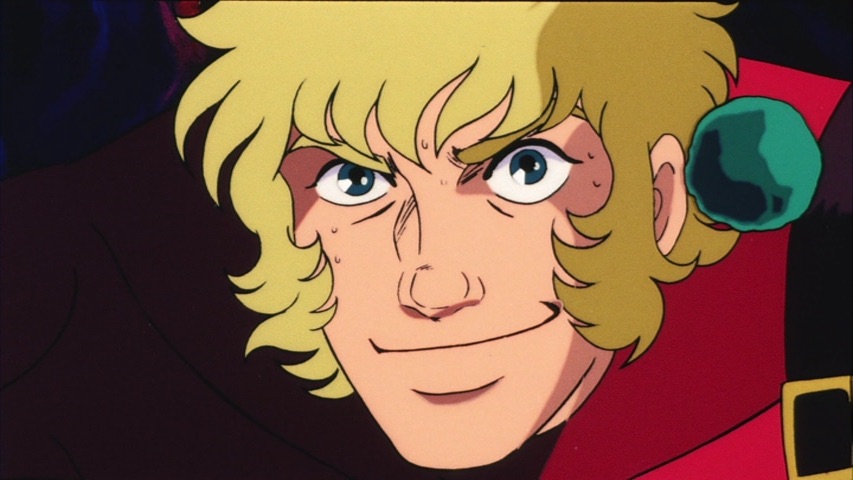
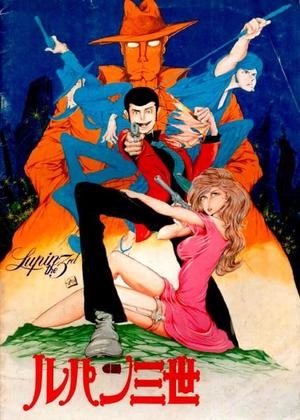
Lupin III: The Secret of Mamo (or the Mystery of Mamo in some territories) was released theatrically in 1978 and is one of the Lupin III films as opposed to one of the myriad specials or TV series. How does it differ from the rest? Couldn’t tell you, I haven’t have the foggiest; my experience with Lupin consists only of this and The Castle of Cagliostro. So why include this in The Trap Door? Well, I have to tackle what I feel is a neglected title, and I see no love for Mamo. And it really is a blast. Imagine if you will, a James Bond movie where the villain’s right-hand man is the main character, they aren't that villainous, and they stay badass. This is Lupin for me. Created by manga artist Monkey Punch (Kazuhiko Katō) in 1968, Lupin III — pronounced "Lupahn the Third" — is the grandson of famed fictional thief Arsene Lupin (which the estate of original Lupin creator Maurice Leblanc has never been happy with). In his exploits as the world’s greatest thief, he traverses the globe with his partners in crime: Jigen, gun master, and Goemon Ishikawa XIII (referred by all as simply Goemon), sword wielding warrior. Along the way, they frequently cross paths with Detective Zenigata (OF INTERPOL!!!) and, of course, team up with or find themselves in competition with beautiful fellow thief Fujiko.
Also, from a scriptwriting angle, having Lupin die in the opening moments and then be alive five minutes later sets up a payoff that I didn't fully expect them to pay out. Some writers do remember to go back to that sort of thing and others just say “Oh, sugar! I forgot I used that idea at the start! Quick, Courier font! Stat!” Mamo pays off with this subplot at the halfway point and repeats the payoff again at the end. Am I reading too much into this? Possibly, but at least this comes from an era in filmmaking when writers and directors worried how their audiences would interpret their choices in character and plot arcs.
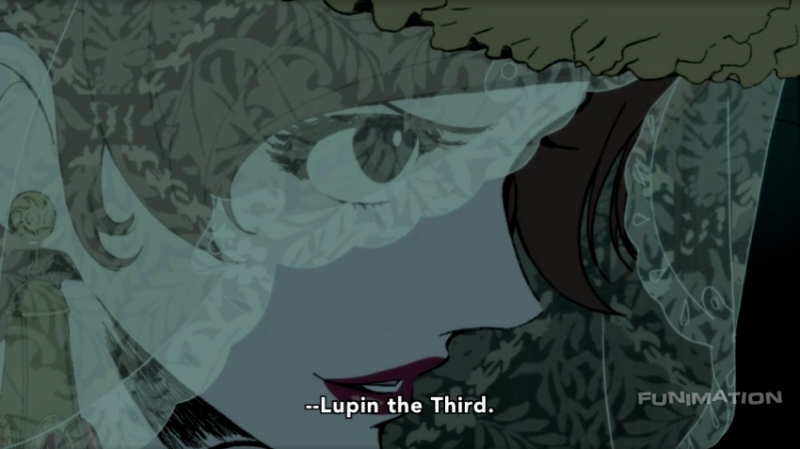
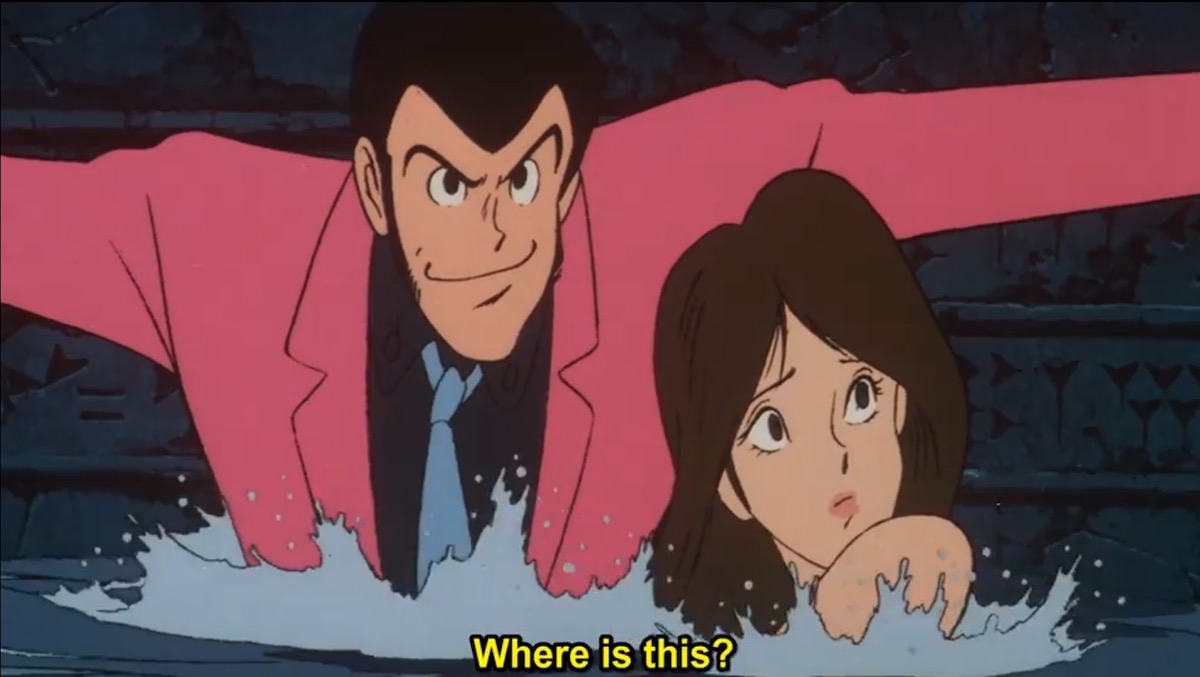
Returning to the film, it’s interesting that this movie introduces Fujiko being buck-ass naked. Contrast how Miyazaki portrays Fujiko in Castle Of Cagliostro and you can begin to see my confusion as to which tone is correct. (I’ve been told that the way Lupin is portrayed in the manga and how it’s portrayed in the moving image version are totally different.) So, is the Fujiko in this movie an undervalued and over-sexualized character? Well, yes and no. We constantly see her in either a state of undress or being hit on by Lupin. I know Lupin really likes Fujiko, despite the amount of times she casually betrays him, but this movie shows Lupin being both sleazy and gentlemanly toward her. Watch as he breaks into a locked room in nothing but underwear looking for a semi-naked Fujiko. (Hint: It isn't to ask her would she like a cup of tea.) Then as the plot unravels around them, watch as he protects Fujiko again and again from Mamo, going to the ends of the earth to get her. It’s a strange law of extremes on display here. But a quick glance at Wikipedia tells me the writing duties were handled by director Soji Yoshikawa and Atsushi Yamatoya. The latter is known for writing and directing pink films, racy Japanese films popular in the 60’s. C’mon, his credits include Alleycat Rock: Female Boss, Banned Book: Flesh Futon and Inflatable Sex Doll of the Wastelands! I dare you to say he was the more conservative one on the Lupin writing team!
I like Lupin himself, and I suspect they’d have to do a radical overhaul of the character for me not to like him. He’s got that lust for life. Robbing people and institutions blind is fun and all, but for Lupin it’s the thrill — the chase — that’s more exciting. Take the opening of the movie. Detective Zenigata has Lupin and Jigen cornered in a pyramid (Cornered? Pyramid? Get it? Huh? Huh?), and Zenigata is going crazy directing the Egyptian police all over the site trying get Lupin. Does this bother our boy? Nope, he takes it in stride. On a motorcycle. And down a rope. While on a motorcycle. I think if Lupin were on his own with no Jigen and no Goeman, he’d probably get along fine. But if there were no Zenigata, or Fujiko for that matter, then his life would have no meaning.
And at this stage in their respective careers, Lupin and Zenigata know each other too well. Zenigata never believes that Lupin has died. Without missing a beat, he goes to a castle straight out of Dracula to find Lupin. Lupin escapes but then he can anticipate Zenigata’s every move, and for his part, the detective has started to plan for every eventuality. The threat posed by a good villain causes heroes to up their game and in Mamo, Lupin has a ball fighting with the title character. A diminutive man, Mamo’s strength as a character lies in his absolute belief that he is THE most important player on this stage. Whether it’s ordering the indiscriminate killing of helpless people to get Lupin or threatening the US President, it’s all in a day’s work for our resident madman. At the end, you’re still not certain what Mamo is, even after all the speeches, exposition and tricks. That’s a good villain.
Speaking generally of the film, the design work on display from art director Yukio Abe is amazing. From the streets of Paris to the wastes of Spain, from the towns of Columbia to Mamo’s invincible fortress island, it’s all amazing. This isn't a Ghibli level of detail, but it's really good nevertheless. I especially like the details in the café scene, where a machine gun-toting helicopter descends just to kill Lupin and co. All hell breaks loose. People die, bullets fly, and cars explode in elaborate slo-mo. Plus Jigen keeps the same amount of wine in his glass while running away from the mayhem. It’s a cornucopia of movement and sound. Equally impressive, even if we don’t get to see it for long, is Mamo’s fortress. On the surface, it’s an elegant affair, but underground, it’s a maze of Roman and Greek gardens and architecture, high arch corridors, tubes, hatches, machinery, labs and endless rooms. But the things I notice are the little touches here and there, like the enormous truck sent to kill Lupin, Goemon, and Jigen, or Zenigata trying to prove Lupin is alive by digging him out of a castle crypt and driving a stake through his heart. How about the chase in Mamo’s pad through famous paintings and works of art? Why, you ask? Why the hell not? Whereas Castle of Cagliostro had lots of deliberate action with continuous movement, Mamo goes for kinetic movement and reused animations for fast character actions, leaving long panning and tracking shots for the quiet moments.
The music is fantastic. It really does embody the '70s funk movement, with Yuji Ohno turning in a great score. I don’t think (with a few exceptions) a lot of anime utilizes music to its full potential. Certainly TV anime suffers the music seeing it’s usually part paid for by the Japanese record companies (thus lots of J-Pop music). But composers like Joe Hisaishi (Miyazaki’s composer of choice) or Susumu Hirasawa (composer for the late Satoshi Kon) shine in theatrical presentations, and Ohno gives it his all for Lupin. It stands in complete contrast to his work on Cagliostro.
I’m not going to write much about the voice cast in case I go into review territory. There are three dubs for this thing, not counting the Toho-produced dub (no credits exist for that dub save that voice acting legend Peter Fernandez worked on it). First Streamline tried their hand and had stalwarts like Bob Bergen, Steve Bulen, and Kirk Thornton as Lupin, Jigen, and Goemon, with Robotech alumnus Edie Mirman taking on Fujiko. Next, Manga UK (back when they were dubbing all their stuff in the high tech environs of Cardiff in Wales) had William Dufris, Eric Meyers, and Garrick Hagon in the roles stated above. Interestingly, Fujiko in this version was tackled by Press Gang actress Toni Barry, who I remember from that show and that other roles with Manga such as Project A-Ko, Dangaioh, and Dominion Tank Police, where she played my beloved Leona Osaki. Finally, dearly departed Geneon commissioned a dub featuring Tony Oliver, Lex Lang, and Richard Epcar as Lupin, Goemon, and Jigen. Michelle Ruff played Fujiko. As an aside, other than the late Yasuo Yamada as Lupin, everybody playing our heroes in Japanese is still doing the same roles TO THIS DAY. Talk about job security!
All in all, there’s enough here to save Secret of Mamo from being forgotten. Even if you disconnect the film from the franchise, it’s a good old-fashioned romp through Europe, the Pacific, and South America as our heroes fire guns, blow stuff up and generally make a mess of the local populations' tranquility. For that reason, it gets to escape from The Trap Door.
(Hey, with the Lupin 40th anniversary celebrations just around the corner, check out Amazon UK for a dirt-cheap copy of the film. Unfortunately, the US version is significantly more expensive.)
Medium: Anime Film
Genres: Adventure, Comedy
Director: Hayao Miyazaki
Studio: Tokyo Movie Shinsha
Release Dates: Dec. 15, 1979 (Japan), Apr. 25, 2000 (Manga Entertainment–N.America)
Rated: PG-13
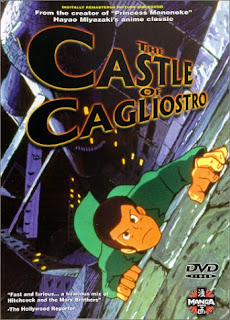
Director Hayao Miyazaki is undoubtedly an anime genius, but his films are, admittedly, quite similar to each other. As a result, as they plumb the depths of the Studio Ghibli catalog, fans of his work might find that they are facing the same themes (environmentalism, pacifism) over and over. For these fans, and indeed for any fan of animation, Miyazaki's Castle of Cagliostro is an absolute treat.
The Lupin III theatrical film was Miyazaki's first job as chief director of a motion picture, and every daring chase scene and luscious background painting makes it clear why it was not his last. The movie follows master thief Lupin III and his black-garbed buddy Jigen as they visit the European country of Cagliostro in search of the secret of counterfeit "Goat" bills. Along the way they run in with the nasty Count Cagliostro, his beautiful (and unwilling) bride-to-be Princess Clarisse, the Japanese detective Zenigata, the stoic samurai Goemon, and the sexy spy Fujiko.
The swashbuckling adventure is sure to please fans of Indiana Jones and James Bond, some of the clearest thematic brothers to the Lupin III universe. Nevertheless, the joy of Lupin III would be nothing in this movie without Miyazaki's astounding skill when it comes to adventure. The plot rolls along at a brisk pace, and though the movie clocks in at a slightly lengthy one hour and forty-nine minutes, there are no more than a handful of scenes that feel like they could have been cut. The master director's skill is most apparent in how he steadily adds new characters and challenges for Lupin to face as he attempts to sneak into Cagliostro's castle and steal away the princess. In fact, the movie reaches about three separate climaxes, each more exciting than the last, concluding with a thrilling battle between Lupin and the Count in the final moments of the film. (However, I personally found that the multi-climax structure can get a little tiring by the time the third one rolls around.)
Every moment of Castle of Cagliostro is simply delightful. The character's exaggerated personalities make them the central draw of the story, whether you're into Lupin's carefree silliness, Goemon's self-enforced aloof attitude, Zenigata's crusade against Lupin, or Jigen's constant squabbles with the same, there is something in here for everyone. In fact, the greatest tragedy of the film is that, as a movie based on a long-running manga and television show, it is forced to introduce a large cast of characters that are barely developed. Everyone except for Clarisse (nothing more than a gasping, despairing damsel in distress) is written in with just enough personality to whet your appetite, but the movie doesn't have time to significantly develop many characters besides Lupin and Zenigata. Heck, Jigen and Goemon appear early on and only actually do anything in the film's final act.
As expected of most Miyazaki films, Cagliostro features wonderful watercolor backgrounds and the director's trademark rounded character design style (negotiated, of course, with manga artist Monkey Punch's original aesthetic). But the most noticeable facet is the animation, which flows with a grace far beyond its contemporaries after all, the original Mobile Suit Gundam was released in the same year! The movie is probably one of the best-looking anime of the 1970s, as the quality of both the art and animation could be mistaken for an early '90s TV series.
Castle of Cagliostro deserves to sit on the shelf of any anime fan, new-school or old-school. Miyazaki has since latched onto many of the themes and techniques that he used in this film (European setting, happy endings, high-flying adventure), but his seminal Lupin III movie bears a distinctly different feel from his Ghibli work. Now, over 40 years after its release, Cagliostro remains a verified anime classic, as beautiful, funny, and exciting as it must have been to audiences in 1979.
[Highly Recommended]
This review is based on a copy of the 2000 Manga Entertainment DVD release of the film, borrowed from the Rensselaer Sci-Fi Assn. anime library.
Media: Anime Film
Genre(s): Action, Geki-ga, Drama
Director: Osamu Dezaki
Studio: Tokyo Movie Shinsha
Licensed? Yes (Urban Vision)
Golgo 13 is a professional. A deadly assassin, he always completes his missions, and he is never late. However, when he takes a job to murder the son of oil baron Leonard Dawson, Golgo (also known as Duke Togo) faces his most deadly challenge yet. Faced with the hired military muscle of multiple government organizations, three insane assassins, and treachery at every turn, Duke must fight for his life and put an end to Dawson's mad plot for revenge.
Let's get this straight: If James Bond was in an anime, he wouldn't be half as cool as Golgo 13. Heralded by many as a pinnacle of the gekiga movement and as a prime example of 1980's anime, The Professional: Golgo 13 is a powerful example of what anime can do when it gets down and dirty with its darker side.
Golgo 13 is a quick-paced ride that flies Duke Togo all around the world, and the action almost never stops. In this regard, fans of the 80's era of testosterone-filled action flicks (both animated and otherwise) will find much to like here. Golgo 13 faces insurmountable odds, and like heroes such as James Bond or John McClane, he rises above them in thrilling and often extremely unique ways. The movie starts off somewhat slow, but picks up near the halfway mark, when Golgo 13 gives us it's first out of quite a few mouth-gaping "wow" moments.
Sadly, the film also follows another widely used 1980's anime stereotype: the frequent use of sex scenes. Yes, in Golgo 13, there are three, count 'em, three full sex scenes, and two rape scenes. Each of them shows as much detail as is possible while remaining with only upper-body nudity. This detail is, truthfully, not neccessary at all, as a simple suggestive version of the scene without any nudity would still illustrate the idea that Golgo 13 has sex with a lot of girls. Even worse than the frequency or detail of the scenes is that many times there are important plot details provided during them, forcing those wishing to skip past them to watch through the uncomfortable moments of what is essentially animated softcore porn. (One time, Duke is actually given mission data from another man standing in the room while he is having sex)
Being that this film was adapted from Takao Saito's original manga, it is understandable that the animation style would take much from its original. Most noticeable in this regard is the use of still shots in action scenes. Almost every time that a blow lands on someone, the camera stops moving and a highly-stylized, manga-esque still appears. These are a jarring addition, and definitely did not age well, but as an example of an older style of anime--one more firmly rooted in it's manga origins--they work great. The character designs are distinct but not particularly standout, except of course for Duke's face, which is famous for never moving, whether he is killing someone, escaping a burning car, or even having sex.
In addition, Golgo 13 is well-animated overall, and much of the joint work between director Osamu Dezaki and animation director Akio Sugino results in some very unique (for the time) uses of animation. Even so, there are a few times when the animation shows its age quite clearly. The first is during the opener, when stop-motion skeletons shoot guns at cheap CG skulls. Next is the comically bad 3-D helicopter scene thrown into the middle of the final battle. While both of these must have seemed incredible to audiences in their day, today they are nothing but humorous additions to an old film.
Streamline Pictures, an older dubbing company that is responsible for the oft-criticized dubs of such classics as Akira and Robotech, produced the incredible dub for Golgo 13. Contrary to what many would say, the Streamline dub for Golgo 13 blows away some of the better dubs of today. The lines are performed well all across the board. Additionally, it is clear that the lines were adapted for American audiences, as opposed to the modern methods of either following exactly or completely changing the original Japanese script. This is made most clear by the abundant use of curses in the dub, which was definitely not in the Japanese version, but adds considerable gravity to the words of the English voice actors. (EDIT) The work of Carl Macek, director of the English language version and founder of Streamline Pictures, is widely reviled by parts of the anime community, but as my first Streamline dub, I found Golgo 13 to be very entertaining.
Quite simply, Golgo 13 can get by on the cool-factor alone on its first viewing. While the sex scenes can get a little annoying, by the time you get to the second half or so, you will be in pure action heaven. The plot is not too complicated, so once the setup is done, Duke can get straight to some badass assassin-killing business. If you can survive the sometimes tedious first half of The Professional: Golgo 13, you will find an awesome action movie at the end. And it you don't like it... Well, Golgo 13 may have a new job on his hands.
![]() |
||||
| Animation: | 2.5 |
Average:
(3.0 stars) |
||
| Plot: | 2.5 | |||
| Voice Acting: | 4.0 | |||
| Sound: | 3.0 | |||
| Overall: | 3.0 | |||